By Reporter
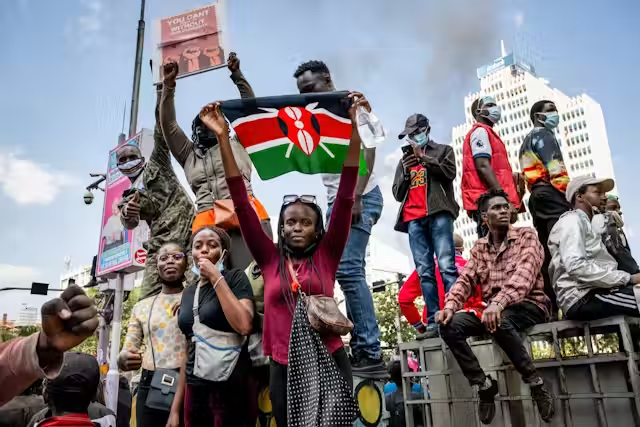
A recent survey report by Mwalekeo Insights has revealed the socio-economic and political impact the Gen Zs have in the creation of a new dispensation in the country.
In the report,52% of rural dweller agree in the power of Gen Zs to bring about positive socio-economic and political change, while 34% do not agree and 15% are uncertain.
Similarly, 68% of urban dwellers agree that Gen Zs are a powerful force for positive socio-economic and political change, while 18% oppose and 14% had mixed feelings.
Equally, 79% of male participants support Gen Zs as agents of positive socio-economic and political change, 16% oppose them while 5% remained neutral.
A notable 77% of respondents acknowledged that Gen Zs are politically aware and actively engaged in political discourse, especially on social media platforms while 13% disagreed and 10% were unsure.
51% of respondents commended Gen Zs for their structured and bold activism, including protests and campaigns addressing governance ad social justice issues. However, 44% felt that their activism lacks structure and might affect its long-term impact. While 5% feel that it is neither structured nor unstructured.
74% of respondents acknowledged Gen Zs’ innovative approach to earning a living, particularly through online businesses, freelancing, and content creation. On the contrary, 21% of the respondents thought of Gen Zs as a lazy generation and are lacking entrepreneurial spirit. While 5% were unsure
48% of participants (older generations) agree that Gen Zs conform to traditional organizational norms at workplaces, with 13% believing that Gen Zs are trying to adapt and conform. However, 39% think Gen Zs are generally non-compliant in organizations.
84% of respondents viewed Gen Zs as progressive, particularly regarding gender equality, sexual rights, mental health awareness, and environmental sustainability.
81% of female participants support Gen Zs as agents of positive socio-economic and political change while 13% dismissed the notion and 6% shared mixed feelings.
The report presented the findings of an opinion poll conducted by Mwelekeo Insights which explored the perceptions and attitudes of Kenyans aged 30 and above toward Gen Zs following the significant social, political, and economic events around and after June 2024.
The poll sought to understand how older generations view Gen Zs’ influence on politics, work ethic, cultural values, and overall societal impact.
The survey used a mixed-methods approach that combined surveys, focus group discussions (FGDs), and in-depth interviews (IDIs), the poll gathered insights from diverse demographic groups across Kenya.
The findings revealed both generational tensions and opportunities for collaboration, highlighting the need for greater intergenerational understanding to foster social cohesion and inclusive development.
The poll explored how Kenyans aged 30 and above perceive Gen Zs in various spheres, examining generational gaps, shared values, and areas where mutual understanding exists and can be strengthened.
Urban respondents, more exposed to Gen Z-led digital activism and gig economy trends, may hold different views compared to rural respondents, who might prioritize traditional values and face limited interaction with Gen Z innovations.
Findings revealed mixed perceptions of Gen Zs’ political engagement. While some respondents admired their activism and willingness to challenge the status quo, others expressed concerns about their perceived lack of experience and pragmatism.
Many respondents acknowledged Gen Zs’ entrepreneurial spirit and adaptability in the gig economy. However, some viewed them as less committed to traditional career paths and more prone to job-hopping.
Older generations expressed both admiration and skepticisms toward Gen Zs’ progressive values, particularly regarding gender equality, mental health awareness, and social justice
The poll identified key generational gaps in values, attitudes, and expectations but also highlighted areas where collaboration and mutual learning could be fostered.