By Habil Onyango
Homa Bay Governor Gladys Wanga at the weekend presided over an event focused on Anti-Gender-Based Violence (GBV) sensitization at Asumbi Girls High School in the Rangwe Constituency.
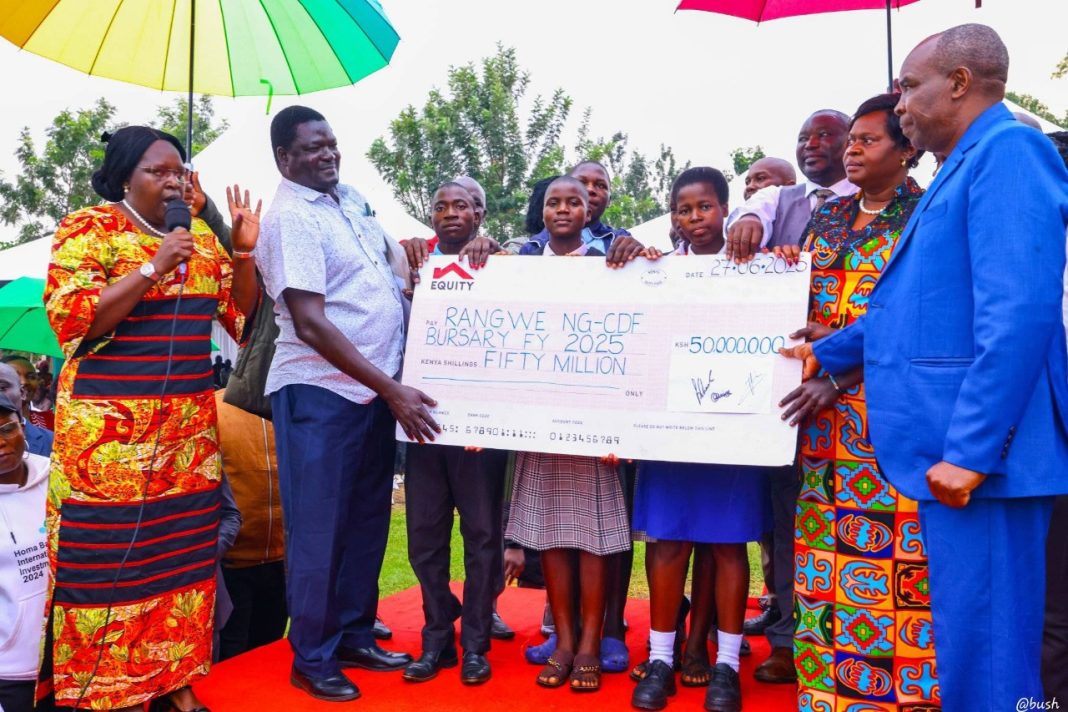
The event also marked the launch of the distribution of the NG-CDF bursary, in which a total of Sh50 million was allocated to support the education of underprivileged students across various educational institutions.
During the event, Wanga, accompanied by local Member of Parliament Dr. Lilian Gogo, addressed critical issues including GBV, femicide, and teenage pregnancies, highlighting their detrimental effects on the county’s transformative agenda. Governor Wanga stated.
According to the KLIN situation analysis report, there are estimated five GBV cases being reported while an estimated other 10 are being prosecuted yearly.
Defilement remains the leading GBV, followed by assault by couples and assault by relatives in Rangwe.
However, in tackling the GBV cases, the Constituency still faces some challenges which include lack of enough stationery, insufficient telephone airtime, lack of fuel, and lack of enough rape kits and evidence bags by the Police Officers handling the cases.
“Today, hosted by Hon. Dr. Gogo, we launched the Rangwe NG-CDF student bursaries and engaged the public on GBV, femicide, and teenage pregnancies.”
She underscored that sexual and gender-based violence (SGBV) constitutes a severe human rights violation with enduring physical and psychological repercussions for victims, often compounded by perpetrators evading justice due to inadequate evidence documentation.
Wanga remarked, “GBV, femicide, and teenage pregnancies are pressing threats that we are diligently addressing as leaders.”
She praised Hon. Dr. Gogo for her steadfast commitment to the advocacy of education and social justice.
According to the Kenya Demographic Health Survey (KDHS 2022), 54 percent of women aged 15-49 have experienced physical violence, while 23 percent have encountered sexual violence. Additionally, the survey revealed that Homa Bay County exhibits the highest incidence of sexual violence in the Nyanza region.
In response to these alarming statistics, Governor Wanga articulated that her administration has formulated a comprehensive policy and legislative framework aimed at eradicating cases of SGBV within the county through multi-sectoral interventions and programming.
Furthermore, partnerships have been established to create GBV centers that provide holistic services for survivors.
The event was attended by other Members of Parliament, including Dr. Eve Obara from Kabondo Kasipul and Fatuma Mohammed from Migori.
MP Gogo emphasized that GBV impacts not only women and girls but also men, families, and entire communities, thereby undermining collective well-being. She stated,
“She said that the initiative not only uplifts countless students through educational support but also addresses the urgent need to combat GBV in our communities.”
Gogo noted that Homa Bay County, especially Rangwe Constituency, faces elevated rates of GBV, with numerous incidents involving physical and sexual violence against women.
“While GBV disproportionately affects women and girls, men and boys can also be victims,” she added.
Gogo emphasized the necessity of a multi-sectoral approach that incorporates stakeholders such as healthcare providers, law enforcement, and community organizations in the fight against GBV.
“Tackling GBV requires coordinated efforts across various sectors, including healthcare and law enforcement,” Gogo explained.
She further highlighted the importance of enhancing access to justice for survivors through the removal of barriers to reporting and ensuring the proper handling of complex cases.
Additionally, she mentioned that training programs for healthcare professionals and law enforcement officers are crucial for effective prevention and response to GBV.
“The program will target the underlying causes of GBV, such as harmful gender stereotypes and social norms,” she declared.
Gogo commended Hon. Fatuma and Dr. Obara for their robust advocacy and presence, illustrating that united women leaders can drive meaningful change.
“Together, these leaders exemplify the commitment to ensuring safety, equality, and opportunity for all. Asumbi will remember this day as a significant milestone in progress and empowerment, and we must break the silence and stand united against all forms of violence,” Gogo concluded.