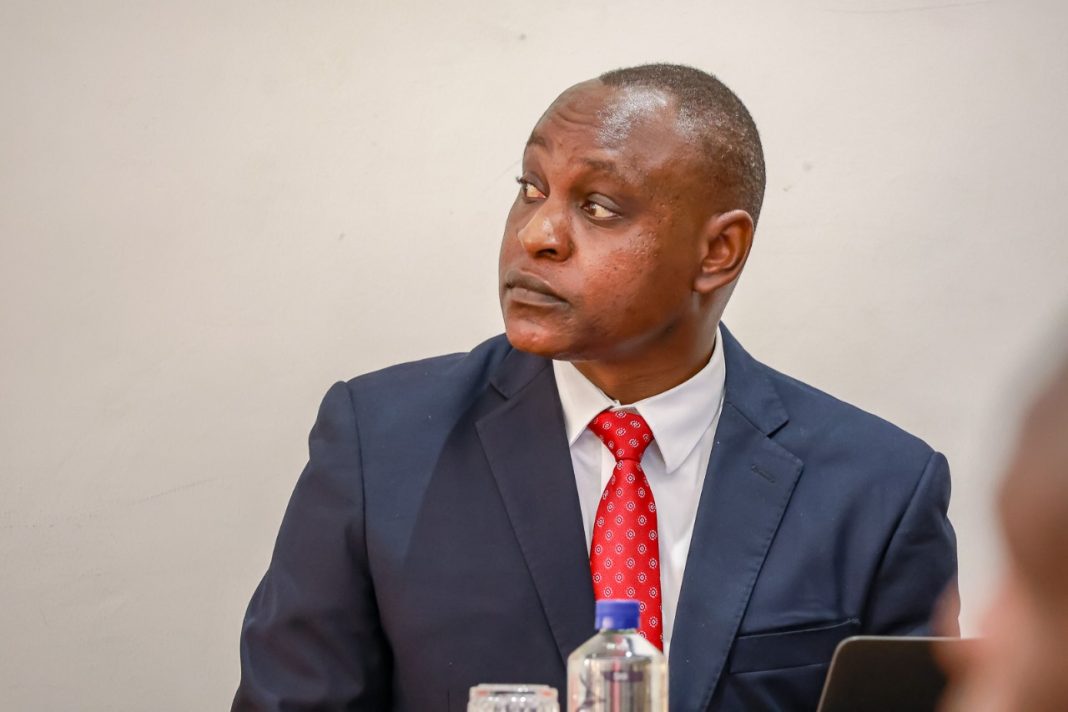
By Anderson Ojwang
The battle for the youth vote in the 2027 general elections has intensified with the launch of the Broad-Based Youth Front.
Migori Senator Eddy Oketch Muok said the movement aims to sensitize young people to acquire national identity cards, register as voters, and participate actively in the next general election.
Muok, who is the founder of the Broad-Based Youth Front, launched the group in Busia County, where he engaged with youth leaders.
“We successfully launched the Broad-Based Youth Front (BYF) Busia Chapter with Governor Paul Otuoma, and we will move to other counties,” he said.
Muok noted that during the ongoing voter registration, the movement is committed to engaging and mainstreaming 10 million youths over the next two years.
“We must increase active and informed youth participation in politics to ensure genuine support for the Broad-Based Government,” he said.
He added that the movement will campaign and mobilize youth votes for President Ruto in the next general election.
“Our target is the youth vote for President Ruto and youth leadership in various elective positions. We will launch the Front in all the 47 counties,” he said.
Muok explained that the Front will also engage in youth empowerment programs and facilitate participation in economic activities in collaboration with the national government.
He added that the movement will be decentralized to the locational level to ensure no youth is left out of the new political and economic dispensation.
The Independent Electoral and Boundaries Commission (IEBC) intends to register 6.3 million new voters ahead of the 2027 general elections.
Recently, IEBC commenced continuous voter registration and released an update on the number of new voters per county.
The commission reported that within just four days of relaunching the exercise on September 29, 2025, a total of 7,048 new voters had registered. Nairobi County led with 1,197 new voters, followed by Mombasa with 536.
Other top-performing counties included Kiambu (386), Kisii (312), Machakos (260), Nakuru (247), Kilifi (243), Mandera (218), Siaya (181), and Bungoma (175).
These numbers reveal strong participation from urban and densely populated regions, alongside surprising entries such as Mandera, which outpaced larger counties like Kakamega (127) and Kisumu (139).
President William Ruto and former Prime Minister Raila Odinga formed the Broad-Based Government to ease tensions following the Gen Z uprising and protests over the contentious Finance Bill, unemployment, and the high cost of living.
The formation of the Broad-Based Government saw the appointment of ODM leaders John Mbadi, Wycliffe Oparanya, Hassan Joho, and Opiyo Wandayi to the Cabinet.
President Ruto and Raila signed a 10-point agenda under a Memorandum of Understanding (MoU) on March 7, 2025, and later formed a five-member committee tasked with implementing the agenda of the Broad-Based Government and the National Dialogue Committee (NADCO) report.
The committee members include columnist Gabriel Oguda, Agnes Zani, Kevin Kiarie, Fatuma Ibrahim, and political communication strategist Javas Bigambo. The principals also established a joint secretariat co-led by executive secretaries from UDA and ODM to support the committee’s operations.
The formation of the Broad-Based Youth Front by Senator Muok, a close ally of Raila, is a clear indication that ODM is likely to support Ruto’s re-election bid.
Kenya’s population is significantly youthful, with recent reports indicating that about 75% of the population is under the age of 35. The 2019 census showed that those aged 18–34 made up 29% (over 13.7 million) of the total population at the time, and projections suggest that the youth population will continue to grow.
Kenya’s mid-2025 population is estimated at approximately 53.33 million, according to the Kenya National Bureau of Statistics (KNBS), with 46% (21.9 million) below the age of 18. Those aged 10–19 (adolescents) constitutes 11.6 million, while the working-age population (15–64 years) accounts for 57.1%, or about 27.15 million people. In 2022, youths aged 18–35 represented 36% of the total population.