By James Okoth
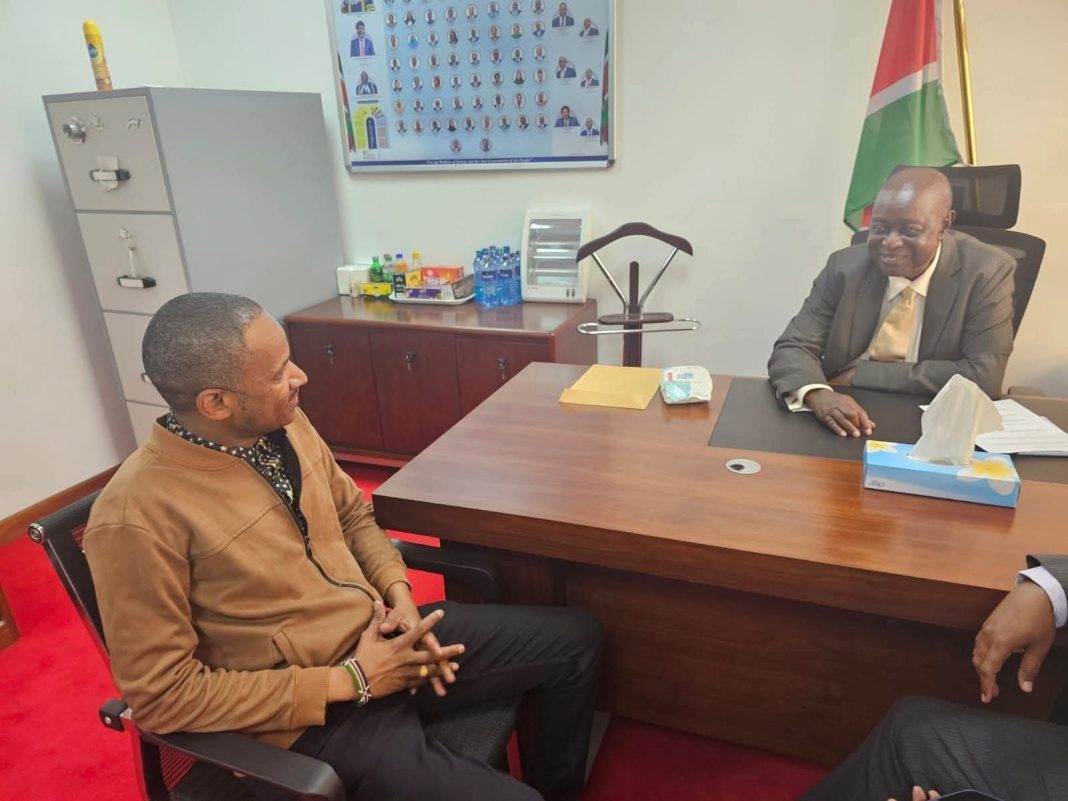
When Embakasi East MP Babu Owino met ODM Party Leader Dr. Oburu Oginga on Thursday morning, it was not just another handshake between a party elder and a restless foot soldier. It was a signal, a deliberate recalibration of power within the Orange Democratic Movement (ODM) at a time when the party is quietly redrawing its internal map for 2027.
The closed-door meeting, described by insiders as “cordial but candid,” underscored ODM’s simmering dilemma: how to blend generational transition with political continuity in the post-Raila Odinga era.
At the centre of that balancing act stands Babu Owino. He is fiery, ambitious, impatient and a man whose political energy refuses to be ignored and whose influence in Nairobi remains a factor ODM can neither dismiss nor fully control.
For months, Babu has been a man on edge, publicly questioning ODM’s direction, privately fuming about exclusion and quietly building his own loyal urban base. His frustrations boiled over when Raila Odinga, in a surprising gesture, softened his tone towards Nairobi Governor Johnson Sakaja, even intervening to save him from a looming impeachment.
That single act unsettled the young lawmaker, who had championed the charge against Sakaja and viewed himself as ODM’s natural defender in Nairobi. When the patriarch pulled the rug, Babu retreated, bruised, but not beaten.
It is against this backdrop that Dr. Oburu Oginga’s summons must be read. This is not just reconciliation; it is political retrieval, a strategic move to bring back a soldier who had begun to drift toward rebellion.
Dr. Oginga has been open about ODM’s need for reinvention. His insistence that the next ODM kingpin cannot be a contemporary of Raila Odinga but must be “young, vibrant and politically daring” has not gone unnoticed.
It is an ideological shift from nostalgia to necessity. ODM, long powered by the mythos of struggle, must now anchor itself in the politics of sustainability. In that emerging order, Babu Owino’s populist credentials and urban command make him an asset the party can ill afford to waste.
To many, Thursday’s meeting marks the beginning of a grooming process, a delicate transformation of a political agitator into a potential city strategist.
But just as ODM begins to flirt with renewal, a fresh rift of caution has emerged. During a recent public engagement in Bondo, Siaya county, Ruth Odinga, the Kisumu County Deputy Governor and a senior ODM figure, warned party members against chanting the “two-term” slogan that has been gaining momentum among grassroots supporters.
“Let us not confine ourselves to the two-term chorus. ODM is bigger than that and our focus should be national. The struggle has always been about leading Kenya, not settling for less,” she said pointedly.
Her words, delivered with the moral weight of the Odinga family name, carried deeper meaning than they appeared to. They were both a warning and a signal that ODM could yet field its own presidential candidate in 2027, a move that would shatter assumptions of alliance politics and reassert the Orange party’s national ambitions.
That warning reverberates directly into Babu Owino’s orbit. If ODM is to re-enter the national presidential race, Nairobi, the country’s political and economic heartbeat, will be the decisive battlefield. The city’s loyalty, energy and symbolism will determine the party’s viability on the national stage.
That is where Babu’s potential role crystallizes. His influence among Nairobi’s youth, his mobilizing machinery and his street-level reach position him as ODM’s possible field general in the capital. He is the man to hold the city while the party tests its strength nationally.
Nairobi has always been more than a city; it is Kenya’s political thermometer. Whoever controls its heartbeat often dictates the national mood. ODM’s waning grip in recent years, weakened by internal complacency and external alliances, has created space for Kenya Kwanza’s infiltration.
In that vacuum, Babu Owino has emerged as a parallel axis of influence. He is loud, loyal, yet unpredictable. He represents the restless Nairobi constituency: the hustlers without privilege, the youth without patience and the dreamers without anchors.
ODM’s survival in Nairobi may now depend on its ability to reconcile its old order with Babu’s new energy. The Oburu-Babu handshake is therefore not just about mending fences. It is about rebuilding ODM’s command post in a city that mirrors the pulse of Kenyan politics.
Every movement that endures must reinvent itself or risk fading into nostalgia. For ODM, that reinvention will not come from new slogans but from new faces, faces that can rally a disillusioned base without dismantling the party’s legacy.
Babu Owino’s journey from radical to relevant will test both his discipline and the party’s tolerance. He must learn that rebellion can ignite a movement, but only strategy sustains it. ODM, on the other hand, must accept that youthful fire cannot be extinguished by tradition. It must be redirected by purpose.
In Babu, Oburu may see the spirit of a new Raila. He is raw, reckless and restless, yet capable of transcending his past through mentorship and message.
Hovering over this generational contest is the ghost of Raila Odinga, whose mythic presence still defines ODM’s identity. Even in his political semi-retirement, Raila’s silence remains louder than most politicians’ speeches.
If ODM indeed fields a presidential candidate in 2027, it will be the ultimate litmus test of whether the movement can survive without its founder’s direct grip. The challenge will not just be about who leads the ticket, but who guards the fortress.
And that fortress is Nairobi.
If Oburu is to manage the national transition, Ruth is to guard the party’s ideological flame, then Babu must become ODM’s urban warrior, the one to reassert the party’s dominance at the apex of national politics.
In that sense, the meeting between Oburu and Babu is both symbolic and strategic. It is the beginning of a careful orchestration that could define ODM’s next political decade.
ODM stands at the crossroads of history, between the comfort of legacy and the necessity of renewal. Ruth Odinga’s warning against the “two-term” chorus, Oburu’s deliberate mentorship, and Babu’s restless ambition all point to a single, unspoken truth: the Orange party is preparing for a return to the national ring.
Whether that comeback succeeds will depend on whether its youthful faces, led by Babu Owino, can translate energy into electoral mathematics and rebellion into strategy.
The Enigma’s shoes remain enormous, but the race to fill them has begun.
In that race, Babu Owino’s name has now moved from speculation to consideration.