
By James Okoth
Awuor Lilian had only spent four months at Victoria Annex, but in that short time the facility had become something much bigger than a hospital.
It had become a place where she felt safe.
A place where she could meet other people living with sickle cell disease, share experiences, encourage others and receive care from staff she says treated patients with love.
Now that sense of security has been replaced by uncertainty.
Lilian says she woke up to the news that the facility was being closed, with patients and staff given only days to vacate the premises.
And as beds and equipment are reportedly moved out, some patients remain admitted inside.
Her question is painfully simple:
“What’s next for us?”
In a Facebook post expressing her distress, Lilian described Victoria Annex as a “saviour” to her and many other sickle-cell warriors.
“This hospital has been a saviour to me for the past 4 months. It’s also a saviour to many warriors.”
She said the facility had become a community where patients could feel understood.
“This place wasn’t only a hospital but it’s also a community for warriors. This is where you could come and feel safe and at home.”
For Lilian, that community mattered almost as much as the treatment.
Patients could meet fellow warriors, share their experiences and encourage each other through the difficult reality of living with a lifelong blood disorder.
Then came the news that has now left her and others wondering what happens next.
“Today they have been given a three-day notice. To vacate this premises by Friday.”
According to her post, some patients were still admitted even as beds were being moved.
“Some of us are still admitted but we are here wondering what’s next for us.”
Her greatest concern is one shared by many patients who depend on public healthcare — affordability.
“What’s next for warriors who could only afford to use SHA?”
Then she asks again:
“What’s next for us?”
Her final words are not a policy argument.
They are the words of a patient who says she feels that a place she had come to depend on is suddenly disappearing.
“This breaks my heart so much.”
A facility built for the warriors
The anxiety comes at a particularly difficult time because Victoria Annex was not an ordinary outpatient facility.
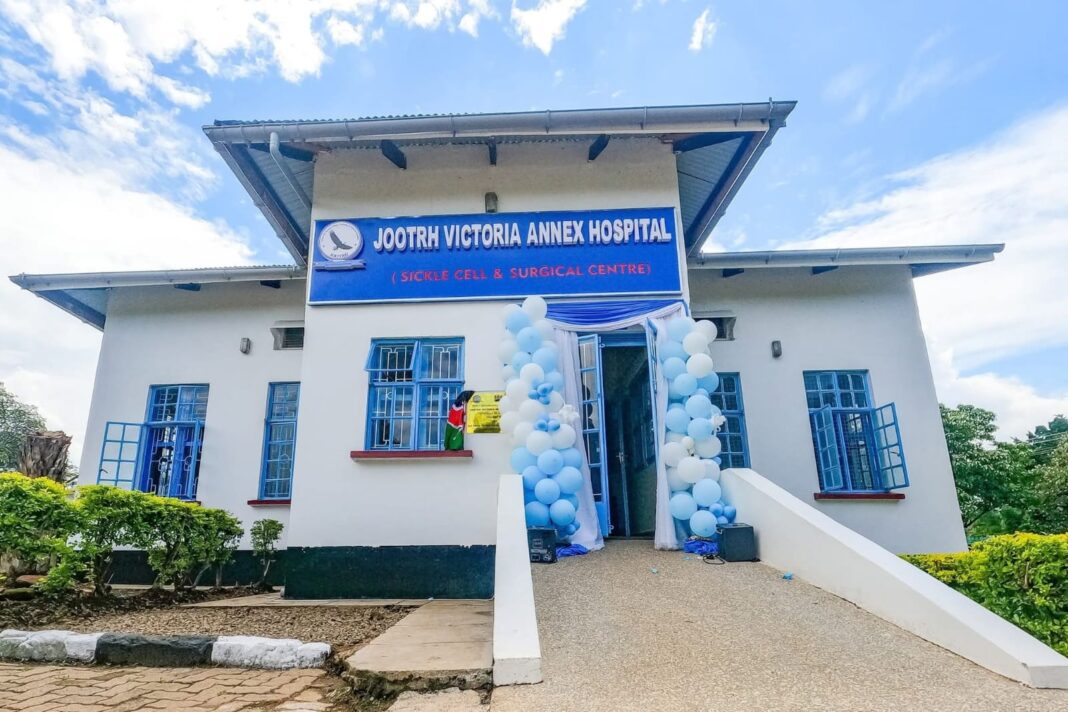
It had been deliberately repurposed and refurbished as a specialised Sickle Cell Disease Management Centre.
When Kisumu County reopened the facility in May 2025, the county described it as a specialised Sickle Cell and Surgical Centre. The county government’s own reopening speech said one of the key features of the Annex would be its role as a dedicated SCD management centre.
JOOTRH likewise described the facility as a dedicated centre for comprehensive sickle-cell care.
The intention was clear: bring specialised treatment closer to patients in Kisumu and the wider Western Kenya region, where sickle cell disease is highly prevalent.
At the time, JOOTRH’s chief executive said patients required continuous and specialised management and that Victoria Annex had been designed around those unique needs. The facility was equipped with a pharmacy, laboratory and triage services to support haematological and surgical care.
For warriors, that investment created hope.
For some, it also created something they had not previously had — a dedicated space where their condition was understood.
Now they fear that space is being dismantled.
‘Where does the county expect these sickle survivors to go?’
Lilian is not alone in expressing alarm.
Another post circulating among the sickle-cell community asks the question directly:
“Where does the county expect these sickle survivors to go?”
The writer says patients have not been adequately informed about what is happening.
“No one is explaining to them what is happening.”
The post points to the apparent removal of beds and hospital equipment while patients are still admitted.
“Hospital equipment and beds used to keep these survivors are being removed from this facility yet we still have some of them like Awuor Lilian who are still admitted.”
It is an image that has unsettled the sickle-cell community: patients still needing treatment while the physical infrastructure around them is being dismantled.
The writer describes Victoria Annex as a facility that had only recently been opened as a specialised sickle-cell and surgical hub.
Then comes the emotional appeal:
“Someone must come out and tell these survivors why their only hope to live another day is being shut down.”
The words reflect the depth of fear among patients.
For many warriors, the concern is not merely about changing the location of a clinic.
It is about whether the change will affect access to medicines, specialists, blood services, advanced procedures and affordable treatment.
A growing centre of specialised care
The timing of the reported move is what makes the situation particularly difficult to understand.
Victoria Annex had been expanding its specialised services.
JOOTRH says the facility introduced automated red-cell exchange therapy, an advanced procedure that replaces abnormal sickled red blood cells with healthy donor cells. The treatment can help reduce complications including stroke, severe anaemia, acute chest syndrome, recurrent pain crises and organ damage.
By January 2026, JOOTRH reported that the number of sickle-cell patients attending the clinic had doubled from about 30 to 60 every week since red-cell apheresis began at the facility.
The hospital’s current information lists an adult sickle-cell clinic every Monday and a paediatric clinic every Wednesday at Victoria Annex.
It also lists adult and paediatric sickle-cell services at Prime Care Centre on Tuesdays.
In June 2026, the national government went further, designating JOOTRH as Kenya’s first public centre for advanced sickle-cell treatment.
Medical Services Principal Secretary Dr Ouma Oluga said the facility was offering specialised red-cell exchange therapy at Victoria Annex and that the government was working with King’s College London towards transforming the Kisumu facility into a regional centre of excellence for sickle-cell management.
Health leaders from across the country were subsequently taken through the specialised services at Victoria Annex, which was described as a regional centre of excellence for sickle-cell disease management and advanced blood and cell therapies.
For warriors now watching beds and equipment being moved, the apparent reversal raises an uncomfortable question:
What changed?
From hope to uncertainty
The county government’s own description of Victoria Annex makes the current anxiety even more striking.
The facility was presented as part of Kisumu’s response to diseases that significantly affect its population, including sickle cell disease.
It was renovated, repurposed and positioned as a specialised centre.
JOOTRH later reported that the facility had become an important part of its sickle-cell programme, including support groups for patients and families.
A December 2025 JOOTRH publication described Victoria Annex as serving two key roles: sickle-cell and blood-disorder care alongside surgical and gynaecological services. It also highlighted the facility’s automated red-cell exchange service as a major development in care for patients with sickle-cell disease.
For patients, therefore, Victoria Annex was becoming an established part of their treatment journey.
Closing or substantially relocating that service now risks creating another period of uncertainty.
And uncertainty is precisely what many warriors say they can least afford.
The SHA question
At the centre of the controversy is money.
Sickle cell disease is a lifelong condition.
Patients may require regular clinic reviews, medication, laboratory monitoring, blood transfusions and, for some, specialised procedures.
JOOTRH says its comprehensive SCD programme includes hydroxyurea therapy, blood transfusion services, infection prevention and management, nutritional counselling, psychosocial support and long-term follow-up.
The hospital’s advanced red-cell exchange programme adds another layer of specialised care.
Patients therefore want to know whether the proposed arrangement will guarantee continuity of all these services.
And more importantly:
Will SHA cover what they need?
Lilian’s Facebook post captures the fear among patients who rely almost entirely on public healthcare.
“What’s next for warriors who could only afford to use SHA?”
That is a question Kisumu County and JOOTRH will need to answer clearly.
If services are moved to Prime Care, patients need to know what changes in financing, what remains covered and whether there will be any additional financial burden.
Prime Care is JOOTRH’s private wing, although the hospital’s current website confirms that it already provides both adult and paediatric sickle-cell clinics there.
The issue, therefore, is not whether Prime Care can provide SCD services.
The issue is whether the transition will preserve affordability, continuity and access for the patients currently relying on Victoria Annex.
The danger is not simply the building
Sickle cell disease requires more than a consultation room.
The disease can cause serious complications affecting multiple organs and may require urgent intervention.
JOOTRH says automated red-cell exchange can reduce the risk of complications such as stroke, acute chest syndrome, recurrent pain crises and organ damage.
The Government Advertising Agency has described sickle cell disease as a major health challenge in Kisumu and the wider Lake Region, reporting that approximately 4.5 per cent of children in Kisumu are born with the disease and around 21 per cent carry the sickle-cell trait. It also notes that without early screening, a large proportion of affected children may not survive beyond five years.
That makes continuity of care particularly important.
A disruption does not automatically mean patients will be denied treatment.
But every unresolved question — where patients report, who treats them, where their records go, whether medicines are available, whether specialised equipment remains operational and what SHA pays — adds anxiety to families already dealing with a demanding disease.
More than a clinic
Perhaps the most overlooked part of the Victoria Annex story is the community that patients say developed around it.
Lilian describes a place where warriors could meet others who understood what they were going through.
“We got to interact with fellow warriors and share our experience. We encouraged each other…”
That social connection is significant.
Sickle cell disease can isolate patients through stigma, repeated hospital visits and the disruption it can cause to school, work and family life.
JOOTRH itself says it has facilitated the formation of warrior support groups that provide assistance to patients and families.
Victoria Annex consequently became not only a point of medical care but also a meeting place for a community.
For patients, moving services is therefore about more than changing an address.
It threatens to break up a system of care and support that they had only recently begun to trust.
‘We cannot fight the county’
The anger among warriors is reportedly growing, but some patients also recognise the imbalance between themselves and government authorities.
They say they cannot fight the county government.
But they can ask questions.
And the questions are becoming louder.
Why was the Annex refurbished and launched as a specialised SCD centre?
Why was advanced red-cell exchange introduced there?
Why was the facility presented nationally as a centre of excellence?
Why were patients encouraged to build their care around the facility?
And why are they now reportedly being asked to leave?
Most importantly, what safeguards are in place for patients who are still admitted?
Is a reversal possible?
Patients have been told that a reversal is possible.
That possibility offers a narrow window for dialogue.
The solution does not necessarily have to be a confrontation between the county government and warriors.
It could begin with an urgent meeting involving the county health department, JOOTRH management, clinicians, patient representatives and other stakeholders.
The patients need an explanation.
They need a transition plan.
They need clarity on SHA.
They need assurance that medicines will remain available.
They need to know whether the specialised red-cell exchange programme will continue without interruption.
And they need assurance that no patient will be abandoned in the middle of treatment.
The bigger question for Kisumu
The Victoria Annex controversy comes at a time when Kisumu is positioning itself as a regional centre for specialised sickle-cell treatment.
The national government has already recognised JOOTRH’s advanced SCD services.
JOOTRH says the facility is intended to reduce the need for patients to travel outside the region for specialised care.
The county government’s own strategic planning has identified Victoria Annex as part of its approach to sickle-cell care.
That makes the current uncertainty more than an administrative dispute over a building.
It is a test of whether Kisumu can maintain continuity in a specialised public-health programme after investing heavily in establishing it.
For warriors, the stakes are intensely personal.
Lilian has already told the public what Victoria Annex meant to her.
It was a place where she felt safe.
A place where she found other warriors.
A place where she received care.
Now she is asking where she goes next.
Another patient advocate has asked the same question from a different angle:
“Where does the county expect these sickle survivors to go?”
Those questions deserve clear answers.
Because while officials can discuss facilities, budgets, ownership and administrative arrangements, patients experience the consequences differently.
They experience them from hospital beds.
They experience them while waiting for medication.
They experience them when a pain crisis comes.
They experience them when they need blood.
They experience them when they need specialised treatment.
And they experience them when the place they had come to trust suddenly begins moving its beds away.
For Kisumu’s sickle-cell warriors, the issue is therefore not simply whether Victoria Annex remains open.
It is whether the specialised, affordable and continuous care that the facility was created to provide will survive whatever changes the county has planned.
Lilian has already asked the question that now hangs over Victoria Annex:
“What’s next for us?”
The county owes the warriors an answer, before the last bed leaves Victoria Annex.