
By Simon Okola
The September sky offers a timely warning: forecasts do not protect communities unless public budgets and climate finance convert them into early action.
Climate Finance and Project Bankability Specialist
Around 23 September, Kenya experiences the equinox, when the Sun crosses the Equator and day and night are nearly equal in length. For a country named after Mount Kenya and straddling the Equator, the moment carries both scientific and symbolic significance. In 2026, it also arrives as a powerful El Niño strengthens across the tropical Pacific.
The two events should not be confused. The equinox is an astronomical event caused by the Earth’s orbit and tilt. It does not cause El Niño, nor does it guarantee rain. El Niño is a large-scale warming of the central and eastern equatorial Pacific Ocean that changes atmospheric circulation and can alter rainfall and temperature patterns far beyond the Pacific. Their coincidence this September is therefore not a causal relationship. It is a useful public reminder that Kenya is entering a period when climate information must be translated into preparedness.
On 3 September, the World Meteorological Organization reported that El Niño was firmly established and expected to intensify to a very strong event, with an exceptionally high likelihood of persisting through February 2027. WMO warned of increased risks of floods, droughts and extreme heat, while stressing that impacts differ by place and depend on other climate drivers. That qualification matters: El Niño raises probabilities; it does not provide a street-by-street forecast. Kenya must therefore rely on regular updates from the Kenya Meteorological Department and local risk information rather than treating a global outlook as a prediction of identical rainfall everywhere.
For western Kenya, the warning is economic
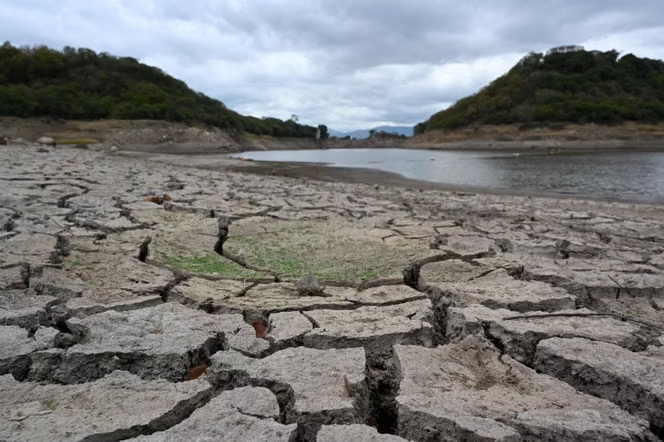
In western Kenya, climate risk travels quickly through the economy. Intense rain can swell rivers, overwhelm drainage systems, damage roads and bridges, disrupt markets and schools, contaminate water sources and trigger landslides. Around Lake Victoria, changing rainfall, strong winds and lake conditions can threaten fishing livelihoods and lakeshore settlements. Yet poor or uneven rainfall can also damage crops, reduce pasture and deepen household food insecurity.
This is why the central question is not simply whether it will rain more. It is whether counties, utilities, farmers, businesses and communities are financially prepared for a wider range of plausible conditions. Forecast uncertainty is not a reason to delay. It is a reason to finance flexible, no-regret measures that deliver value under several scenarios.
A cleared drainage channel, a protected water source, a functioning early-warning system, pre-positioned emergency supplies, safer school infrastructure and an updated evacuation route are useful even when the worst forecast does not materialise. Climate preparedness should be judged in the same way as insurance: its value is not cancelled because disaster was avoided.
Kenya has a last-mile climate finance problem
Climate finance is often discussed as a contest for billions of shillings from global funds. That matters, but communities usually experience the financing gap at the last mile. A forecast may be available nationally, yet a ward lacks money to repair a culvert. A county may map a flood-prone settlement, yet have no pre-agreed budget trigger for evacuation and temporary shelter. Farmers may receive an alert, yet lack affordable credit, suitable seed, water storage or insurance to act on it.
Information without an action budget transfers responsibility to people who often have the least capacity to absorb loss. An alert that says flooding is possible is not enough if households cannot move, drainage remains blocked and health facilities have no continuity plan.
This is the practical meaning of climate-finance readiness. It is the ability to turn a recognised climate risk into a credible project, with evidence, costed interventions, capable institutions, safeguards, measurable results and a financing plan. Readiness must come before the emergency, not after the damage assessment.
Five investments should begin before the rains
First, county governments should ring-fence contingency funds and link their release to clear, forecast-based triggers. Emergency spending should not depend entirely on slow supplementary budgets after losses have occurred.
Second, counties should prepare investable resilience projects rather than broad wish lists. Flood-control, resilient roads, water storage, catchment restoration and climate-smart agriculture proposals need designs, budgets, climate rationales, safeguards, maintenance plans and indicators. Donors and investors finance credible pipelines, not intentions.
Third, funding should strengthen local early action. Community health volunteers, beach management units, farmer organisations, schools, water-user associations and local media often carry the final warning. They need defined roles, trusted messages, equipment and modest operational budgets.
Fourth, Kenya should expand risk-transfer and liquidity tools. Agricultural and livestock insurance, emergency credit lines, guarantees and contingency finance can help households, enterprises and governments recover faster. But these tools must be transparent and affordable; insurance should complement risk reduction, not become an excuse to leave people exposed.
Fifth, every investment should measure resilience delivered. Counting workshops, beneficiaries or money disbursed is insufficient. The real indicators are whether warning lead time improved, losses fell, water and essential services remained available, vulnerable households recovered faster and protective systems continued functioning after project funding ended.
Preparedness can also unlock investment
The business case for anticipatory action is stronger than it first appears. Flood protection, watershed restoration and climate information may not always generate direct commercial revenue, but they can reduce repair costs, protect agricultural production, preserve market access and lower disruption for firms and public services. These avoided losses are real economic value.
Good financial structuring separates benefits that can support revenue from those that justify public or concessional finance. Commercial capital may fund viable productive assets. Grants can support public goods, community mobilisation and project preparation. Concessional loans and guarantees can reduce financing costs, while insurance and contingency facilities can manage residual risk. Treating every adaptation project as either a pure grant or a conventional commercial investment is too simplistic.
Western Kenya can use this approach to build a pipeline around resilient food systems, urban drainage, water security, wetland and catchment restoration, lake-based livelihoods, resilient schools and health facilities. But each project must answer six questions: What hazard is being addressed? Who or what is exposed? Which vulnerability will be reduced? What intervention will achieve that reduction? How will success be measured? Who will maintain the asset or service after initial funding ends?
September should mark the start of action
The equinox will pass in a day. El Niño and its effects may extend well into 2027. The opportunity is to use this September not for alarm, but for disciplined preparation.
National and county governments should publish understandable local outlooks, test response plans and identify unfunded priorities. Banks and insurers should offer responsible products that help farmers and small businesses act before losses. Development partners should finance preparation and early action, not only post-disaster recovery. Project developers should produce bankable, evidence-led proposals. Communities must be involved in defining risks, workable responses and the indicators by which success will be judged.
Kenya cannot control the equinox or El Niño. It can control whether warnings become budgets, whether budgets become resilient projects and whether those projects protect lives and livelihoods. That is the climate-finance test before us: not how much money is announced after disaster, but how effectively finance reduces loss before the next storm, flood or failed season arrives.
Readers should follow the latest national and county-specific forecasts and advisories issued by the Kenya Meteorological Department.
About the author
Olendo Simon Okola is the Founder and Lead Consultant at Agenda Beyond Borders. He works on climate-finance readiness, project bankability, institutional capacity, and investment-ready climate projects across Africa. Email: simonokola@agendabeyondborders.org | www.agendabeyondborders.org