
By Valentine Omondi
The Orange Democratic Movement (ODM) is facing mounting political pressure as the emergence of the Movement for Democracy and Growth (MDG) exposes growing divisions within the party, raising questions about its ability to maintain its traditional political strongholds ahead of the 2027 General Election.
The growing rivalry between the two political formations has particularly attracted attention in Nyanza and Western Kenya, regions where ODM has enjoyed considerable political influence over successive election cycles.
Led by Ugenya Member of Parliament David Ochieng’, MDG is increasingly positioning itself as an alternative political vehicle for leaders seeking elective positions, with several politicians previously associated with ODM already making the switch.
Among the latest developments are the defections of Teso North MP Oku Kaunya and Butula MP Joseph Oyula, whose departure from ODM has added to concerns about the party’s ability to retain its elected leaders.
The defections come at a time when ODM is also navigating internal disagreements over its political direction, its relationship with President William Ruto’s administration and negotiations surrounding the 2027 elections.
TJ Kajwang Sounds Alarm Over MDG’s Growing Influence
The emerging competition has prompted Ruaraka MP TJ Kajwang to issue a warning to ODM members, arguing that the growing rivalry could weaken the party’s bargaining position within the broad-based government arrangement.
Speaking during the burial of Joshua Orero in Homa Bay on November 20, Kajwang cautioned that President Ruto could reconsider his political alliances if ODM lost its parliamentary strength.
He argued that political partnerships are largely influenced by parliamentary numbers rather than personal relationships, warning that a stronger political formation could attract the President’s attention at ODM’s expense.
“Let no one lie to you that Ruto cannot work with Gachagua. I am telling you this because Ruto will work with the party with most MPs in parliament,” Kajwang said.
He also appealed to politicians who had left ODM for MDG to reconsider their decisions and return to the Orange party, warning that continued fragmentation could undermine its influence in future political negotiations.
MDG Rejects Claims of State House Sponsorship
The political contest has also attracted accusations that MDG could be benefiting from President Ruto’s political interests in an attempt to weaken ODM’s influence in Nyanza.
Former Deputy President Rigathi Gachagua has previously alleged that the President is sponsoring the party to attract ODM members and weaken the opposition’s political influence.
However, Ochieng’ has dismissed the allegations, insisting that MDG is an independent political organisation that has existed for approximately a decade.
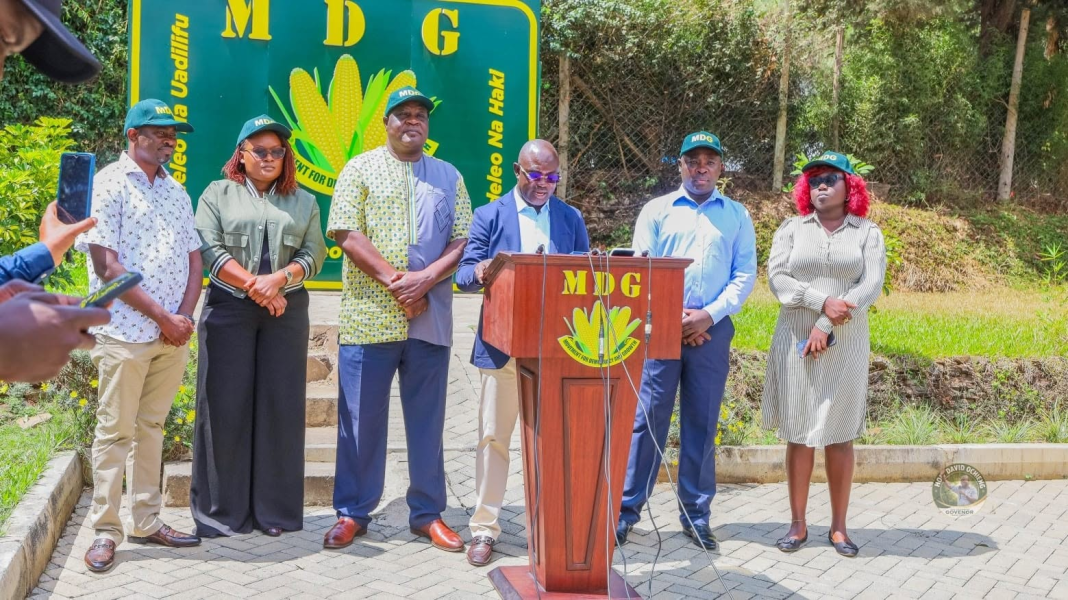
Addressing the media on November 22, the Ugenya MP maintained that the party had never received financial or material support from State House, State Lodge or any individual.
He further ruled out joining Gachagua’s opposition formation, reaffirming MDG’s commitment to the broad-based government arrangement and its support for President Ruto’s re-election bid.
Ochieng’ has also publicly backed Deputy President Kithure Kindiki as Ruto’s preferred running mate for the 2027 elections, a position that adds another dimension to the emerging political competition.
Accusations of Intimidation Add to Political Tensions
The disagreement has extended beyond party defections, with MDG now accusing some elected leaders in Nyanza of intimidating politicians and residents who associate with alternative political formations.
In a statement issued following a party meeting in Siaya on November 24, MDG officials called on elected leaders to respect political diversity and allow residents to freely choose their political affiliations.
The party maintained that it would not abandon its ambitions in the region despite the alleged intimidation, declaring its intention to compete for elective positions in the 2027 elections.
MDG officials also criticised political arrangements in which leaders allegedly meet privately to distribute positions, arguing that voters should determine who represents them.
The party said it would popularise its manifesto and encourage more aspirants, including women, to seek elective positions under its ticket.
ODM’s Political Future Faces a Defining Test
Beyond the rivalry with MDG, ODM is dealing with a delicate transition following the death of its founding leader, Raila Odinga, whose political influence helped establish the party’s national identity and electoral networks.
The party, now led by Oburu Oginga, is also attempting to balance its cooperation with Ruto’s administration against demands from sections of its leadership for a formal political agreement that guarantees the party a meaningful role in the next government.
ODM chairperson and Homa Bay Governor Gladys Wanga has maintained that the party must negotiate its political interests rather than enter an arrangement without clearly defined terms.
Meanwhile, the emergence of alternative political formations has complicated ODM’s efforts to secure its traditional political bases, particularly as aspirants begin positioning themselves for the next election.
With MDG expanding its political activities and attracting leaders previously elected on ODM tickets, the coming months could test the party’s internal cohesion, nomination processes and ability to maintain its political networks.
The central question is whether ODM can address its internal disagreements and retain the confidence of its elected leaders and supporters as competition for the 2027 elections intensifies.