By Anderson Ojwang
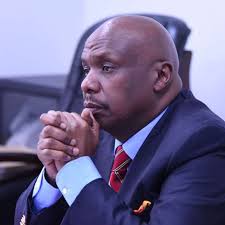
Former Baringo Senator Gideon Moi may have squandered a golden opportunity to rebrand and reposition KANU—the country’s independence party—within Kenya’s political matrix in Thursday’s by-elections.
Gideon’s anticipated candidature for the Baringo senatorial by-election was offering the son of Kenya’s second president, the late Daniel arap Moi, a pathway back to an elective seat and a chance to breathe new life into the party.
The seat was Gideon’s to lose, which explains why President William Ruto prevailed upon him to drop his bid and instead join the broad-based government project.
This decision followed a private meeting with President Ruto at State House, after which Gideon failed to present his nomination papers to the Independent Electoral and Boundaries Commission (IEBC).
A section of Baringo residents even threatened to march to the late President Moi’s grave in protest, expressing disappointment and a sense of betrayal.
In the 2022 general election, the late William Cheptumo won the senatorial race with 147,177 votes against Gideon’s 71,480 and was again poised to defeat UDA’s Kiprono Chemitei in the by-election.
IEBC cleared six candidates for the Baringo senatorial by-election scheduled for November 27:
- Shadrack Kiplawat (Alliance for Change Party)
- Samuel Letasio (Kenya Moja Movement)
- Steve David Kipruto (Republican Liberty Party)
- Benjamin Chebon (The New Democrats)
- Kiprono Chemitei (UDA)
- Daniel Kirui (Umoja na Maendeleo Party)
Gideon would have entered the race with a solid base of 71,480 votes and a shifting political terrain that was increasingly favouring him. But he blew the chance.
President Ruto told residents that he personally prevailed on Gideon to withdraw and join him in a national unification effort.
“To the family of our father, Daniel Moi, and the people of Baringo, let me thank God for allowing us to gather here at Kabarak, the home of our father, the second president of Kenya.
I am happy. When I spoke with my brother Gideon, we discussed past, present, and future issues. After agreeing on everything, the question of how and where to communicate it arose. I told him Kabarak was the best venue. This is our home. Nobody welcomes us here. We know this place better,” Ruto said.
He added that in Moi’s final years in power, he was the closest person to him.
President Ruto said he approached Gideon and invited him to join the broad-based government.
“I told Gideon, kindly join me so we can pull the country together. I have spoken with Raila Odinga. I have sat with my predecessor Uhuru Kenyatta. I told all of them that Kenya must move to the next level. I looked for Gideon and told him the same. If there is any mistake, blame me,” he said.
Gideon later issued a statement saying:
“We’ve elected to pursue the path of unity and shared purpose at this crucial point in our nation. I extend my heartfelt gratitude to the people of Baringo for their support and for granting us a chance to move beyond our differences and build a cohesive and prosperous nation.”
And with that, Gideon missed the opportunity to reclaim the Baringo senate seat and revive KANU’s political relevance.
Broken Promises in Ugunja and Kasipul
Ahead of the by-elections, Gideon was actively scouting for candidates to fly the KANU flag, successfully netting two aspirants in Ugunja and Kasipul.
In Ugunja, KANU recruited former university student leader Chris Budo, a respected community mobilizer.
KANU Secretary-General George Wainaina and Chairman Gideon Moi reportedly promised to fund Budo’s campaign.
But the party later failed to honour the agreement.
“I am disappointed that my party failed to meet its part of the bargain. They asked for my budget, and that was the last time I heard from them. They undermined my campaign. I am very disappointed in my party leadership,” Budo said.
Last Saturday, Wiper leader Kalonzo Musyoka was in Ugunja campaigning for his party’s candidate, Eng. Johannes Odhiambo Orodi.
KANU officials were nowhere to be seen—despite having a candidate they personally headhunted.
KANU has again lost a chance to re-establish itself in Nyanza, a region now politically fluid following the demise of ODM leader Raila Odinga.