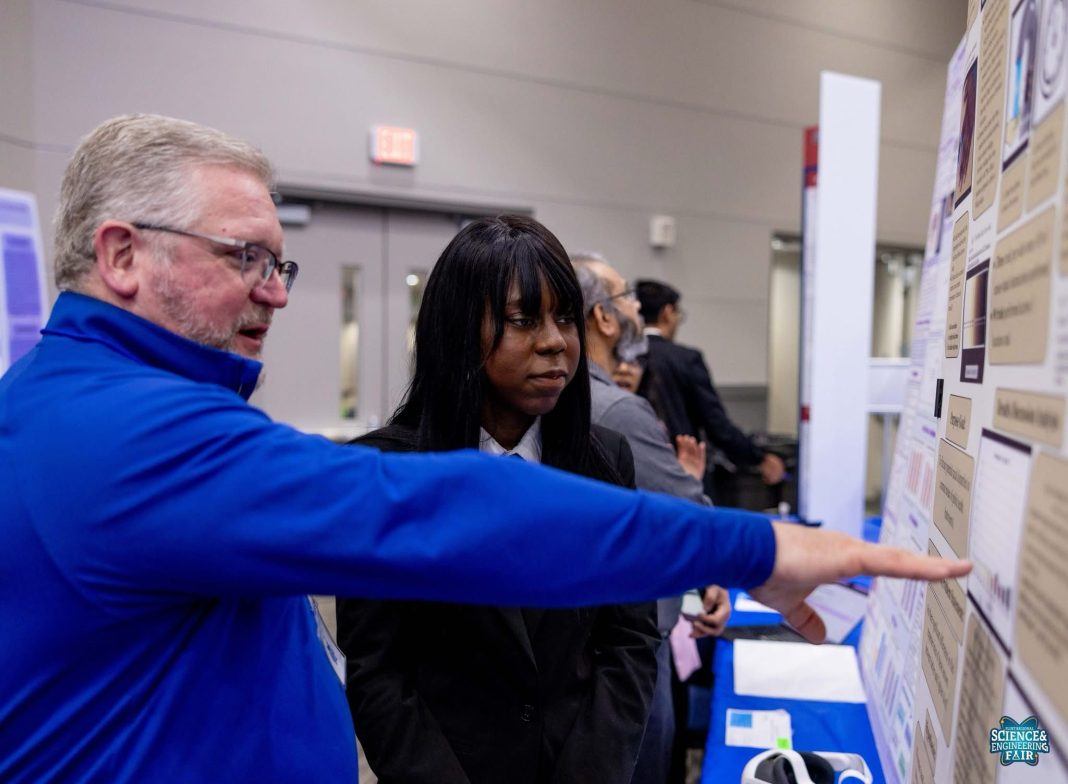
By Anderson Ojwang
In pursuit and search for self-identity and consciousness, an American teen of Kenyan origin embarked on research that gave her freedom from the yoke of denial, fear and self-pity.
The teen, Amari Carthron, is in her senior year (Grade 12) and also attends Delta College part-time to study sociology.
She came up with a research idea to answer her worries and those of many other Black persons in the world.
“I read about a viral video of a Black man who was unable to use a soap dispenser. From this video, I developed an idea for my project to investigate racial bias in public health.”
Specifically, the video shows a Black guest of the marriott hotel in Atlanta struggling to use a soap dispenser in the hotel’s bathroom.
The soap dispenser would not work on his hands because of their technology, and he had to have his white friend help him get the soap to wash his hands.
“I was passionate about the experiment because it was related to my identity.
Previously, I wasn’t really passionate about my science work and because of my identity as a Black woman, I haven’t really felt welcome in STEM spaces, but the research gave me a reason to celebrate who I am,” she says.
Amari’s research was based on investigating the racial bias in public health.
The test involved study on automatic sinks which have the same infrared technology as that found in the soap dispenser from the viral video.
This technology works using infrared sensors that emit infrared electromagnetic radiation that is reflected off the surface of hands back to the sensor.
The sensor then triggers the faucet to dispense water.
Theoretically, these sensors are less effective on darker skin because it reflects a lower amount of electromagnetic radiation.
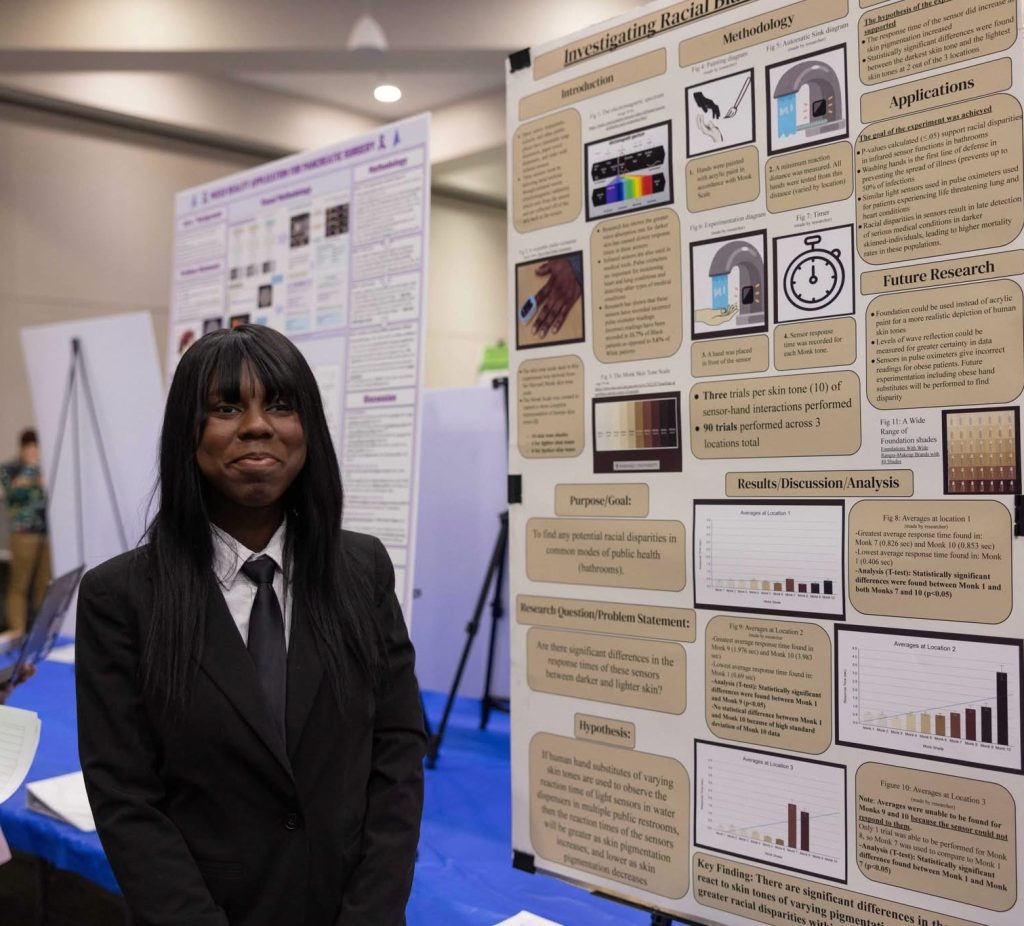
In her experimentation, Amari used synthetic human hands that were painted in an expansive range of skin tones.
She had 10 hands total and tested them each against automatic sinks at three public locations.
She performed 90 trials of experimentation and found that as skin pigmentation (how dark the skin is) increased, so did sensor response time (the time it took for a sensor to respond to a hand and trigger a faucet to dispense water).
Essentially, she did find significant (determined via t-test) racial disparities in the functions of automatic sinks, which are public health devices used in everyday life.
“I was so passionate about the experiment, but there were many times when I got fatigued and I wanted to give up.
The ups and downs of a research can weigh you down to the melting point.
My parents stood by me, and they urged me to keep on going.
My mentor, Ms. Clara Wagner was also a guiding light for me.
My friends and my school also encouraged me to continue.
My aunt was very helpful with dropping me off and picking me up to collect samples for the experiment.
Because of her help, I got a burst of new energy that propelled me to the full completion of the project,” she says.
Amari says the project enabled her to understand the reality of being a Black person and the beauty that goes with it, and she is proud of her work.
To her the project was not an individualistic desire for self-actualization but for the good of the Black community and to help reinforce the importance of their identity.
“I am gifted and talented. I like doing research that has an impact on the human kind.
I am happy that my project was for the good of my community and that is why I feel honored to have emerged among the best in the science fair,” she explains.
Amari Carthron placed fourth at the Michigan State science fair.
Amari was also recognized by the American Statistical Association with an award.
Amari’s project was “Investigating Racial Bias in Public Health” her research studied racial disparities in school bathrooms, store bathrooms, and restaurant bathrooms.
Her research found significant racial disparities in every bathroom she tested.
Sensor response times between the lighter skin tones and the darker skin tones had significant differences between them (p-value ≤ 0.05) at every test location.
This is significant because washing hands is the first line of defense in proving the spread of illness.
“Washing hands is also the most accessible form of disease prevention,” she said.
Celebrating her 18th birthday in style.
Amari is excited about her 18th birthday and is looking forward to marking it with a difference.
A dreamer, she is turning dreams into reality.
This year she is planning to launch her first book, a fantasy.
The book targets teens and young adults in college.
She would prefer to keep the plot of the book secret, but she will say that it is a romantic fantasy featuring magic.
Stay tuned!
“I like daydreaming. My stories are just written down versions of what I dream about.
Last year, I was able to author my first book, which is a milestone,” she says.
Amari says her mother, Glenis Sungu’s resilience and commitment are the virtues that have been pillars in her life.
“I am proud of myself .
I have a long way to go to achieve a lot of things.
This is just the beginning and I am committed to realizing greatness,” she says.
Her mother, Glenis says:
“Amari is a very hard worker.
She doesn’t give up, and she’s a perfectionist.
She’s patient, kind, and respectful. She’s a wonderful example to her younger sister.
Amari has always loved school and reading since was young.
I have always known that she is destined for greatness. I believe in her above all else.”