
By Valentine Omondi
Kenya’s legal fraternity has intensified its push for reforms within the Judiciary after the Law Society of Kenya (LSK) reaffirmed its nationwide boycott of court proceedings, arguing that judicial independence must go hand in hand with accountability.
The protest, which has seen advocates stay away from courtrooms across the country, has sparked a national conversation about the integrity of the justice system, the role of the Judicial Service Commission (JSC), and the public’s confidence in the courts. Although the Judiciary has maintained that courts remain operational, the absence of advocates has forced the adjournment of some cases, leaving litigants caught in the middle of the standoff.
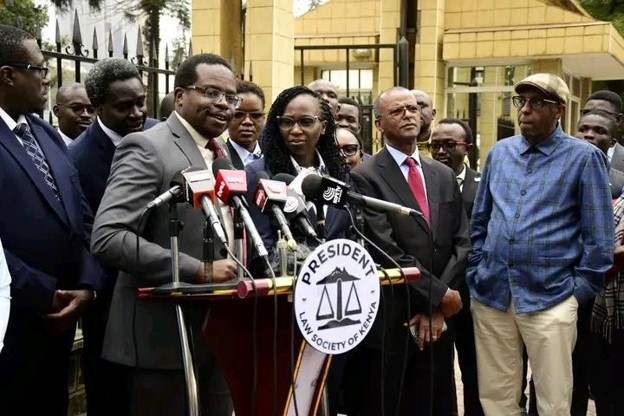
Speaking outside the Supreme Court on Wednesday, LSK President Charles Kanjama urged lawyers to remain united behind the boycott until meaningful reforms are achieved.
Kanjama said the LSK Council, alongside members of the Senior Counsel Bar, will meet the Judicial Service Commission on July 31 to discuss the concerns that triggered the industrial action.
He emphasised that the society’s campaign is not aimed at weakening the Judiciary but at strengthening public confidence in it through accountability and transparency.
The Law Society of Kenya (LSK) has listed Chief Justice Martha Koome and Deputy Chief Justice Philomena Mwilu among nine judges and judicial officers targeted in a court boycott.
The lawyers’ body said the action will continue indefinitely until courts issue orders restraining the Judicial Service Commission (JSC), the Ethics and Anti-Corruption Commission (EACC), and the Directorate of Criminal Investigations (DCI).
The boycott has attracted support from some of the country’s most distinguished legal practitioners, who argue that judicial officers should not be shielded from scrutiny merely because they enjoy constitutional independence.
Former LSK President Faith Odhiambo questioned the apparent reluctance to subject judges to disciplinary processes, saying accountability is a fundamental principle of the rule of law.
“How can we trust our courts if they can stop JSC hearing against corrupt judges and their own accountability? Their independence does not mean that they are above the law,” she said.
Her remarks echoed growing concerns among lawyers who believe unresolved complaints against judicial officers continue to erode public trust in the justice system.
Senior Counsel Philip Murgor also defended the boycott, saying the legal profession had united behind a common cause.
According to Murgor, judges and magistrates entrusted with dispensing justice must also be prepared to account for their conduct whenever legitimate concerns arise.
Senior Counsel Ahmednasir Abdullahi accused some judicial officers of perpetuating corruption within the courts and insisted the boycott would continue until decisive action is taken.
“The boycott will continue until the alleged corrupt practices within the courts are addressed,” he said.
Former LSK President Nelson Havi called for complaints previously lodged before the Judicial Service Commission against judicial officers to be reopened and reconsidered. He also faulted Chief Justice Martha Koome for what he described as a failure to engage the concerns raised by members of the Bar, insisting that dialogue alone would not be enough unless it resulted in concrete reforms.
Former LSK President Erick Theuri described the boycott as a campaign undertaken in the public interest, arguing that judicial accountability is essential in protecting constitutional governance and preserving public confidence in the courts.
He appealed to Kenyans to support efforts aimed at reforming the Judiciary, saying the fight is ultimately about strengthening institutions rather than targeting individuals.
The campaign has also received regional backing.
East Africa Law Society President Ramadhan Abubakar said accountability should apply equally to every arm of government, including the Judiciary.
He argued that while courts regularly hold the Executive and Legislature accountable for their actions, the Judiciary should equally be subjected to oversight whenever credible allegations arise.
Abubakar further called upon the Ethics and Anti-Corruption Commission (EACC) to investigate claims of corruption involving judges and magistrates.
The Judiciary, however, has maintained that justice continues to be administered despite the boycott. Judicial officers have continued hearing matters scheduled before them, although several cases have been postponed because advocates have not appeared in court.
The ongoing standoff comes at a time when Chief Justice Martha Koome is out of the country, leaving the Judicial Service Commission to engage directly with the LSK during the scheduled July 31 meeting.
For many Kenyans seeking justice, the dispute extends beyond institutional disagreements. Every adjourned hearing means delayed justice for families, businesses, and individuals relying on the courts to resolve disputes. Legal analysts warn that while the lawyers’ demands focus on long-term reforms, prolonged disruption could significantly affect access to justice if the impasse persists.
At the heart of the dispute lies a broader constitutional question: Can judicial independence exist without effective accountability? The LSK argues that independence protects judges from external influence but should never shield them from investigation where allegations of misconduct or corruption exist.
As the legal fraternity awaits the July 31 meeting with the Judicial Service Commission, expectations are high that dialogue will produce a lasting solution. However, LSK leaders have warned that should the talks fail to address their concerns, they are prepared to escalate the protests.
The outcome of the standoff could shape not only the future relationship between the Bar and the Bench but also the public’s confidence in Kenya’s justice system for years to come.