
By Valentine Omondi
After the 2022 general elections, Orange Democratic Movement (ODM) party leader and Azimio La Umoja Presidential candidate, the late Raila Amolo Odinga, headhunted a chief finance officer for the county.
Raila poached the immediate former Chief Finance Officer of Laikipia County, Paul Waweru, who was a key pillar in the administration of Ndiritu Muriithi.
Ndiritu was the head of Raila’s presidential campaign and was ranked as one of the top performers during his tenure. Laikipia’s own source revenue grew to near a billion mark. In the financial year…
In a comparative analysis of the own source revenue collection for Laikipia County in 2017-2022, in contrast to Kisumu in the same period, and contrasting Governor Anyang’ Nyong’o to his predecessor Jack Ranguma, leaves a lot of sour taste in the mouth.
Laikipia County revenue collection in 2017-2018
During 2017-2018, the revenue was Sh608,463,783. In 2018-2019, the revenue was Sh815 million. In 2019-2020, the revenue was Sh730 million. In 2020-2021, the revenue was Sh840 million, and in 2021-2022, the revenue stood at Sh902 million.
Contrast Nyong’o’s first term
During the same period, in 2017-2018, Kisumu County collected Sh874 million against the target of Sh1.15 billion, accounting for 76.2 percent. In 2018-2019, the county collected Sh842 million against the target of Sh1.38 billion, a 61 percent performance. In 2020-2021, the county collected Sh822 million against a target of Sh1.58 billion, a 52 percent performance, and in 2021-2022, the county collected Sh982 million against a target of Sh1.98 billion, a 49.5 percent performance.
2013-2017, Ranguma’s tenure
During the reign of the founding Governor Jack Ranguma, the own source collections hit the Sh1 billion mark.
In the financial year 2013-2014, the collection was Sh621 million. In 2014-2015, it was Sh970 million. In 2015-2016, it was Sh978 million, and in 2016-2017, it was Sh1 billion.
Financial performance in 2022-2026
In 2022-2023, the revenue collection was Sh731 million against the target of Sh1.5 billion, a 48 percent performance. In 2023-2024, the revenue collection was Sh1.3 billion against the target of Sh2.3 billion, a 63 percent performance.
In 2024-2025, the actual collection was Sh2.5 billion against the target of Sh3.8 billion, a 64 percent performance, and in 2025-2026, the first half was Sh452 million against a target of Sh3.6 billion.
Reshuffle
CEC Finance George Okongo made changes in the department, removing Waweru, who had stabilised the ship from 2022 to August 2024, from the post and bringing in Fredrick Osewe as the acting chief officer.
Waweru was reassigned by Governor Nyong’o to be Chief Executive Officer of Lake Front Development Corporation.
Disappointment
Nyong’o and Okongo, who appeared before the Senate Public Accounts Committee chaired by Moses Otieno Kajwang’, left the senators disappointed by the highest level of incompetency in the finance department.
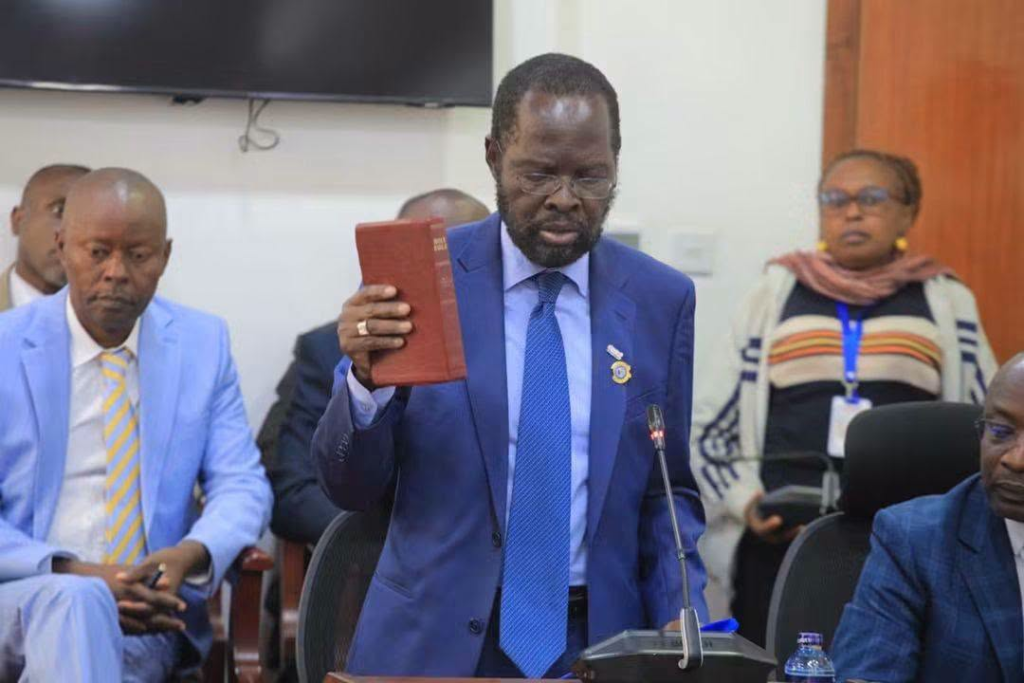
“My concern is that you do not train incompetent people who have failed to include relevant financial figures; you sack or transfer them. Okongo CEC, what have you done to clean up this department, which is letting the county down?” Kisumu Senator Prof Tom Ojienda said.
Kitui County Senator Enoch Wambua wondered what quality of staff were preparing the county’s financial statements.
“If you cannot have people preparing your financial statements who are active in their profession and in good standing in their profession…” he said.
Flopped internal promotion adverts
The recent internal advertisement by the Kisumu Public Service Board for the post of directors failed to be actualised after the department failed to meet the requirements.
The board was forced to give short-term acting contracts to those in office and wait to make external advertisements.
Spike in pending bills
Kisumu County witnessed a spike in pending bills by Sh3 billion after the changes were made in the Finance department.
Premium tears
The excitement and the political storm that marked the candidature of Nyong’o for the county gubernatorial seat in 2017 has turned into gnashing of teeth and premium tears.
The Orange Democratic Movement (ODM) leadership’s false campaign mantra against the incumbent Jack Ranguma – that Nyong’o would transform the county into Europe – has come a cropper.
Currently, suppliers and residents are in more pain and suffering over unpaid services and lack of development projects.
At the Senate, the pain and suffering of the county was laid bare by the Senators over what they termed as a huge burden of Sh5.9 billion pending bill debt Nyong’o will be passing over to his successor.
Sadly, when Nyong’o took over from Ranguma, the pending bill in his term was only Sh800 million, and funds for payment of the bills had been allocated.
Kajwang’ asked Nyong’o whether he was planning to hand over Sh5.9 billion debt to the next administration.
“Are you planning to hand over Sh5.9 billion debt to the next administration? What is the plan, because these responses, whatever is on paper, is just accounting speak. You close that year with Sh5.9 billion as debt. Whether it is legal fees or whether it is one year old or ten years old, but after 10 years of being in office, would you be handing over Sh5.9 billion as unpaid debt to the next administration?” he asked.
Kajwang’ said there was serious concern over Sh5.9 billion of unpaid pending bills, while the revenue for the year was Sh9 billion, which exceeded the debt-to-revenue ratio capped at 20 percent but was at a high of over 60 percent.
“Do you have a payment plan, and have you submitted it to the Controller of Budget, and to what extent has this debt been reduced?” he said.
The senators questioned the sharp rise in pending bills to Sh5.9 billion, demanding a clear strategy on how the county intends to reduce the debt burden.
The committee interrogated Governor Prof. Anyang’ Nyong’o and county officials over what it described as a 108 per cent increase in pending bills within a single financial year.
Committee member Senator Tom Ojienda sought an explanation on the county’s debt reduction strategy, asking what measures had been put in place to bring down the growing obligations.
In response, the Finance CEC George Okongo was hard-pressed and found himself at the guillotine over his responses.
Okongo said the increase was largely driven by court decisions requiring the county to settle long-standing claims, including liabilities arising from a consent agreement with the National Housing Corporation.
They also cited poor local revenue performance as a major contributor to the growing debt.
According to the county, a Sh2.5 billion payment plan had been prepared, with Sh1.9 billion already paid, translating to a 76 per cent performance in settling pending bills in the payment plan.
However, senators questioned the credibility of the figures after discovering that many of the supporting schedules had not been aged, making it difficult to determine when the debts arose and whether the reported payments reflected the actual outstanding obligations.
Wambua demanded a detailed schedule showing the names of creditors and the debts the county claimed had already been settled, but the documents were not produced before the committee.
Kajwang’ faulted the county’s financial statements, saying they had raised more questions than answers.
“Your financial statements are generating a lot of issues and supplementary questions,” Kajwang’ observed, noting that several supporting notes lacked sufficient detail to facilitate proper scrutiny.
The committee further questioned a significant drop in the county’s own-source revenue, with Ojienda seeking explanations over the decline in parking fee collections from about Sh19 million to Sh113,000 and property rates from approximately Sh20 million to Sh6 million.
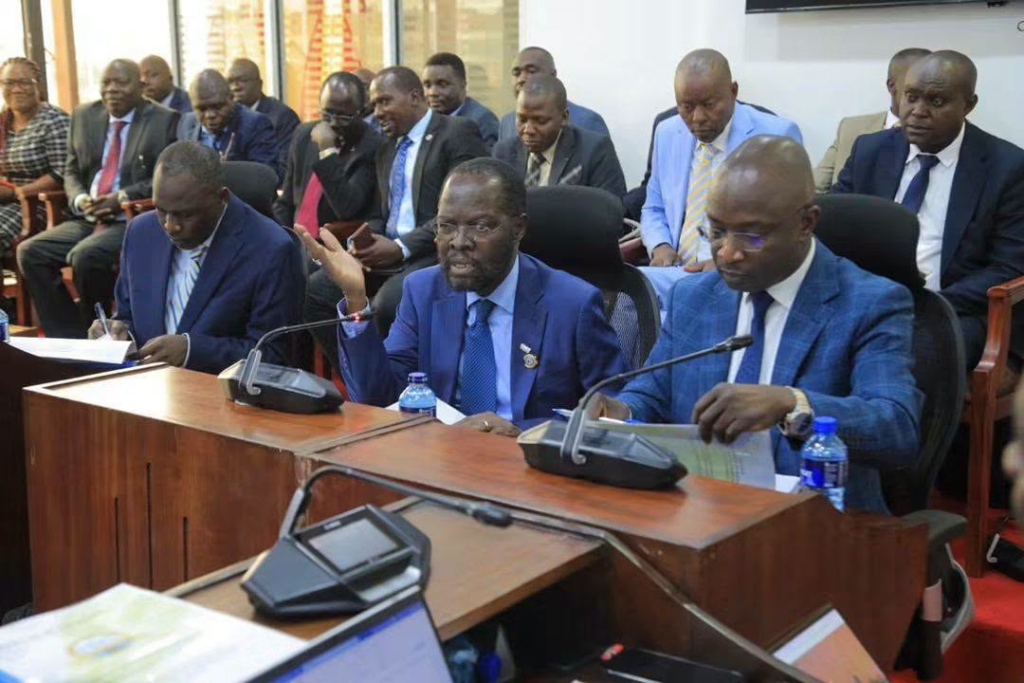
The hearing also turned to inconsistencies surrounding National Social Security Fund (NSSF) liabilities after a figure of about Sh500 million contained in the county’s financial statements was revised during the session, prompting senators to question the reliability of the documents presented before them.
Okongo further disclosed that the county owes its staff about Sh1.3 billion in unpaid obligations.
Governor Nyong’o acknowledged the concerns raised by senators and assured the committee that the county would address the issues.
“Once we get the report of discussions today, we will sit down and go through what has been discussed today and go to practical work on the questions that have been raised,” Nyong’o said.
The governor maintained that some of the pending bills were inherited from previous administrations, while others resulted from national government policies and court rulings requiring immediate payment.
The committee is expected to continue scrutinising the county’s financial records as it seeks accountability over the management of public resources and settlement of pending bills.