
By Anderson Ojwang
President William Ruto in his first term in the office has deliberately presented Western Kenya, that is Nyanza, Western and Rift Valley, with an opportunity to explore, exploit and showcase the potential and compete with other players in the region.
The deliberate move is aimed at anchoring the western Kenya economy to be competitive and to explore and exploit the emerging markets by providing and supplying products and produce.
In the deliberate move, President Ruto is presiding over the construction of SGR to Western Kenya, which is expected to commence early next year.
Prime Cabinet Secretary Musalia Mudavadi aptly captured President Ruto’s dream for the region saying “This dual carriageway will not only ease congestion along one of Kenya’s busiest corridors, it will open new horizons for trade, tourism, and investment across the Western Kenya region, from the Rift Valley to Western and Nyanza
Once complete, motorists will soon make the journey from Nairobi to Busia or Malaba in just five hours, a dramatic improvement from the current nine to twelve. This is the kind of impact that unlocks opportunities, strengthens families, and connects our people like never before,”.
The question that begs, will the region exploit the road infrastructure to drive their economy to become economic tiger?
And last week, the President launched the Nairobi-Mau Summit road upgrade, which is expected to enhance the region’s economic potential and trade opportunities.
President Ruto said “We remain firmly committed to our pledge to the people of Kenya to deliver world-class infrastructure that supports economic growth, enhances safety, and improves the quality of life for all.
Once completed, this vital artery will drastically boost the movement of goods and people along the Western Corridor.
It will stimulate tourism in Nakuru and the greater Rift Valley, and the entire region will benefit from increased trade, investment, and connectivity,”.
President Ruto noted for eons huge traffic snarl-ups along the highway have undermined human and goods movement and were to blame for passive participation of Western Kenya in other markets in parts of the country.
“For years, fellow citizens have spent countless hours trapped in relentless traffic along the Western Corridor, especially on the 175km Nairobi-Mau Summit road section and the 58km Nairobi-Maai Mahiu-Naivasha stretch that winds through the treacherous Kikuyu Escarpment.
Beyond the daily inconvenience, these roads have been scenes of heartbreaking tragedy.
The horror crashes along the corridor have claimed thousands of lives over the years, shattering families, ending dreams, and robbing our nation of immense potential,” he said.
President Ruto expressed concern over the worrying data of deaths caused as a result of accidents and how it has shattered dreams.
**“In 2024 alone, 284 people died on the two sections of the corridor and 168 in 2023, losses that are both devastating and unacceptable.
Today marks the beginning of a new chapter. At Kamandura, Kiambu County, we have launched the dualling of these critical roads, a transformative $1.54 billion (KSh200 billion) investment that will finally bring an end to the gridlock, danger, and inefficiency that Kenyans have endured for far too long,”** he said.
Ruto said the infrastructure will open up connectivity and stimulate trade and economic activities.
“This monumental project will ease movement to the Western region of our country, strengthen regional connectivity, and stimulate trade and economic activity within Kenya and across our borders.
We are taking a decisive step toward building a safer, more efficient, and more prosperous nation for every Kenyan,” he said.
The first section of the Nairobi-Mau Summit road upgrade covers 81km between Rironi in Kiambu and Gilgil in Nakuru County, while the dualling of the Rironi-Maai Mahiu-Naivasha section stretches 58km.
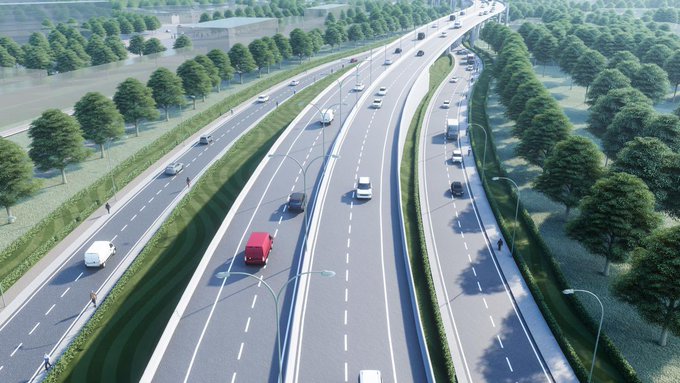
Under this transformative project, the Rironi-Naivasha section will be expanded into a dual four-lane carriageway, and the Naivasha-Gilgil section will be upgraded into a dual six-lane carriageway to accommodate heavier traffic.
The Rironi-Maai Mahiu-Naivasha highway will be transformed into a modern dual four-lane highway.
The construction of the 139km will be undertaken within two years at a cost of $863 million (KSh112 billion) by a consortium comprising the China Road and Bridge Corporation and the National Social Security Fund Board of Trustees.
The 94km Gilgil-Mau Summit road, the second section of the Western Corridor passing through the heart of Nakuru City, will be upgraded into a modern dual six-lane carriageway, ensuring smoother traffic flow and enhanced safety.
In Nakuru City, the project will incorporate a 3.34km dual four-lane viaduct to ease urban congestion as well as a 900 metres retaining wall to stabilise the road and safeguard the nearby infrastructure.
Construction of this section will be undertaken by Shandong Hi-Speed Road and Bridge International Engineering Company Ltd at a cost of $678 million (KSh88 billion), with works scheduled for completion within two years.