
By Valentine Omondi
President William Ruto has threatened to intervene in the dispute surrounding the Kenya Sugar Board, saying about Sh4 billion collected through the Sugar Development Levy remains unused because of a court battle over the constitution of the board.
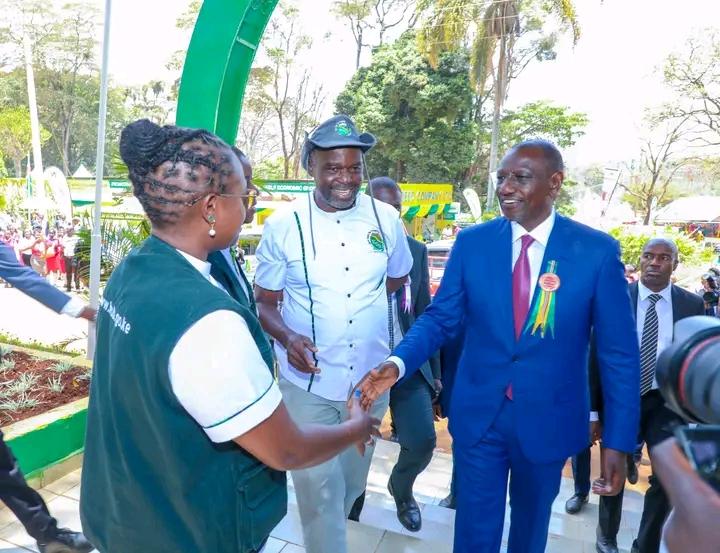
Speaking on Thursday, October 8, 2026, during the Agriculture and Food Security Presidential Town Hall at Jamhuri Park in Nairobi, Ruto accused unnamed individuals of frustrating the operations of the board and warned that he would take action to end the impasse.
“We have collected about Sh4 billion from the sugar levy to ensure we have passable roads, develop seed cane and supply seed cane to farmers and ensure there is research on better varieties of cane for development,” Ruto said.
The President said the money had not been used because people he claimed he had previously removed from the sugar sector had returned and taken their dispute with the Kenya Sugar Board to court.
“Unfortunately, we have not been able to use this money because the characters that I chased have gone to regroup again,” he said.
Ruto accused those challenging the board of holding the sugar industry hostage for what he described as selfish interests, while insisting that farmers should be allowed to elect their representatives to the board.
“Nyinyi ambao mmezungusha Kenya Sugar Board in court, I want to warn you, you cannot hold hostage a whole industry for purposes of your own selfish interests,” he said.
He later issued a more direct warning, saying: “So mnipatie tu nafasi kidogo nitafute nyundo, because hii Kenya kuna watu hawaelewi another language, wacha nitawashughulikia ndio tukuwe na board.”
How the Sh4bn Levy Came into Being
The money at the centre of the dispute comes from the Sugar Development Levy established under the Sugar Act, 2024.
President Ruto assented to the Sugar Bill on November 1, 2024, restoring the Kenya Sugar Board after its functions had previously been handled by the Sugar Directorate under the Agriculture and Food Authority.
The law was introduced as part of wider efforts to revive an industry that had struggled with high production costs, declining cane acreage, weak markets, sugar imports, poor management of millers and inadequate investment in research and cane development.
Under Section 40 of the Sugar Act, the Cabinet Secretary was authorised to impose a Sugar Development Levy of up to four per cent on the value of locally produced sugar and four per cent of the cost, insurance and freight value of imported sugar.
The levy officially took effect on July 1, 2025, with the Kenya Revenue Authority appointed as the collection agent.
The law provides that the money should support different parts of the sugar industry. Forty per cent is allocated to cane development, while other portions go towards factory rehabilitation, infrastructure in sugarcane-growing areas, research, farmer organisations and administration of the board.
In June 2025, then Agriculture Cabinet Secretary Mutahi Kagwe announced a Sh4 billion annual investment plan under the levy, saying 40 per cent would go towards cane development, 15 per cent to roads in sugarcane-growing regions, another 15 per cent to research and innovation, 15 per cent to factory rehabilitation, five per cent to farmer organisations and 10 per cent to administration.
The levy therefore sits at the centre of the Government’s plan to finance the revival of the sugar industry without relying entirely on ordinary budgetary allocations.
The Court Battles That Stalled the Board
The current impasse, however, goes beyond the money.
The Sugar Act provides for a board that includes five representatives elected by growers from the country’s sugar catchment areas, alongside representatives of millers, the Government and county governments.
The election of the grower representatives has been repeatedly disrupted by litigation.
According to Agriculture Cabinet Secretary Mutahi Kagwe’s response to the Senate on September 16, 2026, the first major challenge was filed in Kisumu on January 22, 2025.
Constitutional Petition E002 of 2025 was filed by Abraham Martin and 19 others against the Sugar Board and two other parties. The petition challenged public participation conducted between January 13 and 16, 2025, on draft procedures for electing growers’ and millers’ representatives.
After injunctions in that matter were lifted, the board proceeded with preparations for grower elections scheduled for June 25, 2026.
But about a week before the planned elections, another case was filed in Vihiga.
Kagwe told senators that, in Vihiga Petition E004 of 2026, Silverias Simiyu and others challenged matters surrounding implementation of the First Schedule of the Sugar Act. The court subsequently ordered that the status quo be maintained, effectively stopping the electoral process.
The matter was transferred between Vihiga and Kakamega courts as questions surrounding jurisdiction and interpretation of the orders emerged.
By September, the board remained without all its elected farmer representatives.
On September 14, the High Court declined to punish Kenya Sugar Board officials for contempt over the planned elections but maintained orders suspending the polls until the constitutional challenge concerning sugarcane catchment boundaries is determined.
The dispute has consequently left the board without the full representation envisaged under the 2024 law.
Kagwe told the Senate on September 16 that some members nominated or appointed through the Government and other institutions were already in place, but the remaining positions depended on the conclusion of the litigation.
He acknowledged that the board was operating inefficiently because it had not been fully constituted.
“The fact that it is running does not mean that it is doing so efficiently. It is doing so inefficiently because of the lack of the Board,” Kagwe told the Senate.
He also told senators that some decisions involving the levy could not be made because the board was not fully in place.
“There are many things, such as the use of the levies charged to the Kenya Sugar Board cannot be touched by anybody else not regulated by the Board,” Kagwe said.
What Ruto’s Warning Means for Farmers
Ruto’s intervention now puts renewed pressure on the dispute that has kept the board’s farmer representation unresolved for months.
The President maintains that farmers should be able to elect their representatives and that the levy should be deployed to address problems that have affected sugarcane production, including poor roads, inadequate seed cane and limited research.
In July, sugarcane farmers under the Kenya National Federation of Sugarcane Farmers and the Kenya Association of Sugarcane and Allied Products accused the Government and other interests of frustrating the board elections through court cases.
KNFSF Secretary General Killion Osur Anyango said:
“We came to court with an anticipation of a positive ruling that we are going to have an election because we were supposed to have an election on June 25, 2026.”
The court challenges, however, remain a legal process rather than an administrative disagreement, meaning the President’s warning does not by itself remove the orders affecting the elections.
The dispute also comes against the backdrop of wider problems in Kenya’s sugar industry, which the 2024 reforms were intended to address.
The Government has been pursuing the revival of struggling sugar mills, increased cane production and greater private-sector participation, while farmers have continued to raise concerns over delayed payments, production costs, cane development and representation in the institutions managing the sector.
For now, the central question is whether the Government and the courts can resolve the dispute quickly enough to allow the Kenya Sugar Board to become fully operational and unlock the levy funds intended to support the industry.
Ruto’s message on Thursday was clear: he wants the stalemate brought to an end.