
By Anderson Ojwang
Prof Peter Anyang’ Nyong’o is known as a man of the fast. An alumnus of the prestigious Alliance High School and was awarded a first-class degree from Makerere University in Political Science.
A respected global scholar and the founding secretary of ODM, the driver of Kenya’s Vision 2030. Wuod Mary has drawn both local and international accolades.
The 2017 ODM championed him as the saviour of Kisumu County and birthed the dream of Kisumu city as Europe.
In him, ODM leadership were convinced Kisumu County would be another Singapore, after the failed Canaan pursuit.
Singapore became the next destination for Kisumu, and the dream lives on.
Pollstar InfoTrak, in its latest CountyTrak Performance Index, Kisumu County and the Governor received strong public approval ratings. Governor Nyong’o tied in 6th place nationally among the best-performing governors with a 65 percent approval rating, while Kisumu ranked high among the regions where the residents feel the current administration has significantly improved conditions.
But wait a minute
Was the polling scientific or manufactured to create a conversation?
Take a look at what the Senate has brought forward. How do we trust? Do we trust InfoTrak or the Senate?
Recently, the senators asked Nyong’o if he wanted to pass over Sh5.9 billion in pending bills to the new administration.
Public Accounts Committee Chairman Moses Kajwang’ asked Nyong’o whether he was planning to hand over Sh5.9 billion debt to the next administration.
“Are you planning to hand over Sh5.9 billion debt to the next administration? What is the plan, because these responses, whatever is on paper, is just accounting speak. You close that year with Sh5.9 billion as debt. Whether it is legal fees or whether it is one year old or ten years old, but after 10 years of being in office, would you be handing over Sh5.9 billion as unpaid debt to the next administration?” he asked.
Kajwang’ said there was serious concern over Sh5.9 billion of unpaid pending bills, while the revenue for the year was Sh9 billion, which exceeded the debt-to-revenue ratio capped at 20 percent but was at a high of over 60 percent.
“Do you have a payment plan, and have you submitted it to the Controller of Budget, and to what extent has this debt been reduced?” he said.
The committee interrogated Governor Prof. Anyang’ Nyong’o and county officials over what it described as a 108 per cent increase in pending bills within a single financial year.
And yesterday, the Senate rewarded him with a certificate – a certificate of the worst performer with a grade D in the County Fiscal Performance Measurement Index (CFPMI).
The grade D category
In this category, Kisumu County for the second year running maintained the last bottom place.
A total of 10 counties fall under the “D” performance category, with overall CFPMI scores below 0.400. These counties included Kajiado (0.367), Kisii (0.392), Kisumu (0.340), Laikipia (0.377), Machakos (0.364), Mombasa (0.357), Nyamira (0.364), Nyandarua (0.374), and Nairobi City (0.324).
Weaknesses
Across these counties, common weaknesses were evident in several CFPMI sub-indicators.
Many recorded low scores in development expenditure, falling short of the 30% minimum threshold, undermining the alignment of spending with long-term growth priorities.
Wage and benefits ratios in a number of counties also approached or exceeded the 35 percent ceiling, indicating fiscal pressures from personnel costs.
Additionally, weak audit opinion scores, high pending bills, and low own-source revenue mobilisation further contributed to depressed overall CFPMI scores.
Counties like Kisumu and Nairobi City posted some of the lowest CFPMI scores of 0.340 and 0.324 respectively, pointing to systemic weaknesses in budget execution, transparency, and institutional performance.
These results suggest a critical need for improved financial planning, strengthened fiscal discipline, and enhanced accountability systems across the board.
Intervention
There is need for urgent and comprehensive interventions to reverse the underperformance and restore effective service delivery.
In 2024/25, as presented, nine counties fell within the “D” performance category, down from 10 in 2023/24, indicating a marginal contraction in the lowest-performing group.
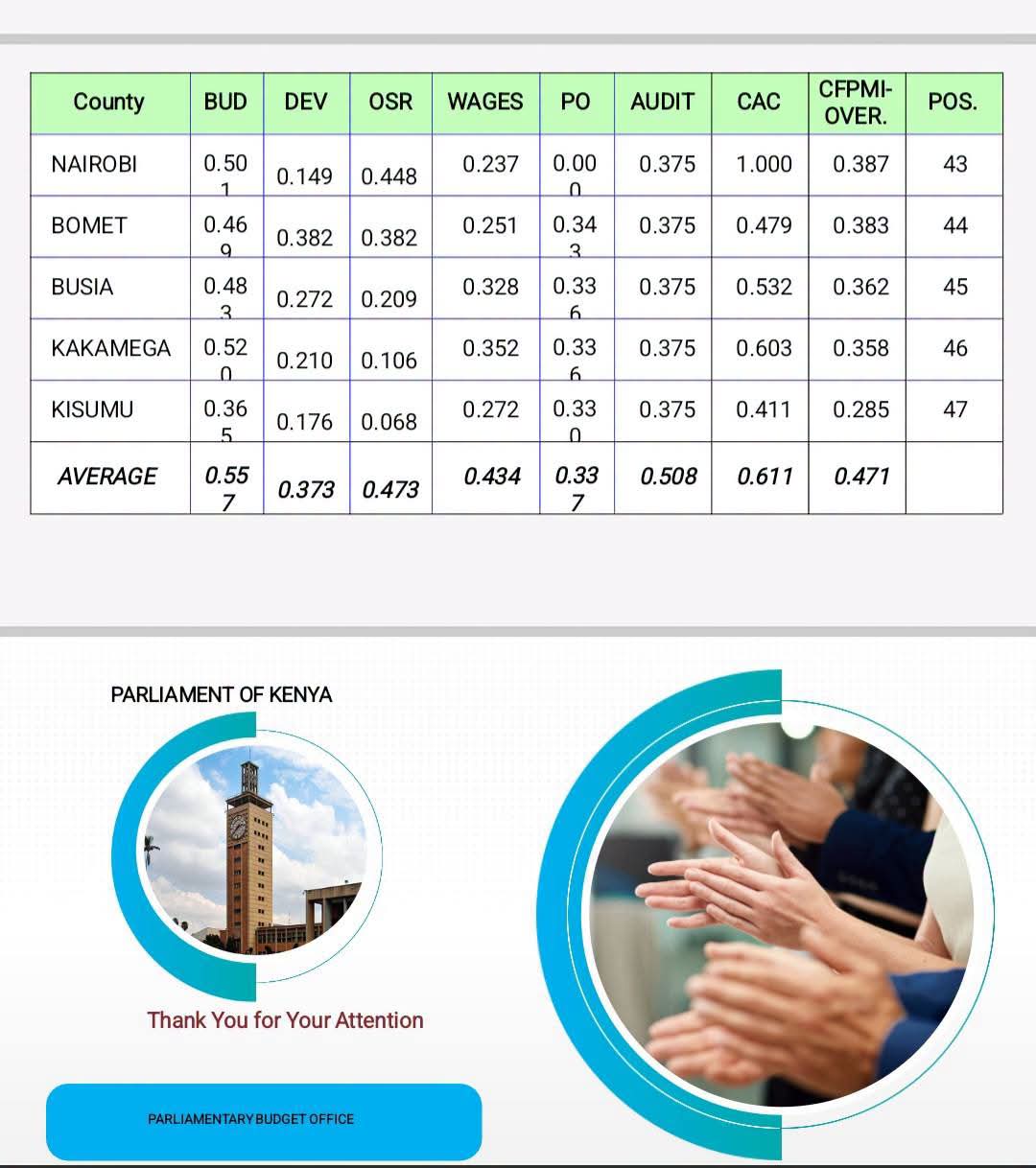
The 2024/25 “D” counties all recorded overall CFPMI scores below 0.400: Bungoma (0.398), Kajiado (0.392), Lamu and Baringo (0.390), Nairobi City (0.387), Bomet (0.383), Busia (0.362), Kakamega (0.358), and Kisumu (0.285).
This reflects persistent fiscal and structural weaknesses similar to those observed in the previous FY.
Exit D category
Compared to 2023/24, the “D” category composition shifted notably.
Mombasa, Nyamira, Nyandarua, and Kisii improved sufficiently to exit the “D” band, while Kakamega and Taita Taveta entered the category in 2024/25 due to weaker fiscal performance, particularly budget execution, Own Source Revenue mobilisation, and development expenditure.
While Kakamega (0.399) and Laikipia (0.398) came close to the “C” threshold, most counties continued to underperform in development expenditure, OSR, and audit compliance.
Laikipia showed marginal improvement compared to its 2023/24 score, reflecting modest gains.
Conversely, Kajiado (0.331) and Machakos (0.371) recorded further declines relative to 2023/24, indicating deepening inefficiencies in budget execution, revenue mobilisation, and wage management.
Bottomers
Kisumu (0.321) and Nairobi City (0.346) remained in the lower tier for the second consecutive FY, underscoring entrenched fiscal stress linked to low development expenditure, high wage burdens, and pending obligations, highlighting persistent challenges in financial control and arrears management.
Overall, the 2024/25 “D” performance results show slight consolidation within the lower tier, as the number of counties declined but systemic weaknesses persisted.
The group continues to face structural PFM constraints, notably underinvestment in development, rising personnel costs, low OSR performance, and accumulated pending obligations. Sustained and targeted reforms in fiscal discipline, revenue enhancement, and expenditure control are essential to prevent further deterioration and enable gradual transition toward mid-tier fiscal performance.