
By James Okoth
The long-awaited extension of the Standard Gauge Railway (SGR) from Naivasha to Kisumu and onward to Malaba has entered the construction phase in Kisumu County.
The move follows President William Ruto’s groundbreaking in March 2026 for the multi-billion-shilling project extending the modern railway network from Naivasha through Kisumu to the Kenya-Uganda border at Malaba.
The Naivasha–Kisumu–Malaba SGR is estimated to cost about Sh700 billion and will cover 371 kilometres. It includes a 264-kilometre Naivasha–Kisumu section (Phase 2B), a 107-kilometre Kisumu–Malaba section (Phase 2C), and an 8.69-kilometre branch line to the New Kisumu Port.
The corridor passes through Narok, Bomet, Kericho, Nyamira, Kisumu, Siaya, Vihiga, Kakamega and Busia counties before linking with Uganda’s planned SGR network at Malaba.
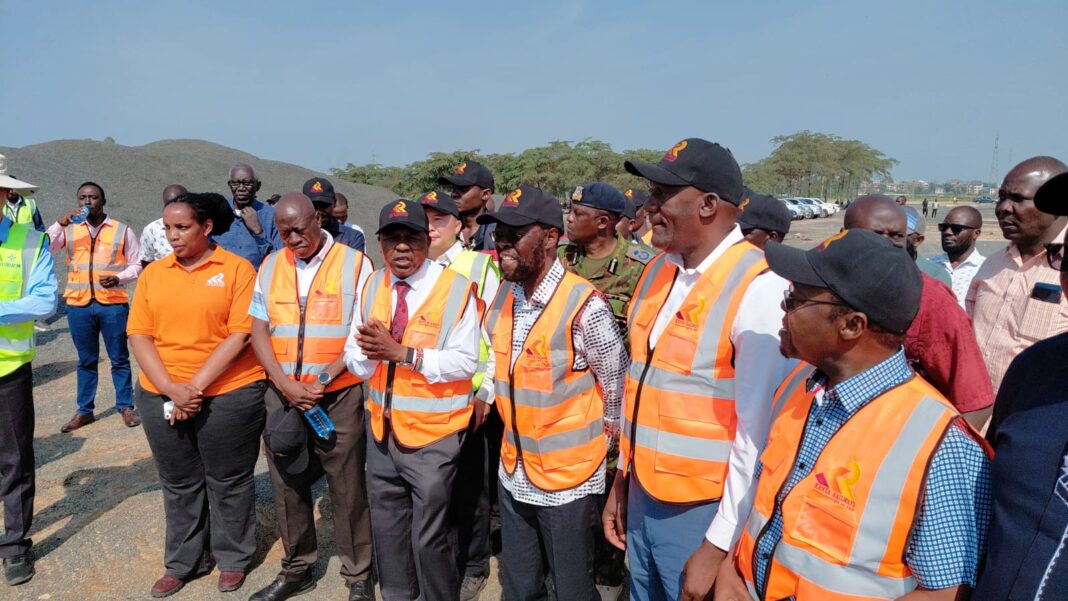
In Kisumu, leaders and residents witnessed construction begin at the Kibos section, where heavy machinery moved in to start earthworks for a future SGR station and cargo hub.
Speaking at the event, Kisumu County Commissioner Mohamed Mwabudzo reaffirmed the National Government’s commitment to completing the project within the planned two-year period.
He said the government would work closely with the County Government of Kisumu and other agencies to ensure smooth implementation.
Mwabudzo also warned against vandalism and sabotage.
“We shall not tolerate vandalism of railway infrastructure, theft of construction materials or any acts of sabotage. Security agencies are fully prepared to safeguard this national project from beginning to completion,” he said.
Kisumu Governor Prof. Peter Anyang’ Nyong’o welcomed the project, calling it a historic investment that will boost the county’s economy and strengthen Kisumu’s role as a logistics gateway.
He urged residents to take advantage of the jobs expected during construction.
The Governor also thanked the National Government for fast-tracking the project after years of delay.
Addressing landowners along the corridor, Prof. Nyong’o asked for cooperation with the National Land Commission once compensation is completed.
“Those whose land has been acquired should vacate promptly after receiving their rightful compensation. This project is for the benefit of future generations and requires our collective support,” he said.
Kenya Railways Managing Director Philip Mainga said the project would create thousands of direct and indirect jobs.
He encouraged local youth to prepare for skilled and unskilled work, while urging women and small traders to set up food kiosks and other support businesses for workers on site.
Mainga said the railway would transform Kisumu into a leading logistics and industrial city.
He added that more than 700 hectares of underused land along the corridor will be opened for commercial, industrial and logistics development after completion.
The Kibos terminus is expected to become a major freight and passenger station, with a cargo facility that will boost trade around Kibos Market and improve movement of goods to and from the Port of Kisumu.
Residents gathered in large numbers at Kibos to witness the start of construction. Business owners, transport operators, farmers and youth groups called the project a long-awaited boost for jobs, trade and Kisumu’s regional role.
Many said the railway will lower transport costs, attract industries and open new business opportunities around the station and cargo terminal.
Local traders said they expect more business from the workers arriving during construction, while youth welcomed Kenya Railways’ assurance that locals will be considered for jobs.
Some of the residents who spoke to the media welcomed the project:
“We have waited for this railway for many years. Today we are happy because we can finally see construction beginning. We hope our young people will secure jobs and our businesses will flourish.” – Local resident.
“The cost of transporting goods has been affecting traders for a long time. This railway will make business easier and attract more investors to Kisumu.” – Trader at Kibos Market.
“We thank the National Government and the County Government for making this project a reality. Our appeal is that local people should be given priority when employment opportunities arise.” – Youth leader.
“Kibos is set to become a busy commercial centre. We are already seeing hope that more businesses, better infrastructure and more customers will come to this area.” – Local business owner.
Once completed, the Naivasha–Kisumu–Malaba SGR is expected to cut freight costs, ease congestion on the Northern Corridor, improve passenger travel, and strengthen trade between Kenya, Uganda and the wider East African Community.
The project will also position Kisumu as a multimodal transport hub linking road, rail and lake transport, with future connections expected to extend into Uganda, Rwanda, South Sudan and the Democratic Republic of Congo.
As excavators roared into action at Kibos, leaders and residents described the day as the start of a new economic era for Kisumu and Western Kenya.