
By Valentine Omondi
The irony was difficult to miss on Sunday.
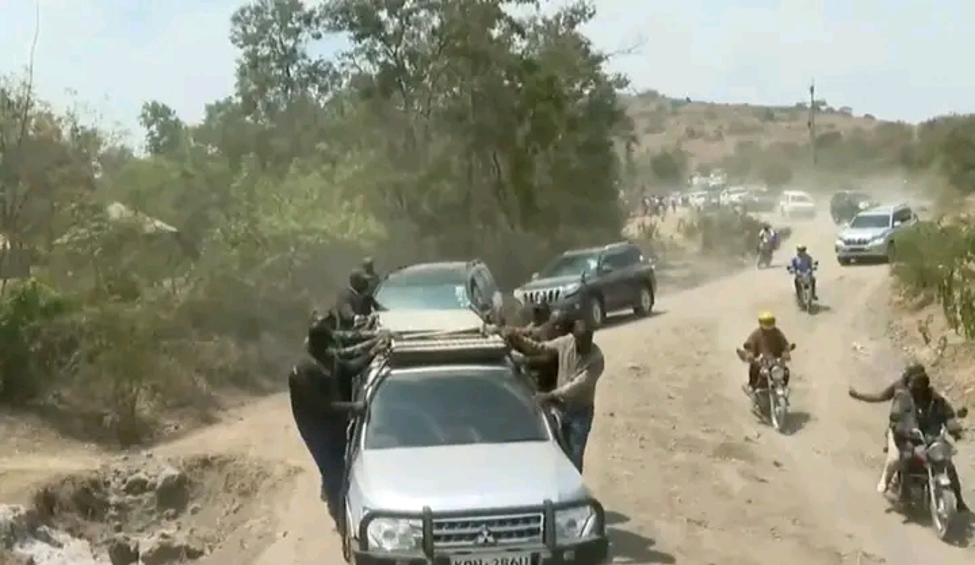
As the Linda Mwananchi convoy entered Homa Bay for a major political mobilisation, it was not the shiny development projects often highlighted by leaders that became the defining image of the day.
It was dust.
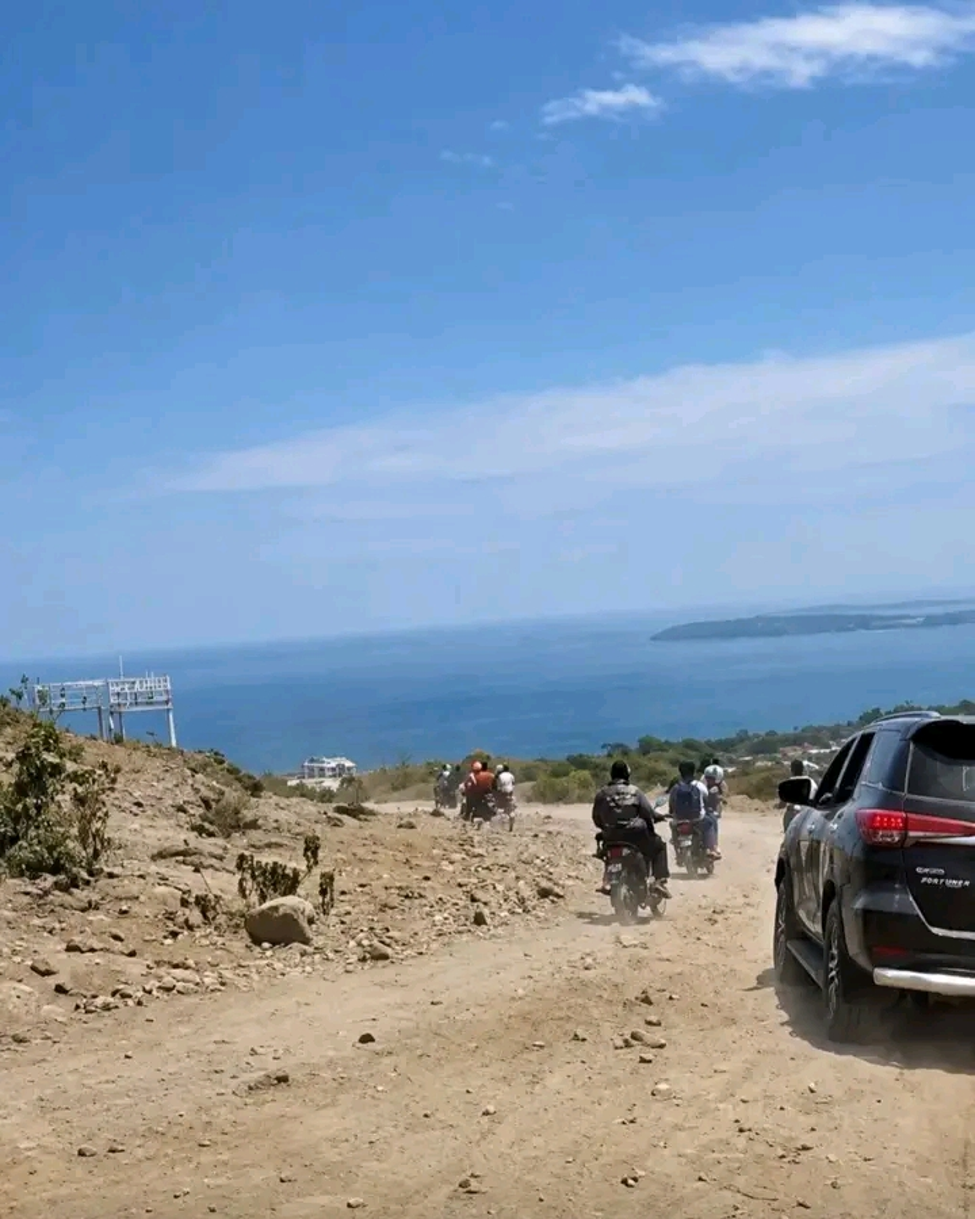
With several major roads blocked by stones, logs, burning tyres, and other barricades, the convoy was forced to abandon some of its planned routes and navigate alternative roads across the county. The detours exposed rough and dusty roads, producing images that quickly spread across social media and reignited a much bigger question about Homa Bay’s development record.
For Nairobi Senator Edwin Sifuna, the dusty journey offered an opportunity to mock what he described as the county’s “shiny” development narrative.
After travelling through the alternative routes, Sifuna posted a photograph of himself covered in dust and wrote on X:
“They said Homa Bay is where the shiny things are, but it turns out it is all conmanship. The dust is constant.”
He later took the criticism further, saying the convoy had been told that being part of the broad-based government meant Homa Bay had undergone widespread transformation.
“They told us that here in Homa Bay, because you are in the broad-based government, all the roads have been tarmacked. We have eaten dust today; we have eaten plenty of dust,” Sifuna said.
His remarks turned what had initially been a logistical problem caused by road blockades into a political attack on the development credentials of the ODM and Kenya Kwanza partnership.
The contradiction in Wanga’s own praise
The criticism is particularly uncomfortable for Governor Gladys Wanga because she has herself been one of the strongest voices praising the development partnership between Homa Bay County and President William Ruto’s administration.
In August 2025, Wanga openly credited the Kenya Kwanza government with transforming the county, telling Ruto during the Devolution Conference in Homa Bay that three quarters of the development visible in the county had not existed when he first visited in January 2023.
“I want to thank you for your partnership in transforming Homa Bay to make it worthy of hosting this conference. When you last visited Homa Bay in January 2023, three quarters of the development seen here was not there,” Wanga said.
She went on to emphasise that she had been an opposition governor at the time and that there was no broad-based government or partnership between the county and the national government.
“But you had no intention of leaving us behind simply because of how we voted in the election in which you were voted as the President,” she told Ruto.
Wanga has also previously said that Homa Bay had never seen a president do what Ruto had done for the county, presenting his administration’s frequent visits and development projects as evidence that the region was finally receiving national government attention.
Among the projects she has highlighted are the dual carriageway in Homa Bay Town, the Lake Victoria pier, and other infrastructure investments.
It is against that backdrop that Sunday’s dusty roads have become politically significant.
If three quarters of the development seen in Homa Bay was absent before Ruto’s administration, as Wanga herself said, the condition of roads encountered by the Linda Mwananchi convoy provides an uncomfortable visual counterpoint to that success story.
But Wanga has rejected the suggestion that the images prove Homa Bay has been abandoned.
Wanga: “They do not understand our pain”
Responding to the criticism at Wikondiek SDA Church in Karachuonyo, Wanga accused those mocking Homa Bay’s roads of failing to understand the county’s historical experience of marginalisation.
“They are laughing at us saying Homa Bay looks like Yemen because of bad roads. They don’t understand our pain because all these years we have been voting but no development has come to this region because we decided to fight for the country, to bring a new Constitution, devolution, and human rights,” Wanga said.
She argued that the county’s infrastructure challenges should be understood in the context of years of political and economic marginalisation rather than being used to dismiss the development taking place under the current administration.
More importantly, Wanga pointed to the very political arrangement Sifuna was attacking as the vehicle through which the roads would eventually be improved.
“But because we’re in the broad-based government, that road they are talking about is under the Lake Victoria Ring Road and will be tarmac,” she said.
The governor has also cited her administration’s own road programme, reporting that Homa Bay had opened 736 kilometres of new roads, maintained 538 kilometres, and rehabilitated 116 kilometres of access roads.
The national government, meanwhile, has major road projects either completed, ongoing, or planned in the county, including the Rusinga Island Ring Road and sections of the wider Lake Victoria Ring Road.
Millie: “Let us stop cheating people”
But Suba North MP Millie Odhiambo has rejected attempts to explain away the roads used by the convoy as insignificant feeder roads.
Her intervention was particularly pointed because she represents an area where residents continue to depend heavily on roads that remain in poor condition.
“Most of our roads are bad in Suba South and North. Let us stop cheating people by saying those are feeder roads and that the main roads were barricaded,” Odhiambo said.
She argued that many of the roads seen during the convoy’s detours are actually important routes.
“What you see, other than Homa Bay to Mbita and Rusinga Ring Road, are the main roads,” she said.
Odhiambo acknowledged infrastructure delivered by previous administrations, noting that former President Mwai Kibaki and retired Prime Minister Raila Odinga oversaw the tarmacking of the Homa Bay Town to Mbita road, while former President Uhuru Kenyatta built the Mbita Bridge.
She also acknowledged projects delivered under Ruto.
“President Ruto has tarmacked the Rusinga Ring Road. He has opened the Mfangano Ring Road and tarmacking is commencing,” she said.
But she warned that describing poor roads as feeder roads could allow the government to ignore communities that still need better infrastructure.
“We have been marginalised for years. Sugar-coating it by calling the bad roads feeder roads will stop the government from prioritising these roads,” Odhiambo said.
She also lamented the international ridicule generated by the images, saying the situation had reached a point where Homa Bay residents needed accelerated development rather than excuses.
“The world has made enough mockery of us today, calling us Afghanistan and all. It is time this ended,” she said.
When politics exposes the roads
The circumstances surrounding Sunday’s road drama matter.
The poor roads were not initially the reason the convoy ended up using them. Several routes had been blocked as political tensions escalated, with stones, logs, bonfires, and burning tyres reported at different points. Police were deployed, and the convoy had to find alternative ways to reach its destinations.
But once the convoy entered those alternative routes, Homa Bay’s infrastructure became impossible to ignore.
The dust that settled on Sifuna’s clothes became a political symbol.
To Sifuna and the Linda Mwananchi camp, it demonstrated the gap between what residents have been told about the benefits of the broad-based government and what some communities continue to experience.
To Wanga, it is evidence of a historical infrastructure deficit that is now being addressed through the same broad-based partnership she has repeatedly praised.
And to Millie, it is a reminder that residents should not be asked to celebrate development on paper while travelling on roads that remain impassable or dusty.
There is, in fact, evidence of significant road investment in Homa Bay. National government investments between 2023 and 2026 have been estimated at about KSh27.9 billion, covering roughly 515 kilometres, with several major projects either under construction or completed.
The dispute, therefore, is not whether Homa Bay has received development.
It is how much of that development has reached the roads used by ordinary residents, how quickly unfinished projects will be completed, and whether the political promises match the reality on the ground.
On Sunday, the Linda Mwananchi convoy did not set out to conduct an audit of Homa Bay’s roads.
But after the barricades forced it onto alternative routes, the roads conducted one themselves.
And for a county whose governor has said three quarters of its visible development emerged during the Ruto era, the dust left behind a question that political speeches alone cannot answer.
Has Homa Bay truly been transformed, or are some of its roads still waiting for the transformation to arrive?