
By Reporter
A livestock bill seeks to establish a comprehensive legal framework for the development, regulation and modernisation of the sector.
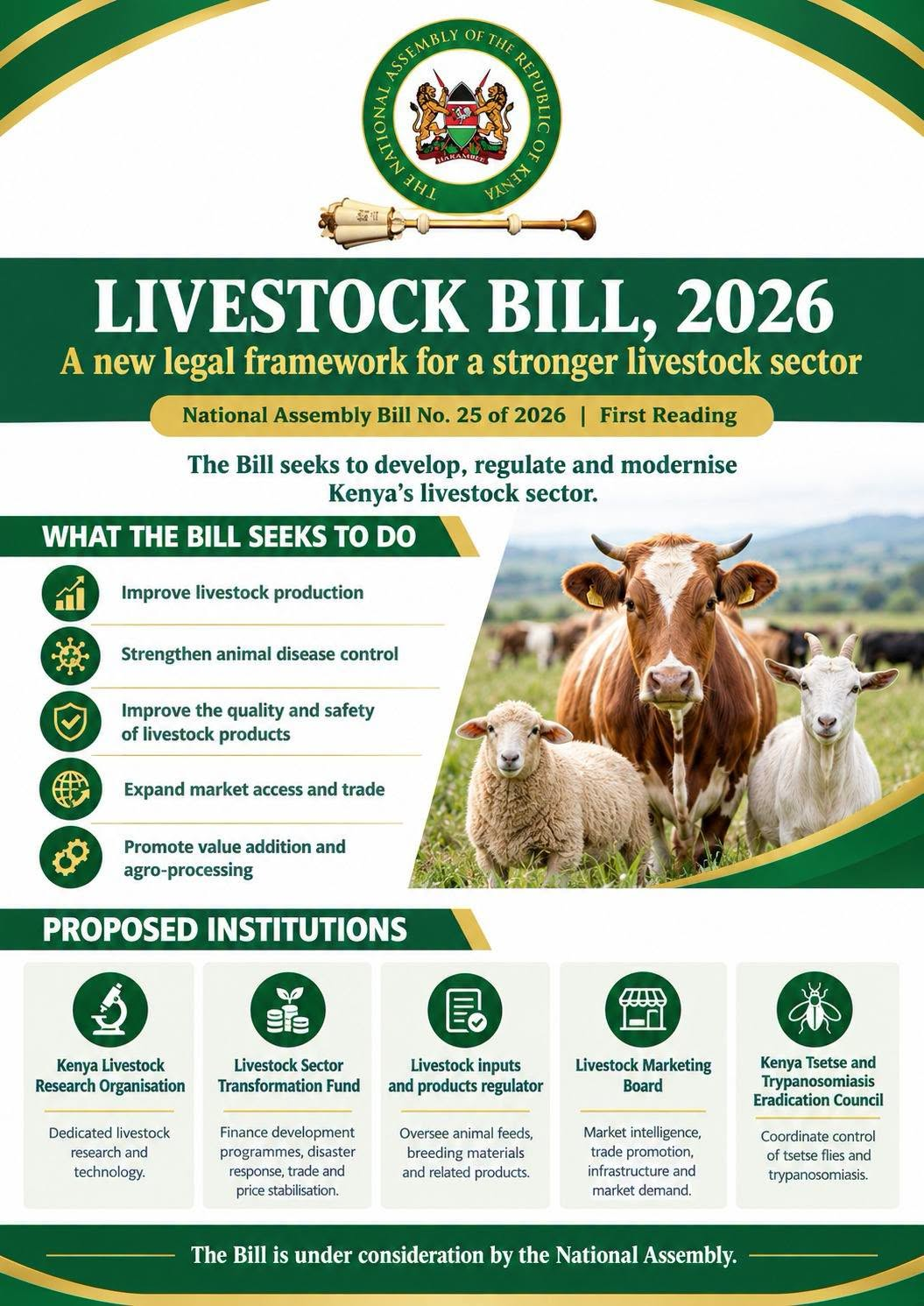
The proposed reforms aim to boost livestock production, strengthen animal disease control, improve the quality of livestock products, expand market access and promote value addition.
This will set the livestock sector on the path to major transformation after the Livestock Bill (National Assembly Bill No. 25 of 2026), sponsored by the Leader of the Majority Party, Kimani Ichung’wah, underwent its First Reading in the National Assembly.
It also seeks to establish specialised institutions to coordinate livestock research, regulate industry inputs, promote marketing and support the development of related industries, including leather processing and manufacturing.
Among the proposed institutions is the Kenya Livestock Research Organization, which would provide dedicated research and technological development for the livestock sector, separating livestock research from the broader mandate of the Kenya Agricultural and Livestock Research Organization (KALRO).
The Bill further proposes the establishment of the Livestock Sector Transformation Fund to finance livestock development programmes, support disaster response, stabilise prices of livestock products, facilitate trade and promote agro-processing.
To strengthen regulation, the proposed law provides for the establishment of a regulatory authority responsible for overseeing livestock inputs and products, including animal feeds and breeding materials. The authority would regulate their manufacture, importation, exportation, distribution and sale.
On market development, the Bill proposes a livestock marketing board mandated to provide market intelligence, promote domestic and international trade, improve market infrastructure, identify market demand and support price stabilisation.
The proposed legislation also seeks to strengthen animal health services through specialised institutions, including the Kenya Tsetse and Trypanosomiasis Eradication Council, which would coordinate efforts to control and eradicate tsetse flies and trypanosomiasis, a disease that affects livestock and other animals.
It also provides for the establishment of the Kenya Animal Genetic Resources Centre to conserve indigenous and other animal genetic resources, manage a gene bank and support breeding programmes. In addition, the Kenya School of Animal Resources and Industry would provide governance and academic oversight for training institutions in animal resources and related fields.
To unlock the economic potential of animal products, the Bill proposes the Kenya Leather Development Authority to promote leather processing, manufacturing, investment, technology adoption and marketing, while supporting the development of leather industrial parks and small businesses.
The Bill also introduces a framework to support the commercialisation of beekeeping.