By James Okoth
Photo || Courtesy
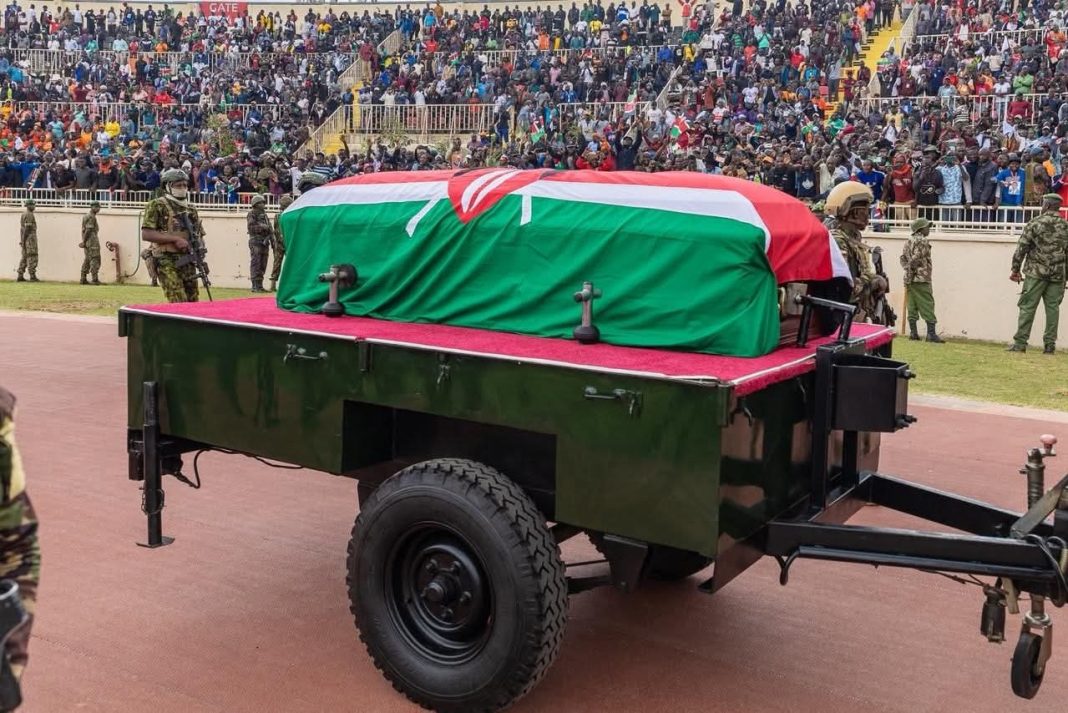
As thousands filled Nyayo Stadium, the ritual was more than ceremonial. It was a convocation of memory, of grief, and of moral summons. The speakers did more than eulogise; they endeavoured to show what Raila Odinga was — and, by implication, what Kenya still must become.
The Anglican Bishop of Bondo, Rt Rev Prof David Kodia, delivered what many described as a fiery, almost prophetic sermon — part eulogy, part admonition. In one of the more charged passages, he warned:
“If there’s anyone here, at whatever level — be it governor, MCA — who has looted this country, you know you stand the chance to be condemned.”
He contrasted Raila’s style of leadership with the pervasive culture of “handouts” and patronage:
“Baba never used the power of money to intimidate people or lure followers. He used the power of persuasion, the power of the word.”
And he closed with a testing challenge, turning grief into accountability:
“How many can fit in the shoes of Raila Odinga today? How many?”
Kodia also gave a deeply personal frame to the celebration:
“Hardly a month ago, I had breakfast with Baba … I saw a man who was ready to meet God at any time — a humble servant …”
In that moment, the pulpit was not a podium of flattery, but a judge’s bench: a demand that Kenya match its grief with integrity — that leadership not become default for the corrupt.
President Ruto stood as living proof that polity and rivalry do not preclude respect. In his address, he offered a nuanced tribute. Among his lines:
“In his passing, we have lost a patriot of uncommon courage, a pan-Africanist, a unifier who sought peace and unity above power and self-gain.”
He underscored Odinga’s role in shaping Kenya’s legislative and constitutional journey:
“He used his time as legislator to play pivotal roles in shaping some of the most consequential laws in our Republic’s history.”
The power of his speech lay in that tension — a sitting president, once a political adversary, invoking Odinga’s legacy in national, not partisan, language.
It is among the mourners that the abstract becomes real, where the man and his myth collided.
A young supporter, Ephuntus Gikonyo (24), spoke to Western Insight:
“Raila Odinga, the father of democracy in Kenya, was a selfless leader who would risk everything — even his life — to make Kenya work.”
Another mourner, Beatrice Adala, at the stadium when the body arrived, captured the raw emotional substrate:
“We are in mourning as a country. We loved Baba so much — he was the defender of the people.”
These voices matter; they testify not to flawless perfection but to a lived dependence. The grief was not just for a political icon, but for a guardian in the crowd’s imagination.
Editorial Reflection: Where Words Met Legacy
In the silence after each speaker, one could sense that Raila’s life was not being commemorated in relief, but in confrontation. The pulpit, the podium, the pen — all were pressed into the service of a challenge.
Kodia’s sermon cut through nostalgia; it declared that the struggle was unfinished — that looters and sycophants still roamed. His was not a soft farewell but a call to moral arms.
Ruto’s tribute sought to place Odinga above politics — to say that his life belonged to Kenya, not to camps. In that way, Ruto did what great statesmen sometimes must: praise the adversary to elevate himself by association.
The mourners bridged the macro and the intimate. Their words grounded the spectacle. They showed that Odinga’s power was never just institutional, but emotional and relational.
In weaving these voices into the tapestry of that day, what emerges is not simply a man of contradictions (and he had many), but a man of coherence in aspiration — one who demanded that Kenya be better than its worst impulses.