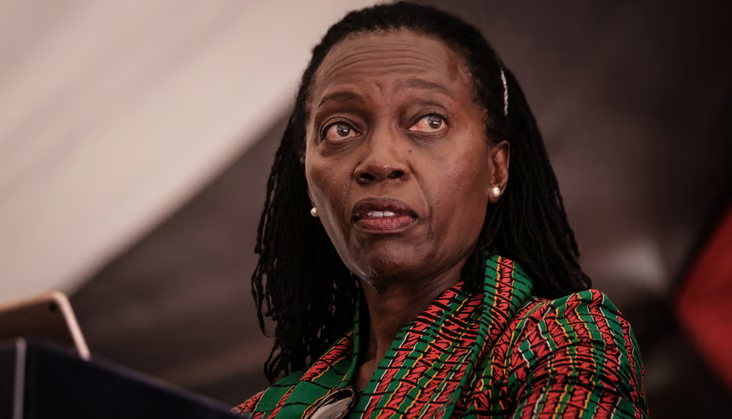
By Clifford Derrick
Episode 1: The Grand Deception: Unveiling the 2007 Betrayal and the Hypocrisy of Martha Karua
The chilling memory of December 30, 2007, remains etched in Kenya’s collective consciousness—a night when the nation witnessed a clandestine swearing-in, a crime scene masquerading as a constitutional rite. The air was thick with the dust of stolen democracy, and the echoes of a fractured nation reverberated through every corner. At the heart of this unfolding tragedy, Martha Karua stood unwavering. As the then Minister for Justice and Constitutional Affairs, your voice was loud and clear, defending the “under the darkness coronation” of Mwai Kibaki as constitutional. Calls for dialogue, for a moment of national reckoning, were summarily dismissed as “dangerous insubordination.” The message was unequivocal: obedience, not reconciliation, was the order of the day.
Fast forward to 2025, and the political landscape presents a stark, almost absurd, contrast. Today, you position yourself as a moral compass, the guardian of democratic ideals, and vociferously condemn Raila Odinga for engaging in dialogue with the very government you deem illegitimate. You scold him, label his actions a “betrayal. “
Perhaps it is you who needs Plato’s counsel—“You don’t change the system by becoming its enemy. You change it by refusing to let it define what’s real for you.”
Unlike you, Raila has internalised this Socratic wisdom. He has returned again and again to the battlefield of politics, guided by a moral compass you never seemed to acquire. You weaponise indignation now not in defence of truth, but as theatre to obscure your history.
You align yourself with a fresh wave of youthful outrage. What changed, Wakili? It wasn’t the constitution, nor the fundamental needs of the Kenyan people. It was, rather, the theatre of power—the shifting roles on a stage where convenience is dressed as principle. Your script, Martha, appears to be one of deep, convenient amnesia.
The Architect of Betrayal: Karua’s Role in 2007 Post-Election Violence
Your role, Martha, was not merely that of an observer. As the then Minister for Justice and Constitutional Affairs, and a prominent figure in Kibaki’s re-election team, you actively helped legitimise the theft of that election. Your unwavering defence of the results and your public dismissal of any evidence to the contrary did more than just sanitise a fraudulent victory; it helped to normalise the violence that tragically followed. International concerns were scoffed at, and overwhelming evidence of electoral manipulation was rubbished. The consequence of this stance was devastating: over 1,400 lives were lost, and more than 650,000 Kenyans were displaced in the ensuing post-election chaos.
A critical moment came when the US Secretary of State Condoleezza Rice reportedly told Kibaki directly that he had lost the election. Your own memoir, if accounts are true, reveals not a shred of indignation at the massacre of your compatriots, but rather a focus on Rice’s “tone.” This chilling detail lays bare a disturbing disconnect: your concern was for the perceived slight to power, not for the unfolding human catastrophe.
This aligns chillingly with Frantz Fanon’s warnings about the post-colonial bourgeoisie. Fanon cautioned that such an elite often mimics their former colonisers, seeking to “inherit, not transform,” the systems of oppression. They weaponise liberation rhetoric while meticulously preserving the old structures of control. In this context, Martha, you became precisely that – a figure who, by defending an indefensible act, helped perpetuate a cycle of injustice and violence that has plagued Kenya for generations. You were instrumental in laying the groundwork for a system where truth is negotiable and power is paramount, even at the cost of human lives.
The Convenience of Amnesia: Karua’s Shifting Stance on Dialogue
Dialogue, Martha, is not a concept alien to Kenya’s democratic journey. In fact, it has been the very midwife of our most significant constitutional and political breakthroughs. It was dialogue that produced the minimum reforms of 1997, creating space for multi-party democracy. It was dialogue that birthed the visionary Bomas Draft constitution, which laid the foundation for the transformative 2010 Constitution. And it was dialogue, specifically the Kofi Annan-brokered talks in 2008, that pulled Kenya back from the brink of civil war, a conflict ignited by the very electoral theft you so vigorously defended.
Yet, you fiercely opposed that Annan-brokered dialogue. The irony, then, is palpable: the democratic gains you now frequently cite to justify your disdain for talking to President Ruto were delivered by the very method you condemn. You only showed up to defend your power, never the people. This stands in stark contrast to Raila Odinga’s consistent willingness to enter hostile rooms for the sake of the Republic, repeatedly choosing peace and national cohesion over personal ambition.
Today, you scorn any notion of dialogue with a government you deem “illegitimate,” chastising Raila for daring to engage with William Ruto, labelling it a “betrayal.” But your current position rings hollow, for you, Martha, were once the very face of Kenya’s greatest democratic betrayal. This is not about principle; this is about a tribal desire to never relinquish the monopoly on state power, a convenience dressed in the garb of consistency.
A question for reflection:
Given that Kenya’s current fight for accountability centers on curbing the executive’s unchecked power—a power that fuels impunity and could be addressed through dialogue leading to a parliamentary system—what does it reveal about the principles of leaders like Martha Karua, who vehemently opposed dialogue to resolve past electoral injustices, yet now condemn calls for dialogue that aim to strip the presidency of the very powers they hope to wield?
Coming Up in Episode 2: The Echoes of Impunity
In the next episode, we delve into the shadowy history of state-sanctioned violence, political assassinations, and the pervasive culture of impunity that has haunted Kenya. We’ll examine the chilling 1969 secret oath, the infamous Artur Brothers scandal, and the tragic events of 2017, questioning the strategic silences of those in power.
(Clifford Derrick is an investigative journalist, strategic communicator, and documentary filmmaker whose work examines truth, power, history, and justice. He writes at the intersection of politics, culture, decolonisation, and human rights.)