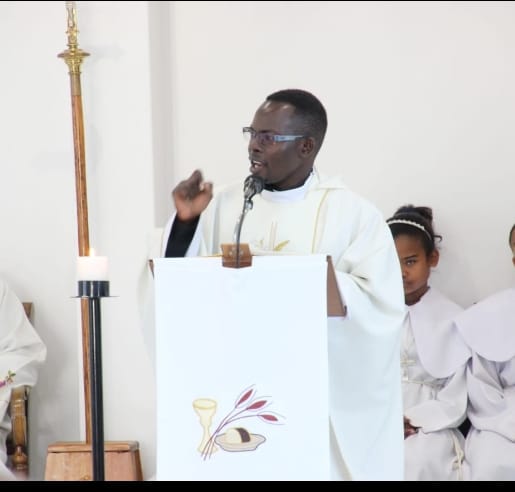
By Rev. Fr. Charles Orero IMC
Our religious congregation is known as the Consolata Missionaries. We were founded in Italy by Saint Joseph Allamano in the year 1901.
Our religious congregation is spread in Africa, Asia, Latin America, and Europe. We are named after Our Mother Mary Consolata.
It is from here that we get our name, Consolata Missionaries. The title “Consolata” is dear to us because it determines our choices and style of work.
It is our pride, our identity, our umbrella, and banner. In fact, we all do everything possible to keep the dignity of this title “Consolata.” It is for this reason that our Founder, Saint Joseph Allamano, insisted that we should have holy pride over the fact that our religious congregation has the title “Consolata.”
The same should apply to the name “Kenya.” This name “Kenya” should be the pride of every citizen, it should be the identity of every citizen, it should determine the mode of operation of every citizen, and it should be the banner under which every citizen operates.
Therefore, borrowing the words of Saint Joseph Allamano, every Kenyan citizen should be proud of the name of our country. Before saying or doing anything, each one ought to find out how his or her words and actions will affect the title “Kenya.” Just like the Consolata Missionaries, every Kenyan should do everything humanly possible to safeguard the dignity of the title of our country, Kenya.
Our style of life as a religious congregation has a lot to contribute towards the unity of Kenya. To begin with, we study our history with great interest, and we remember our founder, Saint Joseph Allamano, and our fellow missionaries who have gone to be with the Lord.
Through this study, we learn how our religious congregation came to be, the struggles and challenges that Saint Joseph Allamano went through in bringing the congregation into existence, and we also learn more about the lifestyle, virtues, and achievements of our deceased missionaries.
All these help us to cherish our congregation, to appreciate the efforts of our Founder, and to imitate the good life lived by our brothers who preceded us.
This is what every Kenyan is called to do. As a nation, Kenya has a very beautiful history, a history of struggle for independence, a history of self-giving as seen in the lives of our brothers and sisters who gave their lives to ensure that independence was achieved. In addition, Kenya has a good history of the life of our founding fathers and mothers, who, like Saint Joseph Allamano, went through many challenges to bring about the independence and the stability of Kenya.
Such history should occupy a special place in the heart of every Kenyan, and it should be taught in schools so that the next generation might know them—even the children not yet born, and they in turn will teach their own children (Psalm 78:6–8). The awareness of this beautiful history will enable every Kenyan to value and appreciate the struggle for independence, and no one will think of dragging the nation back to dark ages. In addition, through this, every Kenyan will learn the style, the struggle, the self-giving, and the dream of our founding fathers and mothers.
It is from this that each Kenyan will avoid any behavior or utterances that might kill the dream of our founding fathers and mothers. In line with this, it should be the effort of every Kenyan, particularly those charged with matters of education, to give special attention to collecting, preserving, and distributing the memoirs of our founding fathers and mothers so that their memory may remain alive in every Kenyan. In fact, they are our heroes.
Our religious congregation is international and includes members from different countries and continents.
Despite this, we live as one family gathered together in the Lord’s name.
We consider each other brothers, and we live and work together, bringing in the richness of our cultural diversities. We show concern for each other, and we are united in mind and soul.
It is this fraternal unity that is the life and soul of our religious family.
Kenya, as a country, should learn from this. If we, Consolata Missionaries, even though we come from different continents and countries, can live as one family, what about Kenya, which is a single country?
If Consolata Missionaries can show concern for one another regardless of the continent and country of origin, what about Kenya?
If Kenyans learn from Consolata Missionaries, then all tribes in the country will be one family. Yes, it is possible for unity to be the soul and life of our country, Kenya.
This will eliminate every form of tribalistic tendency and gender inequality, which are the greatest enemies of the unity of Kenya.
We are not born as Consolata Missionaries. We are trained to be Consolata Missionaries, and through this training, we acquire the basic fundamental elements that form the characteristics of our congregation.
These elements become part of our life, they define us, they give us identity, and they determine our lifestyle. They help us commit ourselves to live a kind of life in our religious institute, aiming at achieving its purpose.
As Kenyans, we have a lot to learn from this. To begin with, most of us are born Kenyans, we grew up in Kenya, and we live in Kenya.
If Consolata Missionaries can be taught and learn the lifestyle desired by their religious congregation, how much more can every Kenyan acquire and live those inborn virtues which will determine the prosperity of our nation? Saint Augustine of Hippo once said that new vessels will for a long-time smell of what is first poured in them.
Every Kenyan, from birth, is similar to a vessel in which virtues are poured. Just like Consolata Missionaries, every Kenyan is invited to commit themselves to putting into practice these virtues, bearing in mind that righteousness exalts a nation (Proverbs 14:34). Our missionary family has its own particular organization (government) designed to effectively achieve its purpose and to support the life and activities of its missionaries. As a matter of fact, our religious family is governed by the Superior General (the president) and his Council (Cabinet).
The General Superior is elected by the assembly of legitimate representatives of our religious congregation, called the General Chapter. These members are drawn from all the countries where we are working.
The General Superior (president) is a symbol of unity in the congregation. He has a duty to visit every country and continent we are working in each year. Whenever he visits a country, he must have a dialogue with each missionary. His visit is usually anticipated because his presence encourages, comforts, and gives new impetus. Our leaders in Kenya should borrow a leaf from this, in that every leader must be a man or a woman of the people. Each leader must go to the people, listen to them, identify with them, encourage them, and find solutions to their challenges. It is from this visit that the leader will come to know the needs of his or her people—whether they have good roads, clean water, electricity, proper health services, and education.
Currently, the General Superior of our religious congregation is Kenyan, Fr. James Bhola Lingerin. This is a pride for Kenya that one of her sons leads such a great religious congregation all over the world. However, it must be made clear that he was not elected because he is a Kenyan.
He was elected unanimously because of the leadership qualities that the chapter members saw in him. In him they saw a man of God, in him they saw a man of deep spiritual life, in him they saw a man of prayer, in him they saw a man of concern, in him they saw a man who listens, in him they saw a man of reconciliation, in him they saw a man of great integrity, and in him they saw a man capable of fostering unity. As Kenyans, we should ask ourselves this question: what inspires us to elect our leaders? Do we elect them because of their leadership qualities? Do we elect them because they are men and women of God? Do we elect them because they can unite our country? Do we elect them because they are men and women of unquestionable integrity?
In each country where we work, we have one missionary in charge called the Regional Superior (governor). He is the representative of the General Superior. It is interesting that, in some of the countries, Kenyans have been elected as the superiors. For example, in South Africa, Rev. Fr. Nathaniel Kagwima is the delegate superior; in Colombia, Rev. Fr. Venanzio Mwangi from Kenya is the Superior; and in Asia, the superior is Rev. Fr. Gakocha Clement Kinyua from Kenya. What should Kenyans learn from this when it comes to leadership? The lesson is that a Kenyan has the ability to lead beyond any geographical region. Therefore, no leader in Kenya should be limited by any regional boundaries. Based on this, it would be pleasant to see a Kikuyu being elected as the Governor or Member of Parliament in Nyanza Region; it would be pleasant to see a Kamba being elected as Governor or Member of Parliament in Mount Kenya Region.
This would be a sign of great political maturity. In other words, geographical boundaries should not be an impediment for any Kenyan to exercise their leadership gifts.
May God bless and unite Kenya.
Father Orero is currently based at Catholic Diocese of Iringa, Tanzania.