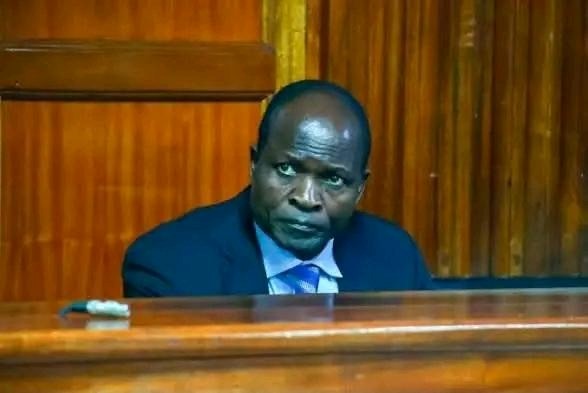

By Valentine Omondi
Former Migori Governor Zacharia Okoth Obado’s journey from the teaching profession to the leadership of Migori County and the Kenya Sugar Board has taken a dramatic turn following his sentencing to 25 years in prison over the murder of Rongo University student Sharon Otieno.
Obado, who served as Migori’s first governor for two consecutive terms between 2013 and 2022, was sentenced on November 27, 2026, by the High Court in Nairobi.
Justice Cecilia Wairimu Githua handed him the 25-year custodial sentence after finding that the aggravating circumstances surrounding the murder outweighed the mitigating factors presented by the defence.
His former personal assistant, Michael Juma Oyamo, was also sentenced to 25 years, while former Migori County Clerk Caspal Ajwang Obiero received 18 years.
The sentencing marked a major development in a case that had attracted national attention since Sharon’s murder in September 2018.
From the Classroom to Sugar Industry Politics
Before becoming a prominent political figure in the former South Nyanza region, Obado worked in the education sector, where he built his professional career as a teacher.
He attended Rapogi Mixed Primary School before proceeding to St Joseph’s Rapogi High School and later St Paul’s Amukura for his A-level education.
He subsequently joined Kenyatta University, where he pursued a Bachelor of Education degree.
Obado began teaching at Tarang’anya High School in 1991 before moving into other professional responsibilities, including serving as a senior manpower development officer in the Ministry of Labour and Manpower Development.
He later became principal of Chunge Mixed Secondary School in 2007, marking one of his final major roles in the education sector before venturing into sugarcane farmers’ leadership and politics.
His departure from the classroom did not immediately take him into elective politics. Instead, he turned his attention to the sugar industry, where he began building a grassroots network through his engagement with sugarcane farmers.
He became involved in the leadership of the Kenya Sugar Board, serving as a director representing the Awendo zone before rising to become its chairman.
His involvement in the industry brought him into contact with sugarcane farmers and private millers, expanding his influence across the South Nyanza region.
The sugar industry became an important platform for Obado to establish political connections and build the networks that would later support his entry into elective politics.
The Road to Migori Governorship
Obado’s growing influence in the sugar industry eventually opened the door to elective politics, where he sought to translate his grassroots support into political leadership.
His first attempt to enter elective politics came in 2007, when he sought the Uriri parliamentary seat through the Orange Democratic Movement (ODM).
However, he abandoned the contest following chaotic party nominations, opting to support another candidate instead.
He later returned to the political scene ahead of the 2013 General Election, this time targeting the newly created Migori County gubernatorial seat.
Obado contested on a People’s Democratic Party (PDP) ticket after falling out with ODM and went on to defeat his opponents, becoming the county’s first governor.
His victory was significant because it made him one of the politicians in the wider Luo Nyanza region to win a gubernatorial seat outside the ODM ticket at the time.
In 2017, he secured re-election, this time under the ODM ticket, defeating former Cabinet minister Ochillo Ayacko.
His two terms in office between 2013 and 2022 cemented his position as a major political figure in Migori County and the wider Nyanza region.
However, his political career was increasingly accompanied by controversy, including corruption investigations and political disagreements that attracted public attention.
Despite the controversies, Obado remained in office until the conclusion of his second term in 2022, after which he left elective leadership.
The Sharon Otieno Murder Case
Obado’s political career took a different turn in September 2018 following the murder of Sharon Belyne Otieno, a 26-year-old Rongo University student who was seven months pregnant.
Sharon’s body was discovered in a thicket in the Owade area of Homa Bay County on September 4, 2018, after she had disappeared the previous evening.
The murder attracted national attention, particularly after details emerged about her relationship with the then Migori governor and her efforts to have him publicly acknowledge their relationship and pregnancy.
Investigations subsequently linked Obado to the case alongside his former personal assistant, Michael Juma Oyamo, and former Migori County Clerk Caspal Ajwang Obiero.
The three were charged with murder in October 2018 and denied the charges.
The trial, which was conducted at the Milimani Law Courts, lasted almost eight years, with the prosecution presenting witnesses and documentary evidence to establish the circumstances surrounding Sharon’s death.
In its judgment delivered on July 23, 2026, Justice Cecilia Wairimu Githua found all three accused guilty of Sharon’s murder.
The court found that Obado supplied the motive, instigation and financial resources that financed the criminal enterprise, while Oyamo facilitated its execution and Obiero provided logistical support and helped conceal the offence.
The judge concluded that the prosecution had established their involvement beyond reasonable doubt.
However, the court acquitted the three men on the separate murder charge relating to Sharon’s unborn child, applying the born-alive principle under Kenyan law.
The conviction marked a major turning point in Obado’s legal battle, paving the way for the sentencing proceedings that followed.
25 Years Behind Bars
On November 27, 2026, Justice Githua sentenced Obado to 25 years in prison, rejecting pleas by the defence for a non-custodial sentence.
The court also sentenced Oyamo to 25 years, while Obiero received an 18-year prison term.
In explaining the sentence, the judge said the aggravating circumstances surrounding the murder outweighed the mitigating factors presented by the three convicts.
She described Obado as the principal architect of the criminal enterprise, noting that he had supplied the motive and financial resources used to facilitate the murder.
The court also considered the fact that Sharon was seven months pregnant when she was killed and that the offence involved planning and coordination.
Interestingly, Sharon’s family had asked the court to consider a non-custodial sentence for Obado, citing forgiveness and the need for him to continue supporting her children.
However, the judge declined the request, observing that financial support to a victim’s family could not determine the punishment imposed for a serious criminal offence.
The court also declined to order compensation to Sharon’s family, saying there was insufficient evidence to establish the extent of the financial loss and damage suffered.
With the 25-year sentence, Obado faces the prospect of spending much of his remaining life behind bars.
Born on June 24, 1962, the former governor was 64 years old at the time of sentencing. If he serves the full 25 years from the date of sentencing, he would complete the term on November 27, 2051, when he would be 89 years old.
However, that date is a projection rather than a confirmed release date. The judge directed that time Obado had already spent in lawful custody be taken into account when calculating his sentence, meaning his actual release could come earlier.
Obado has also challenged his conviction and sentence through an appeal, meaning the case could still undergo further judicial scrutiny.
For a man who rose from teaching to sugar industry leadership and eventually became Migori’s first governor, the 25-year sentence marks a dramatic change in his public life, with his political career now overshadowed by a murder conviction and a lengthy prison term.