Home Blog Page 153

Looming By-elections a litmus test to the Acceptability of Broad Based Government and President Ruto’s Hold on Mount Kenya.

0

By Billy Mijungu

The upcoming by-election in Mbeere North is shaping up to be more than just a routine electoral process. With MP Geoffrey Ruku having been called to the Cabinet, his vacant seat is now a political battlefield where Deputy President Rigathi Gachagua’s influence will be put to the test against President William Ruto’s grip on the Mount Kenya region.

For months, political analysts and insiders have speculated about growing cracks within the UDA ranks, particularly regarding the loyalty of the Mount Kenya region to President Ruto. Since assuming office, Gachagua has positioned himself as the region’s de facto leader, advocating for a more region-centric approach to politics and governance. The Mbeere North by-election will be a crucial indicator of whether Gachagua’s push to consolidate Mount Kenya’s political strength under his leadership is bearing fruit or whether Ruto still maintains undisputed influence.

If Gachagua’s preferred candidate triumphs, it would send a strong message that he is successfully carving out an independent political base. It would embolden him in future political negotiations and solidify his stature as the Mountain’s kingpin. For Ruto, this would be a serious warning sign that his once unshakable support in the region is eroding, forcing him to recalibrate his approach ahead of 2027. On the other hand, if Ruto’s candidate secures victory, it would reaffirm his dominance in Mount Kenya, potentially weakening Gachagua’s standing. It would also indicate that, despite the noise about Gachagua’s rising clout, the region still aligns with the President. For Gachagua, such an outcome would be a setback, potentially undermining his ambitions to solidify his grip on the Mountain.

Mbeere North is a delicate constituency where both national and regional factors will come into play. While Gachagua’s grassroots strategy and his anticipated new party, expected in May, could influence voter sentiment, Ruto’s established campaign machinery and financial muscle remain formidable. Given UDA’s traditional dominance, a Ruto-backed candidate may have the upper hand, but if the anti-establishment wave is strong enough, Gachagua could pull a surprise victory. Recently sacked Justin Muturi could well be the candidate in Mbeere North to continue causing discomfort by tormenting Ruto, or they might team up with like-minded people opposing Ruto to have a candidate.

Mbeere North isn’t the only battlefield. Other looming mini-polls in Ugunja, Banisa and Magarini, alongside four ward contests, will collectively shape Kenya’s political landscape. The performance of various factions, especially Gachagua’s potential new party and other formations, will serve as a crucial prelude to the 2027 elections. How UDA fares across these elections will indicate whether Ruto’s broader support base is intact or if emerging power centers are beginning to shift allegiances.

While Mbeere North alone may not be the ultimate test of Gachagua’s influence, its outcome will certainly provide a snapshot of where the political winds in Mount Kenya are blowing. If Gachagua pulls off a win, he will have made a powerful statement about his relevance in the region. If Ruto’s candidate carries the day, the President will cement his hold on the Mountain, at least for now. Either way, this by-election is set to be one of the most watched political events of the year with far-reaching implications for 2027.

Let me know if you need further edits or refinements.

Re-awekening Coffee potential in Western Kenya to spur economy

0

By Anderson Ojwang                                     

Studies have shown that Western Kenya has the greatest potential of producing the highest quality of Coffee and to spur economic growth in the region.

In one of the studies undertaken by experts hired by some emerging coffee farmers in Nyanza revealed that the temperature and the soil in the region were best for coffee farming in the region.

Former Alego MP and a coffee farmer Mr. Sammy Weya, with temperatures of between 23 degrees centigrade and good soil, it only takes 10 days for seeds to germinate, unlike Central Kenya, it takes 34 days.

In Western Kenya, because the soil is slightly acidic, coffee cherries has a natural sugar taste making it one of the best and high quality. This is an economic potential for Nyanza and Western to join the league of coffee-growing regions in the country,” he said.

Weya said that in Homa Bay, Siaya, Kisumu, Kakamega, Busia, Migori counties have the potential of producing high-quality coffee to reverse the region’s economy.

He said an acre of coffee plantation will earn the farmer Sh 1 million and this can go a long way in addressing poverty in the region.

He said that already the following varieties, Ruiru II, SL 28 and Batian coffee, are being grown in the region.

Weya said the colonial government created a myth that coffee cannot grow well in Nyanza because of the fear of malaria attack and opted to live in the white highlands that were malaria-free.

It is simple knowledge that colonialists did not want to venture into Western Kenya to grow coffee because of the fear of malaria attack, and then develop a myth that the crop cannot grow in Nyana. This myth has been debunked by various studies and the growth of the crop in the region.

Arabica coffee was not promoted in Nyanza was because the colonialists were afraid of malaria and successive governments were never interested in promoting high value cash crops in Nyanza thus marginalizing the community,” he said.

Arabica coffee (Coffea arabica) thrives in cool, tropical highlands with the following conditions:

Climate

          •        Temperature: 15–24°C (59–75°F)

          •        Altitude: 600–2,000 meters (2,000–6,500 feet)

          •        Rainfall: 1,200–2,200 mm per year, well-distributed

          •        Humidity: 60–80%

          •        Shade: Partial shade helps protect from excessive sun and wind

Soil

          •        Type: Well-draining, fertile, volcanic or loamy soil

          •        pH Level: 6.0–6.5 (slightly acidic)

          •        Nutrients: Rich in organic matter, high in nitrogen, phosphorus, and potassium

          •        Wind Protection: Avoid strong winds

          •        Slope: Grows best on sloped terrain for drainage

          •        Spacing: Proper spacing (about 2.5m apart) to allow airflow and prevent disease

With temperatures between 23 and 32 degrees centigrade day and night January to January and altitude above 1200 metres above sea level. Loamy Soils are slightly acidic, making the berries naturally sweet.

Weya said coffee can be grown in the upper canals and intercropped with legumes, macadamia and pawpaw to provide cover.

He said the government disbursed the coffee cherry advance revolving fund, and Nyanza was left out despite the potential, and some farmers were already growing the cash crop.

Between 3rd February 2025 and 10th February 2025, New KPCU disbursed Sh 28,785,253.85 to 2,243 beneficiaries across 14 counties; Baringo County, Bungoma County, Kakamega County, Embu County, Kericho County, Kiambu County, Murang’a County, Machakos County, Meru County, Migori County, Tharaka Nithi County, Trans Nzoia County, Uasin Gishu County, and Nyeri County but Nyanza was left out.

Mumunyonzo FCS in Kakamega County applied for cherry advance for the first time, and is the second FCS to benefit from cherry advance in the county. 10 farmers benefited from the cherry advance of Sh. 366,880,” he said.

Weya said it was unfortunate that despite agriculture being devolved the local leadership has continued to sleep and are yet to take advantage of the emerging coffee farming opportunity.

He said in Uganda that shares common weather, rainfall pattern and soil type have continued to grow coffee while Nyanza and Western, which neighbor them, are yet to venture into farming.

Former Nyakach MP Ochieng Daima said in the area, there are already farmers growing coffee, and the yield is high with huge earnings.

Kabondo is one region in Nyanza where coffee has done well, even in Nyabondo, we have farmers growing it. It is time our people ventured into coffee farming. It is a high-value crop that will change the economy of Nyanza and Western region,” he said.

Weya said that through irrigation, Nyanza can sustain coffee farming, and this will be a milestone in revolutionizing the local and national economy.

He said that currently, China has emerged as a leading coffee market, and Nyanza and Western farmers must be prepared to explore and exploit the opportunities.

China’s coffee market is booming! Expected to hit $23 billion by 2032, with a 2.10% annual growth rate. Rising middle-class incomes and the demand for premium coffee are fueling this surge. Coffee chains and online shopping are making it more accessible than ever,” he said

Will Gachagua maintain the campaign momentum into 2027 ?

0

By Remmy Butia

Former Deputy President Rigathi Gachagua has wasted no time in positioning himself as a key opposition figure against President William Ruto’s administration. His recent public appearances, including a rally in Kiserian where residents displayed campaign posters endorsing an opponent of Governor Joseph Lenku (Seki for Governor 2027), suggest that Gachagua is actively laying the groundwork for a political showdown in 2027.

But can Gachagua sustain this aggressive campaign strategy, and what advice should he consider to remain politically viable?

Gachagua’s Current Strategy: Strengths and Risks

Gachagua’s approach appears to hinge on two main pillars:
Mobilizing the Kikuyu Base – His rhetoric strongly appeals to the Mt. Kenya region, where he portrays himself as a defender of the community’s interests against Ruto’s government.

Opposing Ruto Allies – By openly supporting challengers to incumbent leaders like Governor Lenku, he is signaling a broader strategy to weaken Ruto’s influence across counties.

However, this approach carries significant risks:

Over-Reliance on Ethnic Politics – Kenya’s political landscape is evolving, and while the Kikuyu vote is substantial (about 6-7 million registered voters), winning a national election requires a broader coalition. With over 20 million registered voters, Gachagua cannot afford to be seen as a regional kingpin alone.

Early Campaign Fatigue – Starting campaigns too early can lead to voter fatigue. By 2027, his messaging might lose impact if not strategically timed.

Potential Isolation – If he alienates other communities by appearing too Mt. Kenya-centric, he may struggle to build alliances with leaders from Western, Rift Valley, or Coast regions.

Kenyans are wary of leaders who rely solely on vendettas rather than solutions. Without a clear agenda beyond attacking Ruto, his popularity could fade.

If Gachagua’s opposition appears driven by personal vendetta rather than national interest, he risks being dismissed as a bitter ex-leader rather than a credible alternative. Kenyans respect defiance when it serves the people – not when it seems like political revenge.

Alternative Leadership Appeal

For Gachagua to remain politically relevant post-impeachment, he must present a compelling vision beyond Ruto-bashing. If he champions real issues – economic justice, inclusivity, or institutional reforms – he could rebuild his image. But if his strategy is purely anti-Ruto, he may become a footnote in Kenya’s political history.

Best Advice for Gachagua

For Gachagua to remain a formidable force, he should consider the following:

Expand His Political Base – While consolidating the Mt. Kenya vote is crucial, he must actively engage other regions. Building alliances with leaders from Western, Lower Eastern, and the Rift Valley would strengthen his national appeal.

Avoid Premature Confrontations – Targeting Ruto allies too early may trigger a fierce backlash from state machinery. A more calculated approach, focusing on policy critiques rather than personal attacks, could make his opposition more sustainable.

Develop a Clear Alternative Agenda – Simply opposing Ruto is not enough. Gachagua needs a compelling economic and governance agenda to convince voters he offers a better alternative.

Manage Internal Rivalries – Mt. Kenya politics is highly competitive. If other leaders like Ndindi Nyoro, Moses Kuria, William Kabogo and Martha Karua emerge as alternative voices, Gachagua’s influence could fragment.

Can He Sustain This Momentum?

Gachagua’s early moves show determination, but longevity will depend on his ability to balance ethnic mobilization with national inclusivity, avoid being branded as a divisive figure and maintain discipline in messaging to prevent early burnout.

If he plays his cards right, he could emerge as a leading opposition force by 2027. However, if his strategy remains narrowly focused, he risks being sidelined as just another regional player in Kenya’s dynamic political arena.

Gachagua has the potential to shape the 2027 political landscape, but his success hinges on broadening his appeal beyond Mt. Kenya and presenting a coherent national vision. Otherwise, his early momentum may fizzle out before the real battle begins.

An impeached Rigathi Gachagua might gain fleeting popularity by opposing Ruto, but lasting love from Kenyans requires more than hate – it demands integrity, vision, and genuine service. Without these, his defiance could be seen as mere opportunism, not leadership.

Technical institutions are key to country’ s economic growth says MD Ochiaga

0

By Sandra Blessing

Technical Education plays an important role in the country’s economic development through the production of market-oriented human resources.

The technical and vocational training institutions equip learners with the skills needed in various sectors of the economy.

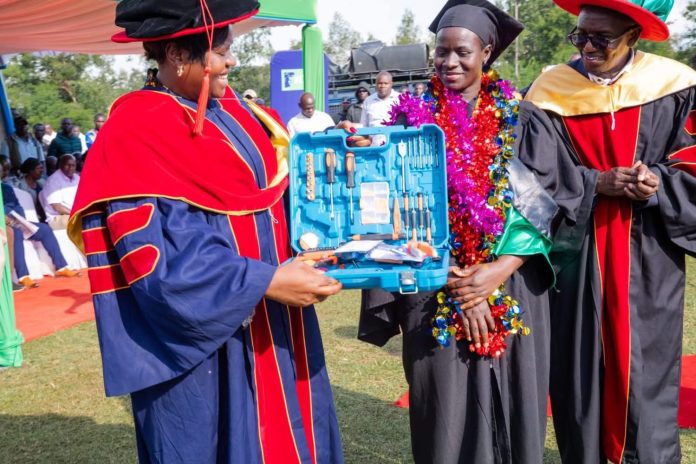
Speaking during 5th graduation at Mawego Technical Institute , Lake Basin Development Authority (LBDA), the Managing Director Mr Wycliff Ochiaga highlighted the significant role technical education plays in Kenya’s economic development.

The ceremony celebrated the achievements of 2,433 trainees who received various certificates and diplomas, marking a milestone in their professional journeys. 

Technical and Vocational Education and Training (TVET) institutions like Mawego TTI are instrumental in equipping youth with practical skills essential for driving the government’s Bottom-Up Economic Transformation Agenda (BETA),” he said.

Ochiaga said the technical institutions prepare graduates to contribute effectively to sectors such as manufacturing, agribusiness, housing, and ICT, thereby fostering economic growth and innovation.

The Lake Basin Development Authority (LBDA) remains committed to fostering economic growth and creating opportunities for skilled youth.

Initiatives like the establishment of a modern fish hatchery in Kisumu aim to boost fish production and generate employment opportunities in the aquaculture sector, aligning with broader strategies to support agriculture and aquaculture—vital components of the region’s economy,” he said

He encouraged the graduates to embrace innovation and entrepreneurship, particularly in emerging sectors like renewable energy and agribusiness.

By leveraging technical skills and exploring these areas, they can contribute significantly to the country’s development and address the evolving demands of the job market.

Upholding integrity, demonstrating hard work, and committing to lifelong learning are essential values for professional success,” he said.

The MD said continuous learning and adaptability were crucial in today’s dynamic world, and maintaining high ethical standards will distinguish graduates in their respective fields.

The ceremony underscored the collaborative efforts needed to empower youth and drive sustainable development in communities. It served as both a celebration of achievement and a call to action for all stakeholders to continue supporting technical education and initiatives that create opportunities for young people.

Tuju wants the judiciary to reprimand Supreme Court Judges who opened a public debate on his case with a financial institution

0

By Reporter

While the Judiciary has asked the former Cabinet Secretary Raphael Tuju, to stop making public statements regarding an ongoing court case involving a company linked to him and a financial institution, Tuju has responded by demanding that the Judiciary should also reprimand two Supreme Court judges who started public debate on the matter..  

On Thursday, Judiciary spokesperson Paul Ndemo in a press release warned Tuju that the matter is before the courts and the Judicial Service Commission (JSC) and as such, the sub judice rule applies.

He said the legal battle between Dari Limited and the East African Development Bank (EADB) was before competent courts and the Judicial Service Commission.

“In accordance with the sub judice rule, which upholds the rule of law and the due administration of justice, these matters should be left for judicial determination and resolution by the JSC,” the statement read in part.  

We urge all parties to refrain from litigating their cases through the media or on social media platforms,” Ndemo added.  

But Tuju in his response said should he prosecuted for sub judice  then the Judges who also spoke on the matter in public should also be prosecuted.

He also demanded to be furnished with  specifics of what he said  which are  subjudice  and are not from  already  filed information in the  court   public records.

If I  am to be put  on the dock for violating the rule of sub judice , I would  be glad to be in  the same  dock  with  the Supreme  court  judges  who  violated  the sub judice rules  in the first place .On my part I have been silent  from April last year  when  I filed  the case  against the SCoK judges at the JSC.  It is only  after they talked  it in public  that I exercised  my right of reply,” he said.

We urge all parties to refrain from litigating their cases through the media or on social media platforms. We also call on the media to verify facts before reporting on such matters to avoid contributing to misinformation or disinformation,” Ndemo wrote in his statement.

Tuju also in his statement wrote back “ I don’t think you will succeed in gagging  the press  on matters  that  are  already filed  in court. And forget about intimidating me.  EADB has  been beneficiaries  of  favorable  reports  from  the media  on this matter  since 2019.”

These developments come as the Judiciary faces heightened scrutiny following a contentious Supreme Court ruling in favour of a senior bank manager, only for subsequent investigations to reveal that the manager had falsified evidence.

The dispute stems from a 2019 UK court ruling that ordered Dari Limited and its guarantors to repay a loan obtained from EADB, which now seeks to The High Court ratified the judgment, and the Court of Appeal upheld the decision, effectively greenlighting the foreign court’s ruling.  

However, Dari Limited’s appeal at the Supreme Court has stalled following a quorum hitch after judges recused themselves from the case. 

This came after Tuju accused them of bias in a formal complaint lodged with the Judicial Service Commission (JSC).  

In light of the seriousness of the allegations, the bench of the Supreme Court recused itself from the appeal. As a result, the judgment of the Court of Appeal remains in force,” the Judiciary noted.  

Last week, Tuju penned an open letter to Chief Justice Martha Koome, and called for formation of a tribunal for two leading counsels..

He maintains that his grievances are genuine, claiming they reflect the lived experiences of ordinary Kenyans seeking justice in the courts, firmly denying any political motivation.

Mahmoud hard test as Africa boils

0
Junior Secondary Schools


By Billy Mijungu

Africa is on fire. From Sudan to Chad, from the Democratic Republic of Congo to Ethiopia and Eritrea, the continent is a battlefield of conflicts that threaten to consume entire nations.

Sudan is engulfed in war, Chad is on the verge of collapse, the DRC is spiraling into chaos, and Ethiopia is preparing for a confrontation with Eritrea over the Assab port. Eritrea, in turn, is ready to carve Tigray out of Ethiopia, a move they are fully capable of executing.

In Nigeria, terrorism has found a home. Armed groups operate with impunity, crossing into Cameroon and the broader region to unleash terror before returning to their safe havens.

South Sudan is boiling with instability, and the entire region is a ticking time bomb. The danger is real, the suffering is immense, and the threats are growing by the day.

Yet in the midst of this turmoil, the African Union Commission stands still. The very institution that should be leading the charge for peace, stability, and security has become a shadow of itself.

The new chairperson, Mahmoud Youssouf, has failed to rise to the occasion. While regional blocs like the Southern African Development Community and the East African Community attempt to mediate in Congo, the AU remains silent, its structures ignored, its presence reduced to irrelevance.

Instead of leading peace efforts, instead of rallying Africa’s diplomatic weight, the chairperson is focused on mundane administrative affairs in Addis Ababa opening Cafeterias and concentrating nepotism.

He has made the AU dysfunctional. His leadership lacks authority, his influence is absent, and his failure is evident.

Africa cannot afford an idle chief diplomat. The AU chairperson is not a ceremonial figure but the driver of the continent’s peace and security agenda. He must be at the forefront, engaging warring factions, negotiating ceasefires, mobilizing regional leaders, and pressing for solutions.

The absence of decisive leadership at the AU is not just a bureaucratic failure. It is a betrayal of the millions suffering under conflict. If Mahmoud Youssouf cannot step up and take control of the crisis, then he must step down. The African Union cannot be held hostage by weak leadership.

The continent needs a chairperson who commands respect, who takes action, and who refuses to watch Africa burn from the comfort of an office in Addis. If he cannot deliver, then he must go.

How 380,000 acres of land in Western Kenya  can transform the country’s rice economy for both Domestic and Export

0

By Anderson Ojwang                   

The rice schemes in Western Kenya are capable of meeting the country’s annual demand of one million metric tons and to allow the country to export the product to international markets.

The rice schemes include Lower Nzoia, Lower Sio, East Kano, West Kano, Ahero and Kuja, which have benefited from ultra-modern irrigation infrastructure from the World Bank’s multi-billion financial support.

The Government had envisaged that by 2032, the country would stop the importation of rice once the various infrastructures become operational for rice production.

This can only be achieved if the government put into productive agricultural use of 380,000 acres in the region to produce one million metric tons.

Kenya’s annual rice consumption is estimated to be over one million metric tons, while local production is around 230,000 metric tons, resulting in a significant import dependency.

Former Alego MP and Entrepreneur Mr. Sammy Weya said studies have shown that Nyanza and Western have enough land to produce the annual rice production demand in the country and this would spur economic growth in the country.

He said through the World Bank-supported rice infrastructural irrigation facilities under the National Irrigation Board (NIB), the region has what it takes to maximize on the rice production in the region.

World Bank has supported with Sh. 100 B for the construction of rice irrigation infrastructure. With this kind of facility, Western Kenya is capable of revolutionizing its economy from just one crop, the rice,” he said.

Currently, the country imports I million metric ton of rice from India and Pakistan at a value of USD .483 million, which is enough to change the economy of Western Kenya.

“ I am concerned about the quality of rice imported into the country because it comes from the food strategic reserves of these countries and may have stayed longer and be fit for human consumption.

If the government invested in rice farming in Kenya and especially in Western Kenya, it would be able to address the issue of poverty and save money inform of foreign exchange.

If we can tap into the rice sector and ensure the country doesn’t spend billions in rice imports but use that money for local production, we shall have opened the Western Kenya economy,” he said.

He said Kenya has the capacity to export rice to the international market if the existing economic opportunities are explored and exploited.

Komboka’ rice variety, introduced in both Mwea and Bura rice irrigation schemes a while back, is one of the varieties that is showing promise for farmers and has seen them harvesting between 38 to 50 bags per acre compared to the old Basmati rice, which a farmer gets about 25 kgs per acre.

For instance, on one acre of a rice farm, the framer would spend an input of Sh  72,500 to produce 3 tons, of puddy rice which is equivalent to 1,140,000 tonnes of rice one season per year. If we plant twice ,we will double and export. A kilogram of rice is sold at Sh 52, and the farmer would make a profit of Sh 82,500 per first harvest and make the same in the second harvest and earn Sh 183,000 in a year on an acre under rice plantation.

Weya said that to make it more profitable and economically viable, the fingerlings can be introduced in the rice farms as it is practiced in Indonesia and Malaysia.

“This will make Western Kenya to have a huge potential to make animal feeds from the by-products the rice bran, sunflower seed cake, soya seed cake and cotton seed cake, which are the main ingredients for animal feeds.

Currently, Kenya imports animal feeds from Uganda and Tanzania, making it expensive for local farmers, yet these can be produced locally to spur various economic activities,” he said.

He said the flooding of the local market by cheap imported rice was hurting the local production. Imported  50 kg of rice retails at Sh  4,500 while the locally produced one is costing Sh 6,000, which translates to Sh 120 per Kg

Our locally produced rice may appear expensive, but it is the best quality and has never overstayed in the stores like the imported ones. If they were to import the freshly produced rice from these countries, the prices would be supersonic high,” he argued.

He said the government must protect local rice farmers and investors from unhealthy competition by instituting policies that encourage investment in the sector.

The government should protect the farmers and investors as opposed to supporting foreign farmers.

The government should support private investors with revolving funds to pay farmers, which should be managed by a private investor and not the government.

If the government would inject Sh 2 B into the kitty  for payment of rice deliveries, within  three years, the country will be able and sustain rice production and  be able to export rice,” he said

Weya said the government should train farmers, give grants to rice farmers, aggregate farms into blocs of 500 hectares and use new technology to enhance production.

The government must adopt modern farming equipment and methods, which include planters, drones for spraying organic fertilizers, land levelling machines, and combine harvesters to fully mechanise rice farming.

The equipment should be available for hire by farmers through a management service at a subsidized rate.

The government should work with KALRO  to get improved rice seedlings and enforce strict  rules on the quality of rice imported into the country,” he said.

Weya said that regarding marketing, the government should make a deliberate directive that all school feeding programs consume locally produced rice.

“Let all health and education institutions in the country consume our locally produced rice. This is the best way to open the local market for our rice and reduce high capital flight on rice importation,” he said.

Ogande Girls Aims to Be Crowned Winners at National Drama and Film Festivals

0

By Robert Omolo

Nyanza’s representative, Ogande Girls from Homa Bay, have set their sights on winning this year’s culture and creative dance category in the National Drama and Film Festivals.

This follows their victory as champions in the Nyanza Regional Drama Festivals, where they won a trophy at Orero Boys High School in Homa Bay County.

The school will now represent the region in the national festival, which will be held in Nakuru County from 6th to 13th April 2025.

The school’s principal, Jane Odhiambo, said they are now putting in more effort to secure the national trophy at the festivals.

She stated that their regional-level win has given them motivation, and they will continue training hard in co-curricular activities ahead of the competition.

The Ogande Girls team is focused on becoming the national champion in cultural dance this year. We’re working hard towards achieving this goal,” she said.

Speaking during the presentation of the trophy at the school compound in Homa Bay Town Constituency, Odhiambo said the win has boosted the morale of many teachers in their preparation to implement Kenya’s new Competency-Based Curriculum (CBC).

The school head dedicated their victory to the support of teachers, parents, and non-teaching staff.

Ogande Girls also represented the county in hockey at the regional secondary schools’ sports games held at St Joseph’s Rapogi in Migori County.

Odhiambo said they are encouraging their learners to discover and nurture their talents, adding that such festivals provide a platform for students to showcase their abilities.

She called for more support to enable the girls’ team to enhance their training ahead of the competition.

Apart from engaging in co-curricular activities, more than 700 candidates attained a mean grade of C+ (plus) and above in last year’s Kenya Certificate of Secondary Education (KCSE) exams, qualifying for direct entry into university.

It was a collective effort that enabled Ogande Girls to emerge as the winners at the regional level. Our girls have also shown a lot of commitment because they want to explore their talents,” she said.

The Kenya Secondary Schools Heads Association (KESSHA) in Homa Bay and Orero Boys High School Chief Principal, Dickens Bula, commended Ogande Girls for their excellent performance, as well as all the schools from the Nyanza region that participated in the festivals.

He called for support for the winning teams.

We are appealing to well-wishers to come forward and support the winning teams from the region to enable them to perform effectively in the festivals,” Bula said.

The economy is finally looking up after a turbulent start: Mudavadi

0

By OPCS Press Service

Kenya’s economic projections are looking up, with growth improvement rising from 4.8 percent in 2022 to 5.2 per cent in 2023, Prime Cabinet Secretary Musalia Mudavadi has said. Similarly, projections have pointed to an even greater growth in the 2024 review.

Mudavadi said inflation significantly dropped from 9.2 percent in September 2022, to 3.5 percent in February 2025. According to him, statistics show a positive growth in the overall Gross Domestic Product indicators.

This has markedly reduced the cost of living and improved household incomes. Furthermore, the exchange rate has stabilized and interest rates fallen, improving credit access to the private sector,” said Mudavadi.

The Prime CS said the current figures come against the backdrop of the Government’s Mid-term Review and calls for the government to re-look at its score card report for the past two and a half years and assess its performance in scaling up strategies to improve service delivery to citizens.

Mudavadi noted that the “New World Order” as a result of the changing geopolitical landscape coupled with the effects of climate change and global conflicts is a wake-up call for Kenya to rethink how to reduce its vulnerability to external assistance and develop innovative ways of financing internal budgetary requirements.

He emphasized that prudent management of resources becomes even more urgent within government.

During the ninth review of our programme with the International Monetary Fund recently, Kenya terminated the multi-year programme, forgoing over Sh110 billion ($853.5 million) in budget and balance of payments support. To bridge this gap, we have to tighten our belts, as we follow up on our formal request for a new IMF programme,” noted the Prime CS.

The critical lesson we have learnt from this is the urgent need for us to grow our own internal resources, to reduce dependency on foreign aid. We must deal firmly with corruption, which is the greatest existential threat to our country’s economic growth and social transformation. That is why we have invited the IMF to undertake a Governance Diagnostic Assessment, to identify weaknesses and corruption vulnerabilities in core state functions that are critical to macroeconomic stability and growth,” added Mudavadi.

Mudavadi has revealed that the IMF team has finalized a scoping mission that will lead to the detailed governance assessment in early June 2025.

This he said will help in developing and implementing a robust governance reform plan for the next few years.

I call upon all Kenyans and the relevant leadership and institutions to fully support this initiative and avail the necessary data and information, especially the respective ministries when called upon to do so,” urged Mudavadi.

Mudavadi said the government is cognizant of the higher expectations of Kenyans more than ever before since citizens are yearning for more from the Government and its leaders especially in delivering on the main pillars of the Bottom-Up Economic Transformation Agenda, BETA.

He explained that the new broad-based government provides an opportunity for government to demonstrate greater responsiveness to the needs of the citizens and validates the resolve to reach out to all Kenyans across board without discrimination in addressing the differences between the Government and the people on the BETA priorities.

One of the BETA pillars, Universal Health Coverage, is frequently in the news. Over 20.6 million Kenyans have registered for the healthcare program, marking a significant step in the transition from the National Health Insurance Fund to the Social Health Authority. 7. While the new healthcare financing model improves the citizens’ access to quality and affordable healthcare, we must address the fundamental issues emerging from the people who interact with the system. These include the eligibility of SHA members, which is determined by a means testing criterion that just over four million Kenyans have completed. This implies that 80 percent of the registered members cannot fully enjoy the envisaged benefits. The therapy is to scale up public communication and stakeholder engagement, to fully onboard all Kenyans on the SHA platform,” he explained.

Mudavadi also noted that government is deepening dialogue with the private healthcare providers on the Government’s commitment to settle historical NHIF debts, accumulated to an estimated Sh33 billion in the past decade.

He stated that government has already paid Sh8.6 billion and President Ruto has assured that all verified debts will be settled, starting with Sh10 million and below owed to small hospitals that constitute 91 percent of the creditors.

Our endeavour is to restore services throughout the healthcare value chain, while rethinking strategies for ensuring long-term stability of the healthcare system. These include engaging members of parliament and county governments to build and equip more public health facilities and hire additional healthcare workers,” he said.

Mudavadi also gave the government’s assurance that issues emerging around the affordable housing agenda are being addressed, noting that key milestones have already been achieved, including launching the construction of 95,737 affordable, social and institutional housing units across the country.

He added that the initiative has up to date triggered at least 200,000 direct and indirect jobs and further, created business opportunities worth Sh 4.4 billion for Jua Kali and other micro, small and medium enterprises.

The key message is about creating sustainable opportunities for jobs, incomes and shared prosperity. The Government is stepping up its promise to build 250,000 houses a year, and Kenyans will see how much affordable housing stimulates economic growth and promotes equity and inclusivity in the distribution of resources,” he explained.

Mudavadi who was speaking at the Kenya School of Government, Wednesday, when he chaired the 1st National Development Implementation Committee (NDIC) meeting of 2025, that brought together top government officials amongst them representatives from the office of the Head of the Public Service who is the vice chairperson of the NDIC and Principal Secretaries drawn from all State Departments.

Kenyans are constantly reminding us of our responsibility as leaders to deliver on the social compact they signed when they elected the Kenya Kwanza Administration. There is need for us to engage more constructively with the people, to persuade them to give us another term to realize our dream of building an industrialized and prosperous Kenya for all,” noted Mudavadi.

Oburu to the Mountain: You betrayed Raila, We don’t regret to be in broad-Based Government 

0
Raila Odinga

By Anderson Ojwang

In his uncharacteristic manner, Siaya Senator  Dr Oburu Odinga opened and poured out his heart on the betrayal of the Lake by the Mountain in the last Presidential election.

Speaking in Meru County at a burial, before his younger brother, former Prime Minister Raila Odinga, Oburu did not mince his word when he talked about the betrayal by Mountain in the last presidential election and why he doesn’t regret being in the broad based government with President William Ruto.

Oburu said Raila made huge sacrifices to then President Uhuru Kenyatta in the hope that Mt Kenya would reciprocate by supporting his presidential ambition, but that went nought.

As things stand, we are in this government called a broad-based government. I am a member of a broad-based government. Martha Karua has told me she is very far from a broad-based government. It is ok. Because we are friends, that doesn’t spoil the friendship. Because we might be there and there, but tomorrow we are together.

So politics is like that, but I want to say that our country must remain united. Raila is very big-hearted. You know, for five years, Raila supported Uhuru Kenyatta without asking Uhuru to give him ministers, to give him anything, because he wanted to bring the Mountain closer to us.

The government you supported, Raila, gave you unconditional support. And we were expecting that when Raila now stands for presidential candidate, the Mountain was going to come and give Raila a reciprocal treatment.

But as things stood out and as fate had it, that did not happen. And, Uhuru Kenyatta warned you people and told you that you would cry.

Now, when you are crying, you want Raila to come and rescue you. How does he do it?  So we are in a broad-based government and we don’t regret.

What we want to do is to have our country united and peaceful. Let us continue. Elections will come and go. When those elections come, people will decide who to lead, but for now, we must be stable and we must stabilize the government of the day.

 For instance, in Kirinyaga county, the home turf of Raila’s running mate Martha Karu, Ruto got  84 percent of the votes, accounting for 220,752 votes, while Raila got a paltry 14 percent, accounting for 37,978 of votes

In Kiambu county, the home ground of President Uhuru, Ruto managed 72.9 percent of the votes, amounting  to 606,105 votes, while Raila only managed 25 percent, accounting for 210,495

Again in Nyeri county, Raith’s village, Ruto received 82.79 percent of the votes, amounting to 272,577 of the votes, while Raila got 15.3 percent, accounting for 52,043 votes.

Finally, in Muranga, Ruto got 81 percent of the votes, accounting for 343,421, while Raila got a paltry 17 percent that accounting for 73,539 votes.

Raila’s running mate Martha Karua acknowledged hostility to the candidature in the Mountain but added that it later thawed down.

People sometimes converge and also disagree, and when you agree to disagree, it is ok. Last season, I campaigned with Baba, and I helped enter the mountain amidst great hostility.

 But after five days of braving that hostility, it calmed down, and we were able to campaign in the region. Because politics is not for the faint-hearted.

I want to agree also, it is the right of those who feel that broad-based is the way to go. It is also our right to be in the opposition, and that is why I firmly remain in the opposition and with the people,” she said.

Former Cabinet Secretary Moses Kuria, once a critic of Raila ahead of the 2022 election, said it was time to slay the dragon of tribalism and unite the nation.

I want to say this specifically to my friend,  former Prime Minister Raila Amolo Odinga, a lot has been said about his stand on contemporary politics of this country. When I became a minister, way before the broad-based government. I sensed something was wrong with this country, and the center can no longer hold, and we can no longer continue with the politics of division, balkanization, and antagonism.

Let me correct you a bit, my senior, Youth leader, you have talked about the people of the Mountain. Let me tell you something, Raila did not come to a broad-based government to save the people from this region, but to save this country. And that is a whole difference.

When we had problems with  Gen Z and you know what happened, He had two options and it was his right to choose any. He would have burnt the country but opted to save the country.

I want to assure you personally, wherever you go, I will go with you to unite the country.

You know what, Senator Oburu, previously, I was a champion of tribalism. I got saved. Every angel has a past, and every sinner has a future. That is why I want to wonder and ask, I have listened to my Sister Martha Karua,  they will condemn the ills of the government, but let us not return the country to tribal divisions.

When I see Karua with those other leaders championing tribalism in Kenya, I say every sinner has a future,” he said.

Rarieda MP Otiende Amolo said in politics there is convergence and divergence, and this should not result in violence but peaceful co-existence.

When we converge, understand us. When we diverge in understanding, we will also understand you. All that we ask is for the church to pray for us that in our convergence and divergence, let it not result in violence,” he said.