
By Sandra Blessings
Kenya is currently handling more than 10 million tons of cargo through the Kenya Railways’ two systems, the Standard Gauge Railway (SGR) and Meter Gauge Railway (MGR).
Kenya Railways Managing Director, Mr Philip Mainga, said the strategic value of investment and having the Standard Gauge Railway (SGR) and Meter Gauge Railway (MGR) operate as complementary networks have ensured huge cargo traffic in the country.
Mainga spoke during a meeting with a delegation of Ugandan Members of Parliament Committee who visited Kenya Railways for a benchmarking tour of the Corporation’s SGR and MGR operations.
Collaboration
He said stronger regional collaboration will unlock the full potential of railway transport in East Africa.
The Chairperson of the Ugandan delegation and Parliamentary Committee on Physical Infrastructure, Mwine Mpaka, said cooperation between Uganda and Kenya Railways was critical to unlocking the potential of Uganda’s own railway network and strengthening the movement of cargo across the region.
The Ugandan Chairperson highlighted Uganda’s strategic position as a transit and distribution hub for cargo destined for the Democratic Republic of Congo (DRC), South Sudan, Rwanda and Burundi, noting that efficient railway connectivity with Kenya would have a significant impact on regional trade.
Mr Mainga observed the strategic importance of Uganda, saying that the country was a critical logistics hub for the Great Lakes region and that Kenya and Uganda must work together to improve the efficiency of transporting goods and services across East Africa.
“Regional collaboration was non-negotiable. East African countries must work together to bring efficiency to the transportation of goods and services to our people,” Mr Mainga said.
Progress
The Ugandan delegation shared its progress in rehabilitating its railway infrastructure, including the replacement of steel sleepers with concrete sleepers and plans to rehabilitate the Malaba-Tororo MGR section.
The Chairperson said Uganda was keen to draw lessons from Kenya’s experience in operating, rehabilitating and integrating its railway systems.
The discussions also explored how Kenya was leveraging its railway infrastructure beyond transportation to stimulate economic development.
Mr Mainga said Kenya Railways was pursuing the development of Commercial and Logistics Hubs along its railway corridors, transforming the rail corridor into an economic corridor.
Under the SGR, planned commercial hubs include Voi, Konza, Athi River, Bomet, Nyamira and Malaba, among others, while hubs were also planned under the MGR in Voi, Taveta, Nakuru, Eldoret and Malaba.
“With adequate land along the railway network, Kenya Railways is turning the rail corridor into an economic corridor,” Mr Mainga said.
They underscored the importance of the East Africa SGR Master Plan, approved by the Heads of State of the East African Community, which seeks to connect the countries of the Great Lakes region, including Uganda, the DRC, South Sudan and Burundi.
Mr Mainga said the integration of rail and lake transport would further strengthen regional trade, with cargo potentially moving seamlessly through Lake Victoria, supported by MV Uhuru I and II and enhanced connections through the Port of Kisumu, Port Bell and Port Jinja.
The engagement also highlighted the progress of the Naivasha–Kisumu SGR Phase 2B and 2C, which Mr Mainga said was currently on course.
The delegation was also briefed on the Nairobi Railway City Project, which demonstrates the role of commuter rail in improving urban mobility and helping to decongest cities.
Capacity building
Capacity development will form the foundation for Uganda’s railway revival.
The Chairperson of the Budget Committee of the Ugandan Parliament, Amos Kankunda, underscored the importance of developing a skilled workforce, supported by a strong regulatory framework and alignment with international standards.
Kankunda, who spoke during a visit to the Staff Safety Training Centre and Benchmarking, underscored the importance of sharing railway heritage and knowledge between the two sister organisations.
“I would like to thank you for this important initiative. Capacity development must be our starting point,” he said.
Kankunda lauded the high standards being set in railway training and certification, noting China’s significant progress in the field.
“If Uganda is training students from here, we must ensure that the certification meets international standards. China is doing very well in this area, and it is important that we benchmark against such best practices to ensure our workforce is globally competitive and ready for SGR operations and maintenance,” he said.
Inducted
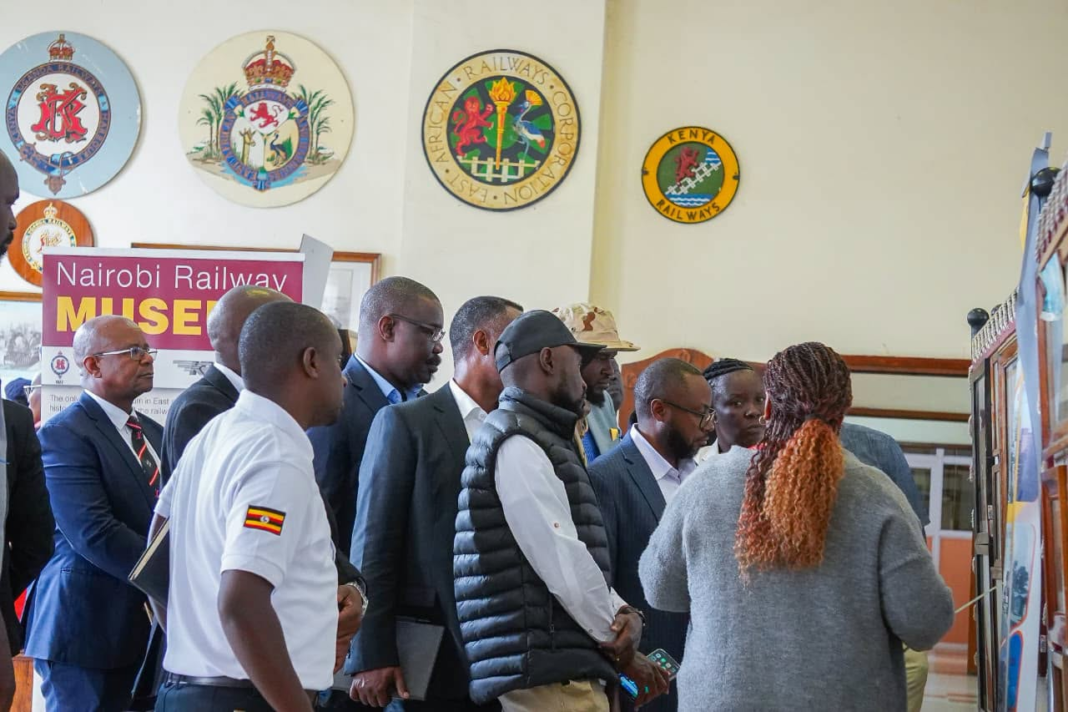
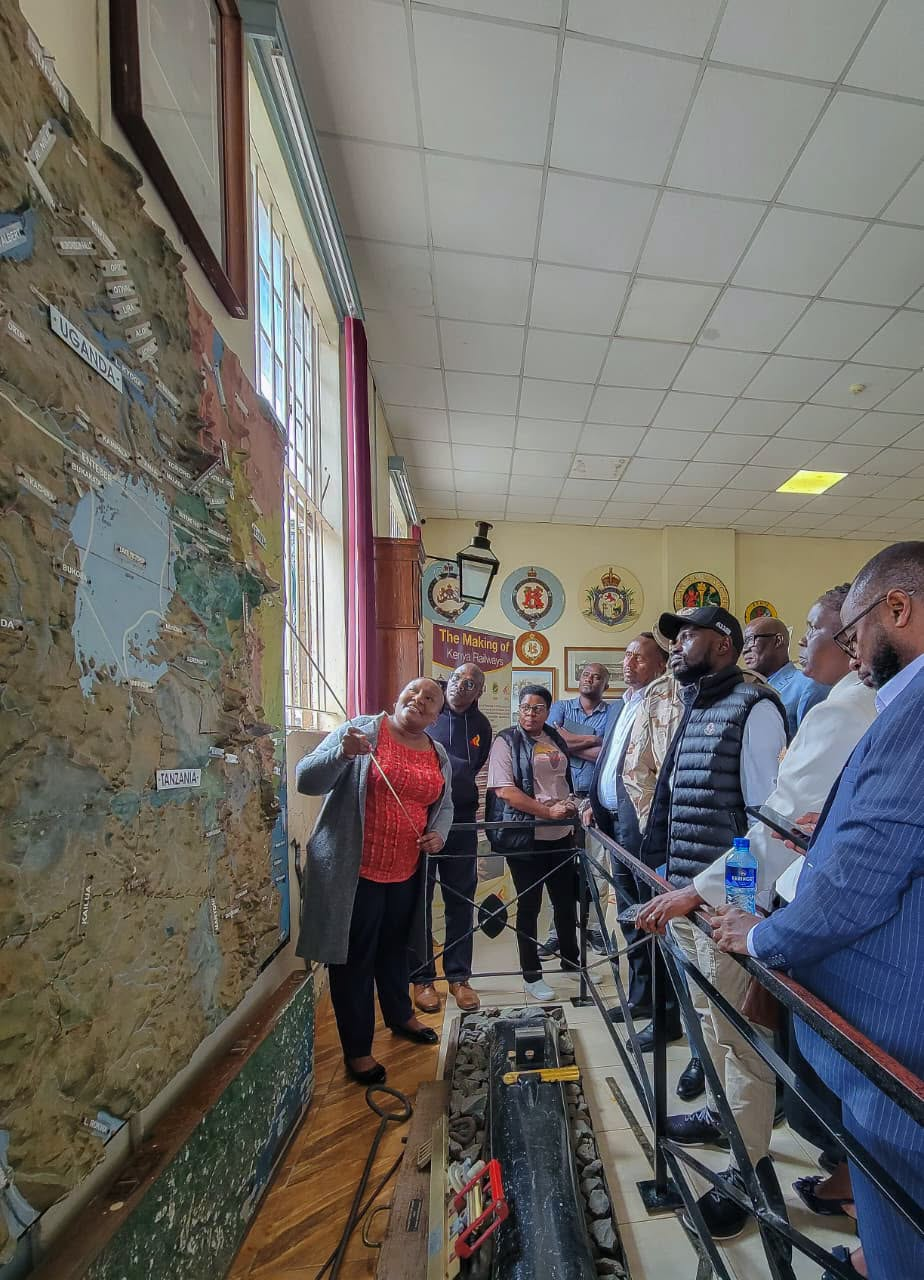
Kenya Railways Senior Heritage Resource Centre Assistant, Ms Lorrine Ubindi, led the delegation on a museum tour tracing the remarkable journey of the railway in Kenya and across East Africa — a 582-mile (931 km) line which was built entirely by hand.
The delegation was taken through a treasure trove of artefacts, from steam engines — the genesis of railway locomotives. The tour brought history to life with the legendary tale of the Man-Eaters of Tsavo, the two lions that halted construction of the Uganda Railway in 1898, and a pause at the preserved seats used by Queen Elizabeth II on her Royal Train during her historic 1950s visit.
In the outdoor yard, the delegation came face-to-face with the true giants of that era: colossal steam locomotives and early 1900s passenger coaches.
The engineering marvels of the original Uganda Railway, famously dubbed the “Lunatic Express,” were built by the British administration through the tireless labour of thousands of Indian indentured workers.
For over a century, this line has been the backbone of freight and passenger transport, giving rise to major towns along its corridor, including Mombasa, Nairobi (formerly Nyrobi), Nakuru, Eldoret and Kisumu (formerly Port Florence).
The historical immersion concluded with an appreciation of recent developments in both the Meter Gauge Railway and the Standard Gauge Railway, showcasing how technology in wagons and locomotives has evolved as a testament to adaptation and human imagination.