
By Anderson Ojwang
At the altar and comfort of power, right inside State House, the contrast in the Jaramogi Oginga Odinga family showed up.
They say a coin has two sides, and for decades, the only known side of the family coin aligned to the world was the emancipation of democracy and human rights.
For decades, the Jaramogi family sacrificed and laid their lives for a free, fair, and democratic space in Kenya.
But the eldest son, Dr Oburu Oginga, took a different path from his father and younger brother, the late Raila Amolo Odinga, and worked with subsequent regimes, holding senior positions in the government until his father died in 1994, when he was elected Bondo MP.
And through the agitation, the family paid bitter and huge prices, with the late Jaramogi Oginga Odinga, the country’s first Vice President, resigning from the late Mzee Jomo Kenyatta’s administration.
Oginga went ahead to write a book, Not Yet Uhuru, that details his misgivings about the new post-colonial administration.
The Synopsis of the Book Not Yet Uhuru
The 1967 autobiography by Kenya’s first Vice President argues that independence (uhuru) merely replaced colonial rulers with a neocolonial elite.
It details his fight against British rule, his disillusionment with Jomo Kenyatta, and the betrayal of the independence dream.
The book’s core themes include:
The Neocolonial Betrayal: Odinga details how the promise of land redistribution to ordinary Kenyans was subverted. Instead, political elites used buying companies to hoard large tracts of land previously owned by white settlers, leaving the masses landless and economically disempowered.
The Kenyatta Feud: The book chronicles Odinga’s complicated relationship with Jomo Kenyatta. He outlines his vital fight for Kenyatta’s release from British detention, only to later face betrayal as Kenyatta aligned with foreign interests and abandoned socialist, pro-mass principles.
State Repression: It documents the stifling of political opposition, including the suppression of progressive voices and the tragic 1965 assassination of freedom fighter Pio Gama Pinto. These events prompted Odinga to resign as Vice President in 1966 to form an opposition party, the Kenya People’s Union (KPU).
Odinga spent most of his time fighting for democratic space and human rights, which eventually culminated in the repealing of Section 2A in 1997 to allow the first multi-party election.
Apart from Odinga, his son, the late Raila Amolo Odinga, was detained and jailed for years over his struggle for a democratic space in the country.
Raila’s struggle culminated in the 2010 Constitution for the country and often sacrificed for the nation.
The current Orange Democratic Movement (ODM) leader, Oburu, on Wednesday rewound the clock when he urged President William Ruto to adopt what he described as “benevolent dictatorship” when making difficult decisions.
The Call
On Wednesday, while at State House, Oburu, who is currently a close ally of President William Ruto and engaged in a pre-election coalition with Ruto’s UDA party, did not mince his words.
“I encouraged the President to occasionally employ a level of ‘benevolent dictatorship’ to stand firm, cut through the political noise, and make the hard, bold decisions necessary to achieve the absolute best for all Kenyans,” Oburu said.
He said bold leadership was necessary to secure Kenya’s economic future and offered President Ruto candid advice on leadership, urging him to remain steadfast in pursuing policies that serve the country’s long-term interests.
The veteran politician even went ahead to suggest that a “little dictatorship” would not be a bad idea, arguing that decisive leadership is sometimes necessary to ensure critical national programmes are implemented.
“We have been in government, and I was an Assistant Minister of Finance. We tried to move, but the private interests around who want to benefit from small infrastructure, which does not take the country anywhere, always come in to put pressure on the government, making it not to progress. Sometimes there is too much democracy; there should be a little benevolent dictatorship so that some things can move. Mr President, I don’t want to say that you should be a dictator; I am not saying that,” he said.
Reactions
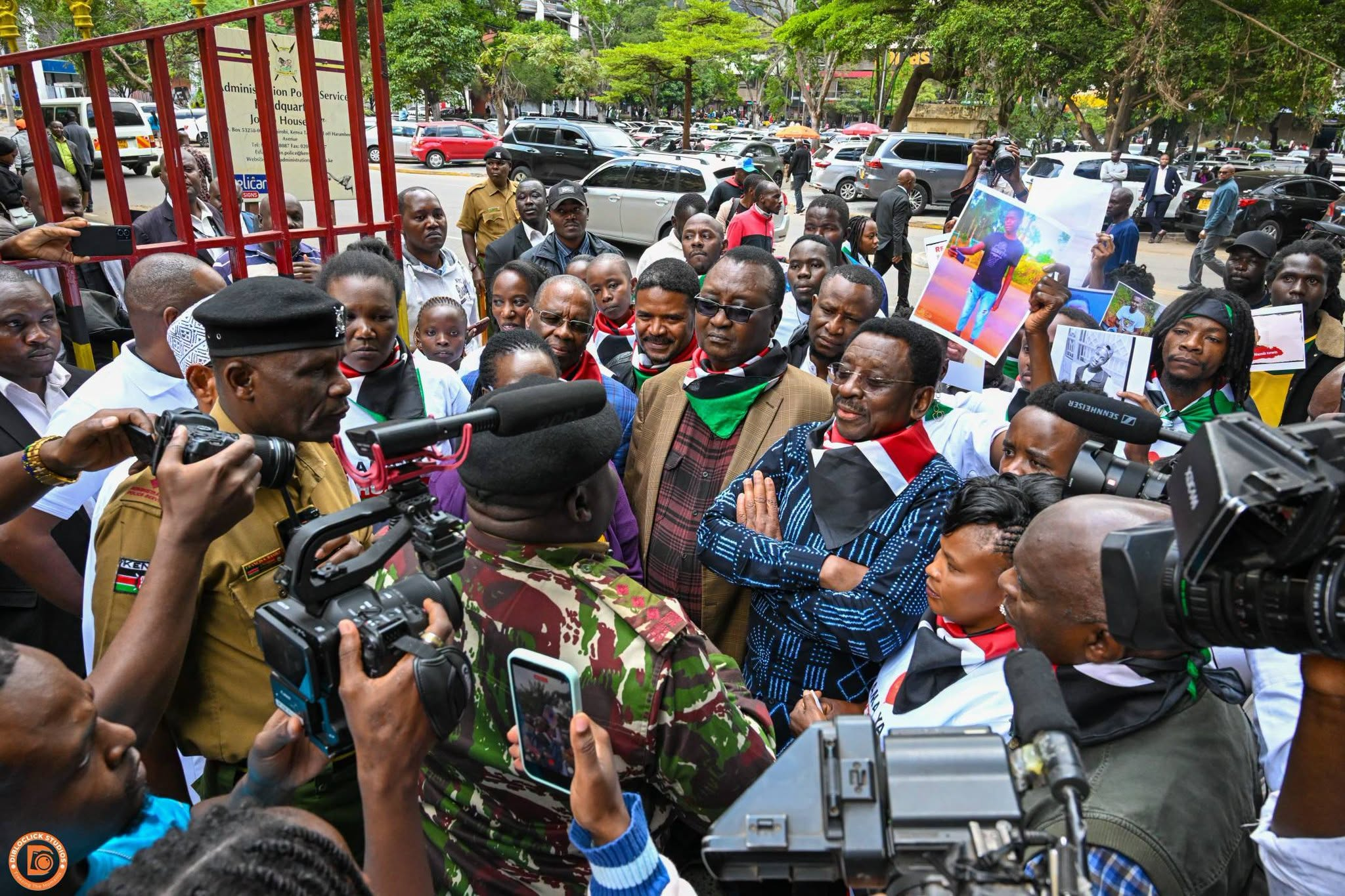
Oburu has come under a barrage of criticism over his call, with leaders arguing that he was watering down the fruits of the Odinga family’s struggle.
Siaya Governor James Orengo termed the call as a national shame by the ODM leadership.
“It is a national shame to hear the ODM Linda Ground faction beg William Ruto to become a ‘benevolent dictator’,” he wrote.
Orengo claimed that President Ruto was already a dictator and wondered what Oburu was up to in his new political venture.
“Let’s be clear: Ruto is already a dictator. We see it every day in the forced abductions, the trumped-up charges against dissenting voices, the forced passage of the punitive Finance Bill, and the illegal fire sale of our public assets,” he said.
Orengo said the letter “D” in ODM stands for Democracy, and Oburu was betraying the course of the struggle by the Jaramogi family.
“It is a betrayal of the highest order for these words to come from the Jaramogi Oginga Odinga family, a family whose blood, sweat, and tears bought the very freedom we enjoy today,” he wrote.
Orengo said Oburu had abandoned the legacy path left behind by the Odingas and was reinventing the wheel.
“To abandon that legacy is to spit on the sacrifices of our liberation heroes. Today, we stood with the Mijikenda elders at the Coast, and their message was loud, clear, and heartbreaking,” he wrote.