By Luiz Kipkoech Patrick
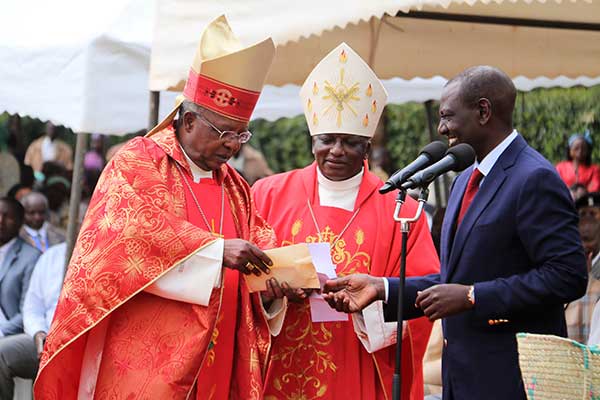
President William Samoei Ruto is, without a doubt, the most overtly religious president Kenya has ever had, at least on the surface. Like a shepherd leading his flock, he strides into church services, his presence a constant reminder that he is not just a man of politics but, seemingly, a man of faith. Sunday after Sunday, the President dons his pious cloak, attending services with unwavering devotion and making sure the congregation hears not just his prayers but also the weight of his generosity.
In a particular Sunday service at the Jesus is Alive Ministries in Nairobi, President Ruto posed a question that lingers like a rhetorical sermon: Why do some people have a problem with giving? This came right before he announced a staggering Ksh 20 million donation to the church. Just days before, he had dropped millions more at a Nairobi fundraiser. His pockets, it seems, run deeper than the ocean when it comes to religious contributions. Yet, this grand display of giving clashes head-on with his previous pronouncement that church harambees would cease in response to the Gen Z-led demonstrations demanding financial accountability.
The contradiction is as glaring as a candle in the dark. It forces us to ask: Is this generosity a pure act of faith, or is it a well-rehearsed political performance?
As someone who sat through Sunday school lessons, I vividly remember the biblical warning against hypocritical giving. Jesus, in Matthew 23:23, had a sharp rebuke for religious leaders who polished their public image with tithes while trampling upon justice:
“Woe to you, teachers of the law and Pharisees, you hypocrites! You give a tenth of your spices—mint, dill, and cumin. But you have neglected the more important matters of the law—justice, mercy, and faithfulness. You should have practised the latter without neglecting the former.“
In simpler terms, Jesus was not against giving, but against hollow generosity—the kind that shines in public but does little to uplift the suffering.
This brings us to Kenya’s current predicament. Our hospitals are running on empty, the job market is shrinking like a drying well, and citizens are being squeezed by taxes so tightly that survival feels like a game of Russian roulette. In such dire times, should a leader’s priority be showering churches with millions or ensuring that economic fairness, justice, and social dignity are upheld?
President Ruto’s Ksh 20 million donation is not just a number—it is a statement and an unsettling one at that. If church harambees were meant to stop, why this sudden relapse? If austerity is the government’s battle cry, why does money flow like an endless river when it comes to publicized acts of giving?
The reality is as clear as day—this is not about faith; it is about optics. It is about branding leadership as a divine calling, as though governance itself is a sacred altar. But faith without justice is an empty shell. True governance is the highest form of tithing—it is a sacrifice of responsibility, integrity, and fairness. The greatest offering a leader can place on the altar is not a bag of money but a set of policies that uplift the poor, create opportunities, and protect the dignity of the people.
The timing of these donations is suspicious, to say the least. They come hot on the heels of heightened opposition activity and an aggressive political war spearheaded by impeached Deputy President Rigathi Gachagua, who has made the Mt. Kenya region hostile territory for Ruto’s allies. They also coincide with a time when Kenyans, burdened by corruption, taxation, and joblessness, are voicing their frustrations more than ever. Could these hefty church donations be nothing more than a smoke screen—a grand performance meant to divert attention from governance failures while reinforcing the image of a God-fearing leader?
Even the Bible warns against such showmanship. In Matthew 6:3, Jesus advises:
“But when you give to the needy, do not let your left hand know what your right hand is doing.“
Yet, here we are, watching as every handshake, every oversized cheque, and every public declaration of “humility” is paraded before the cameras. When giving is done with an audience in mind, it stops being a selfless act and morphs into a political tool—a prop in a well-choreographed play.
This is why President Ruto needs to pause and reflect.
True leadership is not measured by how much one donates in church but by how well one governs. A just leader does not just give—he builds. He builds schools so that parents do not have to wrestle with tuition fees. He builds hospitals so that citizens do not have to rely on charity for medical care. He builds an economy that empowers people to earn a dignified living rather than leaving them begging for handouts.
The issue is not whether people should give to God. The real debate is whether the giving we see today aligns with divine will or whether it is a grand illusion meant to distract the masses.
Kenya does not need extravagant tithes; it needs ethical leadership. It needs policies that uplift the people, not performances that manipulate them. It needs a governance system that embodies the justice, mercy, and fairness that Christ preached.
The real tithe a leader owes is to the people—a tithe of honesty, service, and an unwavering commitment to true equity.
So, the real question is not why people have a problem with giving. The real question is: What would Christ say about a leader who tithes extravagantly while his people suffer?