
Why local communities must move from climate ideas to fundable resilience projects
Climate change is no longer a distant global discussion. It is now part of daily life for millions of people across Africa. Farmers are experiencing unpredictable rainfall. Schools are struggling with water shortages. Families are facing rising food prices. Roads, homes, farms, and public infrastructure are increasingly exposed to floods, droughts, heat, and other climate-related shocks.
For many communities, climate change is not just an environmental issue. It is an economic issue, a food security issue, a health issue, an education issue, and a development issue.
This is why adaptation finance is becoming one of the most important conversations in climate finance today.
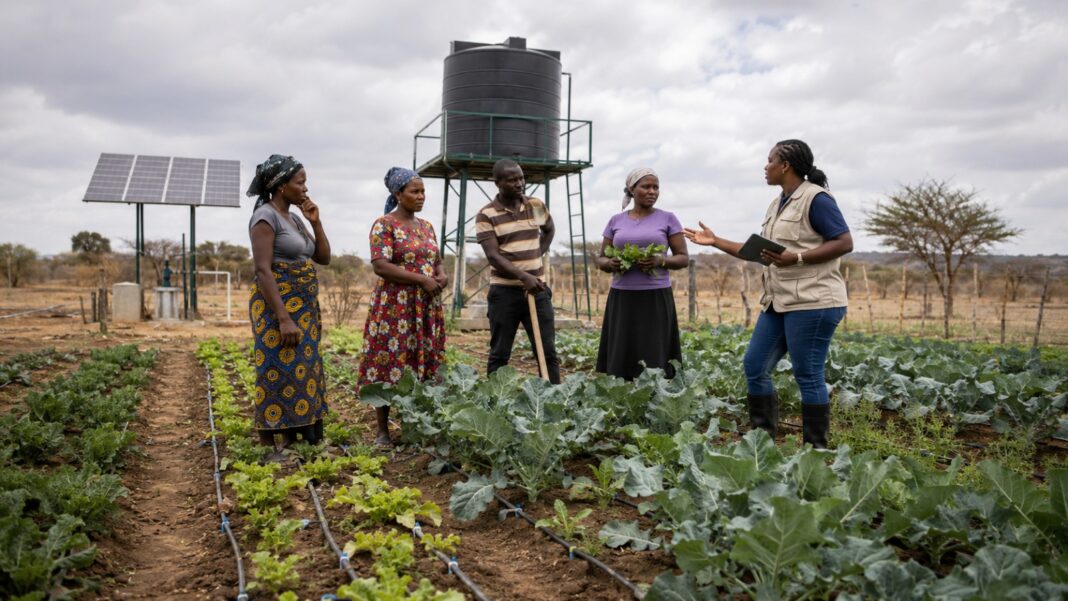
Adaptation finance refers to funding that helps people, communities, institutions, and economies adjust to the impacts of climate change. It supports practical solutions such as water harvesting, climate-smart agriculture, drought-resistant crops, flood control, early warning systems, resilient infrastructure, ecosystem restoration, school gardens, agroforestry, clean energy systems, and livelihood diversification.
While mitigation finance focuses mainly on reducing greenhouse gas emissions, adaptation finance focuses on helping people survive, adjust, and build resilience against climate impacts that are already being felt.
For Africa, adaptation finance is not optional. It is urgent.
The real climate finance challenge
For many years, climate finance discussions have focused on big numbers. Global conferences have produced pledges, targets, commitments, and funding announcements. However, the experience at the local level often remains very different.
Many communities know the climate problems they face. They can describe failed rains, reduced harvests, water scarcity, livestock losses, floods, declining incomes, and damaged infrastructure. Many organisations also have good ideas on how to respond. Yet, these ideas often do not attract funding.
Why?
The problem is not always the absence of climate finance. Sometimes, the problem is lack of preparation.
Climate finance does not move simply because a community has a need. It moves when that need is translated into a clear, bankable, evidence-based, and measurable project.
A donor or investor will ask important questions. What climate risk is being addressed? Who is affected? What is the proposed solution? What evidence supports the project? How much will it cost? What results will be achieved? How will women, youth, and vulnerable groups benefit? How will impact be measured? How will the project continue after the funding period?
Many local organisations struggle at this point. They understand the problem, but they lack the technical support to package the problem into a strong climate finance proposal.
This is where Africa’s adaptation finance challenge becomes a project readiness challenge.
From climate ideas to bankable projects
A good climate idea is not the same as a fundable climate project.
For example, a school may say it needs support because learners are affected by water shortage. That is a genuine problem. But to attract adaptation finance, the idea must be developed further. It may need to become a climate-resilient school project with rainwater harvesting, storage tanks, school gardens, tree planting, solar-powered water pumping, learner climate clubs, and measurable indicators on water access, attendance, nutrition, and environmental learning.
A farmer group may say drought has reduced production. That is also valid. But a fundable project may need to show how climate-smart agriculture, drip irrigation, drought-tolerant crops, agroforestry, soil conservation, digital advisory services, and market linkages will increase resilience and income.
A county government may say communities are vulnerable to climate shocks. But funders may require a pipeline of well-designed projects, each with clear objectives, target beneficiaries, budgets, risk analysis, safeguards, and measurable outcomes.
This means Africa must move beyond general climate concern. The continent must build strong pipelines of adaptation-ready projects.
Why adaptation finance matters for Kenya
Kenya is already experiencing the effects of climate change in many sectors. Agriculture, water, health, education, transport, energy, and livelihoods are all exposed to climate risk. Rural communities, women, youth, pastoralists, farmers, informal workers, and low-income households are often among the most affected.
Adaptation finance can help Kenya respond more effectively.
It can support farmers to adopt climate-smart practices. It can help schools harvest and store water. It can support communities to restore degraded land. It can help counties strengthen early warning systems. It can finance resilient roads, water systems, clean energy, and community-based adaptation initiatives.
But Kenya’s success in accessing adaptation finance will depend on preparedness.
Institutions must understand what funders are looking for. They must collect evidence. They must design strong projects. They must prepare realistic budgets. They must build partnerships. They must show how their projects will deliver measurable resilience.
In the emerging climate finance landscape, preparation is becoming the new currency.
The role of climate funding intelligence
Climate finance is becoming more competitive. Funders are more specific. They want projects that are practical, bankable, gender-responsive, youth-inclusive, evidence-based, and measurable.
This is why climate funding intelligence is now critical.
Climate funding intelligence means knowing where climate finance opportunities are, what donors are currently prioritising, which funding windows are open, what eligibility requirements apply, what documents are needed, what partnerships are strategic, and how to position an organisation before a call for proposals closes.
Many organisations only begin preparing when they see a funding call. By then, it may already be too late. A strong climate finance strategy requires continuous preparation. Organisations should already have concept notes, project data, community evidence, budgets, partner profiles, monitoring frameworks, and institutional documents ready before opportunities arise.
This is especially important for local NGOs, community-based organisations, schools, youth groups, farmer groups, women-led organisations, and county-level institutions. Climate funding intelligence helps organisations move faster, respond better, and compete more effectively.
Adaptation finance must reach local communities
One of the biggest concerns in climate finance is that too much money and decision-making remain far from the communities most affected by climate change.
Climate change is experienced locally. It affects farms, homes, schools, water points, markets, roads, and livelihoods. Therefore, adaptation finance must also reach the local level.
Local actors understand climate impacts in practical ways. Farmers understand changing seasons. Women understand water stress at household level. Teachers understand how drought and hunger affect learning. Youth understand the pressure of unemployment in climate-stressed communities. County governments understand local infrastructure and service delivery risks. However, local knowledge alone is not enough. It must be combined with strong project design, financial planning, monitoring systems, and accountability structures. This is where technical support becomes essential.
Local institutions need help to conduct climate risk analysis, develop concept notes, prepare proposals, create budgets, design monitoring and evaluation systems, and communicate impact in a language that funders understand. When local knowledge meets technical preparation, adaptation finance becomes more accessible.
Measurement is now central
Adaptation finance must also prove results. In climate mitigation, it is often easier to measure success through emissions reduced or avoided. In adaptation, measurement can be more complex. Results may include improved water security, reduced crop losses, stronger livelihoods, better preparedness, reduced vulnerability, improved school attendance, or stronger community resilience.
These outcomes are real, but they must be measured properly. A strong adaptation project should be able to answer: What changed because of the intervention? Were households more resilient? Did farmers reduce losses? Did schools improve water access? Did women save time? Did youth gain green skills or income opportunities? Did communities respond better to climate shocks?
Without measurement, it becomes difficult to justify adaptation finance. With strong evidence, it becomes easier to attract funding, scale projects, and influence policy. This is why monitoring, evaluation, accountability, and learning should not be treated as an afterthought. They should be built into climate projects from the beginning.
The opportunity for Agenda Beyond Borders
At Agenda Beyond Borders, we believe Africa’s climate finance future will depend on readiness, evidence, and local impact. Our work focuses on helping organisations move from climate ideas to climate funding readiness. This includes climate funding intelligence, donor opportunity scanning, concept note development, proposal writing, budgeting, monitoring and evaluation systems, partnership positioning, and impact documentation.
Through this approach, local organisations can become better prepared to access adaptation finance and other climate funding opportunities. The future of climate finance will not only belong to those who talk about climate change. It will belong to those who can design practical solutions, prove community need, build credible budgets, measure resilience, and show funders that their projects can deliver real impact.
Conclusion
Adaptation finance is Africa’s next big climate opportunity. But this opportunity will not be accessed through ideas alone. It will require preparation, evidence, partnerships, technical capacity, and strong project pipelines.
For Kenya and Africa, the message is clear. Climate finance is available, but competition is increasing. Funders are looking for projects that are bankable, measurable, inclusive, and locally grounded.
Communities are already adapting in many ways. The next step is to help them access the finance needed to scale those solutions. Africa must not only demand adaptation finance. Africa must prepare for it. Adaptation finance is the next frontier. Project readiness will determine who benefits.
About the Author
Simon Okola is a project finance and climate finance practitioner, educator, and Founder of Agenda Beyond Borders, a Kenyan-based organisation supporting climate action, youth empowerment, digital skills, project advisory, monitoring and evaluation, and sustainable development solutions.
Agenda Beyond Borders helps organisations move from ideas to funding readiness through climate funding intelligence, proposal development, MEAL systems, and impact-focused project design.
Website: www.agendabeyondborders.org
Email: agendabeyondborders@gmail.com
WhatsApp: +254736733500