
By Anderson Ojwang
Some members of the County Public Service Boards risk prosecution and being surcharged for violating the County Governments Act.
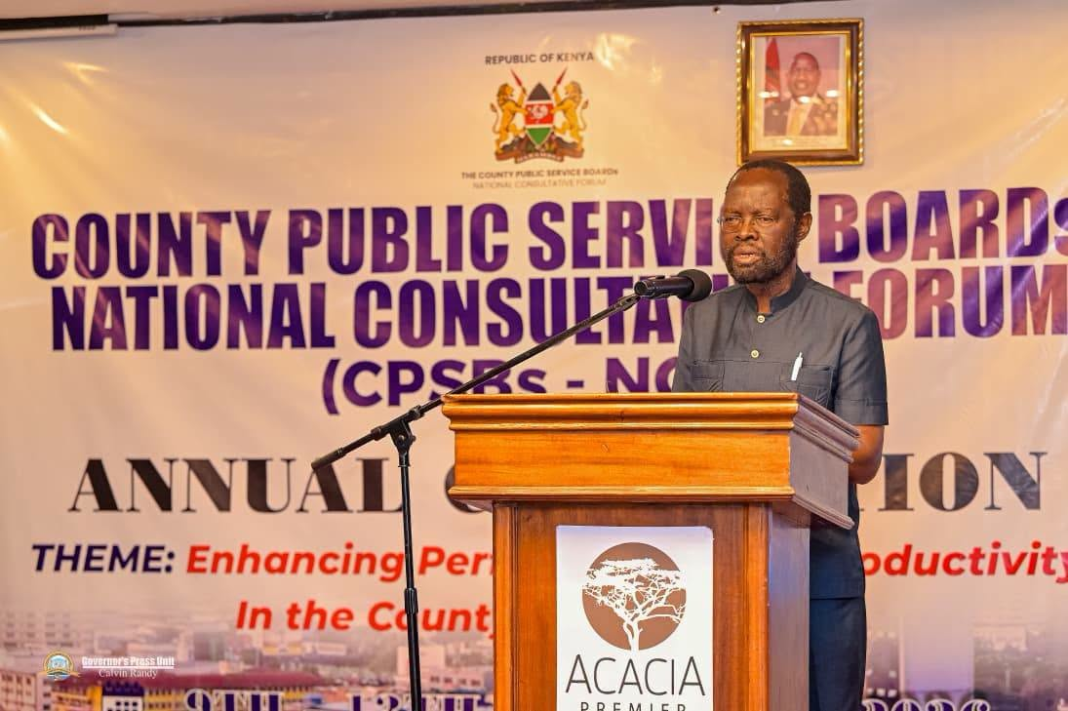
During the recent 2026 annual convention in Kisumu, it emerged that some commissioners were still employees of the county government.
During the deliberations, a commissioner from the Narok County Public Service Board revealed that three members of the board were still actually employees of the county government.
The Ethics and Anti-Corruption Commission (EACC) Director of Preventive Services, Vincent O. Okongo, warned the boards of the dire consequences of violating the law.
He said the EACC would write an advisory to the County Public Service Boards on the matter and that those implicated would be charged in court.
Law
A county employee is generally not allowed to serve as a commissioner (chairperson or member) on the County Public Service Board (CPSB) while actively holding another public or state office.
Key Legal Requirements and Restrictions
Not a Public or State Officer: Under the statutory framework governing county governments (such as Section 58 of the County Governments Act), a person must not be a serving state or public officer to qualify for appointment as a chairperson or member of the County Public Service Board.
Conflict of Interest and Independence: The County Public Service Board acts as an independent body responsible for human resource management, hiring, promotions and disciplinary control over county public officers. Allowing a current county employee to sit as a board commissioner would create a direct conflict of interest.
Political and Office Restrictions: Applicants must also satisfy Chapter Six of the Constitution on leadership and integrity, and must not have held office or stood for election as a member of Parliament, a county assembly or a political party governing body within the preceding five years.
He also raised fresh concerns over the management of public sector payrolls after an interim government audit report revealed potential irregular payments amounting to Sh5.898 billion in the 2024/2025 financial year.
Okongo said weaknesses in government payroll management, employee records and internal controls were exposing public institutions to financial losses and possible manipulation.
Okongo warned that county governments must strengthen their human resource management systems to safeguard public resources.
He cited findings from the interim payroll audit report on the Human Resource Information System Kenya (HRIS-K), which identified missing employee details, invalid Kenya Revenue Authority PINs, multiple identification numbers and shared bank accounts among payroll management concerns.
The audit also reportedly uncovered cases of employees recorded as having been posted before their actual employment dates, while some employees could edit their own records. Millions of payroll records had also been altered without proper timestamps.
Okongo described the findings as a significant governance concern, insisting that digitalisation of public service systems must go beyond technological modernisation to become a tool for strengthening integrity and accountability.
Okongo also urged County Public Service Boards to embrace technology-driven human resource management, noting that systems such as HRIS-K could help improve employee records, strengthen payroll controls and reduce opportunities for ghost workers.
However, he cautioned that technological reforms must be accompanied by strong integrity safeguards to prevent the manipulation of digital systems.
He challenged county public service leaders to measure their legacy not by the number of employees recruited or promotions approved, but by the quality of institutions they build and the services delivered to citizens.
“The people of Kenya do not simply expect us to employ public servants. They expect us to build a public service that serves them with diligence, competence, fairness and integrity,” he said.
Kisumu Governor Prof. Peter Anyang’ Nyong’o challenged the leadership of all 47 boards to ensure that future civil service recruitments were meticulously anchored on strict merit, professionalism and fairness, warning that ambitious county budgets and local development plans could not achieve meaningful transformation without a highly skilled and accountable workforce.
“Devolution will be judged not by the institutions we establish, but by the tangible difference citizens experience in their daily lives,” he noted, urging the delegates to utilise their convention breakout sessions to deeply dissect and expand upon the operational challenges limiting the full potential of local governments.
The theme of this year’s convention is: Shifting from Paperwork to Productivity: Linking Public Sector Promotions to Measurable Performance, with participants drawn from all 47 counties.
The leader challenged the leadership of all 47 boards to ensure that future deployments were rigidly determined by qualifications, regional balance and competence to sustain optimal service delivery.
Okongo said the EACC had conducted corruption risk assessments in several county governments and issued recommendations to address the identified weaknesses, with implementation currently at different stages.
He called on County Public Service Boards to establish effective integrity structures, strengthen internal accountability mechanisms and ensure that employment decisions were guided by merit rather than personal relationships or political considerations.
The warning comes against the backdrop of Kenya’s devolved system of government, which was established under the 2010 Constitution to bring services closer to citizens.
Okongo argued that the success of devolution depended largely on the competence, professionalism and ethical conduct of public servants.
He noted that although county governments might have adequate financial resources and ambitious development plans, such investments would fail to benefit citizens without qualified and motivated personnel.
The EACC director further highlighted the Conflict of Interest Act, 2025, which commenced on 19th August 2025, as a critical legal framework for strengthening accountability in public institutions.
He said the law requires public officers to disclose actual, apparent and potential conflicts of interest and refrain from participating in decisions where their private interests could compromise their official responsibilities.
County governments, he added, must establish institutional mechanisms for receiving disclosures, maintaining conflict-of-interest registers and documenting cases where officers withdraw from decisions because of personal interests.