
By Reporter
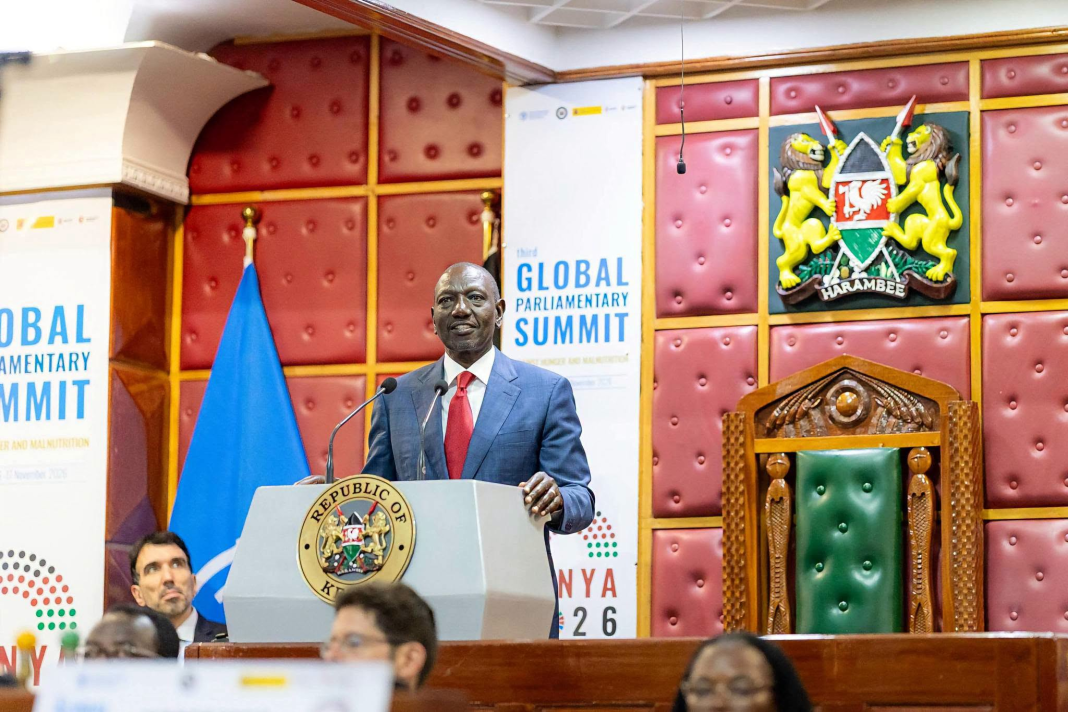
President William Ruto has urged parliaments worldwide to strengthen efforts to combat hunger and malnutrition. He said the world produces enough food to feed its population, but poor policy and investment choices continue to drive hunger.
Speaking at the Global Parliamentary Summit Against Hunger and Malnutrition in Nairobi, President Ruto called for stronger parliamentary action through legislation, budget allocation and oversight.
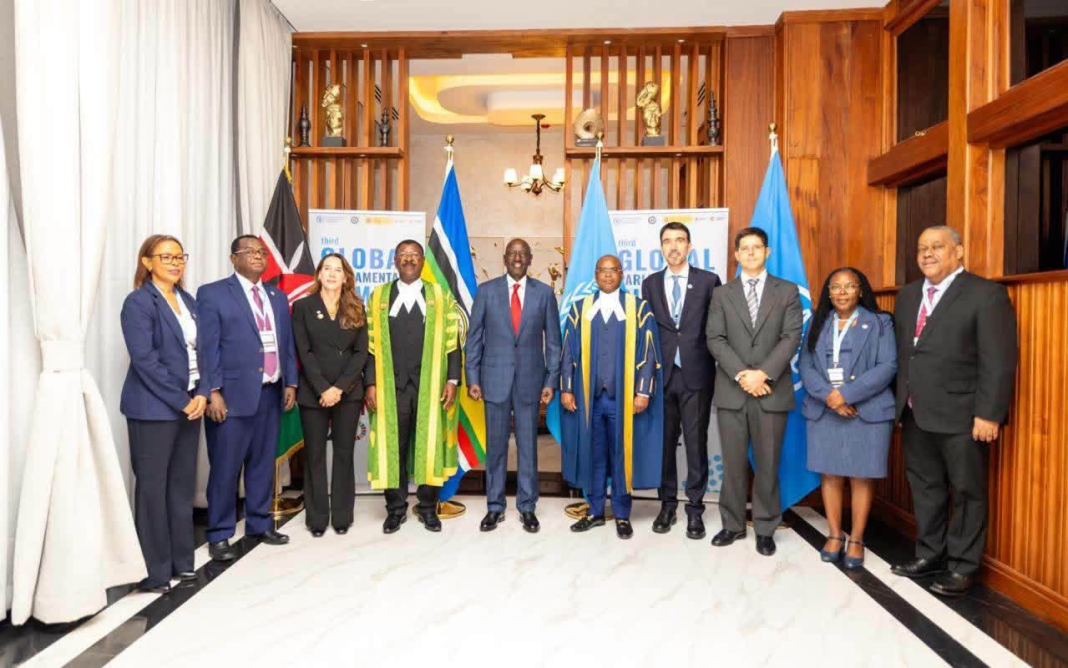
The summit is co-supported by the Food and Agriculture Organization of the United Nations (FAO) and Spain.
President Ruto traced the global parliamentary campaign against hunger from Madrid in 2018 to Valparaíso, Chile, in 2023, where the Global Parliamentary Pact was adopted.
He said the Nairobi meeting provides another opportunity to strengthen the global response.
He warned that Africa could account for nearly 60 per cent of the world’s hungry people if urgent action is not taken. However, he said the continent has the resources to help end global hunger.
“Africa holds more than 60 per cent of the world’s uncultivated arable land, the youngest population and vast renewable energy resources. It is a choice we make when we fail to legislate, to fund and to follow through,” said President Ruto.
He identified legislation, budget allocation and oversight as the three key areas through which Parliament can address hunger.
The President also cautioned that access to food does not necessarily guarantee proper nutrition. He called for greater investment in food quality, agriculture and distribution systems.
Citing Article 43 of the Constitution, which guarantees every person the right to be free from hunger and to have adequate food of acceptable quality, he said the right must be backed by sufficient funding and effective implementation.
President Ruto cited the Government’s Bottom-Up Economic Transformation Agenda (BETA) as an example of efforts to improve food security through increased agricultural production and support to farmers.
He said the Government has distributed more than 38 million bags of subsidised fertiliser to about two million farmers since 2022. The programme has reduced the price of a 50-kilogramme bag from approximately USD 58 to USD 15.
He added that maize production has more than doubled, rising from 34.5 million bags in 2022 to 71 million bags in 2025. This has reduced Kenya’s dependence on food imports.
Milk production has also increased by one billion litres, making Kenya Africa’s largest milk producer. Sugarcane farmers are also receiving bonuses for the first time, he said.
The President expressed concern that Africa spends more than USD 100 billion annually on food imports while continuing to export raw agricultural products.
He called for the effective implementation of the African Continental Free Trade Area (AfCFTA) to connect farmers to markets across the continent. This, he said, would enable African countries to meet more of their food needs through local production and trade.
On financing, President Ruto urged African leaders to mobilise domestic resources instead of relying heavily on external funding.
He challenged parliamentarians to use their oversight role to ensure that national savings, pension funds and sovereign wealth are invested in agriculture and food production.
“Parliamentarians must play a decisive role in unlocking Africa’s potential through effective oversight and by mobilising domestic resources. They must ensure that our savings, pension funds and sovereign wealth are channelled towards supporting our farmers rather than working against them,” he said.
President Ruto officially opened the two-day summit with three calls to action: legislate the right to food, allocate adequate funding and strengthen oversight to ensure resources reach their intended beneficiaries.
“A right without a budget line is a slogan. Legislate, fund and verify that dams provide water, fertiliser arrives and school meals feed children. That is how hunger will be beaten,” he said.
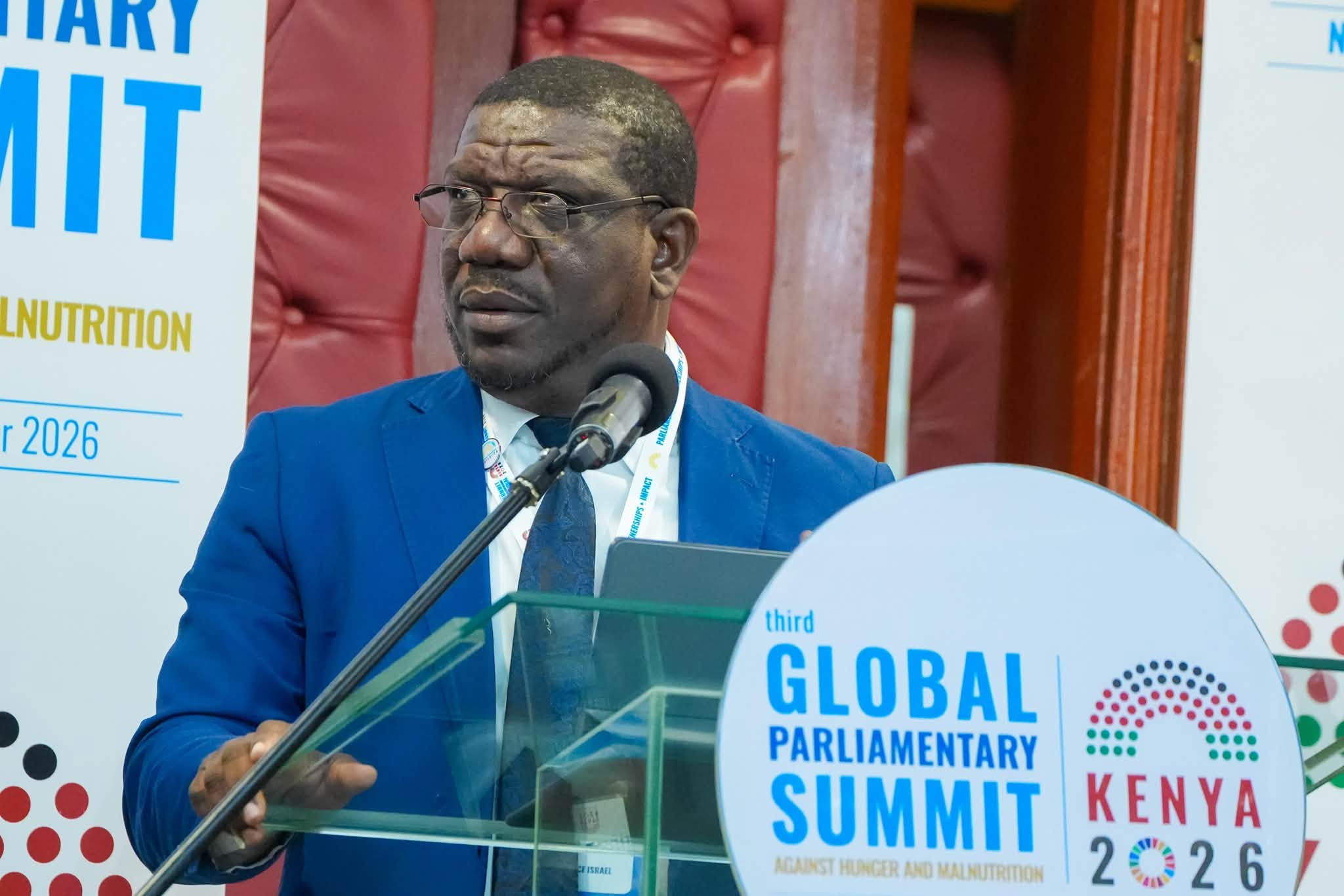
Meanwhile, Minister of Agriculture, Forestry and Rural Transformation of St. Vincent and the Grenadines, Hon. Israel R. Bruce, has challenged international development partners to provide his country with US$2 million (about Sh258 million) to strengthen agricultural production, reduce food losses and tackle hunger and malnutrition.
Hon. Bruce said the targeted investment would help small-scale farmers, women-led cooperatives and rural communities move beyond raw agricultural production through value addition, agro-processing and improved food preservation technologies.
Addressing the Third Global Parliamentary Summit Against Hunger and Malnutrition in Nairobi on Monday, the minister argued that small island developing states were bearing the heaviest consequences of climate change despite contributing minimally to global greenhouse gas emissions.
He said climate change was not an abstract policy discussion for countries such as St. Vincent and the Grenadines but a daily threat to farmers, fishers and families whose livelihoods depend on agriculture.
“For small island developing states like Saint Vincent and the Grenadines, climate change is not a theoretical debate. It is a daily testing of our survival and that of our farmers, our fishers and all our families,” he said.
Hon. Bruce cited the devastation caused by the La Soufrière volcanic eruption and Hurricane Beryl as examples of the environmental shocks that have exposed the vulnerability of the country’s food systems.
He said agriculture and forestry remained the lifeblood of rural communities, but the country continued to face external shocks that disrupted production and threatened food availability.
The minister said his government and Parliament had adopted a three-pronged approach to addressing hunger and malnutrition through legislation, budgetary allocations and rural transformation.
At the centre of the strategy is the Zero Hunger Trust Fund, established through an Act of Parliament and guided by a newly validated 2026–2030 strategic plan.
The fund links social protection with nutrition through school feeding programmes, ecological school gardens and support for senior citizens.
His ministry is also investing in climate-smart crop varieties, rehabilitating watersheds and supporting fishers to make domestic food production more resilient and self-sustaining.
Additionally, the government is using fiscal and public health policies to improve nutrition, including taxes on sugar-sweetened beverages and national dietary guidelines aimed at preventing chronic illnesses.
However, Mr Bruce said these interventions would require greater international support, particularly in financing and technology transfer, to enable small island economies to withstand climate-related disruptions and reduce their dependence on imported food.
He said the proposed US$2 million would support the expansion of agro-processing facilities, school food storage infrastructure, packaging and preservation technologies.
“Value addition turns perishable harvests into year-round nutritious food, cuts costs from post-harvest losses after storms, creates dignified rural jobs, and keeps wealth inside our local economy,” he said.
The minister argued that the investment was modest compared with the trillions of dollars governments worldwide commit to military spending and armed conflicts.
“Parliaments are routinely and swiftly approving trillions of dollars to fund wars, to buy weapons of mass destruction, but yet, when small island developing states or nations that contribute virtually nothing to global carbon emissions ask for a fraction of those resources to fight poverty, climate devastation, and malnutrition, we are met with slow bureaucracy and meagre pledges,” he said.
He called on international development agencies, partner governments and fellow legislators to support small island developing states through fairer climate financing arrangements, agricultural technology transfers and investments that strengthen local food systems.
Hon. Bruce said the Caribbean region continued to face significant food security challenges, citing World Bank figures which put food insecurity at 33.3 per cent in St. Vincent and the Grenadines, 34.4 per cent in Dominica, 22.2 per cent in St. Lucia, 21.1 per cent in St. Kitts and Nevis, and 17.3 per cent in Grenada.
He said the figures demonstrated the urgency of addressing the structural weaknesses that leave small island economies heavily dependent on expensive food imports and vulnerable to international market disruptions.
“Smaller developing states contribute less than one per cent to global greenhouse gas emissions. Yet we stand at the front lines of climate devastation and imported food inflation,” he said.
The minister insisted that developing countries were not seeking charity but fairness and fulfilment of international commitments on climate financing and development assistance.
“We do not ask the world’s wealthier and stronger nations for charity. We ask for justice, partnership, and fulfilment of commitments,” he said.
He challenged developed economies to match their military spending commitments with investments in climate resilience, agricultural technology and food security.
“If the world’s largest economies can find trillions to wage war, they can surely find the will to honour climate finance, transfer agro-processing technology, and stand shoulder to shoulder with small island developing states,” he said.