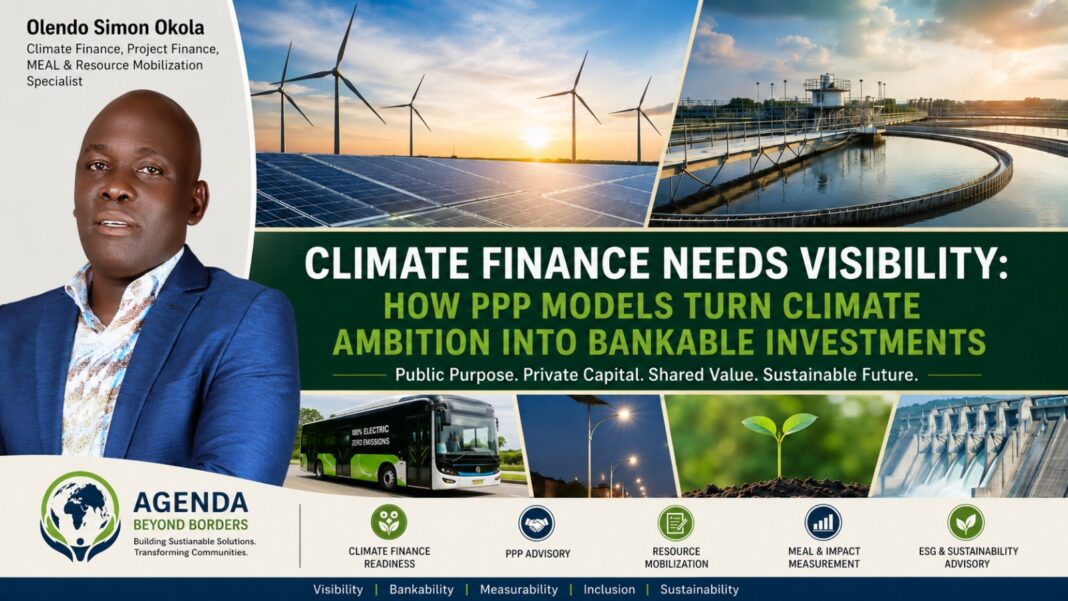

By Olendo Simon Okola
Founder, Agenda Beyond Borders | Climate Finance, Project Finance & MEAL Specialist
Climate finance is no longer a side discussion in development. It has become a central issue in infrastructure planning, public investment, private capital mobilisation, climate resilience, and global economic transformation. Yet, in many developing countries, climate finance remains poorly packaged, poorly communicated, and weakly structured.
The challenge is not only that climate finance is insufficient. The deeper challenge is that many climate projects are not visible, bankable, measurable, or structured in a way that attracts serious public and private capital.
This is where Public-Private Partnership models become important.
At COP29, countries agreed to increase climate finance for developing countries to at least USD 300 billion annually by 2035, while also calling for efforts to scale finance from public and private sources to USD 1.3 trillion per year by 2035. Climate Policy Initiative estimates that climate finance flows reached USD 2 trillion in 2024, but average annual needs from 2025 to 2030 stand at about USD 7.8 trillion.
This gap cannot be closed by grants and public budgets alone. The future of climate finance will depend on how well governments, counties, municipalities, development finance institutions, investors, and technical advisors can convert climate needs into investment-ready projects.
Climate Finance Must Move from Policy Language to Project Pipelines
Many countries have climate policies, Nationally Determined Contributions, national adaptation plans, and green economy strategies. These are important, but investors do not finance policy statements. They finance structured opportunities.
A climate project becomes financeable when it answers practical investment questions. What climate problem is being solved? What asset or service is being financed? Who will build, own, operate, maintain, and transfer the asset? What revenue model will repay the investment? Who carries construction, demand, currency, political, technology, and climate risks? What measurable mitigation or adaptation outcomes will be delivered?
This is where PPP models become powerful.
A climate-smart PPP is not simply a contract between government and a private company. It is a structured partnership that combines public purpose, private capital, technical expertise, risk-sharing, long-term service delivery, and measurable climate impact.
The World Bank identifies several PPP contract structures, including BOT, BOOT, BOO, DBFOM, concessions, and related models, each allocating ownership, financing, operations, maintenance, and transfer responsibilities differently.
Why PPP Models Matter in Climate Finance
Climate finance is not just about finding donors. It is about selecting the right financing and delivery model for the right climate asset.
A solar power project may require a Build-Own-Operate model supported by a long-term Power Purchase Agreement. A water treatment plant may require a Build-Operate-Transfer model. An electric bus system may require an availability-based concession. A public lighting project may require an energy efficiency PPP or energy performance contract.
This distinction matters because each model allocates risk and responsibility differently.
A BOT — Build-Operate-Transfer model allows a private partner to build and operate an asset for a defined period before transferring it to government. It can work for water treatment, irrigation, waste management, and transport infrastructure.
A BOOT — Build-Own-Operate-Transfer model gives the private partner ownership rights during the concession period before transfer. It is useful where the investor needs stronger control over the asset during the project life.
A BOO — Build-Own-Operate model is common in renewable energy projects where private developers build, own, and operate assets while selling power through long-term contracts.
An IPP/PPA model is especially relevant for solar, wind, geothermal, and other power generation projects where an Independent Power Producer sells electricity to an off-taker under a Power Purchase Agreement.
A DBFOM — Design-Build-Finance-Operate-Maintain model is suitable for infrastructure where the private partner manages the full lifecycle of the asset.
A concession model allows a private operator to deliver a public service under regulated terms, often recovering costs through tariffs, government payments, or availability payments.
The key lesson is clear: climate finance does not flow simply because a project is green. It flows when a project is structured around the right revenue logic, risk allocation, delivery model, and measurable climate impact.
Global Examples of Climate Finance PPP Models
South Africa’s Renewable Energy Independent Power Producer Procurement Programme is one of Africa’s strongest examples of climate finance through a PPP-style procurement model. It is best understood as a BOO/IPP model, where private developers finance, build, own, and operate renewable energy plants, while government provides the procurement framework and long-term offtake structure. Since its launch, the programme has mobilised about USD 16 billion in private investment for 79 renewable energy projects totalling 5,243 MW.
Morocco’s Noor Ouarzazate Solar Complex demonstrates a BOOT solar PPP model. Noor Ouarzazate I was structured as a Build-Own-Operate-Transfer PPP, allowing private participation in financing, ownership, operation, and eventual transfer within a public-led renewable energy strategy. This model is suitable where government wants strategic control over climate infrastructure but still requires private capital, technology, and operational expertise.
Egypt’s Benban Solar Park is a strong example of a BOO/IPP model under a long-term PPA framework. ACWA Power notes that its Benban PV IPP project involved a 25-year Power Purchase Agreement with the Egyptian Electricity Transmission Company. This shows how policy clarity, bankable offtake, and investor confidence can unlock large-scale renewable energy investment.
Kenya’s Lake Turkana Wind Power project is best understood as a BOO-style IPP/SPV model. The project sells electricity to Kenya Power under a 20-year Power Purchase Agreement, while the transmission component required separate public infrastructure planning. The lesson is important: renewable energy PPPs must be planned as systems, not isolated generation assets.
Bogotá’s electric bus programme shows that climate PPPs are not limited to power generation. Electribus in Colombia is an availability-based PPP concession, providing 259 electric buses to TransMilenio under concessions running to 2035 and 2036, with operations handled through a separate contract. This model is useful for electric mobility because payments can be linked to asset availability and service performance rather than passenger fares alone.
Brazil’s municipal LED street lighting PPPs also offer practical lessons for African counties and municipalities. IFC and CAIXA supported municipalities to structure public lighting PPPs, with LED replacements capable of reducing energy consumption by about 60%. These smaller climate-smart PPPs are highly relevant for counties, schools, hospitals, markets, and municipalities because verified energy savings can help repay investment.
What This Means for Kenya and African Counties
Kenya and many African countries have strong climate needs and major green investment opportunities. These include renewable energy, water harvesting, climate-smart agriculture, clean cooking, green housing, electric mobility, agroforestry, waste management, resilient schools, climate-smart markets, and county-level adaptation infrastructure.
However, many of these opportunities remain invisible because they are not packaged into bankable pipelines.
Counties should not wait for climate finance to arrive as a grant. They should begin by identifying priority climate assets and classifying them according to suitable PPP models. Which projects can generate user fees? Which can generate energy savings? Which require availability payments? Which can attract carbon revenue? Which require blended finance? Which can be structured as concessions? Which need donor-funded project preparation before private capital can enter?
This is how counties move from climate vulnerability to climate finance readiness.
The New Role of Climate Finance Advisors
The next generation of climate finance professionals must go beyond proposal writing. Proposal writing is important, but it is not enough.
A serious climate finance advisor must understand project finance, PPP structuring, blended finance, ESG, carbon markets, adaptation metrics, public investment planning, risk allocation, and local development priorities.
The advisor must help governments and organisations identify climate-relevant assets, select suitable PPP models, design measurable impact indicators, structure partnerships, prepare bankable documentation, and communicate the investment case to donors, lenders, investors, communities, and public institutions.
Climate finance that is not visible cannot attract partnerships. Climate impact that is not measured cannot attract confidence. Climate projects that are not structured cannot attract capital.
Conclusion
The global climate finance conversation is shifting. It is no longer enough to say that developing countries need support. The new question is: where are the bankable projects, who is ready to implement them, how will risks be shared, and how will impact be measured?
PPP models are not a magic solution. Poorly designed PPPs can become expensive, exclusionary, and politically contested. However, well-structured climate-smart PPPs can unlock private capital, accelerate technology transfer, improve service delivery, and deliver measurable climate outcomes.
For Africa, the task is urgent and strategic. We must make climate finance visible. We must package climate needs into investment-ready opportunities. We must build institutions that understand both public value and private capital. We must move from climate vulnerability to climate finance readiness.
The countries, counties, and organisations that master this transition will not only receive climate finance. They will shape the future climate economy.
About the Writer: Olendo Simon Okola is the Founder of Agenda Beyond Borders, a climate finance, project finance, MEAL, and resource mobilisation consulting firm that supports governments, counties, NGOs, CBOs, private sector actors, and development partners to design, package, finance, implement, and measure climate-smart development programmes. Through Agenda Beyond Borders, he provides advisory support in climate finance readiness, PPP structuring, donor mapping, proposal development, ESG positioning, carbon markets, MEAL systems, and impact reporting. His work focuses on helping institutions move from climate vulnerability to investment readiness by making projects visible, bankable, measurable, inclusive, and attractive to public and private finance.