By Donald Agwenge
On 17th August 2020, Senator Mutula Kilonzo Jnr told Senator Moses Kajwang to “keep your cool boy, this is not a laughing matter, sit down and listen to wisdom.” Exactly five years later, my senator has once again lost his cool. He struts with hollow braggadocio that Parliament is powerful enough to impeach the president, while the president cannot touch a sitting member of Parliament. He is wrong, and this is another moment to sit down and listen to wisdom.
President William Ruto has boldly declared Parliament a corruption zone and a house of extortion. He has thrown MPs under the bus, and the Parliament of Owls has responded with predictable buffoonery. They have threatened to slow down the government’s agenda, summon and harass top officials, and even imagine impeaching the president in their wildest dreams. Yet MPs themselves have admitted that bribery thrives in their ranks, with some confessing colleagues can be bought for as little as ten thousand shillings, cheaper than a pig and a Merino sheep. Ruto has merely confirmed what Kenyans, especially Gen Z, concluded on 25th June last year when Parliament betrayed the people by passing the punitive Finance Bill.
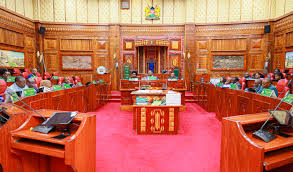
The counterattack has already begun. For the first time, a Parliamentary Group meeting was aired live on television, where the president and his Baba used the moment to lecture MPs and bring them back to order. In doing so, Ruto distanced himself from Adipo Sidang’s image of King Tula Nyongoro in Parliament of Owls. That dishonour now rests with the two speakers of Parliament, presiding over a House of voracious owls condemned by the people and shamed by the head of state.
Their reaction is not surprising. Around the world, legislatures accused of corruption react the same way. In Nigeria, President Olusegun Obasanjo accused parliament of graft. The MPs, as unpopular as ours, tried to intimidate him with impeachment but failed miserably. They then blocked budgets and demanded concessions. Ruto should expect this tit-for-tat political brinkmanship. In the 1950s, Harry Truman called the U.S. Congress “do-nothing and corrupt.” They retaliated by slowing down his agenda and dragging his officials before committees. Dilma Rousseff in Brazil and Roh Moo-hyun in South Korea also condemned their parliaments, and both faced impeachment.
Truman did not face impeachment but saw his approval ratings sink and he chose not to run again. The others lost office, but history remembers them for daring to speak out. Is this President Ruto’s wildcard? To risk his re-election in order to confront corruption at the highest level? He has always been a chess master and I don’t think he would lose against pigs at the feeding trough of August House gluttony. In a contest between Parliament on one hand and the presidency on the other, Kenyans will back him. A super majority already lost confidence in Parliament on 25th June.
President Ruto also holds a joker card. He can borrow from President Charles de Gaulle in France. In 1962, de Gaulle accused the French Parliament of obstruction and corruption. MPs there, like ours today, threatened to sabotage his agenda and talked of impeachment. He was ahead of them. He dissolved Parliament and called snap elections. The people rewarded him with a stronger mandate. When are you dissolving this parliament, Mr. President? Gen Z are ready to bring younger blood focused on their cardinal roles of legislation, representation and oversight, not bribe seekers.
Kenya’s Constitution provides the avenue in Article 261 that gives the president power to dissolve Parliament if it fails to discharge its obligations. Chief Justice David Maraga already issued an advisory on this. The president therefore holds the power to send MPs home within ninety days. Senator Kajwang’s empty swagger that “the president can do nothing to them” will soon be proved as either ignorance or the deliberate deception of a drowning man clutching at straws.
Parliament’s perfidy last June sealed its fate. On that day, MPs chose stomachs that never get full over Kenyans, the real Tumbo Lisiloshiba. Kenyans saw clearly that the problem is not the people but the gluttons who pretend to lead them. Even the youth, often hostile to Ruto, agree with him this time. We are products of classrooms where we read Imbuga, Ngũgĩ, Achebe and Mazrui. They told us betrayal and greed would define our politics. What we are living now is betrayal writ large, a Parliament of extortionists feeding on the nation while pretending to serve.
Between Ruto and Parliament, Kenyans have already chosen. He is not King Tula Nyongoro. That crown belongs to Speaker Wetang’ula and his counterpart in the Senate, who preside over the owls’ gluttony and their endless charade. Against them, the president has the people on his side.
Abraham Lincoln once said “you can fool all the people some of the time and some of the people all the time, but not all the people all the time.” On 25th June, Parliament discovered this the hard way. If President Ruto continues to hold up the mirror, history will remember him as the man who refused to play King Tula Nyongoro in Wetang’ula’s Parliament of Owls.
The writer is a Big Data Strategist. agwenge@nexsms.africa