By Anderson Ojwang
Ndhiwa Sub County in Homa Bay County, Kenya, has high rates of early marriage and teenage pregnancy. Reports of forced marriages and defilement of minors are common vices in the region.
For teacher Caroline Kisuge, once a teacher in the area, it was painful to see the future of a bright girl, who suffered from visual impairment, cut short when she was married off at the age of 14.
“I went back for training at the Kenya Institute of Special Education (KISE) for special needs training. I had developed a strong bond with my pupil and facilitated her learning.
I had a visually impaired girl in my class. I wasn’t able to read Braille or transcribe her work. She was very bright but depended on one officer covering a wide area, who would only come after a fortnight for a few hours.
The girl ended up dropping out of school, and when I followed up, I found out she had been married.
I felt she was wasted, considering how bright she was. If it were today, I would have placed her in a school for the visually impaired so she could fully benefit. It’s sad that I can’t trace Millicent, but her case haunts me to this day,” she says.
However, Millicent’s predicament ignited Kisuge’s desire to help persons living with disabilities. After completing her training as a special needs teacher in Autism Spectrum Disorders, she founded the Jonathan Rays of Hope organisation, focusing on advocacy and empowerment of PLWDs (Persons Living with Disabilities) through Neurodiversity Mashinani.
Kisuge is also a consultant on Autism matters and an award-winning champion of disability rights. She has been recognised by the Diar Awards for her work in promoting inclusion for PLWDs.
“Autism Spectrum Disorders are lifelong neurological developmental conditions that affect communication, social skills, and the way a child interacts with the environment and objects. The severity varies from mild to profound, and symptoms become evident by the age of three.
During training, we visited several special schools as part of our orientation. Some trainees packed their bags and abandoned the course, saying they couldn’t handle the nursing aspect of it—the foul smells from children with drooling and bowel incontinence problems.
For me, I promised to do my best and started viewing life differently. I appreciated the children God gave me and stopped complaining.
It also helped me understand the stages of growth and development in my own children.
I learnt about individual differences and how to accommodate people with diverse needs.
I became more patient with life. I gained so much knowledge, and when I looked at my village, I promised to make disability matters visible in rural areas,” she says.
Kisuge believes that special needs training is essential not only for teachers but also for parents and anyone handling children at different levels in the community.
“My organisation started when I began visiting children from my classroom at home.
I realised they were going through so much. I rescued several children who needed medical attention and better nutrition, as well as those living in poor shelter conditions and suffering from neglect due to stigma associated with PLWDs.
I needed to rehabilitate them. I tried several orphanages, but they could only admit those who were independent.
This took a toll on me when I had to return them to the same conditions I had found them in,” she says.
For her work, Kisuge has received recognition, but she believes the greatest reward is changing and improving the lives of needy children.
“Yes, I received an award from the Diar Awards 6th edition as an Inclusion Champion for PLWDs. The process involved rigorous nominations and online voting, followed by a background check on my public performance.
We were awarded at a ceremony held in Nairobi. This year, my organisation has again been recognised by the same awards for championing PLWD inclusion as a community-based organisation (CBO),” she says.
Despite the harsh economic situation in the country, Kisuge is so selfless that she spares part of her salary and earnings to support the children under her organisation.
“I have a few well-wishers who support us, but mostly, I use my salary and earnings from consultancy work to run the rehabilitation and habilitation centre for abandoned and neglected PLWDs in rural areas.
I have spearheaded donation drives for assistive devices. I started by buying crutches and walking frames with my own money and donating them to those in need.
I also launched a wheelchair appeal and received support from well-wishers. The first case I encountered was from Gwassi, where a child with cerebral palsy had been placed in a sufuria (cooking pot) for 11 years because they lacked a wheelchair. The child couldn’t sit on a chair, so the pot was used to carry them around.
A friend supported the process, and we facilitated a solution for the mother.
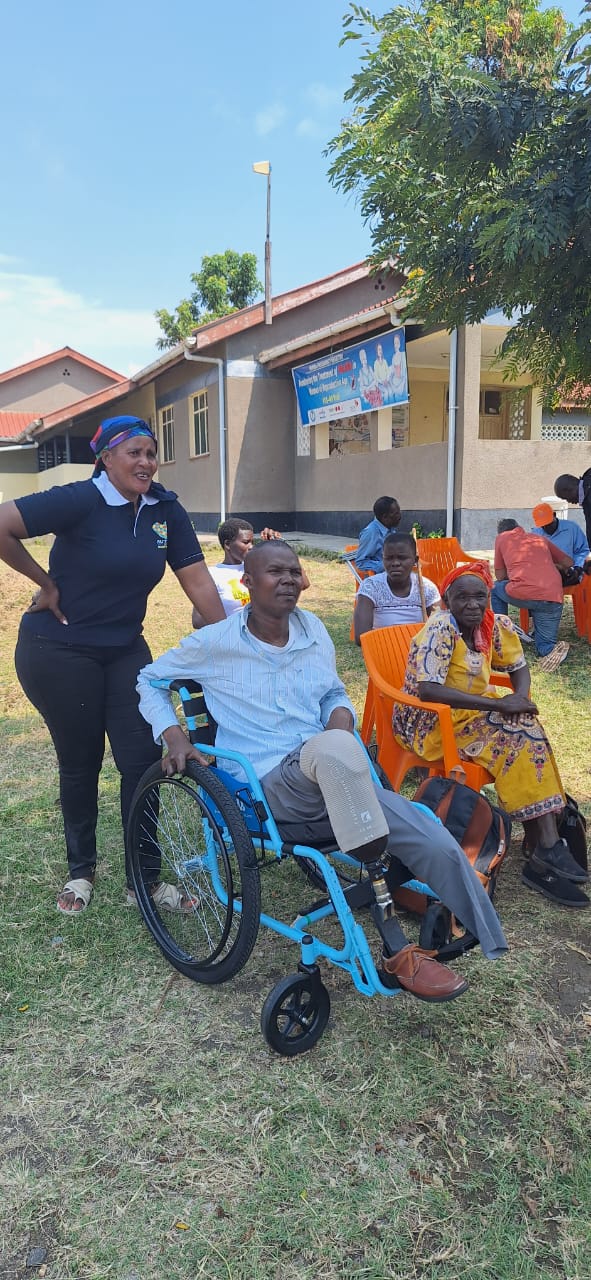
I later partnered with Litein AIC Hospital and missionaries, who donated 31 wheelchairs in Mfangano Island last August. This year, we have donated 72 wheelchairs in Rusinga Island.
The First Lady of Migori County, Dr Agnes Ayacko, has also donated 200 wheelchairs from the Walkabout Foundation to support needy cases in the county.”