By James Okoth
25/10/2025.
When a young Raila Amolo Odinga arrived in the industrial town of Magdeburg, then part of East Germany, in 1965, he was just another bright African student in a foreign land. He was hopeful, determined and quietly burning with the promise of post-independence Kenya. What the Germans didn’t know then was that the man adjusting welding torches and sketching machine designs at the Technical School of Magdeburg would one day become one of Africa’s most resilient political engineers.
At the time, Magdeburg was a city of steel and smoke. Raila immersed himself in this world of precision and pressure, studying Mechanical Engineering and Welding Technology, learning not just the art of design, but the discipline of systems —how to build, maintain and when necessary, to dismantle.
Those lessons would later find their echo not in workshops, but in Kenya’s parliaments, rallies and protests.
When he returned home in 1970, Raila applied his technical skills in the literal sense, lecturing at the University of Nairobi and later, founding East African Spectre, a company that became a pioneer in gas cylinder manufacturing. But the engineer’s soul in him wasn’t confined to blueprints and welding rods. He saw a nation in need of redesign,a political structure welded together by colonial interests, corroded by inequality and in need of recalibration.
He began the lifelong project that would define him: re-engineering Kenya.
Every political era he entered became a schematic drawing entailing a system to be examined, understood and improved. When he entered Parliament, he pushed for constitutional reforms that strengthened democracy’s framework. When he joined the opposition, he built alliances across party lines, connecting broken circuits of trust.
Like a craftsman, Raila tested ideas through trial and resistance, knowing that real change, like a good weld, required both heat and precision.
Raila Odinga’s political design did not stop at Kenya’s borders. His voice became an instrument of African integration, democracy and good governance. From mediating post-election crises in Kenya and the region, to championing infrastructure projects across the continent as African Union’s High Representative for Infrastructure, Raila’s influence extended across the map.
The Magdeburg training, the emphasis on systems thinking, structure and endurance, seemed to echo in his diplomatic wiring. He approached governance the same way an engineer approaches a machine: not as chaos to be feared, but as complexity to be mastered.
He saw Africa as an interlinked network of transport, trade and leadership systems, all in need of fine-tuning for progress. His global voice, shaped in that quiet East German city, grew into one of Africa’s most powerful calls for justice and reform.
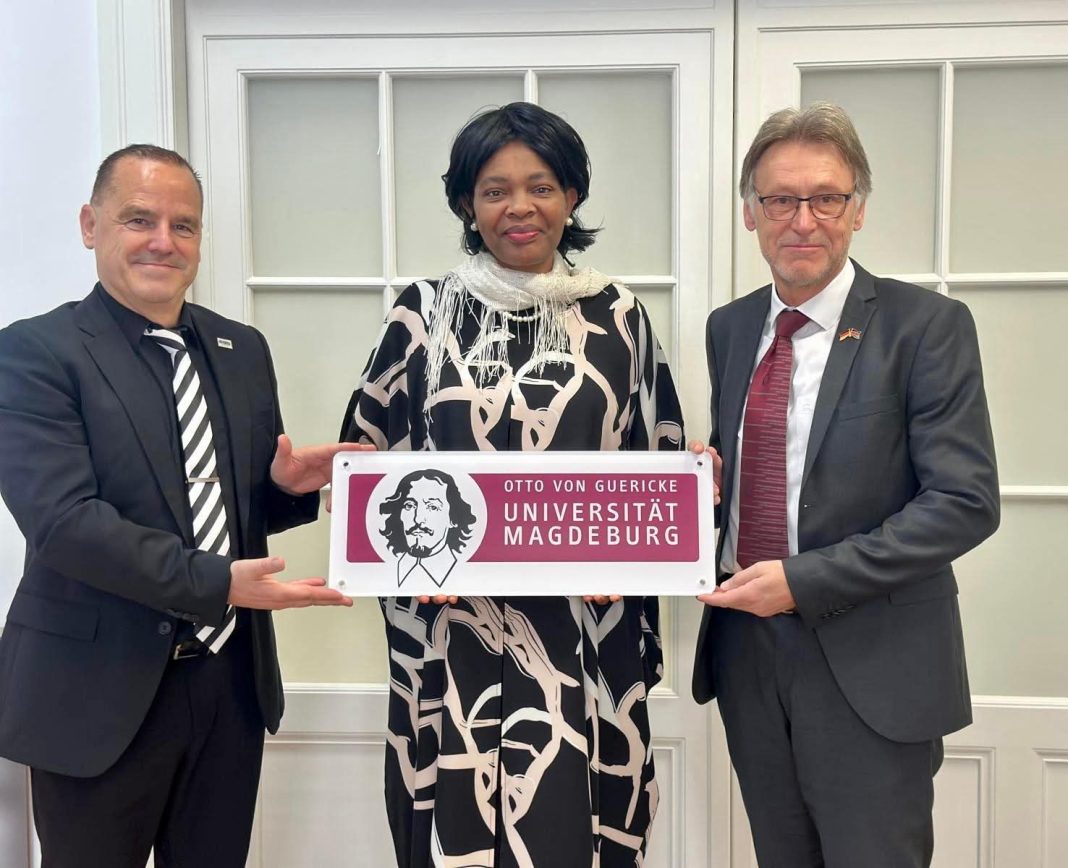
Following his state burial on 19th of October 2025, Magdeburg University, now the Otto von Guericke University Magdeburg, joined the world in honouring one of its most distinguished alumni.
During a visit to Kenya’s Embassy in Berlin, university president, Professor Dr. Jens Strackeljan, presented a commemorative university plate to Ambassador Stella Mokaya for delivery to the Odinga family.
Strackeljan described Odinga as “a great engineer and bridge-builder,” saying his technical training in Magdeburg had a lasting influence on his public career.
“Raila Odinga was a great engineer and bridge builder,” he said, “The new programme will be named after Raila and will strengthen educational and cultural ties between Kenya and Germany,” he revealed part of the objective behind a new university program to honour Raila Odinga, symbolizing Raila Odinga’s enduring connection to the institution that first sharpened his mind and moulded his worldview.
In the end, the man who once welded steel in Magdeburg went on to weld together a nation’s hopes and, in the process, engineered a legacy that will stand as one of Africa’s most enduring blueprints for democracy.