Home Blog Page 141

A 71-Year-Old Nakuru man to trek to Homa Bay for Madaraka Day Celebrations

0

By Habil Onyango

A 71-year-old gentleman from Nakuru County is poised to make history by walking to Homa Bay County to participate in the Madaraka Day celebrations.

Steven Kariuki is determined to reach Homa Bay Town, the County headquarters, where the festivities are scheduled on Saturday, June 1, 2024.

In a video shared by Homa Bay County Commissioner Moses Lilan, who encountered the dedicated Kenyan in Kericho while en route to the Homa Bay on Sunday, Kariuki declined an offer for a lift to Homa Bay.

From Nakuru to Homa Bay is approximately 230 Kilometers and takes 4 hours 30 minutes via road.

According to Kariuki, he started his journey on May 21 and anticipates walking the entire distance to the “County of Endless Potential”.

President William Ruto, alongside other leaders, is expected to preside over the celebrations, which will take place at Raila Odinga Stadium.

The County Commissioner inquired, “Now that I have met you in Kericho and I am also headed to Homa Bay, can I offer you a lift so that we can travel together?”

Kariuki however, stated, “I have made a personal commitment to walk to Homa Bay; however, I appreciate the offer.”

Kariuki perceives this trek as a demonstration of patriotism that he hopes will inspire other Kenyans. He noted that the upcoming Madaraka Day celebrations will mark his thirteenth event attended through walking.

“I have participated in Madaraka Day celebrations in Kakamega, Kericho, Kisii, Kirinyaga, Embu, and Nairobi, where I have attended five times, among other locations,” he shared.

“My objective is to join fellow Kenyans during this significant occasion and celebrate together,” he emphasized.

Moreover, Kariuki urged his fellow citizens to foster peace, love, and harmony while rejecting tribal divisions.

“In Kenya, we constitute a singular entity, and our identity is that of Kenyans.

We must collectively express love for our country; we are all interconnected,” he stated.

The County Commissioner assured Kariuki that he would arrange accommodations in Homa Bay and offered to cover for his return journey to Nakuru County.

“You are welcome to Homa Bay.

Once you arrive, please call me.

I will provide you with a place to stay and ensure your fare back to Nakuru is covered,” Lilan promised.

Kariuki is a family man, and he is also a grandfather.

Kenya’s Planning and Development Department Champions Child Protection Reforms Amid Funding Challenges

0
Junior Secondary Schools

By Billy Mijungu

Nairobi, Kenya – The Planning and Development Department within the State Department for Children Welfare Services has emerged as a cornerstone in Kenya’s efforts to safeguard children’s rights and welfare, according to recent disclosures by senior officials in the ministry.

Operating under the Children Act 2022, the department is mandated to coordinate national child protection systems, build workforce capacity, and support data-driven policy and program decisions.

Its work is driven by a vision of a society where all children enjoy their rights and responsibilities and a mission to strengthen the legal and institutional framework supporting children’s welfare.

The department is responsible for overseeing budget planning, managing the national Child Protection Information Management System (CPIMS), and guiding performance management, research, and evaluation.

It also coordinates strategic workplans, manages public communication, and evaluates the effectiveness of child protection policies and programs.

Among its key achievements is the successful scale-up of the CPIMS, now managing records of over 2.7 million children.

Officials note that this has greatly enhanced national coordination and visibility of child protection cases.

The department has also led the development of a standardized curriculum for child protection officers, which is now being delivered through the Kenya School of Government, further strengthening the capacity of over 1,000 trained volunteers and frontline workers.

One of its flagship initiatives, the International Conference on Child Protection in Africa, has positioned Kenya as a regional leader in child welfare dialogue.

The conference has attracted stakeholders from more than 22 African countries and played a critical role in advancing care reform and national child protection policies.

Despite the progress, the department faces major challenges. Limited budget allocations have stalled several key activities including regular supervision of children, improvement of office infrastructure, and roll-out of services at the county level.

A shortage of technical personnel and inadequate ICT equipment continue to hinder operations.

Additionally, overreliance on donor support raises concerns about the sustainability of the department’s long-term goals.

In response, the department is calling for increased government investment, enhanced staffing, acquisition of digital tools, and greater financial autonomy for the State Department for Children Welfare Services.

It also highlights the need for deeper collaboration with development partners and stakeholders to scale successful interventions and promote sustainable protection systems.

Officials have recognized the critical role of partners including UNICEF, USAID, and numerous civil society and faith-based organizations. Their continued support remains key to advancing the department’s child-focused mission.

As Kenya continues to reform its child welfare landscape, the Planning and Development Department stands at the forefront, championing innovation, accountability, and inclusivity for the country’s youngest and most vulnerable citizens.

Don gets Sh10.5 m court Award

0

By Kepher Otieno

In a landmark ruling that reinforces the legal obligation of institutions to honor employment contracts, the Employment and Labour Relations Court in Kisumu has awarded Professor Atieno Ndede Amadi a total of KSh 10,185,000 in unpaid salary arrears and gratuity.

The judgment, delivered by Justice Nzioki wa Makau, marks the end of a protracted legal dispute between Prof. Amadi and her former employer, Great Lakes University of Kisumu (GLUK), over the non-payment of dues owed during her tenure.

The ruling also sends a strong message to universities and other institutions of higher learning about the importance of adhering to lawful employment agreements and ensuring timely payment of staff entitlements.

It highlights the courts’ willingness to intervene where employees’ rights have been violated and sets a precedent for academic professionals seeking redress for contractual breaches in the education sector.

Prof Amadi, a highly respected scholar and administrator, and a Columnist, served as the Vice Chancellor of GLUK under a five-year contract term, where she was credited with initiating critical reforms, expanding academic programs, and strengthening institutional governance.

Despite her extraordinary contributions to the institution, her employer-GLUK failed to remit part of her agreed-upon compensation package, including salary arrears and gratuity, upon the conclusion of her service contract.

Frustrated by the university’s inaction, Prof Amadi filed a legal suit seeking justice and the enforcement of her legal employment rights.

After a lengthy court process, the judge in the case ruled in her favor, confirming that GLUK had indeed failed to meet its financial obligations.

I am relieved and grateful that justice has prevailed,” said Prof Amadi shortly after the court ruling.

The court case was filed by the claimant on 4th September 2023 and judgment delivered on 12th May 2025.

This case was not only about the money — it was more about justice, fairness, professional dignity, and the value of academic leadership,’’ said Prof. Amadi.

Although the Claimant, Prof. Amadi, had demanded Shs. 12,675,000, in delivering the verdict, Justice Wa Makau ordered GLUK to pay her a total of Kshs.10,185,000 Million.

The principal sum covers the full extent of unpaid salary arrears and gratuity, as stipulated in her contract, plus costs of the suit and interest on the sums awarded at court rates.

This is from the date of judgment until payment in full.

The ruling has been hailed by academicians and other professionals alike as a critical step in advancing accountability and transparency in the governance of institutions of higher learning and others.

Prof.Amadi is a trailblazer in the fields of information systems, finance and academics.

With decades of experience in academia through teaching, research, and administration, she has held various senior positions in both the university and other sectors.

Her tenure at GLUK marked a period of transformation for the institution, especially in building collaborative links and other networks between the university and global research and other institutions.

The outcome of her case is being viewed as a potential precedent for academic professionals who often face delays or denials in receiving their rightful benefits, especially upon exiting leadership roles.

Her Legal experts led by Michael Okelloh of Row Advocates, LLC averred that the judgment sends a strong message to employers, particularly in academia, about the legal consequences of breaching employment contracts.

The defense team in the case was led by Owiti, Otieno & Ragot Advocates of Kisumu. The case was filed on 15/5/25. Ragot said they will contest the matter further.

According to Prof’s lawyer, they intend to proceed to the Court of Appeal in the event the varsity delays in upholding and effecting the jury.

Madaraka Day in Homa Bay — A Celebration of Freedom and a New Chapter of Development

0

By Kepher Otieno

As Kenya marks another Madaraka Day on June 1st, we not only celebrate our hard-won internal self-rule attained in 1963, but also the unfolding promise of equitable development under the leadership of President William Ruto.

This year, the spotlight shines on Homa Bay County—a region rich in history, potential, and now, renewed hope.

Madaraka Day has always stood as a symbol of self-determination, a reminder of our freedom fighters’ sacrifice, and a moment to reflect on the journey toward national unity and shared prosperity.

In recent years, it has evolved into more than just a day of commemoration—it has become an instrument of transformation.

The policy to rotate national celebrations among counties is not only inclusive but visionary.

And Homa Bay, this year’s host, is a shining example of what this model can achieve.

President Ruto’s Hand in Homa Bay’s Transformation

It would be remiss not to acknowledge the role of President William Ruto in Homa Bay’s current transformation.

In a county long overlooked despite its strategic location and abundant resources, the President has shown a genuine commitment to rewriting the narrative.

By championing infrastructure upgrades, affordable housing, trade facilitation, and improved public services, President Ruto has sent a clear message: development is a right for all 47 counties, not a privilege for a few.

The residents of Homa Bay have taken notice. Many I spoke to—business owners, boda boda riders, farmers, youth—shared a similar sentiment: they feel seen, heard, and empowered.

Come the 2027 general election, several said they will remember who made this difference possible.

We owe the Ruto-led government a debt of gratitude,” one resident told me. “This time, we will say thank you with our votes.”

A United Front: National and County Governments in Sync

Also deserving of recognition is Homa Bay Governor Gladys Wanga, who has worked hand in hand with the national government to ensure that this opportunity delivers long-lasting benefits.

Her openness to collaboration and shared development goals has created a seamless partnership, one that prioritises results over rhetoric.

Governor Wanga herself has lauded the rotating Madaraka Day model as a game-changer, calling it an inclusive approach to nation-building.

Her leadership, alongside that of local officials and Principal Secretary Dr. Raymond Omollo—a humble son of the region and an industrous technocrat and beaucrat—has accelerated the implementation of key projects across the county.

Already, the results are visible. Roads have been upgraded, streetlights switched on, housing projects launched, and the local stadium transformed into a modern facility.

These aren’t mere cosmetic changes; they are investments in the people of Homa Bay, catalysts for trade, tourism, and jobs.

Beyond infrastructure, Homa Bay is now positioning itself as a hub for agriculture, fisheries, real estate, and manufacturing. Investors are paying attention. Land values are rising, and the mood across towns and villages is hopeful.

Madaraka Day, it seems, has not only revived the spirit of freedom—it has reignited the engines of growth.

The success in Homa Bay is proof that when counties are given national attention, they rise to the occasion. Rotating national celebrations is more than symbolism; it’s a strategic tool for decentralizing opportunity. It spreads both visibility and value across the republic.

As we gather to mark Madaraka Day this year, let us honour our past while embracing a more equitable future—one where no county is forgotten, and no Kenyan is left behind. President Ruto’s leadership in this endeavor is commendable, and Homa Bay stands today as a living testimony to what visionary governance can achieve.

For the people of Homa Bay, this Madaraka Day is more than a national celebration.

It is a thank-you note to a government that remembered them, believed in them, and delivered for them.

They owe President Ruto more rewards in the 2027 General Elections at the ballot so that more such developments can continue for the common good of all.

The writer is a media consultant and regular commentator on governance, democracy and development.
Kepherpeace@gmail.com

The Nairobi Race!

0
Billy Mijungu

By Billy Mijungu

The Nairobi gubernatorial race will be the country’s political barometer. No contest will embody the mood and direction of Kenya’s political future quite like this one. As the capital city, Nairobi is not just an administrative hub; it is the heartbeat of the nation, a melting pot of tribes, interests, business, and politics. Whoever wins Nairobi commands more than just county power they become a national figure with immense influence.

So far, the field is shaping up with key political figures throwing their hats into the ring. Irungu Nyakera of the Democracy for the People Party, Babu Owino, Dennis Waweru, Tim Wanyonyi, and the sitting governor Johnson Sakaja are among those staking their claim. Each of these individuals brings with them a base, a history, and a promise. Yet, beneath the surface of personality and policy lies the raw arithmetic of tribal and political alliances.

It is important to remind those vying for this seat of one enduring truth. The Kikuyu population in Nairobi tends to vote as a block. Their unity at the ballot is often unmatched. While they are around one hundred and fifty thousand votes fewer than the combined total of the Western Kenya formations and the Kamba vote, they are consistent and coordinated. This fact cannot be ignored. Every time the Western vote is split, it gives the Kikuyu vote more power and potential to decide the winner. Ironically, despite this numerical strength and cohesion, the Kikuyu have never held the governor’s seat in Nairobi. Their votes have instead helped deliver the seat to others.

Take, for example, the election of Mike Sonko, a Kamba, who rode on significant Kikuyu support. Before him, Evans Kidero, a Westerner, defeated the Kikuyu candidate Waititu, thanks to tacit backing from the Kamba bloc. In 2022, Polycarp Igathe, a Kikuyu candidate, failed to clinch the seat despite massive Kikuyu support. Why? Because the community supported a Western candidate, Johnson Sakaja, under the United Democratic Alliance party, a party with a Kikuyu-dominated voter base in the city.

The Kikuyu may not have had a governor yet, but their kingmaking ability is well established.

Looking at the Nairobi County Assembly numbers, the pattern becomes even clearer. Nearly half the elected Members of County Assembly come from the Kikuyu community, a consistent trend that underscores how effectively the Kikuyu numbers game works in the capital. This numerical strength translates into influence, presence, and negotiation power within Nairobi’s political ecosystem.

Looking ahead, today’s political dynamics suggest an even more interesting turn. The Democracy for the People Party will field a Kikuyu candidate, likely consolidating the Kikuyu block behind them. Jubilee, though historically a Kikuyu party, does not seem to have the momentum to carry Dennis Waweru across the finish line. The DCP appears to have captured the imagination and loyalty of the Kikuyu electorate in Nairobi.

Meanwhile, the Western vote is again likely to be divided. With Babu Owino and Tim Wanyonyi both eyeing the seat, unity among Western Kenya voters is improbable.

However, all is not lost. Governor Sakaja still has a chance to consolidate Western support and defend his seat. Similarly, Babu Owino could galvanize the Western bloc, especially if he runs on the Wiper Party ticket.

If he secures that platform, he would gain a significant edge and could emerge as the candidate to beat. His youthful energy, populist appeal, and ground mobilization skills would give him a fighting chance in what is sure to be a high-stakes race.
All in all, it looks like anyone could be Governor of Nairobi in 2027.

The race is wide open. The only certainty is that Nairobi will once again set the tempo for the nation’s political pulse.

Follow the unfolding narrative on Facebook, X, Instagram, TikTok, and LinkedIn @BillyMijungu

Forward #TusongeMbele

Mudavadi Urges Malava Electorate to Vote Wisely in the By-election

0

By OPCS PRESS SERVICE

He tells Western Kenya to continue supporting Ruto’s agenda

MALAVA – Prime Cabinet Secretary Musalia Mudavadi has urged the Malava electorate to vote for a leader who will unite the people and prioritise the development agenda.

He told residents that once the IEBC is fully constituted and the date for the by-election is announced, it will be their civic duty to elect the right leader.

The electorate is preparing to vote in a new Member of Parliament following the death of Malulu Injendi in February this year.

“Once again, Malava has an opportunity. Don’t vote for a joker. What we are witnessing in some parts of the country is a result of the electorate not taking their civic duty seriously when choosing leaders,” said Mudavadi.

“A good leader for Malava is a good leader for Western Kenya and, ultimately, a good leader for Kenya. Build on the foundation of Malulu and do the right thing, kwa sababu uamuzi uko mikononi mwenu,” he added.

Mudavadi reminded the electorate of the good working relationship between their late MP and President Ruto’s administration, and challenged them to rise to the occasion when the time comes.

He stated that the government under President Ruto is ready and willing to continue supporting Malava’s leaders and help the Western Kenya region realise its development goals.

“Please, give the forthcoming by-election very serious thought. President Ruto has shown every spirit and direction that he is working with the people of Malava and wants to continue doing so. Show him, and everyone else, that this is a serious partnership,” said Mudavadi.

“Mimi ni mtu wa Kenya Kwanza, and you have given me a lot of respect. First of all, you disciplined me — mlinichapa na mawe hapa Malava siku moja, mkaninyorosha nikakuwa straight. After that, our partnership has grown and become very good. And you have always given me the highest number of votes. When I vied for the presidency, Malava stood with me. No other constituency gave me more votes than Malava,” he added.

Mudavadi was speaking during the burial of Mzee William Lumati, the father of the newly installed Chancellor of Co-operative University, Dr Benard Chitunga, in Chilugo, Malava, Kakamega County.

He warned the electorate against being swayed by politicians with selfish interests, who are more concerned with personal gain than with serving the citizens.

“I want to request you to give the politics of succeeding Malulu very deep consideration. This is not comedy, wala mchezo wa karata. This is about the future of Malava, the future of the young boys and girls in this area,” said Mudavadi.

He also rallied the Western region to unite and support President William Ruto’s re-election bid in 2027, saying that when the time comes, he will be regularly engaging with the people of Western Kenya to chart the path forward.

How MSF is helping in tackling a silent killer disease in Homa Bay

0

By Habil Onyango
When Dorah Anyango, 56, took her ailing husband to Moi Teaching and Referral Hospital in Eldoret for medication, she never knew her life would change forever.

A resident of Wi Obiero village within Homa Bay County, had for long been living her normal life and ongoing with her normal activities without noticing any serious medical complication.

The mother of six, however, had been experiencing some headaches, a matter which she never took seriously since she could access over-the-counter medications that used to reduce the pain and had never thought of going for a checkup.

Her late husband, who had been suffering from colon cancer, was referred to MTRH, and she accompanied him after his condition worsened.

One day at the hospital, Anyango found herself in one of the wards after she collapsed, not knowing the actual cause after being rushed by the emergency team

“When I came back to my senses, I found myself admitted to another ward, which was different from where my husband was. I could not remember what actually transpired,” she said.

To her surprise, the Doctors narrated to her the ordeal and informed her that she had collapsed due to hypertension, which might have been caused by the illness of her husband, who later passed on.

“I used to suffer from headaches on regular occasions back at home, but never took it seriously since I could afford pain killer drugs which temporarily relieved pain, not knowing that I had some underlying medical conditions.”

“Due to the challenges we were undergoing as a family, sometimes of were stressed up, but I never thought this could lead to hypertension since I never even bothered to go for medical checkups, but I used to depend on pain killers whenever I felt unwell,” she said

“I was really surprised when the doctors informed me that I had high blood pressure since it had never even run through my mind or thought of suffering from such a disease,” she said.

“I thought that my world had come to an end following the revelation; however, after cancelling and being informed that the condition is manageable, I came to reality and accepted the condition before being enrolled on medication”, she said.

Back at home, the patient started buying the drugs at a local private health facility until 2022, when she could no longer afford them due to the high prices.

“We were exhausted after the passing of my husband in 2011, and with the support of well-wishers and family members, I was only able to buy the drugs until 2022 when I stopped due to lack of finances,” she said.

Her condition, however, worsened after defaulting.

However, one evening, good luck knocked on her door when one of her friends directed her to seek medication at Nyalkinyi health centre, where free hypertension services and drugs are being provided.

According to Anyango, ever since she got enrolled at the facility, she has been living a healthy life since she has been getting free hypertension drugs, thanks to the support from Médecins Sans Frontières (MSF), an International NGO based in Homa Bay.

According to the Ministry of Health, globally, three out of every ten individuals are living with hypertension; however, in Kenya, the prevalence rate is 24 per cent.

About 78 per cent of people diagnosed with the disease are not on treatment, and for those on treatment, only 3 per cent have achieved blood pressure control, according to the STEPS survey 2015.

According to the Kenya Health Facility Assessment, 2018, approximately 44 per cent of health facilities in Kenya are not able to diagnose and treat hypertension.

According to MOH, hypertension, along with other NCDs like Diabetes, Hypertension, Asthma, Epilepsy and chronic obstructive Pulmonary Disease, among others, account for up to 39 in every 100 deaths in Kenya.

However, in Homa Bay, MSF is currently offering free medical services to patients suffering from the NCDs at Nyakinyi and Marindi Sub-County Hospitals within Homa Bay Town Sub-County.

Hypertension, or High blood pressure, is a condition where the heart pumps blood around the body with greater force than normal, and it is a common lifelong disorder that many people develop when they grow older.

According to the MSF Programs Coordinator, Anne Bruckenhoff, they came up with the initiative in 2019 following an internal review in the inpatient department at the Homa Bay County Teaching and Referral Hospital, which showed that one in every five deaths occurred from chronic diseases.

She said, according to the review, it was noted that among patients with chronic diseases in the County, four in every five deaths occurred in the first 24 hours of admission.

“Following these findings, in 2021 MSF implemented a decentralised, simplified model of care for chronic diseases in Nyalkinyi and Marindi health centres within Homa Bay Sub County,” she said.

“This was a way to reduce the deaths and complications associated with chronic diseases, which enables the patients to be treated for their disease in smaller facilities closer to where they live,” she said

According to the coordinator, the decentralisation of care also includes an established referral framework for a continuum of care from these health facilities to the Homa Bay Teaching and Referral Hospital.

Bruckenhoff revealed that together with the Ministry of Health, they are currently supporting 1,394 patients at Nyalkinyi and Marindi health centres.

“At the moment, our organisation is providing support to 870 patients at Marindi and another 524 at Nyalkinyi Health facilities, and the number continues to increase,” she said.

“We know many people remain undiagnosed, untreated and unaware of the dangers brewing within them. Hypertension is a silent killer, and everyone is urged to take the initiative and get a check-up so that they can know their condition,” she said.

Apart from offering free medication to the hypertension patients, MSF has also supported the MOH by training Health workers to be able to conduct screening, diagnose and manage the condition effectively.

They have also been facilitating regular follow-ups, offering counselling services to patients and community outreach to keep the patients engaged in the care.

The organisation has also been creating awareness to let people understand blood pressure control.

“Our effort has led to many people now coming out for regular checkups, not only on the hypertension but other NCDs,” she said.

The coordinator, however, revealed that despite the strides they have made in tackling the disease, there are several challenges.

She said that the unavailability of anti-hypertension medication and, lack of enough lifesaving drugs have hindered their efforts to serve the patients diligently.

Access to health care, she said, is limited, especially in the rural areas, due to the distance they need to cover and the transport costs they need to access the two facilities, which are the only ones offering free hypertension services in the entire Homa Bay.

Lack of awareness has also affected the locals since many people still lack the information needed to understand why regular blood pressure checkups are important, which can enable them to seek support.

The coordinator, however, called on different stakeholders, the MOH, Health policy makers, and partners, to prioritise hypertension as a serious health issue.

She advised them to invest in diagnostic tools, especially at the Primary care level and also to supply medications to all medical facilities across the country.

She further called for the training of more health workers on proper management of the chronic diseases, advising, “Hypertension may be silent but the damages it causes is not, act early, measure your blood pressure regularly, control it effectively and help all the community live longer.”

“Hypertension is a silent killer disease; however, with proper care and medication, it is manageable,” she said.

Salome Akinyi from Rongo Constituency, who has been receiving her drugs in Homa Bay, however, said that hypertension is manageable and she has lived with it for over seven years since she was diagnosed with it.

She urged those who have not gone for the checkups to do so to enable them to know their conditions.

“If I had not gone for checkups and enrolled in drugs, I would not be alive by now,” she said.

“To those who are suffering from the disease, the best way to live longer is to enrol for the drugs, take your drugs in time and live a healthy life as directed by the doctors,” she added.

Mboya TJ, a resident of Komollo village, Homabay Town, who was diagnosed with the condition three years ago, however, challenged the County Government to allocate some funds so that they can be easily available in various health facilities within the County.

He said several patients are dying silently since they cannot afford to purchase the drugs, and due to the long distance from the two health facilities established by MSF to access medication.

“The County Government through the MOH should put into the budget allocation for hypertension drugs to enable the sick to access them at closer facilities,” he said.

“They should not assume that MSF are helping the patients; they should also chip in and offer checkups, and offer drugs to patients freely,” he added.

In an effort for a long-term plan, Mboya revealed that they have already formed a Community Based Organisation within Homa Bay Town Sub County, which provides psychological, social and economic support to its members who are suffering from hypertension.

He cited that MSF, being a private and international NGO, might decide to leave the Country at any time, and this might leave their lives in jeopardy since it is the only one caring for the hypertension patients.

“We came up with the group to offer our member psychological, social and even economic support for instance even one of our members might lack money to buy drugs we can organize for a fundraiser and assist him or her to get the essentials even for two or three days to be able to continue with her or his life as usual,” he said.

He, however, advised hypertension patients to join the organisation to help in solving unforeseen circumstances that might affect them in future.

Homa Bay Public Health Officer, who coordinates health promotion and education, Kennedy Omollo, however, assured the residents that the County Government has enough Community Health Providers who are capable of offering check-up services to the locals.

“We have enough well-trained CHP in all parts of the County who are creating awareness and offering various services, including hypertension checkups,” he said.

The Officer, however, advised the locals that early detection and control of blood pressure can keep them healthy.

“Hypertension does not cause symptoms, and this means that most people who have the condition do not feel sick and may not be aware they have it, and this can only be revealed through a checkup,” he said.

He, however, advised that for one to control hypertension, he or she should stop smoking, check the weight by avoiding being overweight, reduce taking too much salt and fats regularly, avoid taking a lot of alcohol, avoid stress and always exercise.

Currently, MSF, whose County office is based in Homa Bay Town, is the only organisation that offers free NCD treatment with only two facilities in the entire Homa Bay County.

Mukuru, a Dream Come True for President Ruto

0

By Remmy Butia

In the heart of Nairobi, where iron-sheet shanties once stood as a painful reminder of urban inequality, a powerful transformation is taking place. The dream of decent, affordable housing for Mukuru slum residents – long dismissed as impossible – has finally come to life under the visionary leadership of His Excellency President William Samoei Ruto, President and Commander-in-Chief of the Kenya Defence Forces.

Today, the first 1,080 housing units rise proudly in Mukuru, a testament to the Kenya Kwanza Government’s Bottom-Up Economic Transformation Agenda (BETA). This is not just brick and mortar; it is dignity, hope, and a new beginning for thousands of families who once lived in squalor.

From Promise to Reality: A President Who Delivers

President Ruto, a leader deeply rooted in the struggles of ordinary Kenyans, made a solemn pledge: to lift millions from poverty by prioritising affordable housing. Unlike leaders who make empty promises, President Ruto acts. His administration, through the Affordable Housing Programme, has turned Mukuru – a symbol of neglect – into a beacon of progress.

These modern, well-planned units come with water, electricity, sanitation, and green spaces – luxuries once unimaginable for slum dwellers. More than just shelter, this project has created jobs, empowered local businesses, and spurred economic growth, proving that the Bottom-Up model is not just a slogan but a blueprint for Kenya’s prosperity.

A Slum Transformed, Lives Elevated

For years, Mukuru’s residents endured flooding, disease, and despair. But now, mothers shed tears of joy as they receive keys to their new homes. Children who once played in open sewers will now grow up in safe, clean environments. This is the true meaning of Bottom-Up development that starts with the most vulnerable.

President Ruto’s leadership has silenced doubters. Critics said it couldn’t be done, but he proved them wrong. His unwavering commitment to housing as a right, not a privilege, is rewriting Kenya’s urban story.

The Journey Continues

The Mukuru project is just the beginning. Under President Ruto’s bold vision, 200,000 affordable homes will be built across Kenya, creating millions of jobs and uplifting entire communities. This is leadership in action – a President who walks the talk, a government that puts Wanjiku first.

As the sun rises over Mukuru’s new skyline, one thing is clear: William Samoei Ruto is a President who keeps his word. His legacy will be etched not in empty speeches but in the homes he built, the lives he transformed, and the future he secured for generations to come.

Raila calls for conversation over the commercialisation of funerals in Nyanza

0

By Team

Finally, the Luo community is waking up to the negative effects of expensive funerals, which are a recipe for poverty and economic degeneration.

Political leaders, scholars, the business community, and residents are in agreement that expensive and elaborate funerals have been turned into a money-minting industry and are having a negative impact on the community.

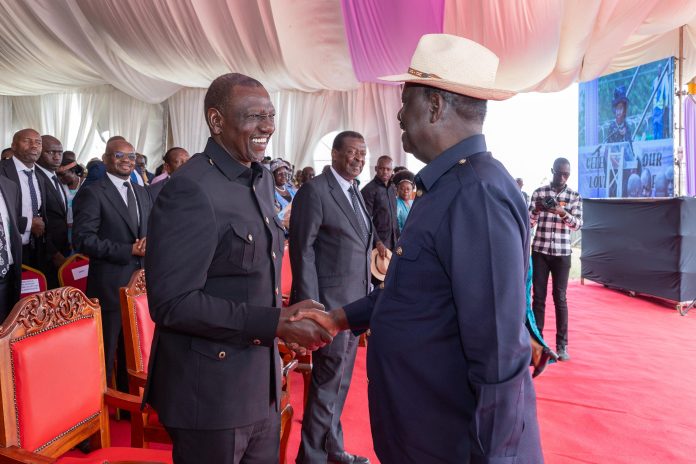
Former Prime Minister Raila Odinga, at the weekend, finally broke his silence over the matter and called on the community and the Luo Council of Elders to initiate a conversation on the issue.

Raila asked the Luo Council of Elders to urgently address the concerns that have emerged over funerals in the community and guide the people on the best way forward.

“We must have a conversation about our funerals and the economic impact it has on the community’s economy. The council of elders needs to guide the community on this important discourse.

Funerals cannot be industries. The Luo community had a structured way for burials and it did not take a long time. The expenditures were clearly guided, unlike what we have today.
This is not the way to grow as a community. It is time we re-evaluated ourselves and returned to the old ways of how the community handled burials and the expenditures that go with it,”
he said.

Luo Council of Elders’ Mzee Odungi Randa said the community has adopted very negative practices and is to blame for the high cost of funeral expenditures.

He said in the past, the Luo community would bury the deceased immediately after death, just like the Muslim community.

“We are a very difficult people. I have raised this matter, and it is now time we must address it as a people. We must go back to our old practices and avoid imitation,” he said.

Randa said he will convene an urgent meeting with the community leadership and professionals to chart a new path on the matter.

He noted that, traditionally, before the burial of the deceased, members of the Luo community did not feast or eat at funerals.

Randa said the elaborate and expensive funerals have a negative impact on bereaved families and often leave them poorer.

Kisumu Woman Representative, Ms Ruth Odinga, said funerals have become lucrative business ventures, and most of those engaged in event management are not even from the Luo community.

“The majority of the event managers are not from the Luo community, and it is sad that after the burial, the bereaved families are confined to poverty. The millions that were raised have all been consumed,” she said.

Ruth said the high expectations surrounding funerals are crippling several financial initiatives by women’s and youth groups, as they are forced to withdraw their savings and also borrow to meet the high funeral costs.

“We, as a community, overspend on funerals, which is unrealistic for the community’s economic growth. We must have a change of attitude on the matter to avoid sinking the community into abject poverty,” she said.

Ruth also blamed politicians for turning funerals into political rallies, adding that they prefer to contribute towards funerals rather than development projects.

Wanga and Magwanga night meeting over Kasipul by-election that ended in a stalemate

0

By Team

A night meeting between Homa Bay Governor Gladys Wanga and her deputy, Joseph Oyugi Magwanga, over a possible candidate to succeed the slain Kasipul MP Charles Ongondo Were, ended in a stalemate.

Wanga arrived at Magwanga’s home shortly after 8.30 pm in the company of three top officers from the County Government and the County Assembly and left shortly after 4.30 am.

It was the first time Wanga had visited Magwanga’s home since she was elected the Governor of Homa Bay County, and sources revealed the meeting centred on the candidate to succeed Ongondo.

Wanga and her team tried to prevail upon Magwanga to support Ongondo’s son, Boyd Were, but the latter was reluctant and did not commit to the proposal.

On the table, sources told Western Insight, Wanga asked Magwanga to support Boyd and, in return, she would support his candidature for the Orange Democratic Movement (ODM) Homa Bay County Chairman seat.

Magwanga confirmed the visit, saying they discussed various issues and neither denied nor confirmed whether he was approached to support the son of his political nemesis in exchange for the County ODM chair seat.

“The Governor visited me last night and we discussed several issues. You are free to speculate on whatever we discussed. I have been having several visitors to my home and everyone is welcome,” he said.

Recently, Western Insight reported that attempts by a section of MPs from Nyanza, led by Wanga who is the ODM National Chairperson, to have Boyd get a direct nomination was hitting a snag and had split the party.

Wanga and the leaders recently presented Mr Boyd Were at a local church and asked the residents to support his candidature to inherit his father’s seat.

Wanga, Homa Bay Town MP Opondo Kaluma, Senator Moses Kajwang, Minority Whip Millie Odhiambo and Roza Buyu (Kisumu West) said the late Were’s son was the best-suited family member to replace his father as Kasipul Member of Parliament.

The team promised to support Boyd, who swore to stand strong with the people of Kasipul during his late father’s burial on his quest to become the next Constituency MP.

But the party’s top leadership hierarchy was uncomfortable with the move and wanted a free and fair nomination conducted to avoid any fallout in the party.

Sources told Western Insight the party was not convinced of Ongondo’s son’s capability of winning the seat should he be given a direct party ticket.

“Kasipul Constituency is volatile and the party is not ready to take any risks. I do not see Were’s son getting endorsement from the party leadership. ODM wants to contain any internal rebellion, and that is why, once the election is called, they will prefer a nomination over the awarding of a direct ticket,” said our sources.

With the recent death of Were, a number of leaders are already drumming up support for the late MP’s son, Boyd Were.

According to the ODM brigade from Homa Bay and other parts of the county, Boyd is seen as the best person to inherit his late father’s seat.

Before his death, Were was facing a herculean task from his main challengers: Mr Newton Kefa Ogada, Philip Aroko, Samwel Owida, Okindo Majiwa, Ajoh Mbuta, Omondi Swaleh, and Rateng Kotiende.

According to Wanga, Homa Bay is an ODM zone and they expect no other party to field a candidate once the by-election is announced.

“As the Governor of Homa Bay and the ODM Chairperson, we support the Broad-Based Government since that is what we promised our party leader and President William Ruto.
However, we must know that Homa Bay and the entire region is an ODM zone and we will defend, protect, and stay strong for the party.

As we plan to go for by-elections in Kasipul, Ugunja Constituencies and other parts of the country, clearly we do not want to be in competition with our allies. We want cooperation and let the ODM seats remain as ODM seats,” she said during the burial ceremony.

The Kenyan Constitution stipulates that the Speaker of the National Assembly declares a parliamentary seat vacant within 21 days of the occurrence of a vacancy. The Speaker then notifies the Independent Electoral and Boundaries Commission (IEBC), which is mandated under the Constitution to trigger a by-election to fill the vacant seat.