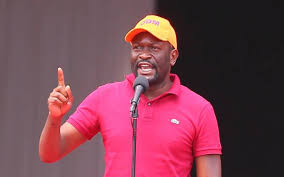

By Al Musasia
From Washington to Western Kenya, political establishments often react the same way when a new generation leader begins to capture the public imagination.
History has a fascinating way of repeating itself.
When Barack Obama emerged on the American political scene, many assumed his greatest challenge would come from Republicans. They were wrong.
Some of Obama’s earliest and most vocal skeptics came from within the very community he was expected to represent. Sections of the established Black political leadership questioned whether America was ready for a Black president.
Others suggested that Obama should wait his turn. Some openly argued that Hillary Clinton was the safer and more realistic choice.
Their arguments were presented as political wisdom. Their concerns were packaged as advice. Their warnings were framed as concern for Obama’s future.
Yet millions of Americans saw something different.
Many believed that behind the caution was a political establishment uncomfortable with the rise of a new political force that threatened to disrupt existing power structures.
History eventually rendered its verdict.
Barack Obama became President of the United States.
Today, a similar conversation appears to be unfolding in Kenya.
As Senator Edwin Sifuna’s national profile continues to rise, an increasing number of political leaders, particularly from his own backyard, have suddenly become concerned about his political future.
They have advice for him. They want him to be patient.
They want him to wait. They want him to support others.
They want him to postpone his ambitions for another day.
The question many of Sifuna’s supporters are asking is simple:
Where were these concerns when Sifuna was building his political career?
Where were these political guardians when he was fighting political battles, defending his party, articulating national issues, and earning his place in Kenya’s political conversation?
Why has the advice become louder precisely at the moment when Sifuna is attracting national attention and building support far beyond Western Kenya?
To many observers, this is not about protecting Edwin Sifuna.
It is about protecting political careers.
For decades, many leaders in Mulembe Nation have enjoyed political relevance within a predictable political order.
They understood the hierarchy. They knew who could rise and who was expected to wait.
They were comfortable operating within a system where ambition was carefully managed and political succession was controlled by established players.
Then came Edwin Sifuna.
Unlike many regional politicians before him, Sifuna’s appeal is increasingly extending beyond his ethnic base. Whether in Ukambani, Coast, Narok, Nairobi, or among the Kenyan diaspora, he is attracting audiences that many traditional politicians struggle to reach.
His supporters point to his eloquence, courage, communication skills, political discipline, and ability to articulate issues affecting ordinary Kenyans.
They see in him a leader capable of speaking a national political language rather than merely a regional one.
That is precisely why some political veterans appear uneasy.
Because if Sifuna’s political momentum continues to grow, it could fundamentally reshape political calculations within Western Kenya.
Many of the leaders now offering unsolicited advice to understand this reality.
A genuinely national Sifuna movement would force every politician in the region to redefine their relevance.
It would challenge old assumptions about who can lead.
It would disrupt long-established political networks.
And it would create a new generation of political expectations among young voters.
This is why some supporters describe the criticism directed at Sifuna using expressions familiar across African cultures.
In Nigeria, they would call it “Bad Belle”, resentment toward another person’s success.
Among the Luhya community, some might describe it as “Inda Ndulu”, the discomfort that emerges when one of your own begins to achieve what others never thought possible.
Whether one agrees with Sifuna politically or not, one reality is becoming increasingly difficult to ignore:
The debate surrounding him is no longer a Western Kenya conversation.
It is becoming a national conversation.
And that may explain why some politicians are growing nervous.
For many years, Mulembe Nation united behind national causes and national leaders. The community’s political influence was never derived from isolation but from its ability to participate meaningfully in broader national coalitions.
Today, many supporters believe Sifuna represents a continuation of that tradition.
Not because he is Luhya.
But because they believe he possesses qualities capable of attracting support beyond the Luhya community.
History teaches us that the greatest challenge facing an emerging political movement is often not opposition from rivals.
It is resistance from those who feel threatened by change within their own ranks.
That was true in Barack Obama’s America.
And some believe it may be true in Edwin Sifuna’s Kenya.
Whether that comparison ultimately proves accurate will be decided by voters, not political gatekeepers.
But one thing is certain.
Whenever a new political generation begins to emerge, the establishment rarely applauds.
It usually resists.
And that resistance is often the first sign that something significant is happening.
SIFUNA NI SISI, NI WEWE, NI SISI WOTE. SIFUNA FOR PRESIDENT 2027.