By James Okoth
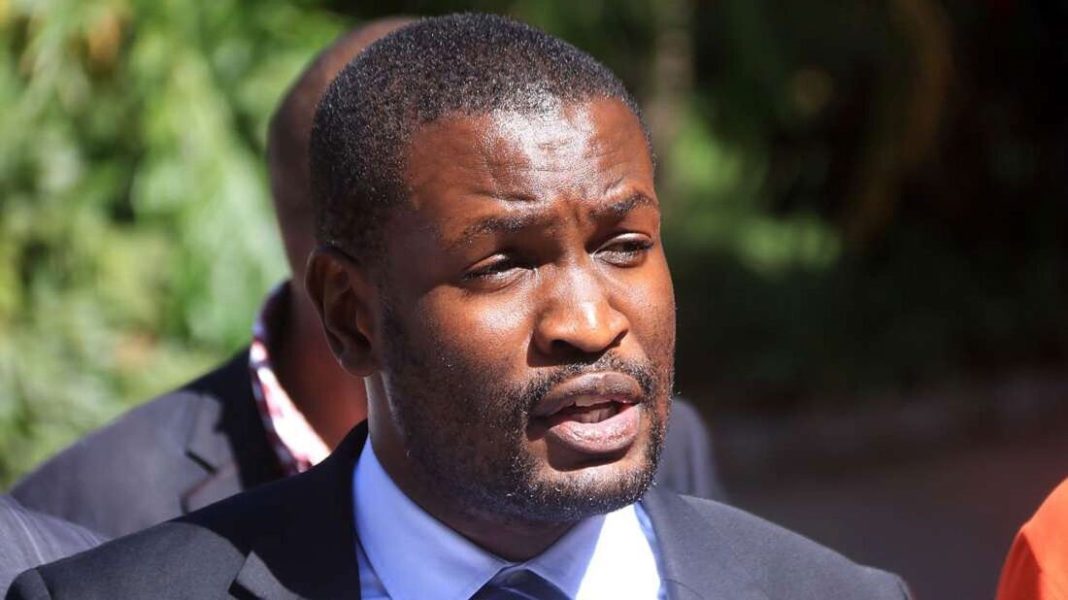
At Raila Odinga’s final send-off in Bondo, politics refused to die with him. Amid solemn hymns and glowing tributes, Nairobi Senator and ODM Secretary-General Edwin Sifuna’s words cut through the air like a blade — firm, personal, and defiant. “I will not break ODM,” he vowed, turning what was meant to be a farewell into a fresh declaration of political intent. In that moment, grief met rebellion, and the future of Raila’s party began to take shape.
Unlike many speakers who addressed the sea of mourners, Sifuna seemed to speak directly to the late Raila Odinga himself. His voice carried an intimate tone — not of farewell, but of continuity. “Baba, I will not break ODM,” he said, almost as if reporting for duty to his departed mentor.
The effect was arresting. Where others praised Raila as a historical figure, Sifuna invoked him as a living cause — a movement that must not crumble with his passing. It was a speech less about mourning and more about mission; less about legacy and more about leadership.
Sifuna’s message landed in a charged atmosphere. With Raila gone, ODM stands at a defining crossroads — torn between staying true to its opposition roots and realigning with the ruling administration for political survival.
Several senior figures, among them Governor Gladys Wanga and Senator Ledama Ole Kina, used the Bondo podium to signal openness to working with President William Ruto. Their tone was conciliatory, their gestures diplomatic, suggesting a readiness to turn the page.
Sifuna, however, chose resistance over rapprochement. His words carried an unmistakable subtext: that ODM’s strength lay not in proximity to power, but in the purity of its struggle.
In one moment that sent ripples through the crowd, Sifuna recalled Raila’s final political challenge — a question posed just 23 days before his death: “Who has told you that ODM will not field a presidential candidate in 2027?”
That single line, revived from memory, now frames ODM’s entire dilemma. Was Raila preparing the ground for succession, or warning against capitulation? Sifuna’s choice to remind the country of those words suggested the latter. In doing so, he subtly positioned himself as a messenger of continuity — the keeper of the party’s unfinished revolution.
To some, Sifuna’s stance sounded rebellious — a challenge to those seeking accommodation with President Ruto. Yet in its essence, it was a declaration of loyalty to Raila’s vision, not defiance of authority. ODM, Sifuna implied, was not just a political outfit; it was the embodiment of a philosophy — one rooted in justice, equity, and democratic accountability.
By pledging not to “break ODM,” he was effectively guarding that philosophy against dilution. His words struck a chord across the base — especially among younger reformists who fear that the party’s ideals could be buried alongside its founder.
Sifuna’s declaration did more than echo Raila’s spirit; it also redrew ODM’s internal power map. His defiance signalled a possible emergence of a new ideological faction — one that may challenge the pragmatists warming up to Ruto’s administration.
The implications are profound. ODM could soon face an internal tug-of-war: between those seeking reinvention through government cooperation, and those who believe survival lies in opposition reinvigoration.
For Sifuna, the choice seems clear. He would rather keep ODM small and principled than large and compromised.
The Broader Meaning
In Kenya’s fluid political landscape, where alliances shift overnight and parties mutate with every election cycle, Sifuna’s voice stands out for its ideological consistency. His declaration in Bondo was not just about ODM; it was about the preservation of conviction in a culture of convenience.
It was a call to conscience — a reminder that politics, at its purest, is about service and belief, not access and appeasement. And in making that call, Sifuna placed himself squarely in the moral tradition that defined Raila’s half-century of struggle.
As the dust of mourning settles, ODM faces its greatest test yet — one not of numbers, but of character. Will the movement that Raila built from exile and defiance survive without his voice? Will it find unity in ideology or fracture under ambition?
For now, Sifuna emerges as the unlikely custodian of that question — youthful, articulate, and grounded in principle. His voice may not carry Raila’s thunder, but it carries the same fire that once lit up Kenya’s fight for democracy.
In Bondo, amid tears and tributes, his vow was not a farewell, but a beginning — the opening chapter of ODM’s uncertain, but necessary, reinvention.
What Sifuna’s Declaration Means for ODM and 2027
1. Reclaiming ODM’s Soul
Sifuna’s defiance symbolises a resistance to ODM’s slow drift toward state capture. His words anchor the party back to its reformist roots — people-first politics, not palace negotiations.
2. A Subtle Power Shift
By standing firm, Sifuna elevates himself as a new moral centre within ODM — potentially the rallying point for post-Raila reformists. His speech quietly repositions him as a player to watch in ODM’s reorganisation.
3. Raila’s Last Instruction
Invoking Raila’s final question — “Who has told you ODM won’t field a candidate in 2027?” — signals that the party must not surrender its ambition or ideological clarity before the next election.
4. Two Futures Ahead
ODM now faces a binary choice:
- Assimilate into Ruto’s government, trading independence for convenience; or
- Reinvent itself through fresh, principled leadership that carries forward Raila’s democratic ideals.
Sifuna’s tone suggests he will fight for the latter.
5. The Stakes
The question now is not just who leads ODM — but what ODM becomes. Will it remain the people’s movement Raila envisioned, or mutate into another bargaining platform? In that defining battle, Sifuna’s vow — “I will not break ODM” — may well become both prophecy and provocation.