By Sandra Blessing
For aeons, despite Kisumu City and its surrounding areas sitting next to the world’s second-largest freshwater lake, Lake Victoria, water supply and connectivity have been low for both domestic and commercial users.
However, the recent and ongoing multibillion-shilling infrastructural investments are rewriting the water story in the county and making the city water-secure. The water infrastructural investment is opening Kisumu City to investors due to the availability of the commodity, which is a key component and driver of investment.
The Sh 7.5 billion infrastructural development, supported and financed by the French Development Agency, the European Development Bank, the European Union, and the Government of Kenya, is radically transforming the water and sewerage facilities in the region and opening the city to economic growth and investment opportunities.
Chief Executive Officer of Lake Victoria South Water Works Development Agency (LVSWWDA), Ms Jackline Kemunto, said the Lake Victoria Water & Sanitation (LVWATSAN) Programme financial agreement was signed in 2020, and construction works began in December 2022.
She said the programme has three components, namely last-mile connectivity, expansion and construction of sewerage facilities, and expansion and rehabilitation of the Dunga Water Intake.
“We are committed to making Kisumu City and its environs water-secure to promote investment opportunities and ensure a healthy community through access to clean, potable water in all households.
We cannot realise economic growth and investment in a city that suffers from water insecurity. That is why Kisumu is emerging as the next economic and investment hub.
Our work as LVSWWDA is to ensure we have infrastructure that responds to the ever-increasing water and sewer demand in the region.
We are up to the task, and our commitment to the above is in line with the government’s Bottom-Up Economic Transformation Agenda (BETA) of President William Ruto and the Kenya Kwanza Government,” she said.
Mr Paul Agwanda, Senior Manager of Water Works, said the three components of the programme will address water security, pollution, and sewerage in the city.
He said that under Component 1, the last-mile connectivity will witness 16,000 homes connected in Kisumu City and Maseno Municipality, increasing connectivity from the current 70 per cent to 95 per cent in water supply.
“Through this, we will be able to tackle the outbreak of waterborne diseases such as cholera because residents will have access to clean water supply at their disposal,” he said.
In Component II, Agwanda said the project involves the expansion, rehabilitation, and augmentation of the Dunga Water Treatment Plant, increasing production from 18,000m³ per day to 45,000m³ per day.
“This is to ensure that during the dry period, when the flow of River Kajulu reduces from 3,600m³ during the rainy season to 8,000m³ during the dry spell, water from the lake will be able to cushion residents from drought.
This is part of the adaptation to climate change affecting all rivers within Kisumu County. We hope to tender in September this year, and by June 2027, the works will be completed,” he said.
Similarly, Agwanda said that Component III includes the extension of sewerage and the construction of the Otonglo Wastewater Plant, which will increase sewerage connectivity from the current 17 per cent to 40 per cent.
“This will drastically reduce pollution of Lake Victoria, which has resulted in algae bloom, water hyacinth, and devastating mass fish deaths in the lake. We want to make the lake clean and habitable for fish.
Fish in the lake usually breed on the Kenyan side of Lake Victoria, and the project will ensure that the fish ecosystem is not contaminated,” he said.
Chairman of the Agency, Odoyo Owidi, said that as a result, the project will go a long way in supporting the ongoing construction of affordable housing by the government in Kisumu and transforming the city’s fortunes.
“Currently, we have ongoing housing constructions in Makasembo, Ondiek, Lumumba, and the ultra-modern El Marina, which was launched a month ago. The infrastructure will be able to respond to the water and sewer demands of these facilities,” he said.
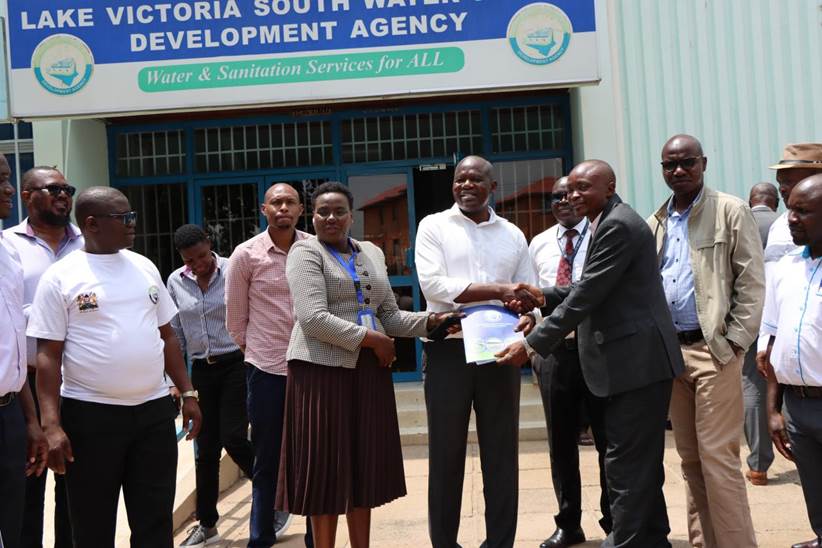
Odoyo spoke as the Victoria South Water Works Development Agency handed over eight double-cabin vehicles and an exhauster to six Water Service Providers.
Two double-cabin pick-ups each were given to Migori Water and Sanitation Company, Siaya Bondo Water and Sanitation Company, Homa Bay Water and Sanitation Company, and Bomet Water and Sanitation Company. The exhauster, on the other hand, was issued to Gusii Water and Sanitation Company (Kisii & Nyamira).
The chairman urged the water companies to ensure the vehicles were properly managed and only utilised for their intended purposes.
The CEO said the Agency was committed to developing infrastructure for various water service providers to ensure the region was water-secure and had a healthy society.
“We undertake the development of infrastructure, and we challenge you to ensure prudent service delivery to residents,” Kemunto said.