By Remmy Butia
Kenya’s political landscape is a vibrant and often unpredictable arena, characterized by shifting alliances, fluid party loyalties, and a constant reconfiguration of power dynamics. At the heart of this ever-evolving system is Raila Odinga, a veteran politician whose career has been defined by his ability to navigate between opposition and government. His journey – from opposing regimes to joining them through negotiations – offers a unique lens through which to understand Kenya’s political dynamics, the role of political parties, and the art of realignment in pursuit of national stability and personal political survival.
Kenya’s Political Parties and Realignments
Kenya’s political parties are less about ideology and more about personalities, ethnic affiliations, and regional interests. Unlike in many Western democracies, where parties are built around clear ideological platforms, Kenyan parties are fluid and often serve as vehicles for electoral competition rather than long-term governance agendas. This fluidity is evident in the frequent defections, mergers, and dissolutions of parties, especially in the lead-up to elections.
For example, the Jubilee Party, formed in 2016, brought together previously rival factions under President Uhuru Kenyatta and Deputy President William Ruto. Similarly, Raila Odinga’s Orange Democratic Movement (ODM) has been a key player in Kenya’s opposition politics but has also entered into coalitions with former adversaries when politically expedient. These realignments are often driven by the need to consolidate support across ethnic and regional lines, as Kenya’s voting patterns are heavily influenced by ethnic demographics.
Pre-Election Coalitions and Post-Election Pacts
Pre-election coalitions are a defining feature of Kenya’s political strategy. These alliances are formed to maximize electoral success by uniting diverse groups and regions. The 2002 National Rainbow Coalition (NARC), which brought together opposition parties to defeat the long-ruling Kenya African National Union (KANU), is a classic example of a successful pre-election coalition. More recently, the 2022 Azimio la Umoja coalition, led by Raila Odinga, sought to unite various opposition groups against William Ruto’s Kenya Kwanza alliance.
However, these coalitions are often fragile and prone to disintegration after elections. The lack of a shared ideological foundation means that alliances are primarily transactional, leading to frequent realignments and defections. Post-election pacts, on the other hand, are often formed to address political instability or to share power. The 2008 power-sharing agreement between President Mwai Kibaki and Raila Odinga, following the disputed 2007 elections, is a notable example. This pact, brokered by international mediators, helped to end post-election violence and restore stability.
Raila Odinga: A Master of Political Realignment
Raila Odinga’s political career is a testament to the art of negotiation and realignment. Over the years, he has transitioned from being a fierce opposition leader to joining governments through negotiated settlements. His ability to adapt to changing political circumstances has made him one of Kenya’s most enduring and influential politicians.
- Joining President Daniel arap Moi’s Government: In the early 2000s, Raila, who had been a vocal critic of President Moi’s regime, surprised many by joining the government. He was appointed Minister of Energy in 2001, a move that was seen as an attempt to bridge divides and stabilize the country ahead of the 2002 elections. This marked the beginning of Raila’s reputation as a pragmatic politician willing to work with former adversaries for the greater good.
- The NARC Government and Falling Out with Kibaki: After the 2002 elections, Raila played a key role in the NARC government under President Mwai Kibaki. However, disagreements over the implementation of the coalition agreement led to a fallout, and Raila returned to the opposition, forming the ODM. This period highlighted the challenges of maintaining unity in coalition governments, especially when underlying tensions remain unresolved.
- The 2008 Power-Sharing Agreement: Following the disputed 2007 elections and the subsequent violence, Raila negotiated a power-sharing agreement with President Kibaki. He became Prime Minister in a coalition government, a role that allowed him to influence policy and governance while maintaining his opposition credentials. This arrangement demonstrated Raila’s commitment to peace and stability, even at the cost of personal political ambitions.
- The Handshake with Uhuru Kenyatta: After the contentious 2017 elections, Raila once again found himself at a crossroads. Instead of prolonging the political crisis, he engaged in a historic handshake with President Uhuru Kenyatta in 2018. This gesture of reconciliation, though controversial among his supporters, helped to ease political tensions and paved the way for dialogue on national unity and constitutional reforms through the Building Bridges Initiative (BBI).
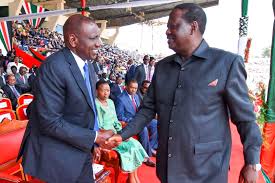
- Joining President William Ruto’s Government: In a surprising turn of events, Raila Odinga has signaled his willingness to work with President William Ruto’s government and is expected to ink a deal today. This move, while criticized by some as a betrayal of his opposition roots, underscores Raila’s belief in the importance of dialogue and inclusivity in governance. By engaging with the Ruto administration, Raila aims to influence policy and ensure that the voices of marginalized communities are heard.
Lessons from Raila Odinga’s Political Journey
Raila Odinga’s career offers several lessons for Kenya and other democracies:
- The Power of Pragmatism: Raila’s ability to negotiate and enter government, even after losing elections, highlights the importance of pragmatism in politics. His willingness to work with former adversaries demonstrates that political survival and national stability often require compromise.
- Building Bridges Across Divides: Raila’s focus on national unity and inclusivity, particularly through initiatives like the BBI, underscores the need for leaders to address ethnic and regional divisions. While the BBI faced legal and political challenges, its emphasis on dialogue and reform remains relevant.
- The Role of Opposition in Governance: Raila’s journey from opposition leader to government insider shows that opposition parties can play a constructive role in governance. By participating in government, opposition leaders can influence policy and ensure that diverse voices are represented.
- The Limits of Electoral Politics: Raila’s experiences reveal the limitations of electoral politics in deeply divided societies. In such contexts, elections alone may not resolve political disputes, and alternative mechanisms, such as power-sharing and dialogue, may be necessary.
Kenya’s political dynamics are shaped by a complex interplay of ethnic loyalties, regional interests, and personal ambitions. Raila Odinga’s career, marked by both opposition and participation in government, offers valuable lessons on the importance of negotiation, pragmatism, and inclusivity in governance. His ability to navigate Kenya’s turbulent political waters – from joining Moi’s government to engaging with Ruto’s administration – demonstrates a commitment to national stability and the belief that dialogue is essential for progress.
As Kenya continues to navigate its political challenges, the experiences of leaders like Raila Odinga provide a roadmap for building a more stable and inclusive democracy. By learning from the past and embracing dialogue, Kenya can strengthen its political institutions and ensure that elections serve as a tool for unity rather than division. Raila’s legacy will undoubtedly be debated for years to come, but his impact on Kenya’s political landscape is undeniable.