Home Blog Page 175

Elevation of JOOTRH to State Corporation by the Cabinet Will Boost Health Services in Western Kenya

0

By Anderson Ojwang

The elevation of Jaramogi Oginga Odinga Teaching and Referral Hospital (JOOTRH) to a national teaching and referral facility and its establishment as a state corporation is a milestone in repositioning Kisumu as a fast-growing city and an investment hub.

This move makes the hospital the first health corporation in Western Kenya, joining the league of Kenyatta National Hospital, Moi Teaching and Referral Hospital, and the National Spinal Injury Referral Hospital.

National Referral Hospitals in Kenya are Level 6 facilities that act as referral points for county hospitals and are the highest referral category in the public healthcare system.

The objective of the Referral Hospital shall be—
(a) to provide highly specialised services, including—
(i) specialised psychiatry services;
(ii) forensic psychiatry services;
(iii) child and adolescent mental health services; and
(iv) receiving and managing referrals of persons with mental disorders from other facilities.

A State Corporation is a corporate body established under Section 3 of the State Corporations Act, Cap 446, or by an Act of Parliament, or under the Companies Act, Cap 486, where the Government controls the majority or all of the shares. Further, a subsidiary of a state corporation is also considered a state corporation.

Kisumu Governor Prof. Anyang’ Nyong’o welcomed the move, saying it will be a game-changer in health service delivery in the region.

I would like to extend my gratitude to the President and the Cabinet as well for making Jaramogi Oginga Odinga a national corporation.

With its new status, JOOTRH will receive adequate resources to continue expanding its service delivery in the Lake Region and beyond.

My sincere gratitude to Richard Lesiyampe, the Chief Executive, and his staff as well as the Board of Management for undertaking various reforms that have improved service delivery in the institution exponentially.

My government will continue to support and nurture JOOTRH in capacity building needed for effective service delivery.

The decision is a big boost to healthcare services for the public. The new status increases JOOTRH’s capacity to serve more patients more efficiently because it will receive more resources.

It is also a big relief to the County Government because it will no longer shoulder its financial burden, especially on staff wages. It will help the County substantially reduce its wage bill,” he said.

A medic and don, Prof. Obondi Otieno, said the move was in line with the institution’s strategic plan and would help improve health services in Western Kenya.

In JOOTRH’s strategic plan as a Centre of Excellence for East, Central, and Southern Africa, it has been our dream all along to have the institution recognised as a corporation, and this is a milestone for the region.

In the institution, there will be a teaching hospital and research centre, and we should no longer have excuses for underperformance.

We will have all shades of expertise in clinical services, and therefore, there should be no excuse for unnecessary referrals to MTRH or KNH unless there is a valid explanation for a lack of resources or qualified human resources.

Again, we will have to source scholarships for willing employees to further their studies, and the National Government will take over the cost of running the hospital and human resource recruitment,” he said.

Jaramogi Oginga Odinga Teaching & Referral Hospital (JOOTRH) has been in existence for more than a century, having been established in the early 1900s to cater for the health needs of workers in the then port town of Kisumu.

Since then, it has grown to become the referral hospital serving county, sub-county, and private hospitals in more than 10 counties in the Western Kenya region, with a population of more than 10 million people.

The inception of JOOTRH was highly influenced by the high presence of malaria and other diseases in what was then Port Florence, which necessitated the creation of a facility to cater for the black population.

The Role of Government in Regulating Religious Education: Encouraging Self-Regulation in Faith-Based Institutions

0

Dr.Edris N.Omondi 

Sometimes last year, the Association of Pentecostal Vocational Training Institute of Kenya (APVOTIK) engaged me, as a second eye, to legally help them draft a self-regulating law, an alternative Bill to the Religious Organization Bill No 44 of 2024, that was withdrawn from parliament due to inadequate consultative processes.

Within the religious practices are the element of trainings. These trainings are not necessarily conventional in nature to attract government competency to regulate their training curriculum but are sacred in nature.

 Imagine a government official, let’s call him the Government Inspector, who’s tasked with regulating religious institutions in a small town. One day, he walks into the “Miracle Worker Ministry” where people are claiming to heal the sick, raise the dead (well, they’re working on it), and perform other extraordinary feats, all in the name of faith.

The Government Inspector, determined to bring order to this chaotic scene, starts questioning the leader of the ministry, Pastor Okello. He says, “I see here you’re offering a “Certificate in Miracle Performance.” But, uh, where’s the curriculum? Where are the standardized tests? You can’t just go around giving certificates for ‘miracle-working’ without some form of accreditation!

Pastor Okello, unfazed, raises his hands dramatically and replies, “Government Inspector, the miracles aren’t for your regulation—they’re a gift! The only accreditation here is divine!”

The Government Inspector, baffled but determined to maintain control, presses on: “But how can we be sure that these ‘miracles’ are authentic? We need evidence. Proof. Maybe some written exams, perhaps? Or a board of examiners to observe the ‘miracle’ process?”

Pastor Okello chuckles, “Well, Mr. Inspector, miracles don’t work well with exams. You can’t put ‘turning water into wine’ on a multiple-choice test. It’s not exactly in the syllabus!”

At this point, one of the “miracle” candidates in the background suddenly shouts, “I’ve been healed!” He runs up to the Government Inspector and throws a handful of paperwork at him. “I’m healed from bureaucracy! No more paperwork for me!”

The scene ends with the Inspector scratching his head, realizing that regulating faith-based miracles is like trying to force a square peg into a round hole. He walks away, muttering, “Maybe I should stick to regulating parking lots instead.”

I have intentionally painted a dramatic illustration of what actually happens within our Pentecostal circles. 

Let me explain-Governments are competent in regulating formal education systems, where standardized knowledge, such as academic subjects and professional training, is imparted. These formal systems are structured to meet specific criteria- within a pedagogical lifetime of an individual, examine through nursery schooling to higher learning environment, ensuring that degrees, certificates, and qualifications adhere to established standards as set by the Government formal learning examining bodies. 

However, governments face limitations when it comes to informal education, particularly in faith-based or religious settings. These types of education are not confined to the rigid structures of conventional academic curricula, and the government’s intervention in regulating them can be seen as a victimization paradox.

For example, as painted through the pastor Okello illustration above, spiritual gifts like the gift of miracles or speaking in tongues are often emphasized as part of personal and communal faith. Such spiritual practices, while integral to the religious experience, fall outside the scope of traditional academic systems. The Commission for University Education (CUE) in many countries is tasked with overseeing formal education programs at colleges and universities. CUE is not equipped to regulate religious teachings, especially in areas that involve spirituality, miracles, and other non-academic phenomena. When the government attempts to classify or dismiss these experiences as “fake” because they fall outside the recognized academic framework, it undermines the lived realities and practices of these communities. It is my believe, I might be wrong-that conversely, such sacrosanct trainings thrive in the unseen world and phenomenon, the kind that exorcises demons and expose witchcraft and black magics in the society. This kind of knowledge cannot be harbored under CUE.

This issue extends beyond Pentecostal communities. Similar dynamics are observed in other faith-based setups, including Islam, Hinduism, and traditional African religions. Religious institutions often provide theological education that shapes the beliefs and practices of their followers. However, the education imparted in these settings is distinct from secular education and cannot, and should not, be subjected to the same regulatory standards. Theological training is inherently personal, deeply rooted in belief systems, and varies widely across cultures and religions. Government control or intervention in these matters can be viewed as an imposition on the freedom of religion and belief, an aspect of fundamental human rights.

The Need for Self-Regulation in Faith-Based Institutions

Rather than exerting control or imposing punitive measures on religious education, governments should encourage faith-based institutions to regulate themselves. Faith communities, such as Pentecostal churches, Islamic organizations, and Hindu councils, should be empowered to establish their own standards for religious education and training. This self-regulation would allow these institutions to maintain their autonomy while also ensuring that their teachings align with their core beliefs and traditions.

Organizations like APVOTIK or equivalent bodies for Islamic and Hindu organizations could play a pivotal role in these self-regulations. These umbrella organizations are already familiar with the nuances of their faiths and can create frameworks that guide religious education within their communities. For instance, an Islamic council can set its own criteria for the training of imams and graduating successful candidates out of the madrasa, while a Hindu or Buddhist organization might establish guidelines for those pursuing spiritual leadership. By allowing these bodies to regulate their education systems, the government can maintain a neutral stance while respecting the autonomy of faith-based institutions.

Such an approach ensures that the government does not become an intrusive force in matters of religion but instead plays a supportive role in ensuring that education is both relevant and non-harmful. This would also foster a sense of responsibility within faith communities to uphold the integrity of their teachings and to prevent exploitation, such as unqualified individuals assuming religious authority.

International Approaches to the Dilemma

This issue is not unique to any one country but is a global dilemma. Several nations, particularly those with diverse religious populations, have already adopted consultative approaches to balancing the regulation of formal education and the freedom of religious expression. For example:

1. India: I did study my Law in India, and always mesmerized by its democracy and approach to religious matters. The Indian government recognizes the distinct nature of religious education and allows various religious communities to regulate their own theological schools. Religious groups such as the Roman Catholic Church, the Hindu community, and Islamic organizations have their own regulatory bodies that set educational standards, ensuring their education systems are consistent with their faith’s tenets while not imposing on the secular education system.

2. United States: In the U.S., the separation of church and state is enshrined in the Constitution, which means that religious institutions, including schools and seminaries, are free to teach according to their beliefs without interference from the government. However, accreditation for religious institutions that wish to issue degrees may come from independent, non-governmental bodies that ensure educational quality without infringing upon religious freedom.

3. United Kingdom: In the UK, religious education in schools is managed under the framework of agreed syllabuses, but religious communities retain the right to impart faith-based teachings through religious schools. For higher education, institutions like theological seminaries operate independently, with their own accreditation mechanisms that align with religious practices.

These examples show that governments do not need to exert direct control over religious education. Instead, they can adopt policies that recognize the autonomy of faith-based institutions while encouraging self-regulation and accountability. Governments should consult with religious leaders and faith-based organizations to understand how religious education works within their contexts and support the development of standards that align with both spiritual beliefs and educational objectives.

The Separation of Sacred and Secular Education

A critical point in this discussion is the need for a clear distinction between sacred and secular education. Sacred education, which pertains to the teachings of faith and spirituality, operates on different principles than secular education, which is based on universal knowledge and academic inquiry. The government should recognize this fundamental difference and ensure that sacred education is not conflated with formal, secular education.

Attempts to regulate or control religious education through secular frameworks not only create tension but also undermine the diversity of belief systems that contribute to the rich tapestry of human cultures. Religious institutions must be allowed to operate according to their own internal logic, free from unnecessary interference or punitive measures. Theological education should remain separate from secular standards, not because it is less important, but because it operates in a different domain entirely.

Conclusion

In conclusion, the government’s role in regulating education should be confined to formal, secular learning environments. Faith-based institutions must be allowed to regulate their own theological education systems, empowering them to develop curricula and standards that align with their beliefs and practices. Governments should adopt a consultative approach, respecting the autonomy of religious organizations while providing support where necessary. Sacred education, distinct from secular education, should not be subjected to the same regulatory processes, as doing so would infringe on the rights of individuals and communities to practice and propagate their faith freely. Encouraging self-regulation within faith-based institutions is the most effective way to ensure that religious education remains relevant, authentic, and protected from unnecessary governmental intervention.

The writer is an Advocate

attorneyedris@ywcg.org

Raila’s moment to enjoy the fruits of his democratic struggles for the Country

0

By Remmy Butia

For decades, Raila Amollo Odinga has been a towering figure in Kenya’s political landscape, a symbol of resilience, and a champion of democracy. His name is synonymous with the fight for multiparty democracy, social justice, and equitable development in Kenya. 

From the dark days of authoritarian rule to the present era of constitutionalism, Raila has been at the forefront of Kenya’s democratic evolution. 

As the nation reflects on its history and looks toward the future, it is time for Raila Odinga to enjoy the fruits of his lifelong struggles for a better Kenya.

A Lifetime of Sacrifice and Struggle

Raila Odinga’s journey has been one of immense sacrifice. Born into a political family – his father, Jaramogi Oginga Odinga, was Kenya’s first vice president – Raila inherited a legacy of fighting for the marginalized. However, he did not rest on his family’s laurels; he carved out his own path, often at great personal cost. During the Moi era, Raila was detained for years without trial for his pro-democracy activities. His unwavering commitment to justice and equality saw him endure imprisonment, exile, and constant political persecution. Yet, he never wavered in his belief that Kenya could be a nation where every voice matters.

Raila’s role in the fight for multiparty democracy in the 1990s was pivotal. Alongside other brave Kenyans, he pushed for the end of single-party rule, a struggle that culminated in the reintroduction of multiparty politics in 1991. This was a turning point in Kenya’s history, laying the foundation for the freedoms Kenyans enjoy today. His efforts continued into the 2000s, where he played a critical role in the drafting and passage of the 2010 Constitution, a document that has transformed Kenya’s governance and entrenched devolution, human rights, and the rule of law.

A Unifier and Statesman

Raila Odinga’s political career has not been without controversy or setbacks. He has vied for the presidency five times, each bid marked by fierce competition and, at times, disputed outcomes. Yet, even in defeat, Raila has consistently demonstrated a commitment to peace and national unity. Following the contentious 2007 elections, Kenya descended into violence, but Raila’s decision to join a coalition government helped stabilize the country. Similarly, after the 2017 elections, his “handshake” with President Uhuru Kenyatta in 2018 ushered in a period of political reconciliation and calm. And even recently during the Gen Zs protests, he was at hand to cool the nation with an MoU with President William Ruto. 

Raila’s ability to rise above partisan politics and prioritize the nation’s interests has earned him respect as a statesman. His calls for inclusivity, dialogue, and unity have resonated across the political divide, proving that his vision for Kenya transcends personal ambition.

The Fruits of His Labor

Kenya today stands as a testament to the struggles of leaders like Raila Odinga. The freedoms of speech, assembly, and political participation that Kenyans enjoy are a direct result of the sacrifices made by Raila and his contemporaries. Devolution, a cornerstone of the 2010 Constitution, has brought government closer to the people, ensuring that resources and opportunities are shared more equitably. These achievements bear Raila’s indelible imprint.

As Raila advances in age, it is only fitting that he enjoys the fruits of his labour. This is not just about political power or personal gain; it is about recognition and respect for a lifetime of service. Raila has earned the right to see his vision of a prosperous, inclusive, and democratic Kenya come to fruition. Whether through formal recognition, such as a statesman’s role in regional or international organizations, or through the acknowledgment of his contributions by fellow Kenyans, Raila deserves to bask in the legacy he has helped build.

A Call to Kenyans

Kenyans owe a debt of gratitude to Raila Odinga. His struggles have shaped the nation’s trajectory, and his sacrifices have paved the way for a more just and equitable society. As the country moves forward, it is imperative to honor its heroes—not just in words, but in actions. Supporting Raila’s vision for a united and prosperous Kenya is one way to do this. Ensuring that the democratic gains he fought for are preserved and expanded is another.

Raila Odinga’s story is intertwined with Kenya’s history. His triumphs and trials mirror the nation’s journey from oppression to freedom, from division to unity. As he continues to contribute to Kenya’s development, it is time for him to enjoy the fruits of his labor. Let us celebrate his legacy, honor his sacrifices, and work together to build the Kenya he has always envisioned—a Kenya where every citizen can thrive.

In the words of Raila himself, “The journey is far from over, but we have come a long way.” Indeed, Kenya has come a long way, thanks in no small part to Raila Amollo Odinga. It is time for him to enjoy the fruits of his democratic struggles, knowing that his efforts have not been in vain.

Kisumu to host  the Classic  Comedy “Le Malade Imaginaire” in April

0

By Obat Masira

Mama Grace Onyango Cultural and Social Centre will host a leading Theatre Arts Company from Nairobi named NAIROBI PEROFRMING ARTS STUDIO under the directorship of Mr. Stuart Nash and assisted by Mr. Gadwill Odhiambo.

The Nairobi Performing Arts Studio will present an adaptation of Moliere’s Classic Comedy titled “Le Malade Imaginaire” a Kiswahili and English Production titled “MGONJWA MWITU” to be staged at Mama Grace Onyango Cultural and Social Centre:- FREE ENTRY on the 6th April, 2025 at 6.30pm, Sunday .(An outstanding production)

The play “Le Malade Imaginaire” explores themes of deception, medicine and Social Status through humor and Satire, making it both entertaining and educational for artistes and students of literature, theatre and the arts. 

The performance will provide artistes and students with a rich cultural experience exposing them to classical adaptation, theatrical performances and the power of storytelling.

MGONJWA MWITU” an adaptation will provide for a great opportunity for the artistes and students to interact with professional actors and theatre practitioners.

Secondary School students are also invited to come and watch this stimulating storytelling production.

The Nairobi Performing Arts Studio also presented a successful classic stage production of SARAFINA at the Kenya Cultural Centre / National Theatre.

This will be their first performance in Kisumu City. Lovers of theatre come and watch this production.

Kenya and Hungary sign key MOUs on education and agriculture

0

By OPCS Press Service.

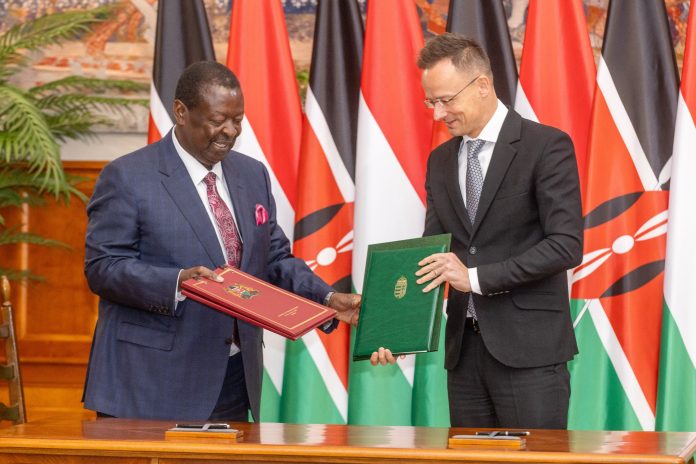
Kenya and Hungary have signed two major Memoranda of Understanding in the education and agricultural sectors, Prime Cabinet Secretary Musalia Mudavadi has said.

Mudavadi said the two MoUs will promote bilateral partnerships in the fields of education and agriculture and further open up new avenues for collaboration in these areas and many others.

He said Kenya and Hungary are further cementing their bilateral relations that date back to more than 60 years owing to the enormous potential and arising opportunities.

Speaking during the signing of the agreements with H.E. Péter Szijjártó, Hungary’s minister of Foreign Affairs and Trade, in Budapest, Mudavadi, said Hungary was an important partner to Kenya in the Education sector.

I take this opportunity to appreciate the government of Hungary for the 200 scholarships offered to Kenyan Students annually by the through the Stipendium Hungaricum Programme. These scholarships have enhanced our people-to-people cooperation and have revitalized substantial positive transformations across multiple sectors of our economies,” said Mudavadi.

On agriculture, Mudavadi said that together with his Hungarian counterpart, they had agreed to work together on the exchange of expertise and best agricultural practices to enhance agricultural productivity in both our countries.

He said already the Hungarian government had established a Demo Farm in one of the agricultural productive county in Kenya, that is designed to showcase Hungarian agricultural technology and innovation, and serves as a model for modern and sustainable farming practices.

I am confident that once we implement the outcomes of the discussion we have had on this sector, we will witness higher levels of Foreign Direct Investment from our respective companies in diverse fields of our economy, especially in the agricultural value addition industries,” said Mudavadi.

Kenya, he said, remains committed to enhancing diplomatic relations with Hungary.

It is for this reason he noted that Kenya was committed to establishing a resident diplomatic mission in Budapest in the near future to give impetus to the already existing diplomatic ties.

President William Ruto had agreed to the opening of the embassy in Budapest, and the Cabinet has already approved. What we are waiting for is budgetary allocation to kick-start the process,” said Mudavadi.

He noted that Kenya and Hungary, through the mutual visits, have exchanged views on how to strengthen and consolidate the good relations that exist between our two countries.

Our countries share a long-standing relationship that dates back to when our country gained independence in 1963. Hungary was the 6th country to establish a mission in Nairobi in 1964,” said the PCS.

During the meeting with the Minister, Mudavadi said that they had resolved to revitalize our relations in the energy sector in efforts of stepping up to strengthen resilience and adaptive capacity by prioritizing green growth while ensuring energy supply and sustainability.

We have therefore resolved to implement the MoU on Cooperation in the Field of Training and Education of Atomic Industry on the Peaceful Uses of Nuclear Energy that we signed during his visit to Nairobi early last year,” said Mudavadi.

He said Kenya and Hungary had agreed to exchange capacity on the use of nuclear energy as an alternative source of clean renewable energy.

On the ICT, the Prime CS said they had agreed with Hungary to amplify relations in the sector, noting their area of priorities were on business, finance, and cloud mapping sectors in our countries.

Mudavadi said that on the Multilateral front, they had agreed to work together within the auspices of the United Nations to address the global dialogue in financing for development, promotion of inclusivity and equality, as well as teaming up to achieve the Sustainable Development Goals (SDGs).

I had the opportunity to seek Hungary’s support in championing for a fair and just multilateral system with a more inclusive global financing architecture,” said Mudavadi.

On the issues of trade, the PCS said they had resolved to promote greater linkages between private sectors and business communities of the two countries in order to enhance the momentum in establishing trade partnership between our business persons.

We have agreed to hold the next session of the Joint Trade and Economic Committee (JTEC) between our two countries before the end of this year. We have further agreed to expedite the conclusion of negotiations on the Agreement on Promotion and Reciprocal Protection of Investment between our countries and begin negotiations of an Agreement on Avoidance of Double Taxation,” said Mudavadi.

Szijjártó said they had agreed to work together within the available instruments of the International Organizations to secure a peaceful future for those areas in our respective continents facing conflict and instability.

Hungary and Kenya continue to urge all aggrieved parties to give a chance to diplomacy and dialogue as an alternate method for settlement of disputes,” said Szijjártó.

BODA BODA AND THE RISE OF AVIATOR GAMBLING: A CURSE OR A BLESSING TO THE YOUTHS?

0

By Remmy Butia

In Kenya, the boda boda (motorcycle taxi) industry has become a significant part of the economy, providing employment to thousands of young people. For many youths, especially in rural and peri-urban areas, boda boda is a lifeline – a source of income that helps them support their families and achieve financial independence. The low entry barriers, such as affordable motorcycle financing options, have made it an attractive venture for young men who might otherwise struggle to find employment in a competitive job market.

However, the boda boda industry is not without its challenges. The lack of regulation and proper training has led to rampant road accidents, often involving young riders and passengers. Many youths are lured into the trade without adequate knowledge of traffic rules, leading to reckless riding and loss of lives. Additionally, the industry has been associated with crime, as some riders are involved in robberies and other illegal activities. For some, the boda boda business is a blessing, but for others, it has become a curse, trapping them in a cycle of danger and instability.

The Rise of Aviator Gambling App: A New Threat to the Youth

While the boda boda industry presents a mixed bag of opportunities and challenges, the rise of gambling apps like Aviator poses a more insidious threat to Kenyan society. Gambling has become a pervasive issue in Kenya, with the younger generation particularly vulnerable. The Aviator app, which allows users to bet on virtual flights, has gained popularity due to its simplicity and the promise of quick money. However, its negative effects on the youth are profound.

Many young people, lured by the prospect of easy wealth, are sinking into debt and addiction. The app preys on the desperation of unemployed youths, who see gambling as a way out of poverty. Unfortunately, the reality is often the opposite – losses accumulate, leading to financial ruin, mental health issues, and strained relationships. The addictive nature of these apps, combined with aggressive marketing strategies, has created a generation of young gamblers who are sacrificing their futures for the fleeting thrill of a win.

Local Vernacular Radio Stations: Promoting Gambling Under the Guise of Entertainment

Adding fuel to the fire are local vernacular radio stations, which have embraced gambling as a form of entertainment. Popular shows like “Open a Box” encourage listeners to deposit money for a chance to win prizes. These programs are often presented as harmless fun, but they normalize gambling and exploit the vulnerabilities of their audiences, particularly women and the elderly.

For women, who are often the primary caregivers in their households, gambling can lead to financial instability and family breakdowns. The elderly, on the other hand, are targeted because of their limited understanding of digital platforms and their susceptibility to persuasive marketing. By promoting gambling in the name of entertainment, these radio stations are contributing to the erosion of social and economic stability in communities.

Kenya: A Nation at Risk of Becoming a Gambling Society

The combination of boda boda challenges, the proliferation of gambling apps like Aviator, and the promotion of gambling by local media is pushing Kenya toward becoming a gambling nation. The allure of quick money is overshadowing the value of hard work and education, leaving many youths disillusioned and trapped in cycles of poverty and addiction.

To address this growing crisis, there is an urgent need for stricter regulations on gambling platforms and more responsible media practices. Additionally, the government and private sector should invest in creating sustainable employment opportunities for the youth, reducing their reliance on risky ventures like boda boda and gambling. Public awareness campaigns are also crucial to educate citizens about the dangers of gambling and the importance of financial literacy.

While boda boda has provided a lifeline for many youths, it is not a panacea for Kenya’s unemployment crisis. Similarly, gambling apps and irresponsible media practices are exacerbating societal problems, threatening the future of the younger generation. Kenya must take decisive action to curb these trends and build a society that values hard work, education, and sustainable development over the false promise of quick riches. Only then can the nation truly prosper.

Who Betrayed Whom? Kalonzo or Raila! History at Play Again

0

By Anderson Ojwang

Kenya’s political landscape has been awash with claims and counter-allegations of betrayal. In the process, history has come into play, with the main players tasting the bittersweet recipe of past deeds that have often come back to haunt them.

Currently, Wiper leader Kalonzo Musyoka is lamenting over an alleged betrayal by former Prime Minister Raila Odinga regarding the signing of a memorandum of understanding (MOU) with President William Ruto.

In the 2007 presidential election, Kalonzo was accused of betraying Raila through a ‘pitia katikati’ moment (passing between) by signing an agreement with President Mwai Kibaki.

And now, the former Vice President has recently had a date with history. History was in play—just like in 2007—only this time, the main character and determinant had changed in the political drama.

After emerging third, Kalonzo became the determinant of the political puzzle between Kibaki and Raila by signing a coalition agreement with the former, joining the government, and subsequently boosting Kibaki’s numbers in Parliament, making him a crucial pillar of the regime.

The 2007 presidential election came hot on the heels of a protracted battle over the ownership of the Orange Democratic Movement (ODM) party. Raila retained ODM, while Kalonzo took ODM-K.

By opting to sign an agreement with Kibaki, Kalonzo dealt a blow to his ally-turned-foe and gave a lifeline to President Kibaki.

This time, after Raila lost the African Union Commission (AUC) chairmanship bid, Kalonzo and other opposition leaders tried to woo him to their side to help liberate the country from President Ruto.

“If Raila loses, let him come back and we will liberate Kenya from Ruto’s administration,” he said. After the election, he added, “The loss has brought embarrassment to Kenya’s image. I place the blame on Ruto, who was the chief campaigner. He had his agenda—that if he secured Raila the AUC seat, he would have an easier time in Kenya. We demand a real explanation,” he said.

However, just as Kalonzo had done in 2007, Raila opted to sign a memorandum of understanding with President Ruto, leaving Kalonzo and his team in disarray.

A bitter Kalonzo responded by accusing Raila of betrayal and promised to mount a strong team to challenge President Ruto.

On his X handle, formerly Twitter, he wrote:
What has come out of KICC today is the biggest betrayal of Kenyans. The People’s Loyal Coalition will never betray Kenyans for temporary comfort.

The unholy ‘MOU Co-operation Agreement’ is not about democracy or strengthening a democratic political culture. Rather, it is the biggest betrayal of Kenyans for political expediency and temporary comfort.

I have been reflecting on Psalm 11—when the foundations are shaken, what will the righteous do?

Kenyans, our foundation has been shaken. Six million Kenyan university students are unable to get employment because of the policies of the KK regime.

Our children are unable to go to class because our foundation has been shaken. Kenyans don’t have health coverage because the foundation has been shaken.

That is the true state of our nation. There is betrayal everywhere—by politicians against Kenyans.

Politicians should never again appear before their people and show off what they have stolen in the shape of ‘donations’.

The People’s Loyal Coalition will never betray the people of Kenya for temporary comfort.”

However, ODM acting party leader Prof Anyang’ Nyong’o, in his response, said Raila never betrayed Kalonzo and challenged him to seek dialogue with Raila and Ruto to join hands in developing the country.

I have read the comments of Wiper leader Kalonzo Musyoka regarding the MOU that ODM and UDA signed in Nairobi on Friday.

Kalonzo’s disconnect is that Azimio was left out. In that regard, therefore, Raila betrayed Azimio.

In the meantime, the same Kalonzo has been meeting with all kinds of characters, including Rigathi Gachagua, without consulting us at all. But we never complained; we took it as his democratic right to do so. Whether or not he has signed some agreement with them is none of our business.

Kalonzo should acquaint himself better with the court of conscience. He should read the contents of the MOU before condemning its signing by the two parties.

The MOU commits the partners to build a much stronger democratic political culture in which all parties and movements, notwithstanding their ‘base of support,’ will build the Kenyan nation together.

There is, therefore, still room for Kalonzo Musyoka to seek dialogue with the two leaders to work for the future of our nation.

Nyong’o, on his X handle, said:
This agreement outlines a roadmap for addressing Kenya’s social, economic, and political challenges. Additionally, we have recognised the importance of establishing a broad platform for collaboration and cooperation among all political forces.”

Former Nyakach MP Ochieng Daima said it was Kalonzo who betrayed Raila first in 2007, and he should be the last person to talk about betrayal.

Kalonzo should be reminded that in 2007, he chose Kibaki over Raila in the disputed election. He was more of a spoiler than a real contestant in the presidential election.

He should never talk about betrayal. Yes, it is true he has supported Raila thrice, but when Raila needed him most in 2007, he bolted.

Kalonzo should not blame Raila for betrayal. Raila is more interested in the future of the country than personal interest,” he said.

“Rediscovering Purpose: The Power of Embracing Our Unique Gifts”

0

Dr. Edris N.Omondi (Advocate)

attorneyedris@ywcg.org

In the course of our lives, we encounter countless paths and possibilities, yet not all of us are destined to walk the same journey. It’s easy to fall into the trap of believing that everyone should follow the same blueprint — particularly in a society like ours, where many are conditioned to pursue a career based on academic qualifications or chase financial success as the ultimate measure of purpose. But the truth is, we all carry unique graces and gifts, and discovering our true purpose lies in embracing what makes us different.

The Fallacy of a One-Size-Fits-All Purpose

The world has witnessed individuals like Michael Jackson, Whitney Houston, Steve Jobs, Jack Ma, or even Oprah Winfrey among many — each one exceptional in their own way. Michael Jackson’s voice wasn’t just trained; it was a gift that spoke to millions. Personally, I grew up moonwalking believing I had his gifting, Similarly, Whitney Houston’s vocal prowess reached heights that many could only dream of. These icons didn’t become who they were through sheer effort alone; they tapped into unique gifts that set them apart. But how many of us truly recognize that we, too, carry unique gifts, different from those around us? We have been in the same plane, but destined differently. Too often, we overlook the reality that education is not the gift itself, but the tool that sharpens our potential. We go through school systems, acquire qualifications, but still wrestle with the question, “What is my purpose in life?

The Struggle with Purpose

This confusion is not an isolated truth — it’s universal. Across the globe, many of us struggle to pinpoint why we are here and what we are meant to contribute. In our societies, this struggle is magnified by societal expectations, where success is often equated with wealth and power. Politicians and those in positions of authority are frequently revered as the epitome of success, creating the desire of become one too. But this mentality is limiting. The pressure to follow a particular career path, driven by money and status, creates a disconnect from our true purpose, which is often not tied to wealth but to fulfillment through service, passion, and authenticity.

The case of the Albanian decent Agnes Gonxha Bojaxhiu-Mother Teresa who settled miles away in Calcutta India, to serve in a strange community and found deep satisfaction in community service is an excellent example of how purpose isn’t always defined by the title or degree we hold. She discovered a fulfilling life in serving others — much like the story told in the book The Monk Who Sold His Ferrari, where the main character shifts from a materialistic, high-powered lifestyle to one of service and spiritual fulfilment. It’s a reminder that many of us, despite our academic accolades or social positions, are still searching for deeper meaning in our lives.

The Dangers of Living Without Purpose

The unfortunate reality is that many people live without ever discovering their true calling. They may go through the motions of life, achieving academic success or climbing the corporate ladder, only to feel a gnawing emptiness inside. As the saying goes, “The grave is the richest treasure chest” — so many pass away without ever having understood what their true purpose was. Tragically, this happens because people are distracted by the allure of material comforts, never questioning whether they are living in alignment with their inner calling.

In contrast, individuals like Tom Mboya, the remarkable Kenyan politician, exemplify the idea that purpose doesn’t always require formal education. Mboya, a leading figure in Kenya’s struggle for independence, did not hold a secondary certificate or a university degree, yet he was driven by a profound sense of purpose. Similarly, in Luo culture, there’s a concept of “Juogi ili,” which refers to the belief that one’s path in life is guided by ancestral spirits, pushing you toward your destiny — a metaphorical reminder that purpose is often deeper than academic or material success.

Finding Your Purpose: How to Rediscover Your Factory Setting

So, how can we find our purpose? How can we get back to our “factory setting,” as some would say, to rediscover why we are here?

1. Embrace Your Unique Gifts, acknowledge that you are not meant to be anyone else. Just as Michael Jackson couldn’t replicate someone else’s dance moves, you cannot follow someone else’s path to fulfilment. Instead of trying to meet the expectations of others, reflect on what excites you, what feels effortless, and what you naturally excel at. Your unique gifts may not always be obvious — they often emerge when you start following your passion.

2. Let Go of Societal Expectations, while it’s important to have ambition, do not fall into the trap of thinking that your purpose is simply tied to financial success or prestige. Many people who’ve achieved great wealth or status often report feeling unfulfilled because they neglected their true purpose in the process. Take the example of Oprah Winfrey, who struggled early in life but ultimately found purpose in her role as a storyteller and motivator. She chose to follow her own path rather than conform to external pressures.

3. Serve Others and Reflect on Your Impact Often, purpose is revealed when we step outside of our own desires and focus on making a positive impact on others. Community service, helping others, or simply being present in someone’s life can provide immense clarity. Much like the mother Teresa,-turned-community volunteer mentioned earlier, we must ask ourselves: How can I be of service to others? What legacy do I want to leave behind?

4. Trust the Process, It’s important to recognize that purpose doesn’t always come easily, and it often requires patience. As seen in the stories of Steve Jobs and Jack Ma, they did not know their exact path at the start but discovered it through trial and error. Life is an ongoing journey, and sometimes, you only uncover your purpose when you are actively pursuing something with passion and dedication.

5. Look Inward for Guidance, whether you connect to spirituality, religion, or meditation, looking inward for guidance can be incredibly powerful. The quiet moments of reflection can help you listen to your heart and soul, revealing the path that is uniquely meant for you.

Conclusion: The Importance of Embracing Your Purpose

Rediscovering your purpose in life is not about following the crowds or chasing societal ideals. It is about looking inward, recognizing your unique gifts, and following the path that resonates with your true self. Society may encourage certain careers or ways of life, but fulfilment comes from aligning your work and life with your innermost passions and desires.

By rediscovering our purpose, we honour the uniqueness within us all and embrace the fulfilment that comes from contributing to the world in our own special way. It’s never too late to find your purpose, and for those who have yet to do so, remember — the richest treasures are not found in gold or titles but in the peace and satisfaction that comes from living a life aligned with your true calling.

Long rains begin in North Rift

0

By Remmy Butia

As the calendar turns to March, the North Rift region of Kenya eagerly anticipates the arrival of the long-awaited March-April-May (MAM) rainfall season. This period, often referred to as the “long rains,” is a critical time for the region, which relies heavily on agriculture for livelihoods and food security. For farmers, pastoralists, and communities across the North Rift, the onset of these rains brings renewed hope and the promise of a bountiful season.

The North Rift, encompassing counties such as Uasin Gishu, Nandi, Elgeyo Marakwet, and Trans Nzoia, is known as Kenya’s breadbasket due to its fertile soils and favorable climate for crop production. However, the region has faced challenges in recent years, including erratic weather patterns and prolonged dry spells, which have disrupted farming cycles and threatened food supplies. The MAM rains, therefore, are not just a weather phenomenon but a lifeline for millions.

As the first rains begin to fall, the landscape transforms almost overnight. Dry, cracked earth gives way to lush green fields, and the air is filled with the scent of fresh soil. Farmers rush to prepare their land, planting staple crops such as maize, beans, and wheat. For pastoralists, the rains rejuvenate grazing lands, ensuring their livestock have access to water and pasture.

The MAM season is also a time of community and collaboration. Neighbours come together to help each other plant, and local markets buzz with activity as farmers purchase seeds, fertilizers, and tools. The sound of children playing in the rain and the sight of livestock grazing in revitalized fields are reminders of the resilience and adaptability of the North Rift communities.

However, the season is not without its challenges. Heavy rains can sometimes lead to flooding, soil erosion, and the spread of waterborne diseases. Local authorities and organizations are working to mitigate these risks by promoting sustainable farming practices, improving water management systems, and providing early warning systems for extreme weather events.

As the North Rift region embraces the March-April-May rainfall season, there is a palpable sense of optimism. The rains are a reminder of nature’s cycles and the enduring connection between the land and its people. For the farmers, pastoralists, and families who call this region home, the MAM season is not just about rain – it’s about hope, renewal, and the promise of a brighter future.

Merge Nadco and BBI Reports and Bring Back the Position of the Prime Minister and Two Deputies

0
Junior Secondary Schools

By Billy Mijungu

There urgent need to rethink our governance structure. The recent alliance between President William Ruto and Raila Odinga has blurred traditional political lines, creating a new power dynamic that allows them to control both government and opposition instruments. This shift, while significant, exposes a deeper issue—our constitutional order is ill-equipped to handle the realities of our politics.

The time has come to revisit our governance framework and introduce necessary reforms. We must bring back the position of the Prime Minister, complete with two deputies, to exercise delegated executive authority. This model would not only enhance efficiency in government operations but also ensure inclusivity in leadership.

The current system, where all executive power is concentrated in the presidency, has proven problematic. It creates a winner-takes-all scenario that alienates entire regions and communities after elections. A restructured executive with a Prime Minister and two deputies would help distribute power more equitably, ensuring that government reflects the diverse political and ethnic fabric of our nation.

Additionally, we must change how ministers are appointed. Cabinet Secretaries should come from Parliament, be it the National Assembly or Senate, with deputies to assist in governance. Parliament must also play a stronger role in confirming these appointments, ensuring that only the most competent individuals serve the people.

Beyond governance, our financial architecture needs urgent restructuring. The country’s ballooning debt demands that we reinstate the debt ceiling to prevent reckless borrowing. We must also rethink the revenue-sharing formula, ensuring that One Man, One Vote, One Shilling becomes a reality.

The Equalization Fund should be expanded beyond arid areas to address specific regional needs and interventions.
To achieve these reforms, we must merge the recommendations of the Building Bridges Initiative and the National Dialogue Committee into one effective constitutional amendment. Our goal should not be endless political negotiations but a well-structured constitutional order that serves all Kenyans.

The challenges we face today require bold decisions. We cannot continue with a system that breeds division and weakens governance. Bringing back the position of the Prime Minister and two deputies, alongside other critical reforms, is not just about politics. It is about creating a governance structure that works for everyone.