Home Blog Page 176

Kenya’a unique political dynamics: Raila’s journey through opposition and government

0

By Remmy Butia

Kenya’s political landscape is a vibrant and often unpredictable arena, characterized by shifting alliances, fluid party loyalties, and a constant reconfiguration of power dynamics. At the heart of this ever-evolving system is Raila Odinga, a veteran politician whose career has been defined by his ability to navigate between opposition and government. His journey – from opposing regimes to joining them through negotiations – offers a unique lens through which to understand Kenya’s political dynamics, the role of political parties, and the art of realignment in pursuit of national stability and personal political survival.

Kenya’s Political Parties and Realignments

Kenya’s political parties are less about ideology and more about personalities, ethnic affiliations, and regional interests. Unlike in many Western democracies, where parties are built around clear ideological platforms, Kenyan parties are fluid and often serve as vehicles for electoral competition rather than long-term governance agendas. This fluidity is evident in the frequent defections, mergers, and dissolutions of parties, especially in the lead-up to elections.

For example, the Jubilee Party, formed in 2016, brought together previously rival factions under President Uhuru Kenyatta and Deputy President William Ruto. Similarly, Raila Odinga’s Orange Democratic Movement (ODM) has been a key player in Kenya’s opposition politics but has also entered into coalitions with former adversaries when politically expedient. These realignments are often driven by the need to consolidate support across ethnic and regional lines, as Kenya’s voting patterns are heavily influenced by ethnic demographics.

Pre-Election Coalitions and Post-Election Pacts

Pre-election coalitions are a defining feature of Kenya’s political strategy. These alliances are formed to maximize electoral success by uniting diverse groups and regions. The 2002 National Rainbow Coalition (NARC), which brought together opposition parties to defeat the long-ruling Kenya African National Union (KANU), is a classic example of a successful pre-election coalition. More recently, the 2022 Azimio la Umoja coalition, led by Raila Odinga, sought to unite various opposition groups against William Ruto’s Kenya Kwanza alliance.

However, these coalitions are often fragile and prone to disintegration after elections. The lack of a shared ideological foundation means that alliances are primarily transactional, leading to frequent realignments and defections. Post-election pacts, on the other hand, are often formed to address political instability or to share power. The 2008 power-sharing agreement between President Mwai Kibaki and Raila Odinga, following the disputed 2007 elections, is a notable example. This pact, brokered by international mediators, helped to end post-election violence and restore stability.

Raila Odinga: A Master of Political Realignment

Raila Odinga’s political career is a testament to the art of negotiation and realignment. Over the years, he has transitioned from being a fierce opposition leader to joining governments through negotiated settlements. His ability to adapt to changing political circumstances has made him one of Kenya’s most enduring and influential politicians.

  1. Joining President Daniel arap Moi’s Government: In the early 2000s, Raila, who had been a vocal critic of President Moi’s regime, surprised many by joining the government. He was appointed Minister of Energy in 2001, a move that was seen as an attempt to bridge divides and stabilize the country ahead of the 2002 elections. This marked the beginning of Raila’s reputation as a pragmatic politician willing to work with former adversaries for the greater good.
  2. The NARC Government and Falling Out with Kibaki: After the 2002 elections, Raila played a key role in the NARC government under President Mwai Kibaki. However, disagreements over the implementation of the coalition agreement led to a fallout, and Raila returned to the opposition, forming the ODM. This period highlighted the challenges of maintaining unity in coalition governments, especially when underlying tensions remain unresolved.
  3. The 2008 Power-Sharing Agreement: Following the disputed 2007 elections and the subsequent violence, Raila negotiated a power-sharing agreement with President Kibaki. He became Prime Minister in a coalition government, a role that allowed him to influence policy and governance while maintaining his opposition credentials. This arrangement demonstrated Raila’s commitment to peace and stability, even at the cost of personal political ambitions.
  4. The Handshake with Uhuru Kenyatta: After the contentious 2017 elections, Raila once again found himself at a crossroads. Instead of prolonging the political crisis, he engaged in a historic handshake with President Uhuru Kenyatta in 2018. This gesture of reconciliation, though controversial among his supporters, helped to ease political tensions and paved the way for dialogue on national unity and constitutional reforms through the Building Bridges Initiative (BBI).
  5. Joining President William Ruto’s Government: In a surprising turn of events, Raila Odinga has signaled his willingness to work with President William Ruto’s government and is expected to ink a deal today. This move, while criticized by some as a betrayal of his opposition roots, underscores Raila’s belief in the importance of dialogue and inclusivity in governance. By engaging with the Ruto administration, Raila aims to influence policy and ensure that the voices of marginalized communities are heard.

Lessons from Raila Odinga’s Political Journey

Raila Odinga’s career offers several lessons for Kenya and other democracies:

  1. The Power of Pragmatism: Raila’s ability to negotiate and enter government, even after losing elections, highlights the importance of pragmatism in politics. His willingness to work with former adversaries demonstrates that political survival and national stability often require compromise.
  2. Building Bridges Across Divides: Raila’s focus on national unity and inclusivity, particularly through initiatives like the BBI, underscores the need for leaders to address ethnic and regional divisions. While the BBI faced legal and political challenges, its emphasis on dialogue and reform remains relevant.
  3. The Role of Opposition in Governance: Raila’s journey from opposition leader to government insider shows that opposition parties can play a constructive role in governance. By participating in government, opposition leaders can influence policy and ensure that diverse voices are represented.
  4. The Limits of Electoral Politics: Raila’s experiences reveal the limitations of electoral politics in deeply divided societies. In such contexts, elections alone may not resolve political disputes, and alternative mechanisms, such as power-sharing and dialogue, may be necessary.

Kenya’s political dynamics are shaped by a complex interplay of ethnic loyalties, regional interests, and personal ambitions. Raila Odinga’s career, marked by both opposition and participation in government, offers valuable lessons on the importance of negotiation, pragmatism, and inclusivity in governance. His ability to navigate Kenya’s turbulent political waters – from joining Moi’s government to engaging with Ruto’s administration – demonstrates a commitment to national stability and the belief that dialogue is essential for progress.

As Kenya continues to navigate its political challenges, the experiences of leaders like Raila Odinga provide a roadmap for building a more stable and inclusive democracy. By learning from the past and embracing dialogue, Kenya can strengthen its political institutions and ensure that elections serve as a tool for unity rather than division. Raila’s legacy will undoubtedly be debated for years to come, but his impact on Kenya’s political landscape is undeniable.
How Sh 7.5 Billion Water and Sewerage Infrastructure by Water Agency is Opening Kisumu City to Investors

0

By Sandra Blessing

For aeons, despite Kisumu City and its surrounding areas sitting next to the world’s second-largest freshwater lake, Lake Victoria, water supply and connectivity have been low for both domestic and commercial users.

However, the recent and ongoing multibillion-shilling infrastructural investments are rewriting the water story in the county and making the city water-secure. The water infrastructural investment is opening Kisumu City to investors due to the availability of the commodity, which is a key component and driver of investment.

The Sh 7.5 billion infrastructural development, supported and financed by the French Development Agency, the European Development Bank, the European Union, and the Government of Kenya, is radically transforming the water and sewerage facilities in the region and opening the city to economic growth and investment opportunities.

Chief Executive Officer of Lake Victoria South Water Works Development Agency (LVSWWDA), Ms Jackline Kemunto, said the Lake Victoria Water & Sanitation (LVWATSAN) Programme financial agreement was signed in 2020, and construction works began in December 2022.

She said the programme has three components, namely last-mile connectivity, expansion and construction of sewerage facilities, and expansion and rehabilitation of the Dunga Water Intake.

We are committed to making Kisumu City and its environs water-secure to promote investment opportunities and ensure a healthy community through access to clean, potable water in all households.

We cannot realise economic growth and investment in a city that suffers from water insecurity. That is why Kisumu is emerging as the next economic and investment hub.

Our work as LVSWWDA is to ensure we have infrastructure that responds to the ever-increasing water and sewer demand in the region.

We are up to the task, and our commitment to the above is in line with the government’s Bottom-Up Economic Transformation Agenda (BETA) of President William Ruto and the Kenya Kwanza Government,” she said.

Mr Paul Agwanda, Senior Manager of Water Works, said the three components of the programme will address water security, pollution, and sewerage in the city.

He said that under Component 1, the last-mile connectivity will witness 16,000 homes connected in Kisumu City and Maseno Municipality, increasing connectivity from the current 70 per cent to 95 per cent in water supply.

Through this, we will be able to tackle the outbreak of waterborne diseases such as cholera because residents will have access to clean water supply at their disposal,” he said.

In Component II, Agwanda said the project involves the expansion, rehabilitation, and augmentation of the Dunga Water Treatment Plant, increasing production from 18,000m³ per day to 45,000m³ per day.

This is to ensure that during the dry period, when the flow of River Kajulu reduces from 3,600m³ during the rainy season to 8,000m³ during the dry spell, water from the lake will be able to cushion residents from drought.

This is part of the adaptation to climate change affecting all rivers within Kisumu County. We hope to tender in September this year, and by June 2027, the works will be completed,” he said.

Similarly, Agwanda said that Component III includes the extension of sewerage and the construction of the Otonglo Wastewater Plant, which will increase sewerage connectivity from the current 17 per cent to 40 per cent.

This will drastically reduce pollution of Lake Victoria, which has resulted in algae bloom, water hyacinth, and devastating mass fish deaths in the lake. We want to make the lake clean and habitable for fish.

Fish in the lake usually breed on the Kenyan side of Lake Victoria, and the project will ensure that the fish ecosystem is not contaminated,” he said.

Chairman of the Agency, Odoyo Owidi, said that as a result, the project will go a long way in supporting the ongoing construction of affordable housing by the government in Kisumu and transforming the city’s fortunes.

Currently, we have ongoing housing constructions in Makasembo, Ondiek, Lumumba, and the ultra-modern El Marina, which was launched a month ago. The infrastructure will be able to respond to the water and sewer demands of these facilities,” he said.

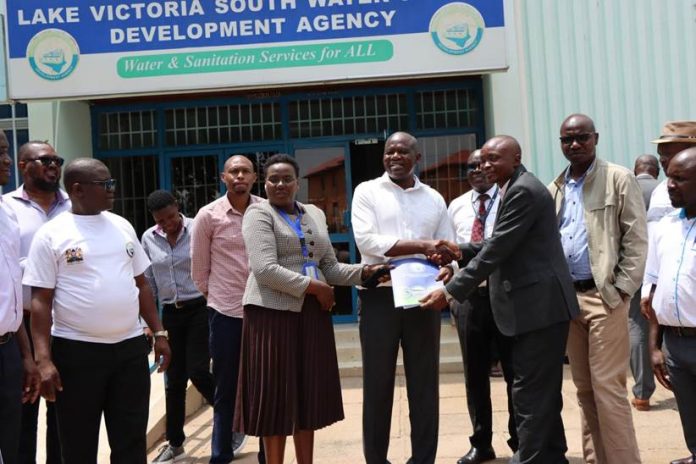
Odoyo spoke as the Victoria South Water Works Development Agency handed over eight double-cabin vehicles and an exhauster to six Water Service Providers.

Two double-cabin pick-ups each were given to Migori Water and Sanitation Company, Siaya Bondo Water and Sanitation Company, Homa Bay Water and Sanitation Company, and Bomet Water and Sanitation Company. The exhauster, on the other hand, was issued to Gusii Water and Sanitation Company (Kisii & Nyamira).

The chairman urged the water companies to ensure the vehicles were properly managed and only utilised for their intended purposes.

The CEO said the Agency was committed to developing infrastructure for various water service providers to ensure the region was water-secure and had a healthy society.

We undertake the development of infrastructure, and we challenge you to ensure prudent service delivery to residents,” Kemunto said.

Raila’s Prophesy to Ruto comes to pass as they sign MOU for ODM-UDA cooperation

0

By Anderson Ojwang                      

Twelve years later, former Prime Minister Raila Odinga’s prophecy about the then-Agriculture Minister and running mate of TNA presidential candidate, Dr William Ruto has finally come to pass.

After a fallout between the former ODM luminaries Raila and Ruto, the two took separate political routes despite attempts by various elders, friends and political interests to reconcile them went nought.

The fallout witnessed Raila lose the Rift Valley support that catapulted his 2007 presidential bid and later resulted in the coalition government with President late Mwai Kibaki.

In the heat of the campaigns, in Kericho county ahead of the 2013 presidential election, Raila told the crowd that “Ruto will need him to win the presidency of the country in future”.

He again repeated the same in 2018 in Kipkelion East, during a burial by saying, Ruto a former ally turned foe should reach out to him because it was the only way he would be guaranteed of ascending to the country’s top seat come 2022 general election.

Raila then told Ruto that politicians from Mt Kenya were already scheming against him.

The prophesy has come to pass but in a different context and content because, in the 2022 presidential election, Raila was fronted by then-President Uhuru Kenyatta while Ruto secured the support of former personal assistant to Uhuru, Rigathi Cachagua, who became his running mate and eventually deputy president.

Ironically and interestingly, President Ruto and his team accused his deputy of undermining him and Rigathi was eventually impeached and currently a leading member of the opposition.

During last year’s demonstration by the Gen Zees over the Finance Bill that nearly paralyzed the government and shook President Ruto’s administration to the core, Raila came to his rescue to thaw the rebellion.

This subsequently, resulted in the formation of a broad-based government that culminated in the appointments of Orange Democratic Movement (ODM) top leadership into the cabinet.

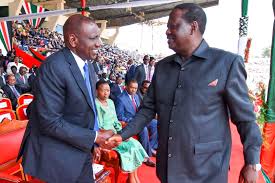
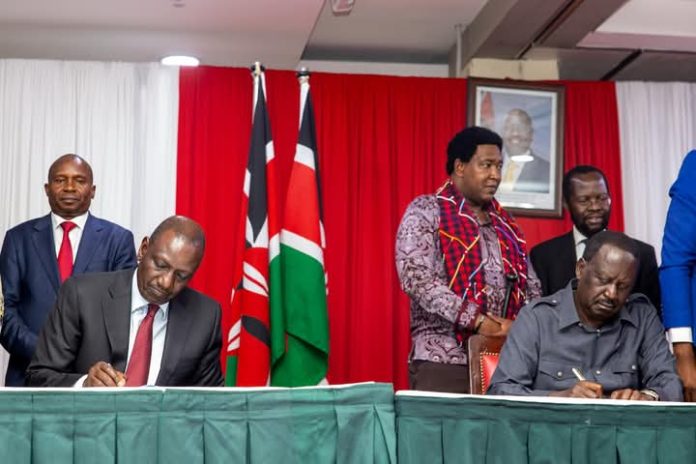
And today, the prophecy came to pass after Ruto and Raila signed a memorandum of understanding, which is framework for the engagement of the two leading parties namely ODM and UDA.

During the signing of the MOU Raila said “When I came back, I went to meet with the President in Mombasa to thank him for the support the government had given me during my campaigns.

He was very gracious. At that time, I found out the two teams from the two parties had worked out some documents that they wanted to be signed.

I told him, I could not sign the documents until, I have consulted my people. So, I took time from that time, went to Kisumu, met prof Anyang Nyong’o, elders and later went to Siaya, Migori, Busia, Kisii, Coast and Wajir and Nairobi and Narok.

I managed the get the feelings of my supporters and that is the reason why we have the conference to sign this document. Today, we have signed MOU between ODM and UDA.

Clarion call is to reduce tension in the country reconcile the nation and move the country forward. As leaders, of the largest political parties in the country, we arrived at the understanding that in a time of significant changes, to our nation, it is not enough to stand aside and criticize, easy as it may be . We have agreed to use our parties as a platform to bring together various voices opinions and concerns to address critical challenges facing the country through the formation of that truly national and inclusive outlook.

The MOU doesn’t define the formation of a political coalition between ODM and UDA, however, its successful implementation could inform the basis of steps to constitute formation for a stable country in the future,’’ he said.

Ruto in return recognized Raila’s contribution to the nation and said he would be forever beholden to the former Prime Minister.

“It was very clear to me that my support for Raila Odinga for AUC seat was not meant for him to surrender his political support base for me.

I said then and again today, he was a great candidate and ran a beautiful campaign. I am proud of him

When he came back, we have been working together on the broad-based arrangements that we have, that is not inspired by what is in it for him or me but how we can close ranks and deal with the issues affecting the people of Kenya

This brings us to this moment and I must congratulate Raila and the ODM party for their boldness and courage to take the position for Kenya and for the people of Kenya.

That is a very bold and courageous decision. It may not be a popular decision but that doesn’t undermine the fact that it is the right decision to stand with the people of Kenya.

The realizations have enabled Kenya’s largest political movements to engage constructively, recognizing the unique opportunity before us.

We must rise above political differences and embrace a higher vision of the Kenya we all deserve.

This moment is not about William Ruto or Raila Odinga, this agreement is not about sharing positions and winning elections, it is about the people and the interest of Kenya. That is what is significant to me.

It is now time to close ranks as leaders because this nation can succeed, we have what it takes to be a great nation. But we haven’t made the steps and decisions that would make the country to be great.

We have been always making politically correct decisions; we need to make decimos thar are correct as far as the interest of the nation is concerned.

I congratulate Raila, for the courage he has to make difficult decisions. Not many leaders can make the kind of decisions Raila have made. I know the kind of difficulty Raila has gone through in taking us to this position.

My brother, Raila history is going to judge you fairly for what you have done for this nation.

Immediately after the elections, I called Raila, I told him, you have been my party leader and my senior. Today, by God’s grace I am president. I want you to be treated well and I will do whatever it takes to make sure, that you have respect in Kenya.” Nyong’o said.

Taifa Care Must Work First, Before People Register

0
Junior Secondary Schools

By Billy Mijungu

Why aren’t people signing up for SHIF/SHA, or the so-called Taifa Care? The answer is simple: It’s not working, and therefore, it does not inspire confidence.

The best way to market a public healthcare scheme isn’t through slogans or government directives. It’s by proving, beyond doubt, that it delivers. People need to see bills being paid efficiently, hospitals accepting Taifa Care without drama, and complaints being resolved swiftly. Until that happens, the uptake will remain low. No one is willing to sign up for a program that appears stillborn.

The government must change the narrative—not by force or propaganda, but through action. It must prove that Taifa Care is functional, effective, and reliable. A good place to start is by ensuring that every government employee, from top officials to civil servants, is exclusively covered by Taifa Care. Retiring all private medical insurers in government institutions would not only inspire public confidence but also save the exchequer nearly Ksh 150 billion annually.

If Taifa Care is truly meant to be the solution for all Kenyans, then let those running the country lead by example. Until then, skepticism will remain, and sign-ups will be sluggish.

Regional Prison Commander Challenges Inmates to Reflect and Refocus on Their Lives

0

By Erick Otieno

Nyanza Regional Commander of Prisons, Patrick Nyaachi, has asked Migori inmates to reflect on their time in prison and decide who they want to be in the future.

Nyaachi, who celebrated International Women’s Day with women inmates at Migori Main Prison, urged the inmates to accept and embrace the change offered at the prison facilities to self-reflect on their lives after their jail term for a better future.

He told the inmates to think about the virtues of freedom and reflect on their time before their jail term to change and become responsible citizens.

He also reminded men of their obligations by pointing out that a home and a society that lacks men’s leadership is not a strong society.

I am urging men to play their part and be responsible citizens in taking care of their families rather than being in jail for crimes that they could have prevented,” noted Nyaachi.

The official also called upon women who falsely accuse their men of various crimes to desist from the behaviour that jeopardises family unity.

Sometimes men are accused falsely and end up in jail for crimes that they did not commit,” explained Nyaachi.

He emphasised that the criminal system will continue to play its part to ensure that those who deserve to be in prison are genuine cases.

The official also added that the correction department will continue to take good care of inmates to ensure they become responsible citizens when they finish their jail terms.

Chief Officer in Charge of Gender and Inclusivity, Prof Rose Odhiambo, explained that culture was still the biggest hindrance to gender equality.

Odhiambo said a section of male and female inmates have been jailed because of Gender-Based Violence (GBV) and Female Genital Mutilation (FGM), cases that she said could be easily avoided.

On her part, Migori Resident Judge Anne Onginjo urged the inmates to be good ambassadors in prison as well as outside after their jail term.

Onginjo, however, called upon Kenyan citizens to be truthful to the court to get justice, adding that being truthful can open doors to an alternative justice system like mediation that can help individuals avoid prison.

“Advancing Inclusivity: The Landmark Persons with Disabilities (Amendment) Bill of 2023”

0

Dr.Edris NOmondi  (Advocate)

Attorneyedris@ywcg.org

In a poignant personal experience, I recall a time when I took my mother, suffering from an amoebic dysentery infection, to a hospital here in Kisumu. After her condition deteriorated and she lost a significant amount of water, she was admitted to receive drip medication. The next morning, we were horrified to discover that her active hand, had turned pale black, and had lost all feeling. It was a traumatic experience for the family, especially compounded by the realization that hospital negligence had indeed led to the loss of her fingers. This first-hand encounter with medical negligence deeply underscored the vulnerability we all can be susceptible to.

Anyone can be disabled:

The 2024 road carnage statistics have shown that approximately 4500 people lost their lives last year, thousands more suffered a form of disability-a reality check- that any of us can suddenly become a disability victim.

The tabling of the Bill:

This personal story resonates well, with the ongoing fight for the rights and welfare of people with disabilities. One notable champion of this cause is a Kenyan nominated Senator, one Crystal Asige, who has achieved a monumental stride for this nation, especially the country’s disabled community.

Allow me to paint an imaginary journey from Senator Asige’s perspective-she first tabled the Persons with Disabilities Bill on 22nd March 2023, before the Senate, got drowned into the august house debate that convinced the Senate to pass the Bill in February of 2024. A year later, the march awaited news rang her door bell-January 16th 2025, and yes, The National Assembly had approved the Bill into Law. With tears of joys that filled her eyes, her sojourn had finally culminated a journey worth the senate. Today, Kenyans of all walk of life, alive to her efforts- celebrate her. Her nomination is worth her representation-a significant historic memoir, that has aligned the rights of persons with disabilities within the constitutional guarantees, especially under Article 54 of our Constitution.

Progressive Constitutional Gains for Persons with Disabilities

It is significant to note that, The Persons with Disabilities Bill, 2023, did outdate, The Person with Disabilities Act, 2003, which had since been in place from June 16, 2004. The take away here is that, the amendments did realign with the 2010 Constitution of Kenya. There is no doubt that the amendments introduced several progressive measures aimed at improving the lives of disabled individuals across Kenya, particularly through greater accessibility, healthcare provisions, and employment protections.

One of the core provisions of the amendments was the reorganization of the National Council for Persons with Disabilities (NCPWD). This restructuring focuses on decentralizing the Council’s operations to enable it, better serve individuals at the grassroots level, specifically by involving county governments as the key implementors of National Government policies on disability and disability programs. This move is crucial for ensuring that disabled persons are not left behind, especially those in remote areas who have previously struggled with limited access to services.

International Win-Comparisons and Benefits

When comparing the Amendments with international standards, the law holds up well in many ways. Countries like the United States have long had legal frameworks, such as the Americans with Disabilities Act (ADA), which ensures accessibility and inclusion for persons with disabilities. Similarly, the United Kingdom’s Equality Act of 2010 provides comprehensive protections for individuals with disabilities, including workplace accommodations and public service access. The Kenyan law draws from these international frameworks, making strides to align with global standards for the protection and inclusion of persons with disabilities.

Additionally, the World Health Organization (WHO) and the United Nations (UN) have long advocated for the rights of persons with disabilities, pushing for laws and policies that promote their social inclusion and equitable participation in society. Kenya’s legislation aligns with these global standards by emphasizing accessibility, healthcare, and education are now within the required parameters on the United Nations Convention on the Rights of Persons with Disabilities (CRPD) and the Universal Declaration of Human Rights.

Some Key Features and Benefits of the Law:

Free Medical Care

Persons with disabilities will be entitled to free medical care and treatment at public health institutions. This provision is particularly significant as it addresses the financial burden that many disabled persons face in accessing necessary healthcare. Section 24(5) of the legislation guarantees this fundamental right.

Family Unity

The law also stresses the importance of family unity, with Section 8(3) ensuring that no person with a disability will be separated from their child on the grounds of their disability. This provision helps challenge outdated stereotypes and highlights that disability should never be a barrier to family cohesion.

Retirement Age

Another important feature of the legislation is that employees with disabilities will now be allowed to retire at the age of 65, as outlined in Section 21(6). This opportunity creates economic participation and stability.

Healthcare Accessibility

Section 24 requires hospitals to establish accessible disability desks, ensuring that persons with disabilities can easily access the services they need, with healthcare professionals undergoing specialized training to provide adequate care for individuals with disabilities, and staff trained in sign language will be available to assist deaf patients.

Improved Accessibility Standards

One of the most important measures in the legislation is the registration of accessibility auditors, who will be tasked with ensuring that buildings, transport systems, and public services are accessible. This will ensure that people with disabilities are not excluded from participating in everyday societal activities, as outlined in Section 35(A)

Tax deductions

  1. For every private employer who engages a person with a disability as a regular employee shall be entitled to apply for a deduction from its taxable income equivalent to 25% of the total amount paid as salary to such employee. (Section 23(1)
  1. For Every improvement made by a private employer to a physical facility, they shall be entitled to apply for additional deductions from its net taxable income equivalent to 50% of the direct costs of the improvements, modifications or special services. Section 23(2)

Conclusion:

The benefits above is but a mention of only many great provisions. The passage of this law marks, a significant leap towards inclusivity and equality for people living with disabilities in Kenya. The law provides new opportunities for County Governments to realign their county disability legislations with the new developments. Of significance at this moment and time, is the incorporation of relevant bodies like the Council of Governors, the Kenya Law Reforms and other relevant government agencies to work together towards coming up with implementable formidable, practical regulations, that will operationalize the letters of the legislation into law.

How an Empowerment Organisation is Giving Hope and a Smile to Widowers

0

By Habil Onyango

For a long time, elderly widowers in society have been neglected and forgotten, as the main focus has always been on supporting widows and the girl child.

Most of them have been living lonely lives after the demise of their partners, with no companion in their homes.

Some even lead a pathetic life with no one to care for them, leaving them with no choice but to wait for their time to depart from this world.

However, widowers across the country now have a reason to smile after an organisation, supported by the Interior Permanent Secretary, Dr Raymond Omollo, came up with an initiative to assist them.

According to Sam Okombo Nyarombo, the Director of the Widowers’ Empowerment Programme, their main aim is to offer healthcare services, empowerment, and support services for the neglected group.

For quite some time, we have talked about the girl child and widows but forgotten about the widowers who have been living desperate lives after the death of their spouses, with little support from the community,” said Nyarombo.

After realising what our elderly single fathers go through after being left alone, together with PS Omollo, we decided to come up with a programme that will see them benefit from mental support, proper healthcare, and other basic needs,” he said.

We want to bring back hope to those who have lost it and make them feel that they are still important members of society,” he added.

According to the Director, who was speaking at Arujo Location Chief’s Camp when the team met elderly widowers, they plan to travel across the country to offer support to those affected.

He said they have already visited a number of widowers in Rusinga, Mfangano Islands, and Gwassi regions within Homa Bay County.

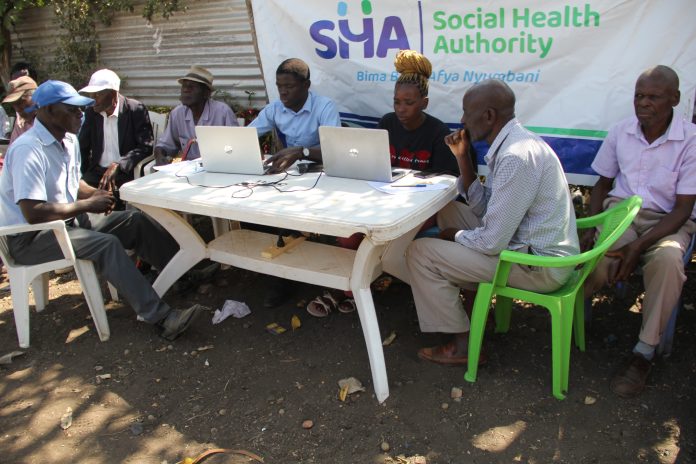
During the visit, the elderly widowers benefitted from medical check-ups, were gifted grooming kits, and also got an opportunity to register for SHA.

We want the elderly widowers to age happily with dignity and feel that they are still an important part of society,” said the Director.

We have had an elaborate discussion where we realised that some have lost their property to unscrupulous individuals and lack knowledge of the legal framework on how to recover it. We have advised them and will follow up and offer legal aid,” he said.

We all know that there have been a number of programmes running for women, such as farming and table banking, but widowers are just left sitting pensively, waiting for their deaths,” he said.

He, however, appealed to the county government to engage more community health workers who can visit and assist the elderly who are unable to access healthcare at their homes.

According to the Arujo Location Senior Chief, Robert Lang’o, the initiative will prolong the lives of elderly widowers.

This is the right time to engage the elderly by giving them hope and providing them with proper healthcare, companionship, and even food,” said Lang’o.

Lang’o revealed that there are close to 1,000 widowers in his location who need assistance and care.

According to one of the widowers, Bernard Owino, 78, he has been staying alone in his homestead for eleven years since the death of his wife.

All my children are grown-ups, and they have their own families. I have been staying alone in my home, washing my clothes alone, and sometimes I lose hope in life,” he said.

However, with the kind of engagement and support we have received today, I have gained confidence and hope, and I am determined to live longer,” said Owino.

According to Ben Otieno, 67, this was the first time in his entire life that he had witnessed widowers being considered for support.

He said being a widower and elderly comes with a number of challenges, including negative perceptions, where some view them as witches and often try to kill them.

In some regions, some elderly people have been burnt alive or murdered for being suspected witches. We need a lot of support and care, and I am happy the PS has seen the need,” said the retired teacher.

We are also happy with the government initiative of directly transferring our monthly stipends to our mobile phones, as before we used to lose a lot of money to young girls whenever we went to withdraw from banks,” he said.

Dr Omollo is also running an empowerment programme for widows by building them modern houses for those in need.

We want to appeal to Dr Omollo to also consider us widowers for modern houses. Some of us are living in dilapidated structures which, given our ages, are not safe at all,” he said.

Raila Odinga Stadium to Be Ready by 20th May for Madaraka Day Celebrations – CS Mvurya

0

By Habil Onyango

The ongoing renovation of Raila Odinga Stadium in Homa Bay is expected to be completed by 20th May 2025, Cabinet Secretary for Sports and Youths Salim Mvurya has said.

The stadium is undergoing a facelift in preparation for the Madaraka Day celebrations on 1st June, which will be presided over by President William Ruto.

Speaking at the stadium during the handover to the contractor, the CS said that the stadium is also being prepared to host other sporting activities.

We have had a meeting with the contractor and other senior national and county government officials, and we have all agreed that this work has to be of a high standard and should be completed in record time,” said the CS.

The works we are doing here—part of it is going to be compliant with the Madaraka Day celebrations, and some part of it will meet the standards required for sporting activities,” added Mvurya.

A week ago, a team managing national ceremonies, led by the Principal Secretary for Interior, inspected the stadium among other infrastructure in readiness for the celebrations.

The team managing national ceremonies visited here and gave their recommendations, which will be implemented to ensure that this stadium is available for the Madaraka celebrations and other sporting events,” he said.

The CS was accompanied by Homa Bay Governor Gladys Wanga and other senior officials from the national and county governments.

I want to thank Governor Wanga for the partnership, since we can only succeed if we work together as a team. I am happy that this has been demonstrated by the ongoing activities,” said the CS.

Mvurya also directed the contractor to ensure that he engages Homa Bay youths in jobs during the facelift.

One important thing we have told the contractor is that the people of Homa Bay should feel that this project belongs to their county by being given priority in the jobs available here,” he said.

I am sure the people of Homa Bay have all the skills needed for this work, and I want to encourage the contractor to utilise the youths from this area so that when the stadium is completed, they will also have money in their pockets,” said the CS.

Governor Wanga thanked the President for the promise he made when he attended the Genowa Governors’ Cup, accompanied by former Prime Minister Raila Odinga, that his government would elevate the stadium to international standards.

The Governor said this commitment is evident through the recent visit by the national government delegation, the CS’s visit, and the ongoing construction work.

There are people who like spreading propaganda that our President only makes promises without action. The ongoing construction work clearly shows that the Head of State has kept his promise, and we are very grateful to him,” said Wanga.

According to the Governor, the stadium will now boast a 12,000-seating capacity, terraces, canopies, new gates, and a changing room once completed.

The Urgent Need for the Own Source Revenue Act to Streamline County Revenue Collection

0
Junior Secondary Schools

By Billy Mijungu

The inefficiencies in county revenue collection across Kenya have long hindered service delivery and development. Corruption, leakages, and inconsistent systems have led to massive revenue losses year after year, depriving counties of the resources needed to improve infrastructure, healthcare, and public services. It is time to embrace a transformative approach that will enhance efficiency, transparency, and accountability in county finances. The introduction of the Own Source Revenue Act presents a vital opportunity to reform and standardise revenue collection, ensuring that every shilling collected is accounted for and used for the benefit of the people.

Own Source Revenue is the proverbial cost of a county lifestyle. It should be oriented towards running the county’s recurrent budget, leaving national allocations purely for development. Counties should not rely on national transfers for salaries and operational expenses while failing to maximise their own revenue potential. A well-managed county should generate enough internal revenue to cover its basic operations, allowing national allocations to fund major infrastructure projects and long-term economic growth initiatives.

One of the most pressing issues in county revenue collection is the fragmented and uncoordinated manner in which counties handle their finances. Some counties rely on outdated manual systems, while others have multiple pay points, making it difficult to track and audit collections effectively. This loophole creates opportunities for mismanagement and loss of funds. Establishing a single pay point system per county will eliminate these inefficiencies by centralising revenue collection and enabling proper monitoring. A unified approach will also simplify payments for residents and businesses, who currently navigate a confusing maze of levies and fees spread across different collection points.

Digitalisation is the backbone of this proposed reform. By integrating all counties into a centralised digital revenue collection platform, Kenya can significantly reduce corruption and improve efficiency. A digital system minimises cash transactions, which are a major source of revenue leakage, and ensures that payments go directly to county coffers. Automation also enhances transparency by providing real-time data on collections, allowing for accurate financial planning and timely allocation of resources. The convenience of digital payments will further encourage compliance among residents and businesses, increasing revenue inflows.

To ensure the success of this transformation, the establishment of County Revenue Boards is crucial. These boards will provide the necessary oversight for the implementation of the single pay point system and the digital platform, ensuring that counties adhere to standardised procedures. By including representatives from key county departments, businesses, and civil society, the boards will bring accountability and inclusivity to the revenue management process. Their role in monitoring collections, identifying inefficiencies, and recommending improvements will ensure that county revenues are managed effectively.

A structured capacity-building programme for county officials is another critical component of this reform. Many counties still struggle with financial mismanagement due to inadequate training and poor digital literacy among revenue officers. The proposed law mandates comprehensive training programmes that will equip officials with the skills needed to operate the digital system efficiently. Public awareness campaigns will also educate residents on the new system, fostering compliance and trust in county revenue processes.

The proposed law also outlines a phased implementation strategy to ensure a smooth transition. A pilot phase in select counties will allow for testing and refinement before a nationwide rollout. This measured approach will address any challenges before full implementation, reducing the risk of failure and resistance. Regular audits and independent evaluations will further reinforce accountability and identify areas for improvement, ensuring that the system remains effective over time.

With a robust enforcement mechanism in place, counties that fail to comply with the law will face penalties, ensuring adherence to the new framework. This deterrent will eliminate complacency and force counties to embrace efficient and transparent revenue collection practices. The Act also mandates the national government to allocate resources for implementation and maintenance, ensuring that counties have the necessary infrastructure to support digitalisation.

The time for reform is now. County governments must embrace the Own Source Revenue Act as a means of strengthening financial health and improving service delivery. A streamlined revenue collection system will not only boost county revenues but also restore public confidence in devolved governance. Kenya cannot afford to continue losing billions due to inefficiencies and corruption. With a clear legal framework and the right technology in place, the country can set a new standard in county revenue management, ensuring that every collected shilling contributes to development and the betterment of citizens’ lives.

Facebook X Instagram TikTok LinkedIn @BilyMijungu #Forward #TusongeMbele

How World Bank Projects Have Transformed Kisumu City into the Cleanest in Kenya

0

By Anderson Ojwang

Kisumu City is the cleanest city in Kenya, second in East Africa, and is rapidly developing as a result of various development projects supported by the World Bank and the County Government of Kisumu.

The administration led by Professor Peter Anyang’ Nyong’o has benefitted from multibillion-shilling projects that have had a positive impact on the general infrastructural development of the lake city.

The multibillion-shilling projects, through the World Bank’s Kenya Urban Support Programme (KUSP1), have radically changed the city’s infrastructure and positioned it as one of the fastest-growing in the region.

City Manager, Mr Abala Wanga, said KUSP1 has improved the infrastructure and image of the city, making it one of the best-planned, cleanest, and most orderly cities in the country.

He said that through KUSP1, the World Bank has built a modern fire station, which is fully equipped and capable of responding to any emergency in the region.

Wanga added that the Bank is also modernising and reorganising Kibuye Market, with 50 per cent of the work already completed and still ongoing.

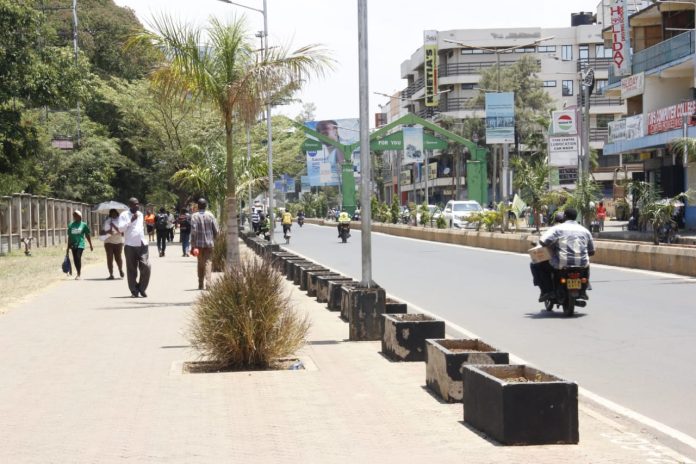
He said that through KUSP1, the Bank has made significant investments in non-motorised transport infrastructure in the Central Business District (CBD) and other areas, greatly improving mobility.

The construction of non-motorised lanes has helped reduce the high incidence of accidents and ensured free movement within and beyond the city. This has changed the face of Kisumu, making it one of the cleanest and most orderly cities,” he said.

Abala noted that Kisumu’s three main parks—Oile Park, Sports Ground, and Victoria Park—have all undergone significant infrastructural improvements and have become focal meeting points for residents.

He said KUSP1 has also contributed to the infrastructural improvement of Kisumu’s Rotary Centre, which now hosts over 2,000 students undertaking semi-skilled training.

We have Kaloleni Social Hall and Nyamasaria Bus Park, both under construction using World Bank funding. These projects are milestones in the city’s growth and development, both now and in the future,” he said.

Under KUSP2, Abala said that a new proposal has been drafted and submitted to the Kisumu City Board. Once approved, it will be forwarded to the Cabinet for final approval. The new phase will focus on legacy projects for the city.

We propose to introduce non-motorised transport corridors from State House to Dunga Beach, ending at Hippo Point.

We will convert Dunga into a Marina Park with a jetty capable of accommodating 100 boats, which will improve the waterfront.

This development will also spur economic activities in the area and create employment opportunities across various sectors,” he said.

Wanga added that the non-motorised transport network will also extend to Nyerere Road, Ngumbi Street, Patel Flats, Lumumba Estate, Anderson Estate, Makasembo Estate, Kachok, and Kisumu Polytechnic.

He said these non-motorised transport corridors will be enhanced with street lighting and CCTV cameras to improve security within the city.

Wanga also stated that, under the programme, the city will construct terraces and walkways.

He added that in the Mamba area, they plan to reorganise the space and turn it into a focal entertainment hub for the city, equipped with various recreational facilities.

We will undertake beautification projects across Kisumu, improving its image and making it one of the most attractive cities in the region and in Africa,” he said.

Wanga further mentioned that the plan includes the construction of a convention centre near the lake and the reorganisation of the CBD.

We have our Industrial Park in Kibos and Nyamasaria, where we intend to relocate manufacturers and traders to create a one-stop industrial hub.

This will help decongest the CBD while providing a dedicated space for investors to set up businesses,” he said.

Wanga also revealed that, through the Department of Health, they plan to construct a public health laboratory to respond effectively to disease outbreaks in the county.