By James Okoth
If there was a moment when politics gave way to pure humanity, it was the night President William Ruto chartered a flight to take Raila Odinga to India for specialised treatment.
As narrated during the funeral by Kisii Governor Simba Arati and Dr Oburu Oginga, Raila’s elder brother, the gesture was not merely presidential — it was profoundly personal. At a time when the nation held its breath, waiting for news of Raila’s condition, Ruto chose compassion over calculation. He did not delegate; he acted.
Oburu’s voice roared with conviction as he recounted how the President personally intervened, ensuring Raila’s evacuation on a fully equipped medical jet — an act of urgency, respect, and quiet empathy.
“When Raila needed help,” Oburu said, “Ruto did not hesitate. He made sure his brother was flown out in dignity and safety.”
Simba Arati, too, captured the raw emotion of that moment — a scene where power met kindness. “That was not a political act,” he told mourners. “That was an act of love — of humanity.”
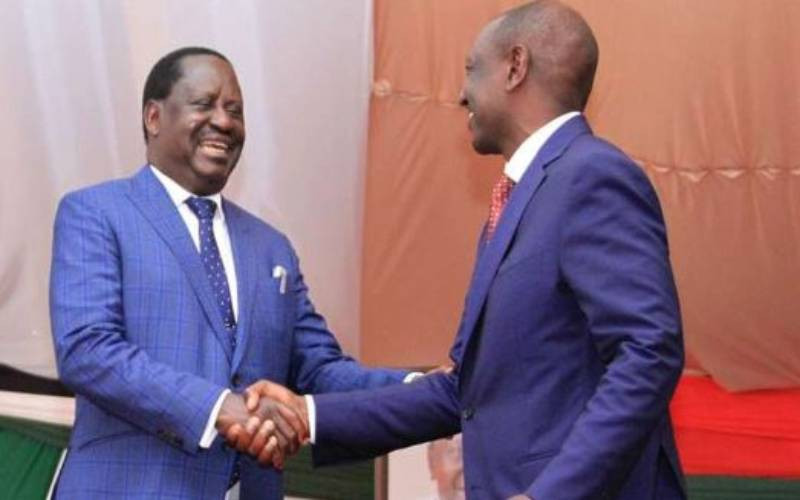
In Kenya’s history of fierce political rivalries, such gestures are rare — almost unthinkable. Here was a sitting President extending his hand, not to an ally or an asset, but to a lifelong opponent whose political fire had once burned against him.
That single act collapsed decades of animosity into a quiet, humbling truth: that even in politics, empathy is leadership.
Ruto’s decision to intervene so personally revealed something few had seen — a man guided not just by the instincts of a politician, but by the values of a brother, a believer, and a human being. It was a reminder that leadership is not only about statecraft or power, but about the moral fibre that guides one’s choices when no cameras are rolling.
That chartered flight to India now stands as a symbolic chapter in Kenya’s political history — a moment that softened the sharp edges of rivalry and redefined the boundaries of leadership.
Ruto’s gesture carried weight far beyond the immediate. It reminded Kenyans that behind every political adversary lies a human life, a family, and a story worth dignity. And in choosing to protect that dignity, the President revealed a dimension of compassion rarely associated with power.
In the larger story of leadership, such gestures speak louder than manifestos. They remind us that power, when guided by empathy, becomes service — and that rivalry, when tempered by respect, becomes legacy.
William Ruto’s decision to fly Raila to India may not change the architecture of Kenyan politics overnight, but it redefined what it means to govern with heart. It showed that beneath the armour of politics lies the enduring human truth: that compassion is the highest form of power.
As Oburu Oginga put it, “That flight told us who Ruto truly is — not just a politician, but a man with a heart.”
And in a nation often divided by politics, that night, even if briefly, Kenya felt whole.