Home Blog Page 170

Could the Valley and Mountain be edging towards a political rapture?

0
By Anderson Ojwang

Could the Mountain be returning to its restive and illusive tendency towards the Valley after 15 years of consummate political marriage?

Is the country about to be treated to a political rapture between the Valley and the Mountain who from independence have witnessed power batons change hands among themselves on different occasions?

The Valley and Mountain have always coalesced together to deny the Lake, Mulembe, and other regions from ascending to the “white house” in the mountain.

But in 2007, when the Valley and the Lake came together, Mountain braved a political earthquake during the controversial presidential elections that were disputed and threw Kenya into post-election violence and eventually birthed the government of national unity.

The incumbent President Mwai Kibaki retained his seat while Orange Democratic Movement (ODM) candidate Raila Odinga became the Prime Minister in the coalition government.

But a fallout in the ODM between Raila and the Valley leader President William Ruto, then Agriculture Minister in the collation government precipitated a new political dispensation that brought the Mountain and the latter together once again.

The new dispensation birthed a political alliance that propelled then Finance Minister Uhuru Kenyatta to the presidency with Ruto becoming his Deputy while Raila returned to his leader of opposition role.

This alliance opened the door for Ruto to climb and capture the mountain and subsequently dislodged the political ruling class and changed the political matrix of the region to his own making. 

Ruto deconstructed the political matrix in the mountain by eliminating the once powerful lights in the region including former Kiambu Governor Kabogo, Peter Kenneth, and Martha Karua among others.

He came up with new leaders from the region including the current deputy President Rigathi, leader of the majority party in the parliament Kimani Ichungwa among others.

The Mountain has been in Ruto’s armpit for the last 14 years but currently, it is getting restive, with tremors and bolts of lightning emergence of “Mr. Truthful man”, who is out to take back the mantle from his master.

The House of Mumbi is in rumbles with emerging political blocs threatening to unleash a political earthquake ahead of the 2027 presidential election.

The Mountain has now been split into two main political blocs within the ruling Kenya Kwanza coalition with one supporting President Ruto and another one for the “truthful man”.

The gloves are off with the Truthful going bare knuckle on his boss by challenging him to stick to his promise to the people of Kenya that his deputy will never be frustrated in his regime.

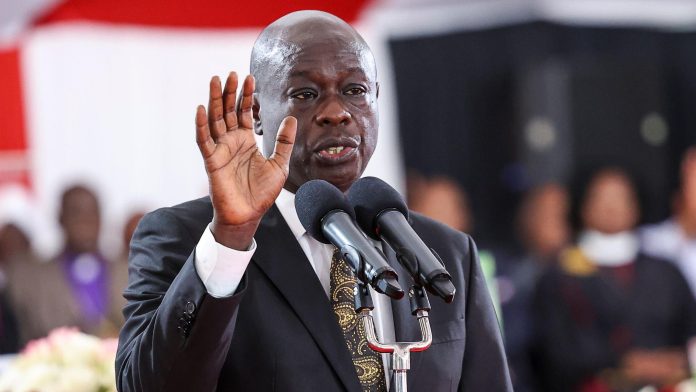
“I ask President Ruto to stick to his promise on the deputy. I also implore him that we should complete our three years and after that, he can decide on his next political course,” Rigathi said over the weekend during a series of rallies.

He went on to say during last Friday’s Citizen TV interview “I ask President William Ruto to please allow me to work for the next three years. Let me serve the people of Kenya. What is happening is not right,”.

Rigathi claimed frustrations by officials from the President’s office and alleged that together with his officials, they were removed from the President’s Diary WhatsApp group, and he is not privy to Ruto’s engagements, which is the reason he has been missing some events.

“I never expected such to happen, given all I went through under the previous administration just to support President Ruto. My family is distressed by the recent political happenings,” he said.

But Ruto’s allies have not taken the rebuttal lying with some MPs saying the impeachment was real and that Rigathi will face his Waterloo.

‘We will impeach you “Mr. truthful man”. The dice are cast and we must hold the dignity of the country high and work for Kenya,’ said MP Didmus Barasa.

But the decibels of rubbles in the Mountain are getting louder with a section of MPs and elders pledging allegiance to Internal Security Cabinet Secretary Prof Kithuri Kindiki as their leader and link with the national government.

Rigathi and Kindiki rivaled for the choice of running ahead of the 2022 presidential elections and the two have remained politically separated.

The Njuri Ncheke Council of Elders said Kindiki had proven himself as a close and reliable ally to President Ruto, thus he was fit to be the region’s kingpin who would also channel development in the area.

“We, Njuri Ncheke from two counties namely Meru and Tharaka do endorse Kindiki to be our link with  President Ruto.  Today we endorse him as our kingpin, spokesman, and the link between us, Mt Kenya East, and the President,” they said.

Kapsaret MP Oscar Sudi added the fuel to fire by declaring that the deputy President was the problem unto himself and was playing tribal cards instead of uniting the country.

“You claim to be truthful but the worst liar. We must be honest with ourselves. Some people are not happy with the current alliance between UDA and ODM and are only interested in their own personal gains,” he said.

During the recent President Ruto tour of Nyanza to the National Assembly Majority Leader Kimani Ichung’wah, said it was wrong for a section of leaders from Mt Kenya to be ungrateful to the president despite getting seven slots of Cabinet secretaries as well as the position of the DP as opposed to Nyanza.

But Rigathi responded, “I saw some debate in Nyanza where some leaders tried to suggest in a very reckless manner that this region has not shown gratitude for the positions that the President has given us in the Cabinet. That is not true.”

He said the claim by Ichungwa’h amounted to trying to abuse the Mountain people who have shown the highest form of gratitude to the president, by supporting his presidential bid.

 “Actually in matters of gratitude, it was the other way round. He is the one who owes us gratitude in this region because we have already vindicated ourselves.” Rigathi said.

Rigathi allies led by Nyeri County Speaker Gichuhi Mwangi said the people of the Mountain should support the DP as he was instrumental in protecting the region’s development agenda.

“DP Gachagua occupies the second highest leadership position in the country, and we must stand with him and support his efforts to steer the government,” he said.

MP Kangema Peter Kihugi said the region must get its share in government to secure development and must unite to protect the region’s interests. 

Tetu MP Geoffrey Wandeto said the DP had succeeded in uniting the region by offering an olive branch to all leaders regardless of their political affiliation.

“You are the anointed leader of the region, like David. You have been selected from many options, but God chose you, and now you are in the right position to unite us,” he said.

With gloves off, Kenyans will be watching if the restive mountain will calm down to drink the sweet waters from the Valley once again.

How marginalization of the fishing industry has denied Kenya  Sh180 B annual revenue

0
Fish
By Hope Barbra

Failure to mainstream the fishing sector into an agency to manage the industry for the last six decades has denied the country revenue running into billions of shillings.

While other sectors of the economy such as cereal farming have been mainstreamed through the National Cereal and Produce Board, the Tea sector mainstreamed through the Kenya Tea Development Authority (KTDA),  the milk sector through the Dairy Board, and the fishing industry has been marginalized. Thus the potential has never been realized.

Similarly, the Kenya Fish  Management and Development Act of 2016 mandated the creation of an agency to manage the fishing sector in the country.

The Act directed that the parliament shall appropriate a general fund for fish marketing authority and this is yet to be undertaken.

But eight years down the lane the fishing sector is yet to be institutionalized to be autonomous but currently still relies on the state department of blue economy for budget to operate.

The Act provides for a wide range of matters concerning the fisheries sector including fisheries management and conservation, aquaculture, and fish processing and marketing. 

It establishes the Kenya Fisheries Advisory Council (“Council”), The Kenya Fisheries Service (“Service”), The Fish Marketing Authority (“Authority”), the Fisheries Research and Development Fund, and the Fish Levy Trust Fund. 

The Act also implements obligations concerning fisheries under international law. 

The objective of this Act is to protect, manage, use, and develop the aquatic resources in a manner that is consistent with ecologically sustainable development, to uplift the living standards of the fishing communities to introduce fishing to traditionally non-fishing communities, and to enhance food security. 

Guiding principles of the Act include, among other things, conservation and protection of fisheries habitats, ensuring the effective application of the ecosystem approach to fisheries management and that biodiversity and genetic diversity in the marine environment is maintained and enhanced, encouraging the participation of users of the fisheries resources, and the general community, in the management of fisheries, application of the precautionary approach to the management and development of the fisheries at no less standard than is set out in any international agreement.

According to the chairman Mr. Martin Ogindo, Kenya has untapped fish potential that is capable of driving the local economy.

Ogindo said currently, the country’s fish production stands at 160,000 metric tons from the lakes, ocean, and aquaculture.

“Kenya has various fishing points with Lake Victoria accounting for 100,000 metric tons while Lake Turkana accounts for 12,000 metric tons and Indian Ocean contributing 20,000 metric tons. Aquaculture accounts for 20,000 metric tons while Lake Baringo, River Tana, and  Lake Naivasha account for 5,000 metric tons combined, he said.

The fish production earns the country a revenue of Sh 30 billion, a figure far below the potential in the fishing industry.

Ogindo said Lake Victoria alone if fully managed can produce 300,000 metric tons of fish and the same is true for Lake Turkana which produces highly prized mango tilapia and Nile Perch.

“Deep fishing in the Indian Ocean can produce 450,000 metric tons of fish while aquaculture can produce over 100,000 metric tons of fish,” he said.

Currently, 70,000 fishermen are directly employed in the various water bodies while another 70,000 are employed in aquaculture and another 500,000 are in the value chain modes.

‘We have over 2 million people who draw their livelihood from the fishing sector and when the industry is exploited to its full potential, more people will be employed,” he said.

Ogindo said the challenges in the fishing industry are the unregulated and managed fishing in the industry and the lack of support from the government to exploit the emerging opportunities.

He challenged the five counties along Lake Victoria mainly Kisumu, Siaya, Homa Bay,  Busia, and Migori, and the national government to develop a roadmap and structure on how to manage the shared potential.

Ogindo said the sector when fully operationalized can earn the country  Sh 180 billion annually and President William Ruto has directed the board that within the next three years the sector must give Sh 100 B to the economy annually.

Ogindo said the board once operationalized will transform the fishing sector and create employment and earn the country additional revenue.

Currently, the authority is not functional as it has no staff and chief executive officer and also office to undertake its operation.

Did “salient rebellion” in Nyanza cost Raila the presidency in the 2022 elections?

0
Raila
By Anderson Ojwang

Could the leader of Azimio La Umoja, Raila Odinga, have faced significant opposition in his political stronghold of Nyanza, leading to his loss in the last presidential election? 

And could the boycott have indirectly contributed to President William Ruto’s victory in the last election?

These are some of the tough questions that have emerged after the election and various data interrogations could give a glimpse of an answer to it. 

Data from the Independent Electoral Boundary Commission (IEBC) shows Raila’s presidential Waterloo could have been from his birthplace of Nyanza which catapulted him to national and international prominence.

In the last presidential elections, Raila lost to his opponent President Ruto by 227,311 votes after he garnered 6,942,830 against the latter 7,170,141. 

Ruto rode to victory after acquiring 50.5 percent against Raila’s 48.8 percent in the final results released by IEBC.

Statistics from the IEBC portal show that Ruto managed only voters 74,857 in the four counties of Luo Nyanza. But as Ruto performed dismally in Nyanza, Raila too had his motor jamming on the road.

The four counties namely Kisumu, Siaya, Homa Bay, and Migori have been the bedrock of Raila’s politics.

But in the last general elections, voters from the region could have negated Raila’s fifth bid when  593,607 voters failed to participate in the elections.

The four counties had registered a total of 2,160,439 voters ahead of the election but at the ballot, Raila only managed to secure  1,566,832 votes which denied him presidency in the grueling contest. 

This accounted for  30 percent of registered voters from Kisumu, Siaya, Homa Bay, and Migori counties who did not participate in the elections at all.

Interestingly, in the controversial 2007 presidential election, the turnout in Nyanza was overwhelming and rock solid.

 The incumbent President Mwai Kibaki won by garnering 4,58,721 votes against Raila’s 4,352,993 with each getting  46.42 percent and 44.07 percent respectively.

Data analysis from the IEBC portal showed Kisumu County had registered 606,754 voters and  419,962 votes were cast at the elections.

Siaya county had 533,595 registered voters with 371,201 turning out to vote. 

In all these counties the voter turnout stood at 71 percent for Siaya, Kisumu county was at 72 percent, Homa Bay and Migori counties tied at 74 percent respectively.

In Migori County 469,019 registered voters while those who turned to vote were 294,034 while Homa Bay had  551,071 registered voters and 399,813 cast the votes. 

Unlike in 2007,  when Nyanza voted for Raila to be a near man and was able to marshal most of the votes from all the constituencies, in the last general election, the story was different.

Statistics show that in 2007 in all the constituencies in now  Migori and Homa Bay counties, the turnout stood at over 86 percent.

For instance in Homa Bay, Ndhiwa constituency, the voter turnout was at 93.74 with Raila getting 57,380 of the registered voters of 64,529.

In Karachuonyo constituency the voter turnout was at 95.37 percent with Raila garnering 59008 votes out of the 62,040 registered voters. 

In Mbita constituency the voter turnout was at 95.57 with Raila securing 38,451 votes out of 40,451 registered voters.

In Gwais, the turnout was at 92.68 percent with Raila garnering 31,605 votes out of 34,394 registered voters while in Kasipul Kabondo the voter turnout was 88.66 percent with Raila taking 68,631 of the 78,171 registered voters.

In Migori county, the trend was similar with Nyatike recording 94.83 percent turnout and Raila garnering 48,655 of 51,682 votes.

In Uriri constituency the voter turnout stood at 87.07 percent with Raila securing 33,661 of the 40601 votes while in  Migori constituency the turnout was at 85.43 with Raila getting 51,648 votes out of  62,070 registered voters. 

In Rongo constituency, the voter turnout was at 85.46 percent with Raila garnering 60,286 votes out of the 70,999 registered voters.

In Kisumu county, the voter turnout stood out at 88 percent with Kisumu Rural constituency had a voter turnout of 84.51 percent with Raila getting 44,129 votes out of 52,937 registered voters.

In Siaya for instance  Alego constituency had a voter turnout of 88.11 percent with Raila garnering 71,188 of the 71,188 registered voters while  Bondo constituency also had 85.45 percent with Raila getting 53,202 votes of the 62,352 registered voters.

Political analysts agreed that the number of dissenting voices in Nyanza could be on the rise and somehow have undermined Raila’s presidential bid to a larger extent.

They attributed the boycott largely to flawed ODM nomination, issuance of tickets, poor mobilization, and lack of competition among political parties in the region.

They said for instance in the last party nominations, the party opted to give direct tickets to all the gubernatorial candidates and this did not sit well with the voters.

For instance, in Homa Bay county where the party leadership opted to prevail upon the aspirants including party National Chairman John  Mbadi, former MP Oyugi Magwanga, former Homa Bay County Secretary Isaiah Ogwe, Kuppet Secretary General Akelo Misore in favor of Gladys Wanga.

Former Nairobi Governor Evans Kidero rebelled against the arrangement and opted to face off with Wanga at the ballot where he lost.

Kisumu Advocate Joshua Nyamori said flawed party nomination and issuance of direct certificates to candidates have negated Raila’s presidential bid and made a section of voters to boycott the exercise.

“From the IEBC data, it is clear that 30 percent of voters from Nyanza never voted. This is a serious concern that if not addressed will continue to affect candidates from the region,” he said.

Nyamori said voter registration mobilization is usually funded and conducted by aspirants and once they are rigged out, their supporters usually fail to vote.

“Out of frustration supporters of disfranchised aspirants opt not to vote. Equally, the affected aspirants also take low key in the election and this usually implies low voter turnout,’ he explained.

Kisumu Central: The Constituency where an MP serve for a term, is now up for grabs

0
kisumu Central
By Anderson Ojwang’

The cosmopolitan and populous Kisumu Central Constituency is writing its’ story as only the constituency in Nyanza where an MP serves for a single term.

Kisumu Central accounted for 47 percent of the registered voters in Kisumu County with the Independent  Electoral Boundary Commission (IEBC) recording 606.784 registered voters in the 2022 general elections. 

Kisumu Central constituency accounted for 130,149 voters making it the determinant in the gubernatorial, women representative, and senatorial contests. 

Previously, the Kisumu Central was known as Kisumu Town constituency before it was split into two constituencies namely  Kisumu Town and Kisumu Rural respectively.

Similarly,  Kisumu Town was again split into three constituencies namely Kisumu East, Kisumu West, and Kisumu  Central respectively.

The constituency is known for its open door policy to aspirants regardless of one’s clan, tribe, societal status, or religion in the pursuit of the seat

The constituency  has produced three MPs after it was curved out with the founding MP being businessman Ken Obura in 2013 .

But Obura only served a term and lost to former Central Gem member of the County Assembly in Siaya county, Mr. Fred Ouda who defeated him in ODM party nominations and subsequently won the seat in 2017.

But as precedent had been set Ouda also fell to the axe and lost in the last general election in 2022 to Kisumu businessman  Dr Joshua Oron, who garnered 54,060 to the former’s  26,104 votes.

Currently, Oron has set his eyes on the Kisumu gubernatorial seat where the incumbent Prof Anyang Nyong’o is serving his final term.

The decision by Oron to shift to the gubernatorial is making the constituency to be where an MP serves for one term.

Similarly, the battle is shaping to be a three prong pitting immediate former MP Ouda alias dugi with the new entrants Dr Benard Aete alias dume dume,  Mr. Edward Onyango alias Bob CEO who have all rolled out elaborate campaign strategy to occupy the seat.

Ouda expressed optimism about recapturing the seat based on various and massive developments he undertook during his tenure.

“My record speaks for itself. I constructed ultra-modern classrooms and initiated other infrastructural development in the area. Several students benefited from my bursary scheme,” he said.

Ouda said he has remained in contact with his voters and continues to support them in various projects ranging from school fees to general welfare including funerals,

“I am more than ready to face off with my able opponents. I know how to win the seat. I am more loyal to the party and the voters,” he said.

But Aete said he was bringing freshness to the city of Kisumu which requires an astute leadership with vast knowledge in management and venture entrepreneurship.

He said through Dr Aete-Dume Foundation already he was sponsoring  68 students in secondary schools with the majority in national schools.

“I have given full scholarships to seven students at Ngiya Gurls, six at Mangu High School, 11 at Kisumu Girls, five at Chakavali Hugh School, four at Chemelil High, and 13 at Chianda High School. Others are in different local schools,” he said.

Dr Aete is credited for the purchase of the Bus by Kisumu Juakali and the artisan group where he spearheaded the funds drive that enabled the group to buy the bus.

“I have conducted funds drive for  9 women groups and various border groups. Currently, I have paid the National Hospital Insurance Fund (NHIF) to 50 old people in the area” he said.

Equally, Onyango who is the grandson of the first Kisumu Mayor Grace Onyango said he is the best bet for the seat and is ready to evoke and rekindle the town’s economic milestones of the grandmother.

“I have already conducted medical camps in all the six wards of Kisumu and I plan to do a repeat because health care is my passion,” he said.

Onyango said currently he sponsoring 10 students to pursue education at various levels and was also engaged in community service even before he declared intent for the seat.

He said at Uhuru Market he constructed 60 shades for businesswomen in the market to empower their business.

‘I have a rich history of the town’s development. I am equal to the task and currently, I have been engaged in empowering the youths through job creation,” he said.

Dr Oron has currently embarked on his pursuit of a gubernatorial seat and has been traversing the county leaving the constituency for potential suitors.

Tussle over Homa Bay County as UDA-ODM lock horns in a recruitment drive

0
Wanga
By Habil Onyango

A political storm is bubbling in the ODM’s ‘political bedroom’  of Homa Bay County as United Democratic  Alliance (UDA) eyes the region.

For the last two years, UDA has been flexing its muscle in the county and recently conducted peaceful grassroots elections, the first of it’s kind in the region.

After four decades, UDA became the first ruling party to open a branch office in Nyanza and mainly Homa Bay town that was attended by President William Ruto.

With the exit of the immediate former Orange Democratic Movement (ODM) party leader Raila Odinga from the local political scene, Homa Bay County, the party’s bedroom is now becoming a battleground.

The battle has further been compounded by the current political alliance between Ruto and Raila that has birthed the broad-based government and thawed the once-emerging tension and suspicion by the two blocs.

Homa Bay the heart of the ODM party is currently facing an unprecedented future with the exit of its top leadership namely Raila, deputy party leaders Wycliffe Oparanya and Hassan Joho, and national chairman John Mbadi to the Kenya Kwanza government where they currently hold cabinet posts.

But the changes in the party’s national leadership structure stirred a political jostling for the Homa Bay branch chair between area senator Moses Kajwang, MPs Ongondo Were (Kasipul), Adipo Okuome (Karachuonyo) and Martin  Owino( Ndhiwa).

However, the party settled on former  Homa Bay Deputy Governor  Hamilton Orata, who was the vice chair to succeed county chair Gladys Wanga.

The exit witnessed the entry of Kisumu Governor Prof Anyang Nyong’o as the interim Party leader, Wanga as the national chairman, Kisii Governor Simba Arati, his Mombasa counterpart Abdulllswamad Sherrif Nassir and  Senator Godfrey Osotsi as the deputy party leaders.

In the last general elections, the County Governor, Senator, Woman Representative, all eight Members of Parliament, and 32 out of the 40 elected Members of the County Assembly seats were elected on the  ODM ticket.

President Ruto has made history as the first head of state to visit Homa Bay nine times in a span of less than two years while in Office.

On his first visit to Nyanza region where he attended a church service in Homa Bay immediately after being sworn almost all the elected leaders on ODM ticket boycotted the event.

However, with his continued frequent tours in the County, Ruto has become the darling of the locals and even the elected leaders.

Ruto in his past visits initiated and commissioned various development projects in the County and even presided over the launching of the UDA County Branch Office.

Wanga now faces the daunting task of keeping ODM visible and vibrant against the onslaught from the UDA fraternity.

UDA had already initiated a membership registration drive in the County and other Counties in the Luo Nyanza region; however, this was stopped by the anti-Finance Bill demonstrations by a section of Kenyans.

However last week, the County UDA Executive Committee members re-launched the exercise vowing to clinch the majority of the elective positions in the County in the 2027 General elections.

Led by the former Nairobi Governor Evance Kidero the team said as the Luo Community, they will support Ruto’s re-election comes 2027 General elections.

“Already we have managed to register a sizeable number in UDA in Homa Bay county and we hope the number will go up,” he said.

But Karachuonyo ODM chairman George Maigo said ODM recruitment has been ongoing and that Homa Bay county remains the ‘bedroom’ of the party

“We are least perturbed by the recent announcement by UDA on their recruitment drive. That is just a cosmetic gesture that has no effect on the resident’s loyalty to the party,” he said.

Maigo welcomed UDA to undertake its recruitment drive saying currently the two national leaders are working together.

“We have been in this political situation and UDA presence in Homa Bay doesn’t bother us. Voters are loyal to the party,” he said.

Adoption of alternative crops to tobacco istransforming fortunes of farmers in Migori

0
Adoption of alternative crops to tobacco
By Erick Otieno

The introduction and adoption of alternative crops to tobacco growing in Migori County is transforming the agricultural economy in the region.

The pilot project in four wards in the county has witnessed a total of 406 acres of tobacco farms turned into alternative crops.

Dubbed Tobacco Free Farms Project which began in 2021 with 370 acres has witnessed an increase in beans production in the region from 134 tons to 200 tons. 

The success story of alternative crops namely iron beans and their profitability has precipitated a new shift from tobacco farming to alternative crops.

At the start of 2022, the Tobacco Free Farm project has witnessed 406 acres of tobacco farms being converted to alternative crops.

With the success of the project, the funding partners include the World Food Program (WFP), the World Health Organization (WHO), the Food and Agriculture Organization (FAO) together with both the national and county governments will be scaling the initiative from four to 28 wards to scale up the production.

A survey report by the American Cancer Society titled The Economics of Tobacco in Kenya found that every year, approximately 6,000 Kenyans die of tobacco-related diseases, while more than 220,000 children and more than 2,737,000 adults continue to smoke each day. 

To mitigate this problem, Kenya ratified the World Health Organization Framework Convention on Tobacco Control (WHO FCTC) in 2004. 

In Kenya, the legislature passed the Comprehensive Tobacco Control Act (TCA) in 2007 to address the production, sale, labeling, advertising, promotion and sponsorship of tobacco products, among other provisions.

In addition to efforts to mitigate the use of tobacco products in the country, the WHO FCTC sought to address the supply side of tobacco control by promoting alternative livelihoods for tobacco farmers. Article 17 of the WHO FCTC addresses the promotion of economically viable alternatives to tobacco growing. 

There are probably more than 50,000 Kenyan households that depend on tobacco farming directly. 

Despite tobacco being grown extensively in some regions in Kenya, it is not a significant crop in terms of broader national agricultural production with recent government data indicating that it constitutes a mere 0.6% of total agricultural gross marketed production by the Kenya government of 2015. 

This is equivalent to just 0.03% of GDP, based on total crops grown in Kenya accounting for 19.7% of GDP in 2014 (Republic of Kenya 2015).

This research demonstrated strongly that tobacco farming is not a particularly lucrative enterprise for most smallholder tobacco farmers in Kenya

WHO Prevention and Control of Non-Communicable Diseases Program Officer Dr. Joyce Nato said the project was an important aspect in controlling tobacco usage for the social-economic and health benefits of the local residents. 

Dr.Nato who spoke during a stakeholder meeting that brought together food and health representatives said the iron beans which have become a safe saver for tobacco growers were developed by KALRO and were rich in iron, drought resistant, and mature within three months.

“We will assist tobacco farmers to do the right agriculture,  market and offer bean seeds facilitation to ensure enhanced income”, Dr. Nato said.

She said WHO in partnership with FAO and WFP has introduced iron beans that mature within three months, are drought resistant, and are highly nutritious. 

“There was no need to stick with tobacco farming which is unhealthy to the environment, human beings and animals, labor intensive, and takes nine months to mature with no or little profits,” she said.

Similarly, Deputy Head Ministry of Health Tobacco Control Ms. Anne Kendagor said tobacco-related illnesses like asthma and cancer were on the rise in the country and county. 

Kendagor revealed that Migori County alone accounted for almost 70 percent of all the tobacco products in the country and yet only a third of the 36,000 tobacco growers were from the county.

“The Tobacco Free Farm project was an initiative to free the Migori residents from the slavery of tobacco farming,” she said.

WFP Farm to Market Alliance (FtMA) Productivity Lead Officer Mr. Michael Njagi said they will continue to provide the market for the tobacco alternative crop growers.

He said that FtMA will support the small farmers who have abandoned tobacco farming to maximize the market opportunities that have been established in 48  farmer service centers across Migori County.

“Already those that are growing iron beans have a ready market. In the first season, the WFP bought all the beans. In the second and third seasons all the beans were bought by local institutions like hospitals and learning institutions”, said Njagi.

Njagi said  FtMA will continue doing mapping for market development and scale to help open new markets to the residents with the help of the Cereal Grower Association.

Migori County Deputy Governor Dr. Joseph Mahiri said the government will continue to enforce rules and regulations governing tobacco farming.

“Migori has become a bench-marking county for other tobacco growers like Busia, Bungoma Counties, and Zambia,” he said.

Kenya and Austria in bid to have MOU on skilled labour migration

0
Musalia
By OPCS Press Service

Kenyan and Austria have committed to finalise a Memorandum of Understanding on Cooperation in the Field of Mobility and Migration to enhance managed legal migration and mutually beneficial exchanges of skilled labour.

Prime Cabinet Secretary Musalia Mudavadi in a sideline meeting with the Austrian Federal Minister for European and International Affairs Alexander Schallenberg, agreed on a decision to establish a formal mechanism for regular and structured political consultations between Kenya and Austria, reflecting the shared foreign policy priorities.

“-We also pledge to strengthen high-level bilateral engagements, including more frequent and substantive exchanges at the highest levels of Government,” Mudavadi said.

Mudavadi said that the two countries committed to amplifying bilateral economic cooperation, leveraging the momentum from the Austrian trade Mission to Kenya in October 2023.

Also in attendance was Maurice Makoloo, Kenya’s Ambassador to Austria, and Ambassador: Robert Zischg, Director of the Department for Sub-Saharan Africa at the Austrian Foreign Ministry, among others.

The move to have Mobility and Migration to enhance managed legal migration and mutually beneficial exchanges of skilled labour with Austria comes days after Kenya and Germany signed a similar agreement.

Mudavadi : Kenya to construct nuclear power plant by 2027

0
Mudavadi-Nuclear power plant
By OPCS and Hope Barbra

Construction for Kenya’s first Nuclear Power Plant construction is set to commence in 2027.

Prime Cabinet Secretary Musalia Mudavadi said the nuclear plant will be connected to the national power grid by 2034.

“We have immense potential for nuclear technology and its application to support sustainable development is critical and will have to be scaled up to realize the goal of a more resilient and prosperous world,” he said.

Mudavadi said through the Kenya Bureau of Standards (KeBS), the government aims to establish a Regional Designated Centre for Non-Destructive Testing (NDT) to serve the broader African region.

 “The collaboration between the Kenya Government and the Agency over the years has shaped the establishment of Non-Destructive Testing (NDT) and Dosimetry laboratories,” he said.

He said Kenya was looking forward to collaborating with the Agency to establish local schemes for personnel training, qualification, and certification to ensure the presence of a competent human resource base in Non-Destructive Testing (NDT)

He said the country remains steadfast in supporting the Agency´s statutory objectives of promoting access to peaceful nuclear science and technology applications for sustainable development.

This he said was meant to enhance nuclear safety, security and strengthen nuclear verification and non-proliferation efforts globally.

Mudavadi said, that Kenya has been a Member State of the International Atomic Energy Agency (IAEA) since 1965, and the Agency has supported the country in the peaceful use of nuclear applications through Technical Cooperation (TC) in various sectors.

“Kenya’s Nuclear Power and Energy Agency (NuPEA) has been the principal interface between the Government of Kenya and the Agency on Technical Cooperation (TC) and related matters,” he said. 

He said Kenya was pursuing means of establishing a Kenya Nuclear Research Reactor (KNRR) Project

Mudavadi spoke when he addressed the 68th Regular Session of the General Conference of the International Atomic Energy Agency in Vienna, Austria.

“Our country has updated its Nuclear Infrastructure Profile (CNIP) and the Integrated Work Plan (IWP) and has identified the activities to be undertaken in Phase II,” he said.

Mudavadi said Kenya welcomed the Agency´s Nuclear Harmonization and Standardization Initiative, and the efforts to support the safe and secure deployment of advanced reactors including Small modular reactors (SMRs).

He said with the assistance of the International Atomic Energy Agency (IAEA), the country had been able to train personnel and undertake a feasibility study to evaluate key elements essential for the sustainable implementation of the Kenya Nuclear Research Reactor (KNRR) Project.

Mudavadi said Kenya had developed a comprehensive action plan for timely and adequate resolution of identified gaps.

“In the area of environmental protection and water resource management, the IAEA has provided equipment and training which have enhanced our capabilities in groundwater assessment and management, hence making Kenya’s objective of availing clean and safe water for our population more achievable,” said Mudavadi.

Kenya, he said, had identified the Blue Economy as the next frontier for socioeconomic development, and supported the work undertaken by the Agency in environmental protection, particularly the nuclear solution to plastic pollution commonly known as the NUTEC Plastics initiative.

“We commend the Agency for its continued support to Kenya in setting up a pollution monitoring program covering major contaminants and ocean acidification. In this respect, we reiterate Kenya’s readiness to be designated a Pilot Country under this initiative and it will be better to also engage the Nairobi-based United Nations Environment Program (UNEP),” Mudavadi said.

Mudavadi said Kenya was ready to share its expertise and institutions in furtherance of the continued partnership with the Agency including hosting scholarly fellows from the region.

“We are pleased to inform you that the Kenya Nuclear Regulatory Authority is a Regional Designated Centre for education and training in radiation protection. We have hosted, among others, the Postgraduate Educational Course (PGEC), in Radiation Protection, and the Safety of Radiation Sources.” he said.

Kenya he noted signed the 5th Country Program Framework (CPF) with the Agency for the period 2023-2027, and the collaboration with the Agency has been pivotal in enhancing Kenya’s capabilities to leverage nuclear science and technology for sustainable development including energy security and independence, climate change mitigation, improving access to cancer care, agricultural productivity, water and sanitation, and environment management.

He said was in line with Kenya’s Vision 2030 and Bottom-Up Transformation Agenda (BETA).

This he said was important in addressing climate change and diversifying access to clean, reliable, and affordable energy.

“We further applaud the Agency’s Rays of Hope initiative, a flagship cancer program meant to increase access to affordable and sustainable radiotherapy services. Here, Kenya has benefited from the technical, financial, and material support of the Agency towards the establishment of two major cancer treatment centers in the country,” said Mudavadi.

Siaya on the road to a new agricultural economy to address high poverty level

0
siaya-road
By Gift James

Siaya County is on the road to rewriting the story of its agricultural economy through various initiatives aimed at boosting the food and revenue base of the region.

Reports show that Siaya, with a poverty index of 38.2 percent had its economy projected to grow by 4.0 percent in the Financial Year (FY) 2020/21 and 5.9 percent over the medium term. 

The economic backbone of Siaya County is mainly on agriculture and fishing sectors with the local agricultural production consisting of rice, cotton, coffee, sugarcane, tobacco, kales, indigenous greens, bananas, sweet potatoes, and cassava.

The county government has rolled out elaborate interventions for the agricultural economy from irrigation to value chain addition to the agricultural products to enhance food security and revenue income to the farmers.

Similarly, the county government is developing a policy framework to guide the agricultural programs in the county.

“Siaya County is in the process of developing a food and feed safety policy to enable structured food and feed safety control systems. This will promote public safety and support socio-economic development,” Mr. Silvestre K’Okoth, the County Executive Committee member (CECM) for Agriculture, Food Security, Livestock & Blue Economy said.

He said after the formalization of the policy, the county government envisages a situation where stakeholders will have specific and targeted guidelines and protocols that will ensure they produce, process, market, store, and eat safely.

He said the County Government targets to collaborate with relevant stakeholders including the Micro Enterprises Support Program Trust (MESPT).

“We will intensify farmer advisory on food safety measures, establish a food safety desk that will help handle matters arising in this field, train all food vendors especially those that sell to a large number of consumers, acquisition of aflatoxin testing equipment, and enhance use of technology on food safety interventions,” he said.

In Nyamila, West Ugenya ward the county government has initiated commercial rice farming with a hope to change the fortune of flood-prone residents.

 The county government intervened through the construction of canals to control frequent spillovers from the nearby Mlambo Dam.

A resident, Mr. Julius Onyango, said the authorities have transformed a once impassable, abandoned, and dangerous field into fertile agricultural land with plenty of flowing water to irrigate any kind of crop throughout the year.

“Nyamila joins Bunyala, Usonga, and Anyiko as a viable upcoming rice-growing zone in the County. I have started writing my story from the four-acre of land and I am optimistic that all my neighbors will make use of the available 600-acre fertile land to produce rice,” he said.

K’Okoth said his department will collaborate with the Departments of Water and Roads to improve the drainage and irrigation systems by strategically installing culverts and opening up access roads to allow for easier passage.

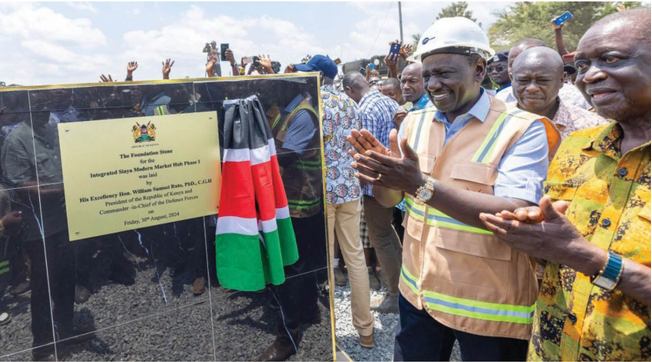
Recently, President William Samoei Ruto commissioned the Siriwo Rice mill in Usonga Ward, constructed by the County Government at a cost of Sh 60 million.

The Mill, one of a kind in the region has a processor capacity of 2.5 metric tons per hour.

“My government has allocated an additional Sh 50 million to ensure that we invest in extra accessories that will ensure the facility runs as a full-fledged factory. I commend Siaya County Under the leadership of Governor James Orengo.

The CEC said the government was on the verge of rolling out a road map for coffee farmers to utilize the 3,000 acres for coffee production.

“About 250 farmers in Ndenga, West Ugenya Ward have formed Ugenya Coffee Growers Cooperative Society. This will hasten provision of agricultural inputs such as seeds, chemicals, fertilizer and aggregation of produce,” Chairperson Cooperative, Mr. Francis Onyango said.

The Department of Agriculture recently gave the farmers 3,000 coffee seedlings to spur the revival of coffee farming in the area.

K’Okoth said the engagement of the county agricultural extension Service to educate and sensitize farmers will go a long way in reviving the sector. 

The government gave 21 Motorcycles to Extension Officers in Nyalgunga, North Alego Ward.  To ease the movement of the extension workers in addressing the needs of various farmers.

A research project by Jaramogi Oginga Odinga University of Science and Technology (JOOUST), enabled the farmers in West Ugenya to acquire an oil processing machine with a capacity of processing three tons of sunflower seeds per day. 

Currently, over 600 members of Wazee Hukumbuka Cooperative Society, Aboke, West Ugenya can now produce cooking oil, and sell the seed cake to fish and livestock feed processors at Sh. 35/= per Kg. 

Chairperson, William Opondo, said they make money from sunflower products and intend to increase acreages under sunflower production, reduce production costs, and enhance their productivity by over 50 percent.

Last season the farmers received 16,350 kgs of sunflower seeds to facilitate the process of realizing over 19,000 acres of land under production. 

Farmers in Yimbo are already reaping big from capsicum farming popularly known as pili pili hoho,

Kanyibok Village Youth Group in West Yimbo Ward, Bondo Sub County has adopted the Use of Six Green houses to grow Capsicum under a solar Irrigation system.

Outbreak of Foot and Mouth diseasesreported in Siaya County

0
foot and mouth
By Reporter

An outbreak of foot and Mouth disease (FMD) has been reported in Siaya County with residents asked to report any emerging cases.

In a public notice to the residents, the  Department of Agriculture  read “The County Government of Siaya wishes to inform the public of a confirmed outbreak of Foot and 

Mouth Disease (FMD), as reported from multiple regions within the county,” 

County Diseases Control Coordinator Dr. Mark Otieno in the notice warned that Foot and Mouth Disease was a highly contagious viral infection affecting cattle, goats, and pigs. 

“Symptoms include the appearance of blisters in the mouth, excessive drooling, and limping. The disease spreads through direct contact between infected animals and the importation of contaminated products,” he said

Dr Otieno said the county technical teams were actively addressing the situation and requested public cooperation. 

“ We urge residents to report any suspected cases to the nearest County Veterinary Offices immediately, quarantine their animals to prevent further spread, and appropriately dispose of carcasses by burning or burying them,’ he said.

Dr Otieno said the residents’  cooperation was vital in safeguarding the health of the livestock and preventing the spread of FMD.