Home Blog Page 28

The Cost of Energy Costs Us Jobs

0

By Billy Mijungu

Kenya has some of the highest electricity costs in Africa at approximately 0.26 US dollars per kilowatt hour while countries like charge between 0.006 and 0.01 US dollars per kilowatt hour. Yet Kenya is a larger and more diversified economy with deeper financial systems and relative political stability in the African context.

This contrast should trouble us because energy pricing is not a minor policy issue. It is the foundation upon which industrial growth, employment and competitiveness rest.Energy is the bloodstream of an economy. It powers factories, transport systems, technology hubs, farms and homes.

Manufacturers calculate energy as a primary input cost and when it is high they either scale down or relocate to more competitive environments. When energy is affordable industries expand and new ones emerge. For industrialization and electric mobility, electricity costs must fall significantly closer to regional benchmarks.

Lower electricity costs repositions Kenya as a manufacturing hub within Eastern Africa. The country already enjoys strong logistical advantages through its port access, regional connectivity, skilled workforce and developed financial services sector. High cost of production driven largely by energy prices.

Affordable power would unlock agro processing, textile production, steel manufacturing, data centers, electric vehicle assembly and battery technology industries. It would translate into millions of direct and indirect jobs.

The cost of living would also ease. When production costs decline consumer prices follow. Affordable electricity reduces the cost of food processing, water supply, transport services and construction materials. Households would retain more disposable income which in turn stimulates domestic demand and strengthens economic circulation.

Investment in energy infrastructure must remain a central national priority because it affects every sector. A low tax environment combined with affordable electricity and a liberalized energy market would place Kenya firmly on the path to industrial excellence. The energy sector has long been concentrated and heavily state dominated which has contributed to inefficiencies and limited innovation. Expanding competition, encouraging private participation and strengthening transparent regulation can drive efficiency and reduce costs.

For sustainable job creation and long term economic transformation, Kenya can exceed middle income status through deliberate reforms that make energy affordable and accessible. Electricity powers livelihoods, industry and national prosperity.

Follow on Facebook X Instagram TikTok and LinkedIn @BillyMijungu #Forward #TusongeMbele

ODM Party Grassroots Elections Expose Soft Underbelly of Nyando MP Jared Okello

0

By Team

The Orange Democratic Movement (ODM) grassroots elections have exposed the soft underbelly of the blue-eyed boy of party leader Dr. Oburu Oginga, Nyando MP Jared Okello.

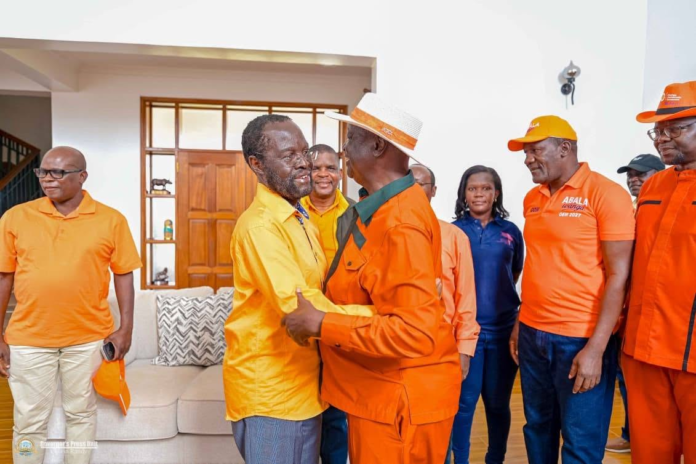
Okello recently hosted Dr. Oburu at his home, where he bragged to the electorate about having sponsored the motion to sack the ODM Secretary-General, Edwin Sifuna, during the recent National Executive Committee (NEC) meeting.

Oburu, at the function, said Okello has been a good family friend and that he has been visiting him both at his rural and Nairobi homes.

But back in Nyando, his opponent for the parliamentary seat, Kenneth Ooko, has been making inroads both in the party and among the electorate.

That is why he recently moved to the Political Parties Disputes Tribunal, which gave him temporary reprieve by halting the harmonized Nyando branch office process.

Okello and three others have sued ODM, Ahero MCA Kenneth Ooko, East Kano/Wawidhi MCA Moses Ochele, and National Election Coordination Committee (NECC) Chairperson Emily Awiti, accusing the committee of unlawfully taking over the harmonization process.

Okello, through his lawyer, argued that on February 24, 2026, to their utter dismay, the Chairperson of the National Election Coordination Committee (NECC), Ms. Hon. Emily Awiti, proceeded with the unlawful meeting ex parte and in the absence of the applicants, and issued a determination in favor of Ooko and Ochele.

They said that by the committee accepting the list presented by the 2nd and 3rd respondents as the valid list for Nyando Sub-County branch delegates, it was a travesty of justice.

Okello argued that on the following day, February 25, 2026, the Chairperson of the National Election Coordination Committee (NECC), Ms. Hon. Emily Awiti, issued a notice announcing that it would conduct the County Delegates elections for Kisumu County on Friday, March 6, 2026, from 9:00 a.m. until 12:00 p.m.

“The complainants accused ODM and the Chairperson of the National Election Coordination Committee of having ignored the fact that Nyando Constituency has five (5) wards, represented by five Members of the County Assembly of Kisumu,” they argued.

Okello, through his lawyer, argued that each Member of the County Assembly is an elected representative of his or her area, and only two members representing two wards were part of the alleged harmonization meeting.

That the majority of the three wards, representing 60% of Nyando Constituency, were disenfranchised and locked out of the negotiation and/or harmonization process.

They argued that the actions of Awiti were unlawful, unprocedural, discriminatory, and disenfranchising to a majority of ODM members in Nyando Constituency.

They further argued that they have not only been prejudiced and disenfranchised by the actions of NECC, but also that their rights to participate in the elections and affairs of the ODM party have been grossly violated, contrary to the protections under Article 38 of the Constitution.

The decision of the National Executive Committee (NEC) of the party to appoint a new Harmonization Sub-Committee, in their view, was premised on the principle of the rules of natural justice, to the effect that the National Election Coordination Committee (NECC) could not sit as an arbiter over a dispute whose outcome it presided over, having been the organizer and referee for the Nyando Constituency grassroots party elections.

According to the complainants, the decision by the Chairperson of the ODM National Election Coordination Committee (NECC), Ms. Hon. Emily Awiti, militates against the old legal principle that “a person cannot sit in his or her own judgment” (Nemo judex in causa sua).

On March 2, 2026, the Tribunal issued orders suspending the implementation of the February 24, 2026 decision by the ODM National Election Coordinating Committee, pending the hearing and determination of the dispute.

Okello and Ooko have engaged in a bitter race for the Nyando parliamentary seat, with the latter enjoying the networks of former MP Fred Outa and previous political opponents of the incumbent.

Okello, in the 2022 ODM nomination, received a direct ticket and went on to successfully defend the seat after defeating his opponents.

Currently, most of his political opponents have rallied behind Ooko for the 2027 General Election for the Nyando parliamentary seat.

Avoiding the Zoning Trap: Why ODM Needs Sifuna, Babu and Orengo Now

0

Al Musasia

Politics is rarely won by sentiment. It is won by strategy, timing, and an honest reading of political reality. At critical moments in history, parties face decisions that determine whether they expand their influence or slowly fade into irrelevance. The current leadership contest within the Orange Democratic Movement (ODM) presents such a moment.
For ODM, the question is not merely who becomes party leader. The deeper question is whether the party will make a strategic decision that protects its candidates nationwide, expands its parliamentary strength, and positions itself for a credible presidential victory in the next electoral cycle.

That strategic decision may require a difficult but necessary step: Oburu Odinga choosing statesmanship over competition and stepping aside to allow a unified leadership under Senator Edwin Sifuna, supported by Governor James Orengo.

The Political Reality of Zoning

Kenyan politics increasingly operates under a strategic doctrine that can be described as political zoning. Powerful parties consolidate territory by negotiating where candidates will run and where they will not. When a party loses negotiating leverage, its candidates are often sacrificed in favor of coalition arrangements that benefit the dominant partner.

This is the danger facing ODM today.

If the party enters future negotiations weakened by internal fragmentation, it risks becoming vulnerable to zoning arrangements by dominant political forces such as UDA. In such a scenario, ODM candidates across multiple regions could find themselves effectively neutralized before campaigns even begin.

Zoning does not merely weaken individual candidates. It erodes the negotiating power of the entire party.
A divided party cannot protect its political territory.

The Value of Strategic Withdrawal

History is full of leaders who strengthened their movements not by insisting on leadership but by recognizing when their withdrawal could produce a stronger political structure.
A strategic withdrawal by Oburu Odinga would not represent defeat. On the contrary, it would represent statesmanship.

By stepping aside, Oburu would accomplish several critical objectives:

  • Preserve party unity at a moment when fragmentation could weaken ODM nationally.
  • Strengthening ODM’s bargaining power in future coalition negotiations.
  • Protect ODM candidates from zoning arrangements that could wipe out the party’s parliamentary strength.

Position the party around a younger national figure capable of energizing new voters.

Such a move would transform Oburu’s role from competitor to kingmaker and institutional guardian of ODM.

Few political legacies are stronger than that.

The Rising Sifuna Factor

Senator Edwin Sifuna represents a different political energy within ODM. He speaks fluently to the generation that now dominates Kenya’s demographics: the youth, the urban middle class, and the digitally connected electorate. But his value goes beyond generational symbolism.

Sifuna has demonstrated several qualities that matter in modern politics:

  • Communication discipline in defending party positions nationally
  • Institutional loyalty to ODM during turbulent political transitions
  • Legal and intellectual grounding that appeals to policy-minded voters
  • Ability to mobilize digital and grassroots constituencies simultaneously
    In many ways, Sifuna embodies the next stage of ODM’s evolution. With the guidance of experienced figures such as James Orengo and the moral authority of the party’s founding leadership, his candidacy could create the kind of generational coalition that successful political movements require.

The Cost of Strategic Miscalculation

The alternative path carries serious risks. If the broad-based faction within ODM misreads the political moment and chooses internal competition over consolidation, the consequences could be severe.

A fragmented ODM risks:

  • Losing negotiating power in national alliances
  • Watching its candidates fall victim to zoning arrangements
  • Allowing rival parties to consolidate regions that ODM once dominated

Weakening its parliamentary presence

In politics, arrogance is often punished by arithmetic. Numbers, not rhetoric, determine power.

A Moment for Statesmanship

Oburu Odinga occupies a unique position in Kenya’s political history. As a senior statesman and a figure deeply connected to the ideological roots of ODM, his decisions carry symbolic weight. If he chooses to step aside and rally the party behind a unified leadership structure led by Sifuna and supported by experienced figures like Orengo, he would not diminish his stature. He would elevate it.

He would demonstrate that ODM is larger than any individual ambition. And he would secure his place as a guardian of the party’s long-term survival.

The Strategic Path Forward

  • The path that strengthens ODM is clear:
  • Unity behind emerging leadership
  • Institutional guidance from experienced statesmen
  • Strategic positioning to prevent political zoning
  • Expansion of parliamentary strength nationwide

A united ODM behind Edwin Sifuna would send a powerful message across Kenya: the party is renewing itself without abandoning its foundations.

Political movements endure when they balance renewal with continuity. ODM now stands at such a crossroads.

If Oburu Odinga chooses the path of strategic withdrawal and unity, the party can enter the next electoral cycle stronger, more organized, and better positioned to protect its candidates and pursue national leadership.

In politics, as in architecture, the stone once overlooked often becomes the cornerstone.

ODM has the opportunity to recognize that moment.
And history rarely waits for those who hesitate.

Why the Fate of Ford Kenya Is Nearing

0

By Anderson Ojwang

The spirit of the late doyen Jaramogi Oginga Odinga, the founder of Ford-Kenya, may have finally departed from the party, and now it could be limping to its grave.

The final departure of Jaramogi’s spirit came with the death of his son, the late Raila Amolo Odinga, in October last year, who was also a founder and a member of the Young Turks.

In Raila, the spirit of Ford-K remained alive even after he resigned and joined the now-defunct National Development Party (NDP) after its merger with KANU.

Ford-K, once a national and vibrant party for the last three decades, witnessed dwindling fortunes after the deaths of Jaramogi and the late Wamalwa Kijana.

After the death of Oginga, Ford-K was embroiled in a power struggle between the Wamalwa–James Orengo axis and Jaramogi’s son, Raila.

The all-out power struggle left Ford-K disadvantaged after Raila resigned from the party and from Parliament, and sought re-election on the ticket of the now-defunct National Development Party (NDP).

Raila won the subsequent by-election on the NDP ticket, and that marked a mass defection from Ford-K to NDP in the 1997 General Election in Jaramogi’s political strongholds.

Ford-K lost in most of Jaramogi’s strongholds, save for Bungoma and Trans Nzoia, where it became dominant.

The November Chwele–Kabuchai Ward By-Election

Last year, during the Chwele–Kabuchai ward by-election — the home turf of the party leader and Speaker of the National Assembly, Moses Wetang’ula, and Bungoma Governor Kenneth Lusaka — the party candidate lost to an independent candidate.

The loss was a condemnation of Ford-K and Wetang’ula, who for the last two decades have been the dominant political players in the region.

The by-election was so important to Wetang’ula that he was on the ground to vote and ensure the results went according to his wish.

Wetang’ula wrote on his X handle:
“This morning I cast my vote at Namakhele Primary School during the Chwele–Kabuchai ward by-elections. I urged our residents to come out in large numbers and exercise their democratic right without fear, assuring them that adequate security officers had been deployed across the area.”

Wetang’ula, in a high-powered entourage comprising Bungoma Governor and Deputy Party Leader Kenneth Lusaka, Senator Wafula Wakoli, Secretary-General John Chikati, and Members of the County Assembly led by Deputy Speaker Stephen Wamalwa, still lost the election.

“We called on the electorate to stay united and protect the political heritage of our great party,” he said then.

But to his political opponents, defeating Wetang’ula and Ford-K marked a new dispensation in the region and ushered in political freedom.

DAP-K wrote on its Facebook page:
“Pale Kabuchai, Mamba amezama katika mazingira yake (Kabuchai, the crocodile has drowned in its own environment). Even a crocodile can die in water, so trust me, bad days happen to everyone. Mamba kesha zalama (crocodile, sleep well).”

The independent candidate, Erick Wekesa, defeated Ford-K’s Vincent Maunda, redefining the region’s politics and establishing Governor George Natembeya as a possible emerging and influential political player in the Bukusu community.

Wekesa was fronted by Natembeya, former Bungoma Governor Wyclif Wangamati, and Kabuchai MP Majimbo Kalasinga, who have all fallen out with Wetang’ula to rewrite the political story of the region.

Sifuna’s Mantra in Luhya Land

Ford-K and Wetang’ula now have to contend with the emergence of Nairobi Senator Edwin Sifuna, who is fast rising in the national political landscape.

Sifuna, a protégé of Raila and the Secretary-General of the Orange Democratic Movement (ODM), has stormed into national political stardom after the formation of the Linda Mwananchi faction within ODM, which opposes a pre-election coalition with President William Ruto’s United Democratic Alliance (UDA).

The Linda Mwananchi faction has held two successful rallies in Busia and Kakamega, which have radically changed the politics of the region.

Already, MPs from the region are rallying behind Sifuna to be a presidential candidate, while Wetang’ula and Prime Cabinet Secretary Musalia Mudavadi have declared interest in the presidency in 2032 and will be supporting President Ruto’s re-election.

Kabuchai MP Majimbo Kalasinga warned that MPs opposed to Sifuna will be voted out in the 2027 General Election.

“If you come from Western and you don’t sing Sifuna’s song, you are going home. Those who want to contest for the presidency in 2027, we have no problem with them. For us, we have Sifuna as our 2027 presidential candidate,” he said.

The possible entry of Sifuna in the presidential contest may be the last straw that breaks the camel’s back, and Ford-K may breathe its last in the 2027 elections.

Wanyonyi’s Gubernatorial Candidature: A Nightmare for Ford-K

Apart from Sifuna’s wave, Ford-K and Wetang’ula will have to contend with Westlands MP Tim Wanyonyi, who has declared interest in the gubernatorial seat.

Tim will not run for the seat on a Ford-K ticket, and his candidature is a nightmare for the party in its backyard.

Party leaders and organs have promised him a battle of his life.

“The only party I cannot contest against is Ford-K, but I don’t know which party I will use,” he said.

In a swift rejoinder, Ford-K Secretary-General John Chikati said the party will conduct its nomination for the gubernatorial candidate and had not settled on Tim Wanyonyi.

“At no time have we talked with Tim Wanyonyi, either at the management level of Ford Kenya or in a structured way, that he is going to be our governor and that we are going to campaign for him. So we are shocked that he is saying he is not going to vie on a Ford Kenya ticket as if he is a member of Ford Kenya. He is fighting a losing battle,” he said.

Senator Wafula Wakoli said:
“We were looking for a leader who would unite all parties, residents, and tribes together, but my brother Tim has shown that he is not the person we thought he was. He has removed the burden that was on our shoulders as Ford-K leaders, and we are ready.”

Tim teamed up with Natembeya, Wangamati, and Majimbo Kalasinga, among others, during the recent Chwele–Kabuchai ward by-election to defeat Ford Kenya in the ward contest.

Edwin Kiptoo Shines as NCBA Golf Series Lights Up Mombasa

0

By PHILLIP ORWA

Edwin Kiptoo returned 72 nett to win the Division A title as the 2026 NCBA Golf Series delivered a competitive fourth leg at the historic Mombasa Golf Club this past weekend.

Playing off handicap 11, Kiptoo edged out Sheel Dodhia, also handicap 11, who finished runner-up on 73 nett.

Peter Kimanga, handicap 11, completed the podium with 75 nett in a tightly contested Division A category.

Division B honours went to Martin Irungu, handicap 15, who carded 71 nett to win on countback ahead of Sam Muraya, also handicap 15, who posted a matching 71 nett score. Johnson Muriuki, playing off handicap 18, secured third place with 77 nett.
In Division C, Rana Umair, handicap 25, produced a standout round to take the win with 64 points. Joseph Kitema, handicap 27, finished second on 67 points, while Col. James Ndungu, handicap 19, placed third with 69 points.

The Best Gross award winner went to Gurbux Singh, playing off handicap 2, who 83 gross score to underline his consistency at the Coast leg of the series.

More than 80 golfers turned out for the February Mug, battling coastal conditions in pursuit of top honours and qualification slots to the season-ending Grand Finale at Karen Country Club.

NCBA Regional Retail Manager, Coast Region, Yasir Ashur, congratulated the winners and reaffirmed the bank’s commitment to the sport and the region.

“Every time we bring the series here, we’re reminded of the strong passion for golf in the coastal region. From this event, we now have golfers who have secured their places in the NCBA Golf Series Grand Finale in November at Karen Country Club. Congratulations and all the best as you continue preparing,” he said.

Ashur added that NCBA’s support for golf goes beyond tournaments, noting that the bank remains committed to developing the sport at all levels. “We want to inspire juniors to be the next Njoroges while at the same time giving them opportunities to make a living out of golf. That is why we continue to work closely with the relevant bodies to strengthen the development of the sport and complete the golf cycle.”

The Mombasa leg adds to the growing momentum of the 2026 NCBA Golf Series, which continues to bring together corporate leaders, amateur golfers and rising talent across the country. Winners from this leg now join other qualifiers who will compete at the Grand Finale later in the year, where the overall champions of the circuit will be crowned.

The Series now moves to its next stop at Mt. Kipipiri Golf Resort as golfers continue their quest to conquer the course and secure their place at the finale.

White Cap Announces Sh45 Million Sponsorship for WRC Safari Rally 2026

0

By PHILLIP ORWA

Kenya Breweries Limited (KBL), through its premium beer brand White Cap, has committed Sh45 Million in sponsorship towards this year’s World Rally Championship (WRC) Safari Rally, that is supposed to take place.
From March 12th to 15th in Naivasha.

This year, WRC Safari Rally will be on its sixth consuctive year,, and will bring together elite local and international rally drivers, reinforcing Kenya’s status as a global motorsport hub.

During the sponsorship unveil at the Tusker Brew House in Ruaraka, Whitecap was also named the Official Pouring Partner for the event.

Speaking at the announcement, KBL Managing Director Andrew Kilonzo reinstated the significance of hosting the Safari Rally to Kenya’s sporting landscape, adding that it matches with the country’s ambition to transform the sector from a traditional athletics powerhouse into a global, multi-sport, and commercialized hub by 2030.

“We have increased our sponsorship for the Safari Rally by Ksh25 million as a demonstration of our commitment to the sport and adventure for our consumers and fans of the rally. The increased investment will go towards WRC event logistics and the elevation of the overall village experience at the 2026 rally. We have all been witnesses of the impact the Safari Rally has had on our sporting landscape for decades. For four years in a row now, we have continued to play a part in this sport, capturing the imagination of fans as we indel our mark as a longstanding partner in the sports sphere in the country,” said Kilonzo.

Beyond sports, Kilonzo further highlighted KBL’s dedication to championing responsible drinking and environmental sustainability, stating that the company will leverage this partnership to promote its key corporate responsibility pillars.

“Our partnership is grounded in a strong sense of responsibility and purpose. As a responsible corporate citizen, KBL ensures that its support for sports extends far beyond entertainment. We are abusiness that is anchored on environmental sustainability, and the Safari Rally offers us an opportunity to champion environmental protection and water conservation to ensure it remains intact for future generations. In addition, while the spectators experience the thrill of the rally, we encourage everyone to prioritize their safety and embrace responsible enjoyment.”Kilonzo said.

Under the sponsorship, White Cap will be the Official Responsible Drinking Partner for the event, reinforcing its commitment to championing responsible enjoyment at social events.

The brand will redefine the fan experience at the spectator zones with a premium paddock-inspired area, drawing from the hospitality of iconic Formula 1 circuits. Set against the backdrop of the legendary Miti Mbili jump, fans will enjoy elevated viewing decks and exclusive zones designed for optimal comfort and excitement, with live on-screen coverage delivering every moment of the rally in thrilling detail.

WRC Safari Rally Kenya CEO Charles Gacheru expressed gratitude to White Cap for their support, acknowledging the significant role sponsorship plays in the success of the event.

“For the history of Safari Rally event, it has always captured the soul, passion and energy of millions of Kenyan spectators and those who travel far to come enjoy the thrill. As organizers, we are committed to delivering exceptional experience to all, as usual. KBL has always played a critical role in our sports, and this sponsorship will go a long way to boost the delivery of the event,” he said.

For the first time since the return of the Safari Rally, spectators will get a chance to watch the event shake down during the 2026 edition where the competitors will tackle 20 special stages covering around 350 competitive kilometers of some of the most iconic and punishing terrain in world rallying.

“This year is different because the shakedown has shifted to Naivasha, giving fans an array of spots to access the rally stages.

Thanks to the new location at Nawisa, right next to the service park in Naivasha, rally enthusiasts can come and watch the cars as they prepare for the competition. This is a historic moment for our fans here in Kenya and for the global rally audience watching on live.”
My clarion call to all attendees is to obey traffic marshals and ensure they are responsible for their own safety,”
Gacheru added

Miriam Chebet and Amos Kiprotich Triumphant at the Third Edition of The Betika Kapsabet 15 KM Road Race

0

By PHILLIP ORWA

Miriam Chebet and Amos Kiprotich delivered commanding performances to win the third edition of the Kapsabet 15KM Road Race on Sunday, March 01, 2026.

Chebet, a gold medalist over the 5000m and 10,000m during BingwaFest at Siaya, stormed to victory in the women’s race, clocking 49:33.4 to finish as the only woman under the 50-minute mark.

She was followed by Judy Jepngetich (50:01.6) and Maryan Njoki (50:11.5), in a tightly contested podium battle.

Chebet said: “It was a good race, and everything worked just as I had planned. I have been fine tuning on my speedwork since winning at Siaya during BingwaFest, and it is all paying off. I will sit down with my coach, reflect on the race, and plan what’s next. We are thankful to Betika for the continued support in athletics as it means a lot to us athletes.”

In the men’s race, Kiprotich returned first in 44:22.0 ahead of Philemon Rono Cherop (44:22.6), with Dennis Kipkurui rounding off the podium in 44:23.1.

On his part, Kiprotich termed the race a tactical one, having stuck with the leading pack for the better part of the race before breaking away with one kilometre left.

“It was a very tactical race, and I am content with the execution. I stuck with the leading group, and we all pushed ourselves so that we could post better times. I am happy to have come out victorious today,” the Sirikwa Classic Cross Country silver medalist said.

Chebet and Kiprotich each received Sh250,000, while second-placed Jepngetich and Rono pocketed Sh150,000 each, third-place finishers Njoki and Kipkurui took home Sh100,000 each.

The fourth and fifth-place finishers went home with Sh50,000 and Sh40,000, respectively, while the sixth to tenth-place finishers in both the men’s and women’s categories got Sh20,000.

This was the third edition of the Betika Kapsabet 15km Road Race, and it attracted more than 700 athletes.

Selected Results
Women

  1. Miriam Chebet – 49:33.4
  2. Judy Jepngetich – 50:01.6
  3. Maryan Njoki – 50:11.5
  4. Brenda Jepchumba – 50:27.5
  5. Janet Jepkoech – 50:45.2
  6. Jedidah Sang – 51:16.3
  7. Phenah Yego – 51:18.5
  8. Ninah Chepchumba – 51:26.5
  9. Irine Jeruto – 51:39.2
  10. Hellen Chepkoir – 51:43.0

Men

  1. Amos Kiprotich – 44:22.0
  2. Philemon Rono Cherop – 44:22.6
  3. Dennis Kipkurui – 44:23.1
  4. Cyrus Kipkemoi – 44:24.7
  5. Justus Kiprop – 44:37.1
  6. Alfred Chelal – 44:40.9
  7. David Cheserek – 44:44.3
  8. Cornelius Kemboi – 44:45.6
  9. Vincent Kimutai – 44:49.0
  10. Geoffrey Kipkemboi – 44:49.8
  11. Simon Thuku – 45:00.1

NURSING COUNCIL HAILS HEROIC NURSE FOR RESPONSE TO DEADLY NANDI HELICOPTER CRASH

0

By Remmy Butia

The Nursing Council of Kenya has publicly commended a local nurse for her extraordinary bravery and swift response to the tragic helicopter crash that occurred in Chepkieb in Mosop, Nandi County, on Saturday evening claiming the lives of Emurua Dikirr MP Johana Ng’eno and his team.

In a statement released to the press on Monday, the Council praised Nurse Sharon Cheptanui (Jebet), who was among the first responders at the scene. According to the Council, Sharon selflessly rushed to provide critical aid amidst the wreckage, demonstrating the highest standards of the profession in the face of tragedy.

“The Nursing Council of Kenya commends the courage and professionalism of Nurse Sharon, who selflessly responded to the tragic helicopter crash in Mosop, Nandi County,” read the statement.

The Council highlighted that her actions serve as a powerful reminder of the critical role nurses play in emergency response situations, often risking their own safety to save others.

“Her actions exemplify the commitment, compassion, and resilience that define the nursing profession, even in the most harrowing circumstances,” the statement added.

The crash, which occurred on Saturday in Chepkieb village in Mosop sub county, claimed multiple lives. Details surrounding the incident are still under investigation by the Kenya Civil Aviation Authority.

Beyond their recognition of Cheptanui’s heroism, the Nursing Council extended its sympathies to all those affected by the devastating incident.

“We extend our deepest condolences to the families of the victims and stand in solidarity with all frontline responders affected by this tragic incident,” the Council said.

Cheptanui, has since been hailed on social media as a hero, with Kenyans praising her for her presence of mind and dedication to her duty amid the chaos of the crash site. The Council’s acknowledgment underscores the profound emotional and physical toll such incidents take on first responders, who must navigate the aftermath of traumatic events while providing care.

The ODM–UDA MoU Review: What Next for the Parties?

0

By Anderson Ojwang

With only five days to the end of the first year of the Memorandum of Understanding (MoU) signed between the Orange Democratic Movement (ODM) of the late Raila Amolo Odinga and the United Democratic Alliance (UDA) of President William Ruto, we delve into the successes and failures as we head to the review.

In this interactive interview, we engaged former Alego MP Sam Weya, who gives his view and verdict on the arrangement ahead of the review.

Q1: Why did ODM enter the framework?

Hon. Weya: On this day one year ago, ODM entered into a structured national cooperation framework with the government.

Our decision was guided by three principles:
• Safeguarding national stability
• Advancing constitutional and institutional reforms
• Protecting Kenyans from economic and governance excesses

This was not a coalition arrangement.
It was not a power-sharing agreement.
It was a reform-centered framework designed to de-escalate political tension and deliver measurable change.

Today, we present a factual progress review.

Q2: When and for how long was the MoU valid?

Hon. Weya:
• The MoU was signed on 7 March 2025 at the Kenyatta International Convention Centre.
• It was intended as a framework of cooperation and reform between ODM and UDA, not a formal coalition agreement.
• According to political statements, the agreement was set to run for one year and officially expire on 7 March 2026 — exactly one year after signing.
• Part of the pact required bi-monthly progress reports and a final implementation report due by the March 2026 deadline.

So the duration was roughly one year, with milestones and a final review scheduled for March 7, 2026.

Q3: What were the 10 points in the agenda?

Hon. Weya: The MoU’s 10-point agenda focused mainly on governance reforms and national cohesion rather than on elections or party alliances. Here they are in summary:

  1. Full implementation of the National Dialogue Committee (NADCO) report.
  2. Inclusivity in budgetary allocations and public appointments.
  3. Protecting and strengthening devolution.
  4. Economic investment in youth opportunities (e.g., agriculture, ICT, blue economy).
  5. Leadership integrity and ending opulence in public office.
  6. Protection of the right to peaceful assembly and compensation for past rights violations.
  7. Forensic audit of national debt and how it was used.
  8. Intensified fight against corruption.
  9. Stopping wasteful public spending.
  10. Protecting sovereignty, the rule of law, constitutionalism, and press freedom.

Q4: Why is it seen as “nothing has been achieved”?

Hon. Weya: Many observers and ODM leaders argued that by late February 2026, the committee responsible for implementing these reforms had not produced clear outcomes and was under pressure to show progress.

Some key issues noted in coverage and commentary included:
• The implementation committee was late in submitting a complete review.
• Critics said the UDA government wasn’t serious about honoring the pact.
• There was internal ODM disagreement on whether the deal was delivering for the public.

Q5: Given limited progress, what should ODM do?

Hon. Weya: This is ultimately a political judgment, but here are reasonable options ODM could consider based on democratic practice and political strategy:

a) Insist on accountability
ODM could publicly demand full transparency on what has (and hasn’t) been delivered on each of the 10 points, using the March 2026 review as leverage.

b) Use political leverage
If the government has not delivered, ODM can use parliamentary tools (debates, oversight committees) to press for concrete action.

c) Clarify its political positioning
Because the MoU focused on reforms rather than an electoral pact, ODM can publicly clarify what it plans for the 2027 General Election — whether it will run its own candidate, support a coalition, or negotiate a new agreement.

d) Propose a fresh framework or coalition
If both sides still see value in cooperation, ODM could propose a new or updated framework with clearer deliverables, timelines, and accountability mechanisms.

e) Reaffirm its independence
ODM can reaffirm its party’s autonomy and commitments to its supporters, especially if the MoU’s goals were not met.

Overall View

Hon. Weya:
• The ODM–UDA MoU was a one-year political cooperation agreement from March 2025 to March 2026.
• It outlined a 10-point reform agenda mainly about governance, inclusion, devolution, and rights.
• Implementation stalled, and many feel little progress was made.
• ODM’s options include pushing for accountability, defining its 2027 strategy, or renegotiating cooperation.

ODM Side – Criticisms & Internal Reactions

1️⃣ “Implementation Has Stalled”

Several ODM leaders argued that the agreement did not translate into measurable reforms, especially on:
• Cost-of-living relief
• Audit of public debt
• Protection of civil liberties
• Full implementation of the NADCO report

They claimed the government slowed down reforms once political tensions eased.

2️⃣ Edwin Sifuna’s Position

ODM Secretary General Edwin Sifuna was publicly cautious about extending or softening the agreement.

His key concerns included:
• Lack of structured reporting on progress
• Risk of ODM appearing absorbed into government
• Fear that the party was losing its oversight identity

He maintained the MoU was not a coalition but a reform framework — and should be judged strictly on deliverables.

3️⃣ James Orengo’s Criticism

Siaya Governor James Orengo was among those openly critical.

He suggested:
• The government was not fully committed to structural reforms
• ODM risked weakening its opposition credentials
• Grassroots supporters were confused about ODM’s political direction

Grassroots Discontent

At the county level, some ODM supporters felt:
• The party had “softened” toward the government
• Economic hardships had not reduced
• There was no visible dividend for supporting the cooperation

This created internal pressure for ODM to redefine its political position before 2027.

UDA / Government Side – Responses & Position

“The MoU Was About Stability”

Supporters of President William Ruto argued:
• The agreement helped cool post-election tensions
• It created space for economic recovery
• It reduced street protests and political instability

From their view, the drop in political temperature was itself a success.

Reform Takes Time

UDA figures maintained:
• Constitutional and fiscal reforms require parliamentary processes
• Some NADCO proposals needed legal amendments
• Economic reforms cannot be instant

They argued expectations were unrealistic within one year.

Not a Power-Sharing Deal

Government allies emphasized:
• It was not a handshake-style power-sharing pact
• ODM was not formally in government
• Cooperation did not mean shared executive authority

This was meant to counter claims that ODM had “joined the government.”

Cure for Political Tension

The disagreement boiled down to three issues:

ODM Concern | UDA Response
No visible reform progress | Reform is gradual
Risk of losing opposition identity | Cooperation ≠ coalition
Grassroots dissatisfaction | Stability benefits everyone

Politically, What This Means for ODM

Hon. Weya: Given the mixed reactions, ODM faces three strategic choices:

  1. Reassert opposition strength — distance itself clearly and resume aggressive oversight.
  2. Demand measurable benchmarks — publish a public scorecard on each MoU item.
  3. Redefine its 2027 position early — clarify whether it remains a reform partner, independent challenger, or coalition negotiator.

THE 10-POINT REFORM AGENDA: STATUS REVIEW

A. Cost-of-Living Relief

Commitment: Immediate measures to ease economic hardship.

Status:
• Limited interventions implemented.
• No sustained structural reduction in household costs.
• Fuel, food, and essential commodities remain high.

ODM Position: Stabilization without tangible relief is incomplete. Immediate fiscal and tax policy review is required.

B. Audit & Transparency of Public Debt

Commitment: Transparent audit and publication of debt obligations.

Status:
• No comprehensive independent audit publicly tabled.
• Public debt trajectory remains unclear to citizens.

ODM Position: A time-bound, independent audit process must be initiated and reported to Parliament.

C. Protection of Civil Liberties

Commitment: Safeguarding constitutional rights and lawful protest.

Status:
• Reduced political tensions.
• However, isolated concerns persist regarding enforcement standards.

ODM Position: Institutional safeguards must be formalized, not dependent on political goodwill.

D. NADCO Report Implementation

Commitment: Structured implementation of the NADCO proposals.

Status:
• Select legislative discussions initiated.
• Core constitutional and electoral reforms remain pending.

ODM Position: A clear legislative timetable must be published and adhered to.

WHAT HAS BEEN ACHIEVED?

Hon. Weya: ODM acknowledges:
• Political temperature has significantly reduced.
• National dialogue space remains open.
• Parliamentary processes on certain reform areas have begun.

National stability is a shared achievement — and ODM played a central role in securing it.

WHAT REMAINS UNACCOMPLISHED?

Hon. Weya: However, stability alone cannot be the final objective.

The following remain insufficiently addressed:
• Concrete cost-of-living relief
• Structured debt transparency
• Full NADCO implementation
• Institutional reform timelines

Kenyans must see reform outcomes — not just reform conversations.

ODM’S WAY FORWARD

Hon. Weya: ODM now proposes the following steps:

1️⃣ Public Reform Scorecard
A jointly published implementation tracker with measurable milestones.

2️⃣ Time-Bound Legislative Calendar
Clear deadlines for each pending reform item.

3️⃣ Economic Relief Framework
Immediate cross-party parliamentary engagement on tax and cost-of-living interventions.

4️⃣ Accountability Clause
Should agreed benchmarks remain unmet within defined timelines, ODM will re-evaluate its engagement framework.

REAFFIRMING ODM’S IDENTITY

Hon. Weya: ODM remains:
• A reform movement
• A constitutional defender
• A national stability anchor
• An independent political party

Cooperation does not mean absorption.
Engagement does not mean surrender.
Stability does not replace accountability.

MESSAGE TO KENYANS

Hon. Weya: ODM chose dialogue to protect Kenya.
We now insist on delivery to protect Kenyans.

We remain committed to:
• Democratic integrity
• Economic justice
• Devolution
• Institutional reform

Our loyalty is to the Constitution and the people — not to convenience or political comfort.

CONCLUSION

March 7, 2026 marks a review point — not an endpoint.

ODM will continue to pursue reform responsibly.
But reform must now move from discussion to implementation.

EACC Investigating Jaramogi Oginga Odinga University of Science and Technology Over Academic Malpractices

0

By Reporter

The Ethics and Anti-Corruption Commission (EACC) is investigating Jaramogi Oginga Odinga University of Science and Technology (JOOUST) over what it termed as academic malpractices at the institution.

EACC Central Nyanza Regional Director Mr. Abraham Kemboi said they were investigating the university for alleged academic malpractices where students pay lecturers for marks.

Kemboi said they were also investigating allegations that some students graduate on the basis of fake results entered into the university portal system.

“We are almost concluding the investigations. We have M-Pesa transactions between the lecturers and the students. It is saddening and baffling to encounter such situations in our universities,” he said.

Kemboi said in some instances, students do not attend classes or sit exams but proceed to be processed for graduation.

“There are some students who do not attend class but are given marks. They proceed to graduate. It is an unbelievable and terrible situation unfolding in our education sector. It is widespread in almost all our universities. So what kind of graduates are we producing for the job market and the country? This is a situation we must contain,” he said.

JOOUST Director of Communication Prof. Obiero Ogone said he was not aware of such incidents and urged the EACC to arrest and prosecute those involved in the academic malpractice.

“I am not aware of the allegations, but if they have proof, then let them proceed with the investigations,” he said.

Kemboi said the Commission was also investigating alleged corruption in cases of variation in capital projects under the previous administration.

“We have hostels which the previous leadership used as a vehicle to defraud the institution. We will move to recover the money lost. That was a criminal act and we will act accordingly,” he said.