Home Blog Page 94

Affordable Housing is a Worthy Cause that Cannot Go Unnoticed, but Something Must Change

0

By Billy Mijungu

As we head towards the 2027 elections, my expectation was that the gross percentage contribution to the housing fund would gradually reduce every six months. My assumption is that the rate of absorption of the fund for housing is most likely lower than the rate of contribution.

When a fund accumulates more money than it spends, there is a risk of creating unnecessary pressure on contributors. It is only fair to progressively reduce the contribution rate as reserves are built and the revolving fund becomes stronger, especially now that the state has started allocating houses to contributors.

Housing is a basic need, but beyond that it is a strong social stabilizer. When families live in decent houses with proper sanitation and utilities, they become healthier and more productive. It is from this lens that allocation of houses should be guided. More units should go towards social housing than market rate or even the category that has been described as affordable housing.

The real objective must be to regulate high housing rents, eliminate slums, and create organized urban centers that address both public health and environmental concerns.

Slums across the country remain an indictment on our collective conscience. Millions of Kenyans live in overcrowded informal settlements where sanitation is poor, water is scarce, and health risks are ever present. The housing fund presents the greatest opportunity yet to change this story. It is not enough to build houses and allocate them to contributors.

The program must go further and deliberately allocate a bigger share to social housing, where families currently trapped in informal settlements are moved into dignified homes. This would have a ripple effect in reducing preventable diseases, improving education outcomes, and strengthening social cohesion.

One thing however stands out. The housing fund is already making a difference. As the market corrects, the construction sector will trend upwards, creating jobs and stimulating the wider economy. It is also commendable that citizens are increasingly borrowing to build their own homes. That in itself shows confidence in the future of housing, though it also points to the fact that the absorption of the fund into actual housing units has not yet matched the rate of contribution.

The government should also think bigger by expanding the scope to include commercial housing. Businesses across the country are struggling under the weight of high rent for commercial spaces. It is a paradox that many entrepreneurs pay more for their business premises than they pay for their family homes. If the housing fund could support the development of modestly priced commercial spaces, it would not only support entrepreneurship but also regulate business rent across towns and cities.

This in turn would attract investors and create affordable opportunities for small and medium enterprises to grow.

Infrastructure development must move hand in hand with housing. A house without sewer systems, roads, water supply, schools, and health centers is an incomplete solution. Housing must be seen as the heart of a broader ecosystem of human settlement. Counties should therefore be brought in as stronger partners, not just to provide land, but also to ensure that supporting infrastructure is developed in tandem with housing.

As the national government gradually reduces contribution levels, counties can help channel more of the fund into social housing that directly benefits the poorest residents.

One thing is certain. The housing fund will continue to dignify lives. It has the potential to go far beyond shelter, reaching into public health, education, economic development, and the overall quality of life. If managed with fairness and vision, it could become one of the most transformative programs in our history, ensuring that future generations live in dignity and security.

Jaramogi Oginga Odinga Teaching and Referral Hospital conducts the first Red Cell Exchange in Kenya

0

By Sandra Blessings 

Jaramogi Oginga Odinga Teaching and Referral Hospital (JOOTH), the newest state parastatal, recently conducted a successful, the first of a kind a medical procedure in Kenya.

The doctors successfully conducted Red Cell Exchange, which is a super-specialty intervention for Sickle Cell Disease. 

Permanent Secretary of State Department Medical Services, Dr Ouma Oluga commended the institution for the groundbreaking medical service in the country in the health care provision.

“I congratulate the Ag CEO Joshua Okise and the team of specialized health staff coordinated by Dr. Joy Muyonga for this groundbreaking medical service,” he said.

Dr Oluga said patients across the region will soon no longer have the anxiety, worry and suffering that has characterized living with sickle cell disease.

Similarly, Kisumu Governor Prof Peter Anyang Nyong’o said JOOTRH has achieved a first in the Country’s public health system.

“We celebrate Jaramogi Oginga Odinga Teaching and Referral Hospital (JOOTRH), which we have steered as a County over time, and is now our newest parastatal under the stewardship of State Department of Medical Services,” he said.

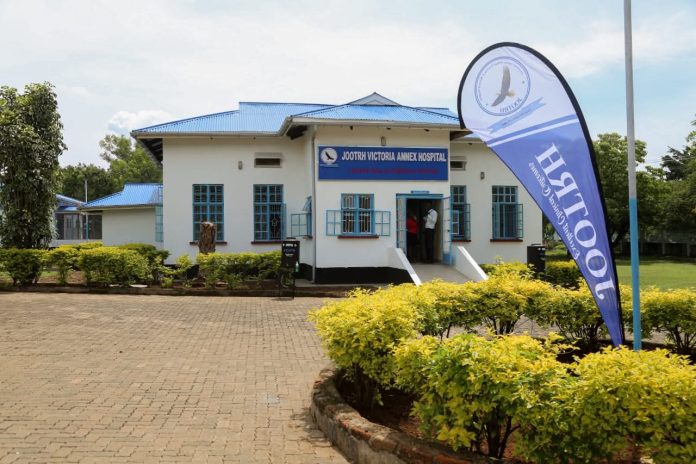
Nyong’o said the JOOTRH’s Victoria Annex has successfully conducted the first automated Red Blood Cell Exchange (RBCx), a super specialty intervention that offers renewed hope for patients living with Sickle Cell Disease (SCD).

“The burden of SCD is heaviest here in Nyanza and Western Regions, where about 18% of children carry the Sickle cell trait and 4.5 % develop the disease. 

Across Kenya an estimated 14000 children are born with SCD every year, without intervention, majority in Nyanza/Western do not live to see their 5th birthday,” he said.

He commended JOOTRH medical team for their dedication for the tireless work done. 

Red blood cell exchange is a medical procedure that uses a machine called an apheresis system to remove abnormal red blood cells from a patient’s blood and replace them with healthy donor cells. 

It’s a non-surgical therapy primarily used to manage complications of sickle cell disease by reducing the amount of abnormal sickle-shaped red blood cells in the body. 

The procedure involves inserting two cannulas (thin tubes) into the patient’s arms, with one removing blood to be processed by the apheresis machine and the other returning healthy donor blood.

How the Procedure Works:

  1. 1. Blood Removal:

A small amount of blood is removed from the patient through an inserted needle or catheter. 

  1. 2. Apheresis:

The blood travels to an apheresis machine, which uses a centrifuge to spin and separate the different components of the blood, including red cells, white cells, platelets, and plasma. 

  1. 3. Removal of Abnormal Cells:

The abnormal red blood cells are then discarded. 

  1. 4. Healthy Cells Transfused:

Simultaneously, healthy red blood cells from a donor are returned to the patient. 

  1. 5. Monitoring:

A trained nurse monitors the patient throughout the procedure to ensure their comfort and to watch for any side effects. 

Purpose

  • Sickle Cell Disease Management:

The primary goal is to reduce the concentration of sickle hemoglobin (HbS) in the blood, which helps prevent complications like tissue hypoxia and infarction by improving the function of red blood cells. 

  • Emergency and Preventative Care:

It can be performed in an emergency to treat acute complications or as a regular program to prevent new ones. 

Potential Side Effects

Some side effects may occur, similar to blood donation, and can include: 

  • Dizziness, lightheadedness, or nausea
  • Headache or chills
  • Discomfort, bruising, or numbness at the needle site
  • A temporary decrease in platelet count
  • Rarely, allergic reactions or infections

Senator Orwoba: President Ruto trusted Dr Omollo even before his appointment to the powerful Internal Security docket

0

By Hope Barbra

The controversial former senator Gloria Orwoba has revealed that President William Ruto trusted Dr Raymond Omollo even before he appointed him to the powerful docket of as the permanent secretary for Internal Security and Administration permanent secretary.

Speaking during an interview, Orwoba also claimed some of permanent secretaries closed to her detested Omollo’s closeness with the president.

She said the permanent secretaries were concerned by Omollo’s closeness to the president and his often accompanying to functions and thus making him the President’s blue-eyed boy.

Orwoba said Omollo earned his appointment for having delivered for President Ruto in the 2022 presidential elections.

Orwoba said in 2022 Ruto then deputy president and Kenya Kwanza presidential candidate asked her to contact Omollo so that they could organize logistics and presidential election program for Nyanza.

“Omollo did a good job. Ray and his team after elections went around to pick form 34A at gun point it was a daring moment, but they braved it. 

Even when ODM went to court to challenge the election results, they had to rely on our forms from Nyanza because we did a good job. ODM was disorganized and didn’t have the forms.

People who don’t know him wondered how he got into the space. He worked for it, and this is the truth.

The president trusted him and even when the president would call and asked me how we were doing in terms of work, I would tell him, Ray is doing a good job. He helped relieve us of the burden the logistic burden. He did a good job, and I didn’t have an issue with him. He made our work of coordination easier and achievable.

There was a group of PSs who were witch hunting him, they tried to tell the president negative things about him, but the president never listened to them. They would come and tell me, Ray thinks he is superior, and he thinks he is the blue-eyed boy.

I told them you don’t know him, he is professional, give him a chance and you will understand him. Honestly, he is a good person, and we have no point of departure,” she said.

Former deputy President Rigathi Gachagua during Dr Omollo thanksgiving in his Kanyipir village in Karachuonyo in 2023, said President Ruto made a great choice in Omollo.

“President William Ruto made the right choice of making Dr Omollo the Internal Security permanent secretary.

I wanted the position of the permanent secretary of internal security to be given to my person, But the president told me, for that post, I already have someone. Let’s talk about of the posts.

I did not Know Dr Omollo then, but I can confirm here that President Ruto made the best choice. Dr Omollo has served the president and the nation with dedication, honesty and commitment which is above reapproach.

I want to say, Dr Omollo is a great worker, and I accept the president wisdom to give him the post despite Nyanza having voted for the Azimio Presidential candidate. The president has been vindicated in his choice,” he said then.

Omollo former boss then and now the deputy president Prof Abraham Kindiki Kithure said it was a wise choice by the president to appoint Raymond to the powerful office.

“Your Excellency, I am here to say that you made no mistake in appointing Raymond. He is trustworthy. I can say without fear of contradiction that the choice of Dr Raymond Omollo was one of the most important decisions you made in your administration.

Raymond is disciplined, straight forward, humble, obedient to authority and is not given to drunkenness and other forms of indiscipline, between Raymond and I we will do the job you made us to do,” he said.

Omollo has been a cog in President Ruto’s charm in Nyanza and currently enjoy warm reception and support from the region, which was one hostile to him.

Omollo’s coordination skills has ensured that he doesn’t antagonize the local leadership with president Ruto.

MPs led by Sam Atandi, Jared Okello, Mark Nyamita among others have constantly praised Omollo for his role to the president and uniting the community.

Omollo has firmly established himself as one of the most effective and influential figures in President William Ruto’s administration.

Recognized as one of the top-performing Principal Secretaries, Omollo’s rise to prominence is a testament to his dedication, strategic acumen, and unwavering commitment to service delivery.

Since his appointment, Dr. Omollo has become the President’s go-to leader in the Nyanza region, a position that has not only solidified his influence but also transformed him into a key player in the national political landscape.

His leadership has been marked by significant achievements, particularly in enhancing national security, advocating for better working conditions for National Government Administration Officers (NGAOs), and securing salary increments for police officers.

These reforms have endeared him to Kenyans, who view him as a leader dedicated to improving the lives of those in the public service and ensuring the safety and security of the nation.

Extortion Has Created a Hostile Business Environment

0

By Billy Mijungu

Extortion and bribery have crept deep into the arteries of our state institutions, creating a hostile business environment that is suffocating investment and growth. Investors are not just worried about economic headwinds but also about a system that has normalized corruption as part of the cost of doing business in Kenya.

Registering a business in Kenya today is relatively simple. Compliance at the Business Registration Services is almost seamless, and this has encouraged many to take the first step into entrepreneurship. However, the real elephant in the room emerges immediately after registration. Securing compliance certifications and licenses is a nightmare, particularly for foreign investors who have become the prime targets for extortion. Tales of frustrated investors are everywhere. At the Kenya Bureau of Standards, at the National Environment Management Authority, at health licensing organizations, and at the Kenya Revenue Authority, investors recount endless frustrations that are only eased through bribes.

The result is a growing number of businesses that pay rent and keep staff on payroll for years without ever manufacturing a single product. They are taken round in circles, their investments stalled, and their capital slowly drained. The cost of corruption has made investor flight a frightening reality. Many investors have quietly exited, while others have relocated to neighboring countries where compliance is clearer, fairer, and less punitive.

The problem is compounded by monopolies and powerful import cartels. Where a product has strong demand, entrenched interests often block local manufacturing so that they can protect their import culture and sustain market domination. New investors who express interest in producing locally are frustrated at every turn. This stranglehold must be broken if Kenya is serious about industrialization.

The consequences are far-reaching. Capital flight is accelerating as manufacturers choose to operate in friendlier markets in East Africa and beyond. Some companies resort to a troubling shortcut: importing finished products, making minor changes locally, and then branding them as Made in Kenya. Others simply place the last component of a manufactured product in Kenya while the bulk of the work is done abroad. Both practices deny the country revenue, deny Kenyan youth employment opportunities, and erode the credibility of our manufacturing sector.

Another concern is the preference for licensing assembly plants instead of promoting true manufacturing. Assembly is not industrialization. It is a halfway measure that provides limited jobs but does not create the full ecosystem of skills, supply chains, and value addition that genuine manufacturing brings. By encouraging assembly over manufacturing, the government has inadvertently slowed down growth and locked the country into dependency.

Kenya needs a reset. The government must go beyond making business registration simple. It must deal with corruption decisively, streamline licensing processes, and dismantle monopolies that frustrate competition. Investor protection should not just be spoken about in economic blueprints but must be seen in action. If this is not done, investors will continue to walk away, and Kenya will keep losing opportunities that could create industries, jobs, and revenue that would transform the economy.

Good news for traders as Kenya-Uganda governments eliminate trade barriers and tariffs on local products

0

By Hope Barbra

Kenya and Uganda have moved to Fastrack trade between two countries by committing to eliminate Non-tariff Barriers (NTB) and tariffs, which have been trade barriers to the two countries.

In a joint communique of the joint Trade Ministerial meeting with the Ministers directing that all products originating between Kenya and Uganda to be treated as transfers.

“Both Ministers committed to eliminate all existing Tariffs and NTBS hindering trade between the two countries and fully implement all trade related commitments under the EAC Treaty and Protocols. In this regard, the Ministers agreed to remove all discriminatory excise duties, levies and other charges of equivalent effects,” read the statement 

This follows the recent directive by president Yoweri Kaguta Museveni, of Uganda, and  president William Samoei Ruto,  of Kenya, during their bilateral engagement held in Nairobi, Kenya from 30th to 31st July 2025, that Ministers responsible for trade of both countries urgently convene a meeting to resolve all trade barriers between the two countries including congestion along the major trade corridors, tariff and non- tariff barriers.

Subsequently, the two Ministers convened a meeting on 31st July 2025, in Nairobi City and agreed to exchange lists of all products affected by Non-Tariff Barriers (NTBs).

This was followed up by convening a technical meeting in Mbale City from 18th to 22nd August 2025 to consider the exchanged lists.

“The technical officers were also directed to undertake assessment at the borders of Suam, Busia, Malaba and Lwakhakha to ascertain the causes of delays and congestions at those borders and provide comprehensive recommendations to the Ministers on how to resolve the barriers during their meeting of 29th to 30th August 2025,” it read.

Uganda’s, Minister of State for Trade, Industry and Cooperatives (Trade). Wilson Mbasu Mbadi  led the Ugandan delegation. 

The delegation  comprised of representatives from Ministry of Finance Planning and Economic Development (MoFPED, Ministry of Trade, Industry and Cooperatives (MTIC) Ministry of Trade, Industry and Cooperatives (MTIC), Ministry of Foreign Affairs (MOFA), Ministry of Agriculture, Animal Industry and Fisheries (MAAIF), Ministry of Works and Transport (MoWT), Uganda Revenue Authority (URA), Uganda Free Zones and Export Promotion Authority (UFZEPA), Uganda National Bureau of Standards (UNBS)

For Kenya, Cabinet Secretary, Ministry of Investments, Trade and Industry, Mr., Lee Kinyanjui led the delegation.

He was accompanied by the Principal Secretary, State Department for Industry Dr Juma Mukhwana, and Principal Secretary, State Department for Trade Ms. Regina A. Ombam. 

Other members of the delegation included representatives from the Ministry of Trade, Investments and Industry, Ministry of Foreign and Diaspora Affairs (MoFDA), Kenya High Commission-Kampala, Kenya Bureau of Standards (KEBS), Agriculture and Food Authority (AFA), Kenya Revenue Authority

The two Ministers reiterated their commitment in implementing the Directives of the Heads of State: to specifically decongest the borders of Malaba and Busia and address all barriers hindering trade between the two countries.

While conducting the border inspections, the Ministers received additional administrative/operational, infrastructural and systems related challenges causing congestion at the borders. 

In addressing the delays and congestions, the Ministers provided short, medium and long-term directives.

The Ministers noted the achievements so far made in resolving long outstanding NTBs which have been hindering trade between the two countries.

On the Congestion at the border, the ministers directed border agencies to clear the congestion at the Malaba border within 24 hours and reduce and maintain it not more than 4 kilometers.

Ministers also directed border agencies to clear the congestion at Busia border within 24 hours and maintain it to not more than 500 meters.

Ministers equally directed border agencies to immediately address delays relating to multiple check points.

They directed the border management agencies to ensure 24/7-hour operations of their respective functions.

“Government of Uganda committed to immediately address the issues related to the weighbridge operations along the major trade corridors as a measure to facilitating faster movement of goods,” it read.

Both Ministers committed to prioritize and mobilize resources for critical border infrastructure, including road upgrades, and bridge construction.

Both Ministers committed to expeditiously complete the construction works on the Kenya side and commission operations to enhance service at Suam OSBP Operations.

“Lwakhakha Border; Both Ministers committed to upgrade the road infrastructure and acquire a scanner on the Kenya side.

Joint Border Committees (JBCs): Both Ministers directed Joint Border Committees (JBCs) to be operationalized to resolve daily operational challenges and escalate unresolved matters to higher authorities immediately,” it read.

President Ruto commission’s Ugunja-Sega-Ukwala water project to serve 100,000 people

0

By Hope Barbra 

President William Ruto at the weekend commissioned the Sh 1.046 billion Ugunja-Sega-Ukwala water supply in Siaya county.

Speaking in Ugunja, President Ruto said 20,000 families in the area will benefit from the water supply and that the government will give SH 100M for last mile connectivity.

“I came for church service in the area, but I was informed that I had to commission water project in the area. They ask me to come here and commission this project.

I am here today, because Kenya’s development programs top my priority agenda. We have agreed that we will not entertain politics of division and tribalism.

We want every corner of the country to also benefit from the national government projects.

We are here today, because of the water project. The water project we are commissioning today, we want it to benefit 100,000 people.

From Ugunja to Ukwala,I have met the chief executive officer of Lake Victoria South Water Works Jackline Kemunto and she has said, she wants the water to reach all the homes.

You want the last mile connectivity, on that note, I want to tell the cabinet secretary of Water and Irrigation, he is present here, that after two weeks, he should prepare a budget that will ensure the water is supplied to all homes.

The broad-based government has given out Sh 100M to distribute the water in all homes. We have agreed with your governor James Orengo, that we will partner in this undertaking.

Your governor will also allocate some funds for water extension, and the national government will also give out additional funds to ensure every home is served with water,” he said.

The Project is part of the Kenya Towns Sustainable Water Supply and Sanitation Program (KTSWSSP), jointly funded by the African Development Bank (AfDB) and the Government of Kenya.

The project was designed to serve over 100,000 people across the towns of Ugunja, Sega and Ukwala with a daily supply capacity of 8.4 million litres of water.

Key features of the project include:

Energy efficiency: The system incorporates three hydro-power turbines, generating renewable energy that will save over KShs. 790,000 monthly on electricity costs.

A standby pumping system to ensure uninterrupted water supply.

Construction of six reservoir tanks: 85 km of transmission and distribution pipelines, nine water kiosks and three ablution blocks

A scheme office: acquisition of a water bowser and last-mile connectivity materials to extend service to underserved areas.

This project marks a significant milestone in the government’s efforts to improve access to clean water and sanitation in growing urban centers, enhancing public health, economic productivity and quality of life in the region.

Ahead of the commissioning by the president, Ministry of Water, Sanitation & Irrigation Cabinet Secretary Eng. Eric M. Mugaa  inspected the Ugunja-Sega-Ukwala Water and Sanitation Project. He was accompanied by Water Secretary Eng. Samwel Alima, LVSWWDA Chairman Mr. Daniel Omino, LVSWWDA CEO Ms. Jackline Kemunto, CRVWWDA Chairman Hon. Ndiritu Mathenge and CRVWWDA CEO CPA Douglas Murei

KMPDU clarifies: Matata Nursing Home Hospital is registered, operational

0

By Hope Barbra

Kenya Medical Practitioners and Dentist Board (KMPDB) has clarified and confirmed that Matata Nursing Home has not been deregistered and is active in their register.

The Chief Executive officer (CEO) Dr David G Kariuki in a letter to the director of Matata Nursing home, John Malago  wrote” reference is made to your letter dated 27th August 2025 on facility KMPDU registration number 000600. This is to formally confirm that Matata Nursing Home, registration number 000600, license number 6907175 is currently active in our register.

Should you further   clarification, do not hesitate to contact the undersigned, “dated 28th August 2025.

Malago said their facility was compliant and SHA compliant with the patients using the SHA facility to access treatment at the facility.

“We are registered by SHA and the patients registered under SHA visiting our facilities have been accessing medical care service. We are compliant and operate within the law,” he said.

He said the deregistered Matata Nursing Home Company limited is not related anyway to the Matata Nursing Home hospital and have different registration numbers.

“It is unfortunate that a section of the media decided to use the photo of our history in their story without verifying with us. That was unprofessional and was meant to paint us negatively.

We are law abiding facility and operate professionally.  We condemn the negative campaign by some quarters who harbor ulterior motive, “he said.

Malago said their facility was established in 1992 and is a leading health care service provider in the greater Southern Nyanza.

Clerk Abeka Defends Governor Wanga against Criticism from Former Speaker Gaya

0

By Habil Onyango

Homa Bay County Assembly Clerk Hanningtone Dey Abeka has responded sharply to former Speaker Julius Gaya’s recent criticism of Governor Gladys Wanga’s development record, saying Gaya should be the last person to speak ill of the Governor.

Abeka pointed out that when Gaya held office and enjoyed the privileges of his position, he frequently praised Wanga for her efforts in developing the county. However, since resigning, Gaya has begun to criticize the Governor’s performance.

“When Gaya was receiving salaries and other benefits from the county government, he was very vocal in telling residents how positively Governor Wanga was changing their lives,” said Abeka.

Now that he has decided to step down, he is criticizing the Governor’s development record.” He spoke

Gaya recently made remarks in Karachuonyo, blaming the Governor for failing to fulfill her pledges to the people of the region, which Gaya hails from.

Despite supporting Wanga’s candidacy during the last elections, he expressed regret during a funeral service in Karachuonyo, apologizing to the community for convincing them to support her.

“Through my influence, you accepted and voted for Wanga as the next Governor. However, I apologize for misleading you; she has completely failed to honor the promises she made during the campaigns,” Gaya stated.

He also criticized Wanga for delays in employee salaries, which he claims have reached up to two months.

Abeka countered that Homa Bay has only one leader—the Governor—and that she deserves respect.

He accused Gaya of jeopardizing other people’s futures due to his greed during his tenure.

Furthermore, Abeka urged Gaya to stop dragging the Governor’s name into discussions about salary delays, explaining that the funds for employee salaries come from the National Treasury and are only disbursed when released.

“If salaries are delayed, how is Gaya concerned since he chose to resign from his position?” Abeka asked. “Does he expect the Governor to go and milk cows to sell for paying employees?”

In Kanyaluo ward, Abeka emphasized that Wanga has made significant strides in developing Homa Bay in just three years since her election.

“The level of development that the Governor has brought to Homa Bay is impressive,” he said, adding that he believes there will be no worthy competitor against Wanga in the 2027 general elections.

Gaya, who has also faced criticism from some ODM officials and MCAs, has expressed regret for advocating for a “young lady” to lead the people of Karachuonyo.

ODM Karachuonyo branch chairman George Maigo described Gaya’s remarks on Wanga’s performance as unfortunate.

Maigo stated, “What Wanga has accomplished in the last three years cannot be compared to what the previous administration, led by Governor Cyprian Awiti, achieved in ten years while Gaya was serving as an MCA.”

He urged Gaya to refrain from comments that portray the people of Karachuonyo as against Wanga’s leadership. “Wanga was elected by the people, and her administration is centered on the people,” Maigo emphasized.

Maigo asserted that Gaya does not represent Karachuonyo and should not claim to speak on behalf of the voters ahead of the 2027 elections, as the party will guide the direction of the electorate.

Governor Wanga has previously defended her development record and her appointments in Karachuonyo, highlighting that nearly half of her county appointees come from the region. Among those appointed are her Deputy Oyugi Magwanga, Agriculture Chief Executive Committee Member (CECM), and other CECMs, including Joash Aloo (Trade), Dannish Onyango (Roads), Solomon Obiero (Finance), and Elijah Munga (Sports), among others.

“Almost half of my government comes from Rachuonyo,” Wanga said at a past event.

Gaya, however, told those opposed to his comments that he is yet to start a real criticism on Wanga’s leadership.

African Innovators Who Could Change the Course of Humanity.

0

By Billy Mijungu

Africa is often portrayed as a continent that lags behind, but hidden within its soils, cities, and villages are dreamers who are steadily reshaping the world. From recycling plastic into fuels to building cars that run on radio waves, these innovators are proving that the African dream is not only alive but capable of changing the course of humanity.

In the eastern province of Mpumalanga, South African innovator Sibusiso Shabangu is showing the world how waste can be turned into wealth. Shabangu has developed a process that converts discarded plastics and old tyres into usable fuels including petrol, diesel, gas, and even jet fuel. His workshop does not stop there; from the same waste, he produces candles and floor polish. By turning mountains of waste into essential products, Shabangu is solving two of the continent’s greatest challenges pollution and energy shortages.

Further north, Zimbabwe’s Maxwell Sangulani Chikumbutso is redefining mobility and energy itself. His creation, the Saith FEV, is one of the world’s first vehicles that requires neither fuel, charging, nor any external power source. It runs purely on radio waves, a breakthrough that could overturn how humanity thinks about energy. Chikumbutso’s laboratory has also produced drones, helicopters, and wireless electricity generators, inventions that could position Africa at the very frontier of global technology.

In Kenya, Nzambi Matee is tackling a crisis of her own plastic pollution. The young engineer founded Gjenge Makers, a social enterprise that transforms plastic waste into bricks that are not only affordable but also stronger than concrete. Her innovation is a direct solution to urban housing challenges while simultaneously cleaning the environment and creating jobs for youth and women. For her work, Matee received recognition from the United Nations, but for Kenya’s poor communities, her impact goes far beyond awards.

Nigeria’s Oluwaseun Omotayo has turned his attention to food security. Through his company ColdHubs, he provides solar-powered walk-in cold rooms that preserve perishable food for weeks instead of days. In a country where farmers lose a significant portion of their harvest to spoilage, this invention is saving livelihoods, reducing hunger, and ensuring that smallholder farmers earn more from their sweat.

Ethiopia too is rising through the vision of Betelhem Dessie, celebrated as one of the youngest pioneers in African tech. She has created digital platforms and coding programs that are training thousands of young Africans, preparing them not just to consume technology but to build it. Her work ensures that Africa’s future innovators will come from classrooms and coding labs in Addis Ababa and beyond.

These stories remind us that innovation is not the monopoly of Silicon Valley or Shenzhen. On African soil, in conditions often defined by scarcity, inventors are daring to dream big, turning limitations into opportunities. From waste to wealth, from sun to storage, from radio waves to revolutions in transport, Africa is quietly scripting a new chapter for humanity.

Will Muge be the first woman Governor for North Rift Region?

0

By Remmy Butia

In the often male-dominated political landscape of Kenya’s Rift Valley, a new force is steadily and confidently carving her path. Hon. Cynthia Muge, the Nandi County Women Representative, is not just a rising star; to her growing legion of supporters, she is the ‘Jelagat Mutai’ – a fearless and determined warrior poised to redefine the county’s leadership.

Jelagat Mutai is not bestowed lightly. In the rich Nandi heritage, it signifies a brave and fierce fighter, one who charges into battle with unwavering courage. For many in Nandi, this perfectly encapsulates Muge’s political journey, a story of defying odds and breaking barriers.

Her political career began with a stunning upset in the 2017 general elections. As a young woman, she took on established political machines and ran as an independent candidate for the Member of the County Assembly (MCA) seat for Kilibwoni Ward – the largest ward in Nandi County. Against all predictions, she won, becoming the youngest female MCA in the county at the time.

Her tenure in the Nandi County Assembly was marked by a vocal and assertive style. She quickly established herself as a formidable debater and a staunch advocate for her constituents, refusing to be sidelined and holding the county executive to account. This performance laid the groundwork for an even bigger ambition.

In 2022, Muge set her sights higher. She was elected as the Nandi County Women Representative, catapulting her into the national arena as one of the youngest members of the 13th Parliament. In the hallowed chambers of the National Assembly, she has maintained her reputation as a vocal legislator, passionately articulating issues affecting the women and youth of Nandi and beyond.

However, it is her next move that has set the county’s political scene abuzz. The Women Rep has officially set her sights on the county’s top job – the Nandi County gubernatorial seat in the 2027 elections.

Insiders close to her campaign confirm that Muge has already begun early groundwork, strategically building a formidable support base that transcends traditional political divisions. Her message, focused on transformative leadership, youth empowerment, and accountable governance, is resonating with a demographic eager for change.

“A new chapter for Nandi is possible. It is a chapter built on integrity, innovation, and inclusive development where every voice is heard,” Muge stated at a recent youth forum in Mosoriot. “Our people deserve leadership that prioritizes their welfare above everything else.”

Political analysts are watching her ascent closely. “Cynthia Muge represents a new wave of Kenyan politics,” says a political commentator based in Eldoret. “She has built her brand from the ground up, from MCA to Parliament, on a platform of defiance against the status quo.

While the 2027 race is still years away, Cynthia Muge’s early declaration and mobilization signal a fiercely competitive contest ahead. She is not just running; she is charging forward, embodying the spirit of the fearless warrior her supporters believe her to be. Whether she clinches the seat or not, one thing is certain: Cynthia Muge is a formidable force that Nandi’s political establishment can no longer ignore.

Looking ahead to 2027, Muge has set her sights on the Nandi County gubernatorial seat. With her track record of grassroots mobilization, clear vision for development, and growing political capital, many observers see her as a leading contender who could reshape the county’s future.

Whether Cynthia Muge will ultimately be remembered as the Jelagat Mutai of Nandi remains to be seen. But what is undeniable is her rise as a powerful female leader who continues to break barriers and inspire a new generation in Kenyan politics.