Home Blog Page 109

How Raila Odinga Engineered Politics from the Workshop to the World

0

By James Okoth

25/10/2025.

When a young Raila Amolo Odinga arrived in the industrial town of Magdeburg, then part of East Germany, in 1965, he was just another bright African student in a foreign land. He was hopeful, determined and quietly burning with the promise of post-independence Kenya. What the Germans didn’t know then was that the man adjusting welding torches and sketching machine designs at the Technical School of Magdeburg would one day become one of Africa’s most resilient political engineers.

At the time, Magdeburg was a city of steel and smoke. Raila immersed himself in this world of precision and pressure, studying Mechanical Engineering and Welding Technology, learning not just the art of design, but the discipline of systems —how to build, maintain and when necessary, to dismantle.

Those lessons would later find their echo not in workshops, but in Kenya’s parliaments, rallies and protests.

When he returned home in 1970, Raila applied his technical skills in the literal sense, lecturing at the University of Nairobi and later, founding East African Spectre, a company that became a pioneer in gas cylinder manufacturing. But the engineer’s soul in him wasn’t confined to blueprints and welding rods. He saw a nation in need of redesign,a political structure welded together by colonial interests, corroded by inequality and in need of recalibration.

He began the lifelong project that would define him: re-engineering Kenya.

Every political era he entered became a schematic drawing entailing a system to be examined, understood and improved. When he entered Parliament, he pushed for constitutional reforms that strengthened democracy’s framework. When he joined the opposition, he built alliances across party lines, connecting broken circuits of trust.

Like a craftsman, Raila tested ideas through trial and resistance, knowing that real change, like a good weld, required both heat and precision.

Raila Odinga’s political design did not stop at Kenya’s borders. His voice became an instrument of African integration, democracy and good governance. From mediating post-election crises in Kenya and the region, to championing infrastructure projects across the continent as African Union’s High Representative for Infrastructure, Raila’s influence extended across the map.

The Magdeburg training, the emphasis on systems thinking, structure and endurance, seemed to echo in his diplomatic wiring. He approached governance the same way an engineer approaches a machine: not as chaos to be feared, but as complexity to be mastered.

He saw Africa as an interlinked network of transport, trade and leadership systems, all in need of fine-tuning for progress. His global voice, shaped in that quiet East German city, grew into one of Africa’s most powerful calls for justice and reform.

Following his state burial on 19th of October 2025, Magdeburg University, now the Otto von Guericke University Magdeburg, joined the world in honouring one of its most distinguished alumni.

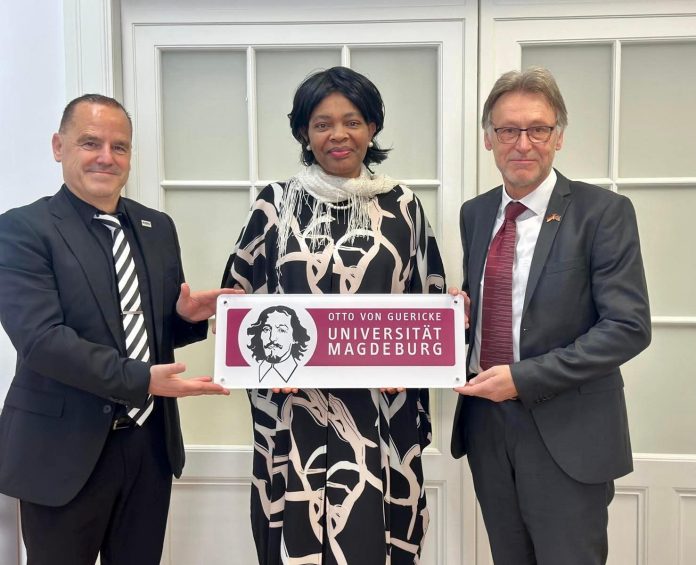
During a visit to Kenya’s Embassy in Berlin, university president, Professor Dr. Jens Strackeljan, presented a commemorative university plate to Ambassador Stella Mokaya for delivery to the Odinga family.

Strackeljan described Odinga as “a great engineer and bridge-builder,” saying his technical training in Magdeburg had a lasting influence on his public career.

“Raila Odinga was a great engineer and bridge builder,” he said, “The new programme will be named after Raila and will strengthen educational and cultural ties between Kenya and Germany,” he revealed part of the objective behind a new university program to honour Raila Odinga, symbolizing Raila Odinga’s enduring connection to the institution that first sharpened his mind and moulded his worldview.

In the end, the man who once welded steel in Magdeburg went on to weld together a nation’s hopes and, in the process, engineered a legacy that will stand as one of Africa’s most enduring blueprints for democracy.
Bad Law That Denies Us Good, Professional and Experienced Leaders

0

By Billy Mijungu

Politicians with professional backgrounds are now employable and that is the right way to go. We have seen former politicians become Principal Secretaries and Cabinet Secretaries, serving at the apex of their professional callings. Others have transitioned from politics to the Judiciary as judges or magistrates, and many more are directors in public institutions.

This cross pollination between politics and professionalism enriches governance. It proves that public service and professional competence can coexist.

However, professional people looking to venture into politics are becoming fewer. The reason is the unfair and discriminatory provision in the Political Parties Act, which forces public servants to resign before seeking elective office. It is a bad law.

Why should a teacher resign to contest as an MCA? What financial influence or conflict of interest can a teacher possibly wield that would distort an election? The same applies to thousands of civil servants whose only desire is to serve their country differently.

Those holding senior financial or executive authority, such as CEOs and Managing Directors of state corporations, could be treated differently.

They may be allowed to take official leave during the campaign period, as their positions come with significant influence and access to public resources. If they win, they transition to their new role; if they lose, they return to their jobs. That is the fairest balance and the most professional way to encourage capable people to join politics without fear of losing everything.

Why, for instance, should a Clerk of an Assembly or of Parliament be compelled to resign before running for Speaker? These are the very people who understand the rules, procedures, and spirit of the House better than anyone else.

They are already the silent engines of parliamentary business. Forcing them out before they contest is both illogical and wasteful of institutional talent.

It is time to repeal this bad law or have the courts interpret it differently in favor of fairness and meritocracy. Kenya deserves leaders drawn from the best professionals, not just those who can afford to gamble their livelihoods. Public service should be a bridge to leadership, not a barrier.

How Kasagam-Based Officers Saved Kenya from a National Shame

0

By James Okoth

25/10/2025.

In a nation still mourning the death of its most iconic statesman, the late Rt. Hon. Raila Odinga, one act of lawlessness had threatened to stain Kenya’s image and expose the soft underbelly of its security system. But a daring and disciplined operation by Kasagam-based police officers turned what could have been a national embarrassment into a moment of redemption for law enforcement.

On the morning of October 25, 2025, officers from Kasagam Police Station acting on credible intelligence launched a high-stakes raid in Manyatta “B” Slums, Mbeme area, Kisumu East Sub-County in an operation that would soon uncover the pistol that went missing from Governor Fernandes Barasa’s bodyguard during Raila Odinga’s burial in Bondo just six days earlier.

The stolen firearm, a Jericho pistol serial number 40309458, loaded with 14 rounds, belonged to Police Constable Benson Kodiah Olayo, a GSU officer attached to the VIP protection detail of the Kakamega Governor. Its disappearance during one of the most heavily guarded funerals in Kenya’s history sent shockwaves across the nation and raised uncomfortable questions about the state of security preparedness.

For nearly a week, the stolen gun symbolized a potential breach of state security, with implications reaching far beyond the boundaries of Kisumu. But even before the dust of speculation settled, the Kasagam crime unit was already quietly working on intelligence leads.

At precisely 13:30 hours, guided by a reliable tip-off, the OC Crime Kasagam led an undercover team into the narrow alleys of Manyatta “B.” The officers raided a rented house belonging to 19-year-old Timothy Odhiambo, who was in the company of three others: David Beckham Odhiambo (20), Tony Blair Omondi (16) and Harun Ibrahim (17), all described by police as dangerous young criminals.

The initial search yielded nothing. But after tense interrogation, Odhiambo broke down and led officers to his mother’s house, barely 400 metres away. The house was locked, but police gained entry by cutting through the padlock.

Inside the kitchen ceiling, the breakthrough came. The missing pistol, intact and loaded, neatly hidden away in a makeshift compartment was found.

As police retrieved the weapon, the suspect’s mother, Lilian Atieno Nyabende, resurfaced at the scene. She was arrested to assist in ongoing investigations, as forensic officers from the Kisumu Scenes of Crime Unit moved into document and process the recovery site.

Within hours, the stolen pistol that had caused national outrage was secured, recorded under OB No. 15/25/10/2025, and verified against the records of Bondo Police Station OB No. 47/19/10/2025.

The recovery was not just a police victory; it was a salvaging of national dignity.

In an era where public confidence in security institutions often wavers, the Kasagam team demonstrated the power of community intelligence, swift coordination and fearless execution. Their success neutralized what could have spiraled into an international security scandal in which a state-issued firearm, stolen during a former Prime Minister’s funeral was potentially circulating in criminal hands.

Their action reminded the nation that policing still works when courage meets commitment. It also underscored the critical role of public cooperation, as the tip-off came from vigilant locals unwilling to shelter crime.

As the suspects await arraignment and the DCI Kisumu East digs deeper into the gang’s network, the broader question remains: how did a weapon disappear under the noses of elite officers in Bondo?

That question will define Kenya’s next conversation on VIP protection protocols, event security management and intelligence coordination during high-profile gatherings.

Still, for now, Kenya can breathe a little easier because in the crowded backstreets of Mbeme, a small team of determined officers refused to let the country’s image crumble.

In saving one gun, Kasagam Police saved Kenya from a national shame.

Multi-party arrives in Nyanza as fears of split emerge in ODM

0

By Anderson Ojwang

Despite Nyanza getting the credit for crusading for multi-party politics in the country, the region has remained with a single-party mentality.

The Orange Democratic Movement (ODM) has been the dominant party in the region, while other leading political parties have given the region a wide berth.

The residents have been conditioned to believe in the mantra “Odwa en ot achiel” (Our house is one), “Wadhi konyo Jakom lweny malo” (We are going to help Jakom fight imaginary wars) and “Ka Jakom owacho left to en left or right to en right” (If Jakom says left, it is left; if he says right, it is right), to their detriment.

The seeds of the arrival of multi-partyism were witnessed in the November-scheduled by-elections, where ODM attracted the fewest aspirants for its primaries.

For Ugunja, only three aspirants sought the ODM ticket, while other parties are presenting nine candidates for the by-election.

Similarly, in Kasipul, only five aspirants contested in the controversial ODM nomination, and the seat has attracted 10 other candidates on independent tickets and from other political parties.

The recent death of ODM leader Raila Odinga is a double-edged sword for ODM and Nyanza. Raila, who was the glue and de facto leader of both Nyanza and ODM, has left a vacuum, and the centre can no longer hold.

Before Raila’s death, camps had already emerged in ODM over the alliance with President William Ruto and support for the broad-based government.

At the burial, the split was evident, with party secretary Edwin Sifuna reading from a different script, while the pro–broad-based government faction had their own script.

“We should do things that will make Baba smile. In my view, this is not the time to push divisive narratives in ODM. You all know ODM is a party for all Kenyans.

We, as party leaders, must show unity in the party. I, Sifuna, will not be part and parcel of those who want to destroy the party.

I will keep the party united and together, even in the face of open provocation. Let us, as party officials, wait and listen to what the members are saying before we act.

Let the people tell us what they want us to do with ODM. Raila spoke before the public on 22nd September before the MPs. So I kindly ask that we respect what Raila said,” he said.

Raila had said, “As a party we must prepare for the 2027 General Elections, and whatever position you hold, do not commit the party to things that have not been deliberated by the party organs. Who has told you otherwise?”

Sifuna said they will follow and implement Raila’s final instructions delivered before his death.

But yesterday, acting party leader Dr. Oburu Oginga reaffirmed that the ODM party supports the broad-based government and will support President Ruto.

“Raila left us at a place as a community. Raila left us in the government. We have benefited in the broad-based government, and that is where we will remain.

I must thank Ruto for giving Raila a State funeral. We do not take it for granted. We are going to move together with President Ruto.

My people from the fraternity of Luo Nyanza came to endorse my appointment as the party leader. I want to thank you for honouring me,” he said.

While Oburu was hosting Nyanza ODM members at his home in Bondo, Sifuna was meeting the families of the victims who died in the course of mourning Raila.

“We invited the families of the late Vincent Otieno Ogutu, Evans Onyango Kiche, Josfae Jida Burke and Josephine Akengo to Chungwa House today. They were among those killed in the course of mourning Baba at Kasarani and Nyayo Stadium. We extended our condolences and support on behalf of the entire ODM family,” he wrote on his X handle.

When he spoke, Orengo said Oburu was the suitable party leader and an honest and trustworthy person.

“The party is the foundation of any democracy. If we did not have a strong party, we would not have democracy in Kenya.

The ODM party leadership must remember its history. I give you my support and look forward to working with you.

You don’t need any political post in the party. I, Orengo, have not held any post in the party, but I still commit to the party.

When we seek alliances with other people, we must be smart and should not put all our cards on the table. We must listen to the ground. ODM should not be swallowed by another party. ODM must remain the biggest party,” he said.

Kisumu Woman Representative Ruth Odinga, in a move to appease members and the public, said ODM nominations will be free and fair unlike before.

Adhiambo said, “We will straighten ODM under Oburu Oginga. Oburu, my brother, is a fair and honest person. He won’t hold your hand or endorse you. So don’t go to him for that. You will have to go to the ground and ask the people for votes,” she said.

A Saboti MP had warned ODM chairperson Gladys Wanga, saying, “Why are Wanga and company so active politically after Baba’s death? What happened to the period of mourning? Since Baba died, they are more into broad-based politics than the life of Raila. Even if Baba left you in broad-based politics, why are you defending it more than the owners and UDA MPs? Why are you in a hurry to quickly chase leaders like Caleb, Sifuna and Babu Owino out of ODM, whom Baba never chased away, but loved?”

President Ruto, at the burial, said he will not allow ODM to disintegrate or be taken over by some quarters.

“I know I am the leader of UDA in the Kenya Kwanza government. I want to promise you ODM members, in regard to Raila’s wish, that we will respect ODM and support you to hold the party together. The future and strength of ODM matters so much to me.

I will not allow— in honour of Raila and within my means— those who want to remove ODM from the broad-based government for their selfish gain. That will not happen,” he said.

Where the World Is and Where Kenya Stands on Digital Policing

0

By James Okoth

In an era when technology has redefined every sector from banking to healthcare, the justice and security chain remains one of the hardest to modernize. Yet across the world, a few nations have begun rewriting the rules, taking policing, prosecution and court processes fully online.

In Dubai, the police force has already stepped into the future. Unmanned Smart Police Stations, open 24 hours, seven days a week, allow residents to report crimes, pay fines and obtain clearance certificates without ever speaking to an officer. The entire process is digital, traceable and seamless. Each complaint is automatically logged and linked to investigative systems and the courts, eliminating the long delays that once defined traditional policing.

In South Africa, the idea of an “e-police station” is no longer futuristic. The Kabokweni Police Station in Mpumalanga, launched in 2015, runs on a digital docket system that tracks every report from entry to closure. In municipalities like Ray Nkonyeni, digital call-handling systems allow citizens to report incidents online, with dispatch centres monitoring real-time police responses.

Then there is Rwanda, where the justice system has quietly become one of Africa’s most digitised. Through the Integrated Electronic Case Management System (IECMS), all court cases — civil, criminal, or administrative — are filed, processed and decided electronically. Judges, prosecutors and lawyers operate on a shared digital platform, cutting costs and drastically reducing case backlogs.

Across these examples, one lesson stands out: when technology meets accountability, justice becomes not only faster but also fairer.

Kenya, too, has begun to walk this path.
The Ministry of Interior, through the National Police Service, is midstream in a bold plan to digitise police stations and streamline justice delivery.

In Nairobi, more than 70 police stations have replaced their traditional Occurrence Books (OBs) with digital OBs in a move that allows reports to be logged, stored and accessed in real time. A citizen who reports a theft or assault can now have their case tracked electronically, reducing the risk of lost records or altered statements.

By April 2025, the Interior Ministry projects that Kenyans will be able to report select incidents without physically visiting police stations. The move is part of a KSh 28 billion digital modernization program, expected to cover at least 80 percent of policing and administrative services in two years.

In parallel, the Judiciary has accelerated its own reforms, expanding e-filing, virtual court hearings and digital case tracking. Combined, these efforts are quietly nudging Kenya toward an integrated justice ecosystem.

Yet, despite the bold vision, the transformation is still incomplete. Many rural and peri-urban police stations remain fully manual, relying on physical occurrence books and handwritten dockets. Internet connectivity, equipment shortages, and inadequate training have slowed the rollout.

There are also deeper structural concerns.
Digital systems without clear data governance risk creating new forms of opacity, where only a few officers understand the technology, leaving citizens and oversight bodies in the dark. Privacy advocates have also raised questions about how data from the police’s “Safe City” surveillance network is stored and used, given Kenya’s limited record of transparency in security matters.

Perhaps the greatest challenge lies not in technology itself, but in mindset. For digitisation to succeed, it must not only replace paper with screens but also transform culture. Shifting from secrecy to accountability, from bureaucracy to service.

The Ministry of Interior under recent leadership has shown willingness to modernise, but it remains a house of contrasts. On one hand, there is progress: digital border systems, e-citizen integration and plans for online police certification. On the other, persistent issues of inefficiency, corruption and delayed service delivery continue to haunt the ministry’s reputation.

While Kenya’s digital agenda is ambitious and commendably clear in its roadmap, success will depend on three things:

  1. Integration: ensuring police, prosecution, and courts share one digital case file.
  2. Transparency: making crime and case data publicly accessible in anonymised formats for accountability.
  3. Capacity: training officers and citizens alike to use and trust digital systems.

Compared to nations like Dubai, South Africa, or Rwanda, Kenya’s digitisation of justice is still a work in progress, promising but patchy.
The groundwork has been laid: digital OBs, e-filing courts, crime-reporting apps, and ambitious plans for full online access.

But the test of progress will not be how sleek the systems appear, but how fairly and efficiently justice is delivered. The future of policing, in Kenya and beyond, will not be defined by sirens and uniforms but by data, transparency, and trust.

What if Min Piny Rose Where Baba Fell?

0

By James Okoth

In Kenya’s long political theatre, transitions have rarely been about structure. They have been about symbolism. The death of Raila Amollo Odinga was not just the passing of a political icon; it was the quiet redirection of energy, authority and myth.

When power left Raila, it did not simply vanish. It drifted home, to Bondo and into the hands of his elder brother, Dr. Oburu Oginga. The elder statesman, himself a veteran of Parliament and diplomacy, now finds himself the default custodian of a name heavier than any title: Odinga.

But the real question is not who inherited Raila’s structures, it’s who inherited his spirit.

At the burial, Oburu stood beside the casket with the quiet solemnity of a man who knows both duty and destiny. His gestures were slow, deliberate, the kind of calm that signals closure and command. For ODM stalwarts, it was both reassuring and unsettling: a reminder that power, even within legacy, abhors a vacuum.

Yet, away from the cameras and the chants, another force lingered in silence. Ida Odinga.

While the nation mourned its “Baba,” it forgot to look closely at the woman who had stood beside him for half a century; the one who shaped his discipline, sharpened his defiance and steadied his compass through exile, detention and political storms.

Raila Odinga was Baba, the father of the nation’s opposition. Ida Odinga is “Min Piny,” the mother of the nation.

And yet, in the fragile hours after Raila’s burial, when political tongues began to roll, few dared to ask:
Could Ida Odinga be Kenya’s next torchbearer of the Odinga legacy?

ODM, now adrift in grief and recalibration, seems blind to its most natural continuity, Ida herself.
In a party long accused of male dominance and dynastic inertia, her potential is viewed not as evolution but disruption.

Party insiders whisper about Oburu’s seniority, or Winnie’s youthful charm. They however ignore the only figure who commands both national empathy and historical depth. It was Ida who nurtured ODM when its leader was devoted to high voltage national politics. It was Ida who rallied women’s movements when the party was branded defiant. It was Ida who, in moments of chaos, became the calm center, strong, articulate and unyielding.

Yet, the very thought of her stepping into the political front line makes many in the party uneasy. Why? Because it challenges an order built on patriarchy disguised as loyalty.

Ida Odinga’s political potential is not invisible. It’s inconvenient. She carries authority without asking for it; influence without the need for titles. Her calm voice, her maternal authority, her firm grasp of both politics and protocol. These qualities unsettle the loud and the ambitious.

For years, she avoided the spotlight, content to play strategist, counsellor and keeper of the Odinga moral compass. But now, in Raila’s absence, the question is no longer whether she wants power…it’s whether Kenya is ready for a woman to wear Baba’s shoes.

Her emergence would stir the party’s soul, forcing a reckoning with its gender biases and its comfort with symbolic motherhood over actual leadership. To many ODM men, she is the heart of the movement. But hearts, in politics, are rarely trusted with power.

If Ida Odinga were to step forward, not as Raila’s widow, but as a stateswoman, she would likely find a country willing to listen.

In an age where politics is losing empathy, her maternal symbolism could heal as much as it could lead.

But for now, ODM remains trapped in nostalgia, clinging to Baba’s memory while ignoring the mother’s mandate.
As Oburu steadies the family’s political estate, the soul of the movement still hovers, not in strategy meetings or press briefings, but in that silent question that refuses to fade:

What if Min Piny rose where Baba fell?

When the Skies Wept

0

By James Okoth

In the quiet, little-known village of Wathorego, in Kisumu East, Kisumu County, dawn has always followed a rhythm older than memory. At 4 a.m. the call to prayer from a nearby mosque rises softly through the mist. Moments later, the hum of the first plane cuts across the silence. A predictable sound that villagers use to mark the hours. Children, as young as three, know their mornings, mid-mornings and evenings by the aircraft passing overhead. Time, in Wathorego, lives in the sky.

But on the morning of October 15, 2025, something changed. The planes came early, low, loud, unsettled. One tore through the clouds before the first call to prayer; another followed, its roar deeper, longer, and strangely mournful. By sunrise, the village already sensed that the skies were trying to say something.

Then the radios spoke the unthinkable: Raila Amollo Odinga, the enigma, the reformer, the man whose name had long defined Kenya’s democratic heartbeat, was gone. With him, even the air above Wathorego lost its calm.

In Nairobi, the nation’s grief gathered at Jomo Kenyatta International Airport. Engineers and pilots of Kenya Airways prepared what would soon become a flight of history and symbolism — the return of Raila Odinga’s remains from India.

The carrier made a moving announcement that stunned millions.

“KQ203 will change to RAO001 as soon as we reach Kenyan airspace at around 8:50 a.m. to honour and respect our departed leader.” Kenya Airways announced.

It was the first time in Kenya’s aviation history that a commercial flight had been renamed to honour an individual. As the plane, a Boeing 787 Dreamliner, approached from Mumbai, tens of thousands tracked it live online. The call sign RAO001 glowed red across global flight maps, its progress watched in real time by Kenyans at home and abroad. It’s path glowed red across radar maps, a single dot, carrying a nation’s grief.

At 8:52 a.m. as the aircraft crossed into Kenyan airspace, air-traffic controllers cleared a silent corridor. The hum of other planes ceased. For a few solemn minutes, the entire sky seemed to belong to Raila.

The days that followed saw Kenya Airways make another extraordinary gesture. With thousands planning to travel to Kisumu for the funeral, the airline increased its flight frequencies and upgraded equipment on the busy Nairobi–Kisumu route.

“We’ve increased our flight frequency to Kisumu over the weekend to meet the high travel demand.” Kenya Airways made the announcement.

Additional flights included:

Friday 17 October – KQ656 (13:30) and KQ658 (19:00)

Saturday 18 October – KQ650 (06:50) and KQ654 (08:05), both upgraded to larger Boeing 737s

Sunday 19 October – KQ654 (08:05) and KQ671 (19:00), also operated with Boeing 737s

Within hours of the announcement, nearly all flights were sold out. Ticket prices doubled from the usual KSh 8,000–10,000 to between KSh 18,000 and 23,000, as Kenyans scrambled to be part of history. Exact figures for ticket sales were not released, but industry reports confirmed that most flights ran at full capacity.

From the skies, the Nairobi–Kisumu corridor looked like a procession — a continuous string of red-blinking lights over the Rift Valley, each one carrying mourners, journalists or dignitaries heading home to say goodbye.

By October 19, the village of Wathorego no longer needed clocks.
The hum of aircraft had turned from rhythm to requiem. Military choppers hovered low, their rotors trembling the sugarcane leaves, almost sweeping away tens of hundreds of tired roofs. Media drones buzzed like restless insects. Jets roared in formation, some circling before diving toward Kisumu International Airport, others veering toward Bondo.

Children who once squealed with delight now stood silent, hands shielding their faces from the sun. Each sound was a reminder that the sky above them was hosting a funeral far greater than their small world could contain.

One afternoon, silence returned. The final chopper carrying Raila’s body home to Bondo disappeared into the western horizon.
The sky, at last, rested.

Days later, the old order resumed. The muezzin’s 4 a.m. prayer echoed again. The planes returned to schedule…the gentle 6:20 am, the sharp 8:40am and the evening hum. Children once more counted planes, whispering, “That’s the morning one… that’s the afternoon one.”

Though sky life is progressively returning to rhythm, every plane that passes still seems to say his name softly and endlessly as the roads to and from his Bondo home continue to surge.

This, however, is a story of another day!

How a Kenyan in diaspora is pioneering digital education model in rural Kenya

0

By Samuel Owida

A Kenyan-born data scientist based in Washington, D.C. Pius Odhiambo has pioneered a groundbreaking digital education model that is reshaping learning in rural Kenya. 

Since its inception in 2020, the KISWATE Digital Academy has addressed major challenges faced by underserved communities by merging technology, cultural preservation, and grassroots support.

KISWATE—named from the Kiswahili phrase “KISWAhili TEkelezi,” meaning “functional Kiswahili”—embraces a dual mission: revitalizing the national language in neglected regions while deploying cutting-edge digital infrastructure designed specifically for rural schools.

Remarkably, it operates as a “school without walls,” serving over 15,000 students and 500 teachers across multiple counties without owning physical buildings.

At the core of KISWATE’s operations is the KISWATE Digital Attendance and Discipline Tracking Register (KDADTR), a Smart ID-based platform that automates daily school functions including attendance logging, discipline management, meal programs, and transport coordination.

“This technology has increased our school attendance rates by over 35% and improved discipline reporting accuracy to nearly 98%, compared to manual systems,” said Odhiambo, founder of KISWATE. 

This digital system enhances transparency and accountability in schools historically challenged by inefficient administrative processes,” he said

A persistent obstacle in Kenyan education has been the disproportionate teacher-student ratio, with some rural schools facing ratios as high as 1:70, far above the recommended 1:40.

This disproportionate phenomenon hasn’t been and can’t be addressed by the change of curriculum from decades-long 8:4:4 system of education to Curriculum Based Competency (CBC) to improved Curriculum Based Education (CBE).

KISWATE counters this by leveraging artificial intelligence-powered digital lessons and virtual classrooms, enabling personalized, interactive learning experiences regardless of teacher shortages.

“AI-driven tutoring allows students to learn at their own pace, filling gaps left by teacher scarcity,” said Jane Mwangi, a KISWATE e-learning coordinator.

This innovation ensures students in remote communities have equitable access to quality education.

Digitization also alleviates financial burdens on families by reducing reliance on costly printed textbooks, which can cost up to 30% of annual school fees. 

The academy’s digital textbooks significantly cut costs, easing economic pressures and helping keep children in school.

Beyond technology, KISWATE supports rural schools through scholarships, lunch programs, and community activities, melding modern innovation with vital humanitarian aid. 

About 45% of enrolled students receive some form of direct support from the academy.

The academy plans to launch a physical hub, “KISWATE Villa,” by late 2025 to merge its virtual presence with community engagement on the ground.

Additionally, KISWATE’s digital and AI solutions provide critical continuity in conflict-prone areas such as northern Kenya and Rift Valley regions affected by cattle rustling, enabling safe, remote learning where physical schooling is disrupted. 

“Insecurity no longer means the end of education for our children,” stated community leader Moses Lekape from Baringo County.

KISWATE stands as a powerful example of how diaspora expertise, technology, and community commitment can together transform Kenya’s educational landscape making learning accessible, affordable, and culturally relevant for rural learners.

This digital revolution could mark a turning point in achieving Kenya’s vision for inclusive, quality education for all.

Government, KAA intensifies Airport modernization to boost regional connectivity, airstrips upgrades to drive trade and tourism

0

By Patrick Amimo

The Government Delivery Unit (GDU) has stepped up oversight on the modernization of Kenya’s airports and airstrips in a renewed push to strengthen regional connectivity and position the country as an aviation hub in Africa.

Acting Head of the GDU, Mr. Olando Sitati, on Friday led a team of officers in a meeting with senior managers from the Kenya Airports Authority (KAA), led by Acting Managing Director Mr. Abraham Kiprutto and General Manager for Projects and Engineering Eng. Meshack Ochieng.

The session reviewed progress on priority airport and airstrip projects spread across all regions, forming part of the National Government’s promise to upgrade air transport infrastructure under President William Ruto’s transformation agenda, anchored in Kenya Vision 2030 and the Bottom-Up Economic Transformation Agenda (BETA).  

“Modern and efficient airports are key to positioning Kenya as a first-class economy by 2050,” said Mr. Sitati, reaffirming the government’s commitment to timely and impactful delivery of flagship infrastructure projects.

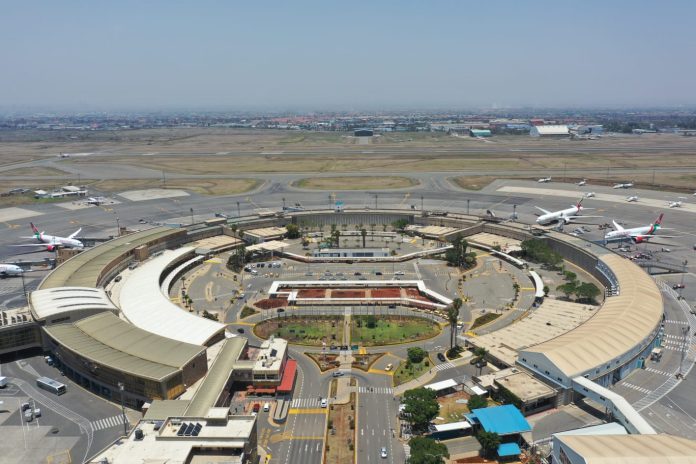
At Jomo Kenyatta International Airport (JKIA), key projects include installation of modern passenger boarding bridges and ground-handling equipment by June 2026, construction of a new runway by June 2027, and a world-class passenger terminal by 2029. The upgrades are expected to enhance passenger experience, improve cargo handling, and reinforce JKIA’s role as a regional aviation hub.

The GDU and KAA teams also assessed the status of ongoing and planned works at several regional airstrips, including Kabunde, Lichota, Suneka, Malindi, Ukunda, Voi, Ikanga, Lokichoggio, Narok, Kilgoris, Bomet, Kerenga, Lanet, Garissa, Mandera, Elwak, Itugururu, Mitunguu, Nanyuki, Kakamega, Matulo, Busia, and Ithookwe.

Other major developments include the extension of the Eldoret International Airport runway to 3.5 kilometers to handle larger aircraft, widening of the Kisumu International Airport runway, rehabilitation of Moi International Airport airside grounds, and the expansion of the Malindi International Airport runway to 2.5 kilometers.

KAA has also identified a new site for the proposed Busia Airstrip, while plans are underway to upgrade the Boma, Elwak, Aldas, Kanyonyo, and Nyaribo airstrips.

According to the GDU, these high-impact investments are expected to enhance mobility, create jobs, attract investors, and decentralize aviation training across the country, thus driving Kenya’s vision for inclusive, modern, and sustainable growth.

 “These high-impact investments will connect regions, stimulate trade, and help Kenya realize its ambition of becoming a first-class economy by 2050.”

When the River Remembers: A Luo Reflection on Unity, Legacy, and the Road Ahead

0

By Joshua O. Nyamori

There are moments in history when a people must look not outward, but inward – into the soul of their destiny.

Luo Nyanza stands at such a moment today.

The passing of Rt. Hon. Raila Odinga, CGH, has left a silence so deep it ripples from the plains of Kano to the hills of Got Ramogi and across the calm waters of Nam Lolwe. In that silence, a question rises: Who are we now, without him?

For more than half a century, Raila was not merely a political leader – he was a moral compass. His courage, endurance, and inclusivity gave the Luo nation an identity larger than politics. His friendship and eventual cooperation with HE. President William Samoei Ruto, CGH., shortly before his passing, was no coincidence. It was a signal – a vision for how our community could find its place in Kenya’s next chapter: not through perpetual resistance, but through strategic belonging.

The waters that cradle our story do not lie. Every river that nourishes Luo land – from Kuja to Awach, from Nyando to Sondu – begins its journey in the high ridges of the Nandi Hills. It is as though creation itself wrote a covenant between our peoples – that the destiny of the Luo and the Kalenjin is one of convergence, not conflict.

From the springs of Nandi to the calm of Nam Lolwe, the river does not ask who owns it; it only flows – giving life to all who draw from its path.

History reminds us that the Luo have always been stabilisers, not spoilers.
From the migration out of Bahr el-Ghazal to the Great Lakes, our ancestors carried with them not the spear, but the staff of governance. They built kingdoms, harmonised clans, and offered counsel across borders – from Bunyoro to Busoga. The Luo spirit has always been one of order, wisdom, and moral authority.

That spirit shaped the very foundations of Kenya.

When the young republic stood on shaky legs, Jaramogi Oginga Odinga gave it conscience – refusing the comfort of power at the cost of principle. In his final years, even Jaramogi found it prudent to cooperate with President Moi, choosing dialogue over division, stability over spectacle.

Tom Mboya gave Kenya structure – building institutions, negotiating labour, and drafting the blueprint for national progress. These were not men obsessed with power; they were architects of possibility.

And Raila Odinga, their heir in vision and courage, spent his lifetime weaving bridges where others built walls. When President Ruto ordered a State burial with full military and presidential honours for Raila, he did more than honour a man; he honoured a people. In that solemn salute, Kenya said to the Luo: We see you. We honour you. You are part of us.

That gesture was not mere ceremony; it was moral symbolism. It opened a bridge between memory and renewal – a bridge we must now walk across with dignity and purpose.

To walk with President Ruto is not to abandon our history; it is to fulfil it. It is to say that the ideals of Jaramogi, Mboya, and Raila – courage, fairness, inclusion – do not die with them; they live on through partnership and nation-building. The politics of permanent protest has run its course. The time has come for a politics of reconstruction.

Our young people – from Kanyada to Karachuonyo, from Manyatta to Muhoroni – are not asking for handouts. They are asking for direction, for meaning, for belonging. That meaning will not come from recycled divisions, but from participation – from being on the table where Kenya’s future is decided.

Let us not spend another decade watching from the fence while others shape the nation. Let us step forward, not as petitioners, but as partners. Let the Lake become a lighthouse once again – guiding the Republic with reason, culture, and courage.

The Luo have never been a people of retreat. We are a people of destiny.

And destiny now calls us – not to stand apart, but to stand tall.

To walk with President Ruto is not betrayal; it is continuation. It is the path Jaramogi would have reasoned, Mboya would have built, and Raila – in his final acts of statesmanship – already began to illuminate.

For in the end, the river that cleaves the valley does not divide it – it nourishes both sides. And so must we!