Home Blog Page 114

Winnie to Ruto: I am ready to return home, in a new political realignment

0

By Anderson Ojwang

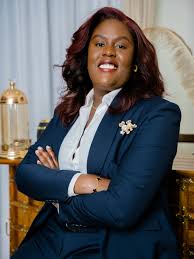
In what can be said as a political realignment after the death of the enigma Raila Odinga, his last-born, Winnie Mandela Odinga, told President William Ruto that she was ready to come back home.

Winnie, who is a member of the East African Legislative Assembly (EALA), told mourners that in Bondo, there still lives a lion.

“I have heard people talk badly about Bondo. I want to say here, we have a lion here. I am the lion. Do not be worried. For President Ruto, I am ready to come back home,” she said as Ruto smiled and consulted with his aides.

Winnie has been the cornerstone of Raila’s political journey after the death of his son, Fidel Odinga, and she has been significant in his presidential campaigns.

Raila, before his death, had entered into a political alliance that birthed the broad-based government after the 2024 Gen Z anti–Finance Bill protest.

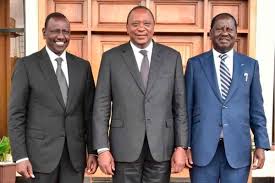
Ruto and Raila recently signed a Memorandum of Understanding (MOU) that gave a framework for a broad-based government, which brought together UDA and ODM.

Raila was recently replaced as the party leader of the Orange Democratic Movement (ODM) by his elder brother, Siaya Senator Dr Oburu Oginga, as the acting party leader.

Already, jostling for the leadership of Nyanza has begun in earnest, with various leaders expressing interest.

Viewed as potential heirs apparent are former Cabinet Minister Raphael Tuju, Winnie Odinga, Embakasi East MP Babu Owino, Cabinet Secretary for Treasury and Economic Planning Mr John Mbadi, his Energy counterpart Opiyo Wandayi, Homa Bay Governor Gladys Wanga, Permanent Secretary for Internal Security Dr Raymond Omollo, and Rarieda MP Otiende Amollo, among others.

With Raila’s death and a power vacuum emerging in the leadership of Nyanza, the battle for the region is likely to mirror the post–Jaramogi Oginga Odinga succession.

The post-Odinga succession battle pitted the current Siaya Governor James Orengo and his Kisumu counterpart Prof Anyang’ Nyong’o against Raila.

Raila emerged the winner, and the two later became his close political confidants until his death.

Nyong’o became the acting ODM party leader when Raila was contesting for the AU Chairperson seat, which he lost.

When Lions Fall Silent: The Philosophy of Baba’s Freedom

0

By Clifford Derrick

When lions fall silent, the savannah holds its breath. The grass stiffens, the air thickens, and the smaller creatures—who once trembled at the roar—begin to wail in confused relief. Yet beneath that silence lies a harder truth: the lion is gone, but the wilderness has lost its order.

The passing of Raila Amolo Odinga has cast that silence across Kenya, across Africa, and into the uneasy conscience of history. For more than half a century, he lived as both the student and the sculptor of freedom—testing its tensile strength, bearing its burdens, and discovering, as Frantz Fanon warned, that each generation must discover its mission, fulfil it or betray it. Raila Odinga discovered his; others betrayed it.

The Anatomy of a Lion

He was born into history’s storm, cradled by the defiance of his father and the colonial twilight of a nation unready for the responsibilities of freedom. The young Raila learned that liberation is not an event but a temperament—a discipline of courage. In Jaramogi’s home, Uhuru was never a slogan; it was a metaphysical command.

If Jaramogi dreamed the outline of freedom, Raila was fated to live its contradictions. He studied machines in East Germany, only to return to a Kenya still shackled by mental chains. He entered politics not to wield power but to correct it—to remind his country that freedom’s measure is not declaration but design.

As Ngũgĩ wa Thiong’o taught us, the bullet aims to kill the body and the school to kill the mind. Raila spent his life reversing both. His ordeals at the Nyayo House torture chambers and imprisonment at Kamiti Maximum Prison did not break him; they burnished him. He emerged from each captivity as a philosopher of hope, carrying the unbroken tone of a man who refused to hate even those who crucified him.

The Contradiction of Power

To understand Raila is to wrestle with contradiction—the way moral clarity invites political tragedy. He lived in a country that celebrated his courage but feared his conviction. He was called a destabiliser for questioning tainted elections, only for the same institutions to praise him, in death, as guardian of our democracy. There is something profoundly Kenyan, profoundly African, in this rhythm of rejection and remembrance. We have made a ritual of crucifying our prophets before consulting their ghosts.

Hannah Arendt called it “the loneliness of the pariah who insists on thinking.” Raila lived that loneliness. His thinking offended the comfort of mediocrity; his courage embarrassed the cowardice of convenience. Yet through it all he carried himself with the quiet of one who knew that leadership is stewardship—not domination—a presence accountable to the future as much as to the present.

The Freedom that Refused to Die

There are men who chase history, and there are men who bend it back toward its original moral direction. Raila belonged to the latter. Like Nelson Mandela, he understood that endurance without bitterness is the final stage of freedom. And like Nkrumah, he knew that Africa must unite or perish—that the map of Kenya is one corner of a greater moral geography.

He spoke of roads, rails, ports, skies, grids and data—technocratic words that, in his hands, became sacred metaphors. To Raila, infrastructure was theology: the physical proof that African nations can connect what colonialism divided. To bridge a river was to repair a wound; to lay a railway was to realign destinies; to open skies and ports was to dismantle the geography of servitude. He was a philosopher-engineer of freedom, for whom power was not a possession but a conduit.

Gratitude & Fidelity

We must give thanks to those who believed in him when it was unfashionable and costly to do so—those who walked with him through NDP, into KANU, across LDP and NARC, who endured with him in CORD and NASA, who hoped again in Azimio la Umoja, and who, at the end, understood the discipline beneath his decision to leave his people inside the state through a broad-based arrangement: not capitulation, but calculation for stability and inclusion. Your fidelity was not in vain. History heard you.

A Word to His People—and to the Opportunists

And now, to my Luo kin and to all communities who have long borne the costs of dissent and the price of principle: do not let the voices that denied Baba in life seduce you in his death. Beware the hands that resisted him yesterday but now stretch for your grief today. Beware the sudden converts to his gospel who would cash in on the funeral to mortgage the future.

He stood for equity and for a republic where development is not a tribal trophy but a citizen’s right. Hold that line. Do not let your pain be harvested by the very forces that locked the gates against him. “Wan joka nyanam, to wan gi juok Baba.” We are his people, and we are also his spirits. Those who already joined the former oppressor’s chorus should step aside and let the government serve the very citizens Baba fought for—Nyanza’s fisherfolk and traders, the hustling youth of Kibera, the farmers of Western, the pastoralists of the North, the Coast and every Kenyan too long ignored by power’s habits.

A Word to Government

To the government of the day: govern in good faith. As Jaramogi’s courage multiplied through generations, so has Raila’s juogi—his animating spirit—lodged now in countless hearts. He left a plan, as his daughter Winnie intimated; a moral architecture for stability with justice, reconciliation with memory, growth with dignity. Honour it. If you deviate—if you return to the old arithmetic of exclusion—know that you will not face one man’s dissent but a chorus of principled resistance, grounded in the very spirit that outlived torture, exile, and stolen hours.

Africa’s Unfinished Union

Beyond Kenya, he leaves Africa a blueprint—not a daydream. He named the arteries of our freedom: continental highways and standard-gauge rails to move goods and dignity; open skies to lower costs and raise opportunity; energy grids to power industry and learning; an African digital commons to protect our knowledge; a currency architecture to end the dependency that cheapens our labour; and a moral economy where profit bows to people. He warned against the new colonisers in tailored suits—those who barter our minerals and futures with a handshake and a press release.

He exposed the local elites who collude, the soft empire of attention that distracts our youth, the algorithmic lullabies that turn revolt into content and courage into costume.

To Africa’s young: your smartphones are instruments; your conscience, the battlefield. Do not mistake noise for power. Freedom is not a hashtag but a daily discipline of building—patiently, stubbornly, together.

The Pain that Tells the Truth

Behind the laughter and the easy handshake lived a private sorrow—the sorrow of a man who gave everything for a people who often returned everything but misunderstanding. He bore it without bitterness. Arthur Schopenhauer said truth moves from ridicule to opposition to self-evidence; Raila lived all three. The ridicule was public, the opposition institutional, the self-evidence—alas—posthumous. And still he taught us grace: that a nation is repaired not by vendetta but by vision.

The Lion and His Pride

To his family: Mama Ida—Min Piny’s resilience, Rosemary Odinga’s grace, Raila O. Junior’s steadiness, Winnie Odinga’s fire, not forgetting Maurice Ogeta’s unwavering loyalty—these are not merely filial virtues; they are ongoing chapters in his text on freedom. He has gone where our ancestors convene councils under the great fig tree; but he did not go empty-handed. He carried our unfinished work with him to report, and to intercede.

Raila Odinga did right by the world. He stood for justice when silence was easier, for unity when division paid better, for principle when compromise promised comfort. Such men do not vanish; they leave imprints on the conscience of a people. He now rests among those who shaped history with their courage and their love for humanity—the beautiful company of the righteous dead who continue to light our path.

The Roar Beyond the Grave

Let us not merely mourn him. Let us metabolise his life into motion. Let us make his contradictions our compass and his faith our framework. For if Africa still waits to be free, it is because too many mistook a lion’s silence for peace. Raila Amolo Odinga is gone. But the architecture of his dream remains. And somewhere between Bondo and the infinite, the lion still walks.

Personal Farewell

“Baba, greet for me my late mother, Judy Mbewa, Nyar Seme Kakelo—one of your ardent believers. She is waiting with both hands. Carry our revolutionary greetings to George Oduor, Jaramogi, Nkrumah, Mandela, Biko, Chris Hani, Malcolm X, Patrice Lumumba, Sankara, Martin Luther King Jr., Wangari Maathai, and Winnie Mandela. Tell them we are still on the long road, that we have not laid down our tools, and that your juogi walks among us.”

“Baba yawa!”
“Rest well, Baba. Ywe gi kwe my hero!”
“Jowi! Jowi! Jowi!”

Mt Kenya Misses the Opportunity to Ascend to Presidency for a Third Time Through the Lake as Raila is Buried

0

By Anderson Ojwang

Today, in Bondo, Kango Ka Jaramogi, Martha Wangare Karua would have been Kenya’s sixth president. ‘President Karua’ would have presided over the burial ceremony of the departed enigma Raila Amolo Odinga.

The Gikuyu community have missed the golden opportunity that could have enabled them to ascend to the presidency for the third time through the Luo community.

Today, Mt Kenya watches in consternation, bitterness and regret as Raila is laid to rest in Bondo, while Karua has become a pale shadow of the once vibrant and iron lady of Kenya’s politics.

As the ACK Bondo’s Bishop Prof David Kodia will be saying the final words of ‘Unto soil I came and I return’, Mt Kenya will be watching painfully, and Karua would be mourning a buried political ambition — the presidency.

President William Ruto will preside over the event after he signed a memorandum of understanding with Raila over the broad-based government.

The Gikuyu community first rode to the presidency after the late Jaramogi Oginga Odinga declined to take over the mantle from the British colonialists until the late Mzee Jomo Kenyatta was released from prison.

In 1960, during Kenya’s final years under British colonial rule, Jaramogi Oginga Odinga made a decision that shaped the country’s path to independence. The British colonial administration offered him the opportunity to lead Kenya as the country’s first Prime Minister while Jomo Kenyatta remained in detention.

At the time, Kenyatta had been imprisoned since 1953, accused of leading the Mau Mau rebellion. Despite the British government’s proposal, Odinga rejected the offer to take over national leadership. He insisted that no meaningful political transition could occur while Kenyatta was still behind bars.

Odinga reportedly told the colonial officials, “If I accept your offer, I will be seen as a traitor to my people. Kenyatta is our leader and must be released to lead us.” He made it clear that Kenyatta, despite his imprisonment, was the chosen leader of the Kenyan people and that any attempt to sideline him would not be acceptable.

This decision by Odinga helped to maintain unity among Kenya’s political movements and reinforced Kenyatta’s position as the symbol of the independence struggle. It also prevented possible ethnic divisions, particularly between the Luo and Kikuyu communities, by showing solidarity across tribal lines.

When Kenyatta was eventually released in 1961, he resumed leadership of the nationalist movement. In December 1963, Kenya gained independence, and Kenyatta became Prime Minister. As a reward for his loyalty and support, Odinga was appointed Kenya’s first Vice President.

And Odinga and the Luo community sacrificed to Kenyatta and the community, and the presidency sat in the mountain.

During the struggle for the repeal of Section 2A of the Constitution and eventually the first multiparty election, Kenneth Matiba and the Gikuyu community had resolved to support Odinga for the presidency.

By 1990, Odinga had already decided to chart his own political path.

Lawyer Paul Muite, who later became Odinga’s running mate, invited Kenneth Matiba and Charles Rubia to his house, where they discussed the need to partner with Jaramogi Oginga Odinga to build a formidable alliance to face Moi.

According to Muite, they later invited Bishop Okullu and Joab Omino to inform them about the idea.

In the agreement, Jaramogi was supposed to be made the joint presidential candidate after the constitutional reforms.

These discussions were taking place without Jaramogi’s knowledge.

The group approached Odinga and presented to him the idea of a future political alliance with him as the presidential candidate.

In this regard, Rubia and Matiba met Jaramogi at his private office at Agip House and his company office at Spectra International in Industrial Area.

Odinga was sceptical about their genuineness. According to Muite, Jaramogi, after listening to them, asked in a shrill voice, “I am not opposed to a partnership. But do you remember how our first marriage ended?”

But after the repeal of Section 2A and on the return of Matiba from treatment abroad, the memorandum of understanding was disregarded, and Matiba declared his presidential bid.

Muite, who was still rooting for Jaramogi’s candidature, recalled Rubia telling him that political pacts were not laws to be obeyed, while Matiba told him, “Don’t you know, Paul, even those Luos, they will all vote for Ken Matiba, not Jaramogi?”

Both Matiba and Odinga lost to Moi, and the Gikuyu community lost the opportunity to ride to the presidency through the Luo for the second time, as Jaramogi died a year later after the 1992 election.

Moi won the 1997 election while Matiba boycotted the election and died in denial of losing to Moi.

In 2002, Raila Amolo Odinga delivered the presidency to the Gikuyu community, to Mwai Kibaki, while he was in a wheelchair. The famous “Kibaki Tosha” was all that he needed to become Kenya’s third president.

In the 2022 presidential election, then-President Uhuru Kenyatta supported Raila for the presidency and negotiated for Karua to be the running mate.

Raila agreed to Uhuru’s political arrangement, which saw Kalonzo Musyoka, who had been the former Prime Minister’s running mate in the last general election, give in to the deal.

On February 26, 2022, Uhuru led a Jubilee Party National Delegates Conference (NDC) at the Kenyatta International Convention Centre (KICC) in Nairobi. The NDC endorsed the Orange Democratic Movement (ODM) leader, Raila Odinga, as the party’s preferred presidential candidate for the August general elections.

But former Uhuru’s personal assistant, Rigathi Gachagua, led the community in rejecting Raila’s candidature and instead voted overwhelmingly for President William Ruto.

Gachagua became the Deputy President but was later impeached and replaced by Prof Abraham Kithure Kindiki.

The Enigma Awaits His Final Rest — Would ODM Have Matched the State’s Grandeur?

0

By James Okoth

Raila Amolo Odinga — the enigma, the reformist, the indefatigable father of Kenya’s democracy — is set to take his final bow. As the nation braces for his burial tomorrow, anticipation and emotion sweep across the country. The send-off planned in his honour has already assumed a scale and solemnity rarely witnessed in Kenya’s history — a blend of national pride, global reverence, and political symbolism befitting a man who defined the nation’s democratic journey for more than half a century. Yet, one question lingers — would the Orange Democratic Movement (ODM), the party he founded and nurtured, have managed a farewell of this magnitude if the State had not stepped in?

The turning point came when President William Ruto, in a sombre address from State House, Nairobi, shortly after Odinga’s death, announced that the government would accord him a full State funeral. His words resonated across the political divide.

“Raila Odinga was not just an opposition leader. He was a patriot whose sacrifices and convictions shaped our democracy. As a country, we owe him the honour befitting a statesman who gave his all for Kenya,” he declared, crowning the country’s mood of profound loss and sombreness.

That declaration marked a moment of national maturity. It was both a political and moral decision — one that acknowledged that Raila’s contribution to Kenya transcended party boundaries. Strategically, it reflected President Ruto’s intent to project unity and statesmanship at a time of national grief. Symbolically, it placed Raila Odinga among the pantheon of Kenya’s founding and transformative leaders. Historically, it was a remarkable full circle — the same State that once detained and opposed him now preparing to honour him with a 21-gun salute.

The government has since spared no effort in staging a world-class State farewell. The military rehearsals, the precision of protocol, the elaborate planning for tomorrow’s ceremonies, and the turnout at Nyayo Stadium in Nairobi, Kenya’s capital, and at Mamboleo Stadium in Kisumu City have all reflected the weight of Odinga’s national stature. Heads of State, diplomats, clergy, and citizens have joined hands in tribute to the man whose name became synonymous with resilience, reform, and democracy.

On the other hand, ODM — though emotionally and ideologically closest to Odinga — would have faced enormous challenges in mounting such a large-scale operation. The party’s heartbeat lies with the people — the millions of Kenyans who saw Raila as their liberator. An ODM-led burial would undoubtedly have been emotionally powerful, driven by grassroots loyalty and cultural depth. It would have been rich in song, dance, dirge, and symbolism — a reflection of the people’s love and Baba’s revolutionary soul. Yet, the logistical precision, security apparatus, and diplomatic coordination required for an event of this scale are powers only the State commands.

In essence, Raila’s final rites have become a powerful meeting point between the State and the people — two forces that often clashed during his lifetime, now united in honouring him. The government brings the order, structure, and global recognition; ODM and his followers bring the passion, culture, and authenticity. Together, they are shaping a farewell that transcends politics — a national moment of reconciliation and respect.

When the guns fire tomorrow in salute at his Opoda farm in Bondo Sub-County, the echo will carry more than honour — it will carry history. It will mark Kenya’s collective redemption: the State saluting a man who once stood fearlessly against it, and a people witnessing their hero embraced by the nation he fought to reform.

Raila Odinga’s burial, therefore, is not merely a farewell. It is the closing of a long national chapter — the reconciliation of power and people, of struggle and statehood. And in that unity, perhaps, lies the truest reflection of the Kenya he dreamed of — a nation finally at peace with its greatest son.

How Raila Odinga’s Bond with the Late Michael Kijana Wamalwa Lives On through Eugene’s Symbolic Gesture at Kang’o Ka Jaramogi

0

By James Okoth

Photo||Courtesy

In the early years of Kenya’s push for multiparty democracy, two men — Raila Odinga and Michael “Kijana” Wamalwa — emerged as the faces of hope, courage, and reform. They came from different regions, spoke different political dialects, but shared a single heartbeat: a desire to see Kenya free, fair, and inclusive.

Raila, the son of Jaramogi Oginga Odinga, was the firebrand reformer shaped by years of detention and resistance. Kijana Wamalwa, a polished lawyer and orator from Trans Nzoia, carried the intellectual flair and national outlook that inspired a generation. Together, they embodied the reform spirit of the 1990s — bold, fearless, and unbowed.

Their friendship blossomed beyond political convenience. They were allies, brothers in struggle, and visionaries who dreamed of a Kenya larger than tribe. Both believed that politics could be civil, ideas could triumph over insults, and unity could outlast elections. In many ways, Wamalwa’s charm and grace softened Raila’s fiery edge, while Raila’s tenacity and mass connection deepened Wamalwa’s political grounding.

When Jaramogi Oginga Odinga passed away in 1994, it was Kijana Wamalwa who took over the leadership of FORD–Kenya — continuing the reformist flame that had united opposition voices. His eloquence and intellectual depth rejuvenated the party, positioning him as a national leader and later Kenya’s seventh Vice President under President Mwai Kibaki in 2003.

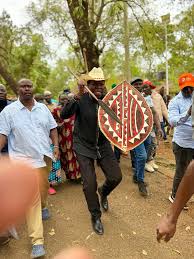
That same year, tragedy struck. Wamalwa’s sudden death left Kenya in mourning, and for Raila, it was personal. He travelled to Kitale and mourned Wamalwa in the most symbolic of ways — culturally parading bulls to honour his fallen comrade. It was a gesture steeped in Luhya tradition — a statement that friendship transcends politics, and respect can be spoken in the language of culture. For the Wamalwa family, it was a moment that etched Raila’s name in their hearts.

Years turned to decades, and the circle of history began to close. When Raila Odinga passed away, Kenya once again stood still. His death marked the end of an era — the fall of a democratic giant whose voice had shaped Kenya’s modern political identity. And just as Raila once went to Kitale to honour Kijana, Eugene Wamalwa — Kijana’s brother — made his journey to Kang’o Ka Jaramogi in Bondo.

In a deeply cultural act of reciprocity, Eugene arrived with bulls, re–enacting Raila’s gesture in reverse — this time as a tribute from the Wamalwa family to the Odingas. The symbolism was profound: it was not just a cultural offering, but a closing of the circle of friendship, respect, and shared struggle between two families who had walked Kenya’s democratic path together.

“When my brother Kijana rested, Raila came to Kitale with bulls to honour him as a true friend and leader. Today, I return the same gesture — not just in memory, but in gratitude. What he gave to Kenya, and to us as a family, can never be repaid, only remembered,” Eugene said moments after delivering the bulls.

Eugene’s words carried the weight of history. They spoke of continuity — of how leadership and legacy can pass from one generation to another without bitterness or rivalry. The moment placed him in the emotional heart of Kenya’s political story, not as a mere spectator, but as a custodian of his brother’s ideals and Raila’s enduring vision.

As the nation prepares to lay Raila Odinga to rest, Eugene’s gesture at Bondo reminds Kenyans that politics need not erase humanity. It underscores that friendship, respect, and culture still have a place in public life.

For Eugene Wamalwa, this act may also shape his political future. It situates him in a lineage of reform, empathy, and cross–regional unity — traits that both Raila and Kijana embodied. Whether he builds upon that moral inheritance to redefine his own leadership will depend on how he interprets this symbolic bridge between past and present.

But one truth is clear: the bulls that once travelled to Kitale and now to Bondo carry more than tradition — they carry Kenya’s story of friendship, respect, and political brotherhood that outlives the men who began it.

When the Handshake and Broad-Based Converged in Kisumu in a Peaceful Last Honour to Raila

0

By Anderson Ojwang

In Kisumu today, the Handshake of former President Uhuru Kenyatta and the Broad-Based Government of President William Ruto converged in a peaceful last honour of the departed enigma, Raila Amolo Odinga.

Unknown to many, the venue — Jomo Kenyatta International Stadium, at Kisumu’s Showground — was the product of the political Handshake between Uhuru and Raila after the disputed 2017 elections.

Then Cabinet Secretary for Sports, Amina Mohamed, disclosed that President Uhuru Kenyatta had given her specific instructions that a world-class stadium be built in Kisumu forthwith.

“We were directed by President Uhuru Kenyatta to put up a stadium in these grounds and make sure it’s a modern, beautiful and befitting facility for the city of Kisumu.
We have to ensure that work is completed between six and ten months. If we have a beautiful stadium in Kisumu, it will serve the entire region well, so I’m grateful that the President gave priority to this region,”
Amina said then.

The 30,000-capacity Jomo Kenyatta International Stadium, constructed at a cost of Sh350 million, first opened its doors to the historic 2021 Madaraka Day celebrations.

The 2018 Kenya Handshake was a political truce made on 9th March 2018 between President Uhuru and former Kenyan Prime Minister Raila. It brought an end to the acrimony between leading political parties and tribes and promised to usher in a new era of peace. The two leaders pledged to work together to address ethnic division, corruption, and historical injustice.

The historic peace accord gave Kenya a rebirth, with Kisumu becoming Uhuru’s beloved destination, which he frequented and drove in freely.

Unknown to him and Raila, the Jomo Kenyatta International Stadium — the Handshake project — was today the venue where mourners gathered peacefully to honour Raila en route to Bondo for his burial on Sunday.

At the stadium, the Broad-Based Government took charge, giving Raila a statesman’s and befitting last respect. Raila landed in a military chopper and was later flown to his Opoda home for an overnight stay.

During the 2024 Gen Z protests over the anti-finance bill and high cost of living that nearly degenerated into making Kenya a failed state, Ruto and Raila formed the Broad-Based Government.

Recently, Ruto and Raila signed a memorandum of understanding formalising the Broad-Based Government.

Kenyans stand to gain more from the Broad-Based Government as opposed to a divided country along ethnic lines.

“No community, county, or region will be sidelined by the Broad-Based Government.”

The Broad-Based Government raised the status of Raila’s last journey, affording him a near-presidential treatment.

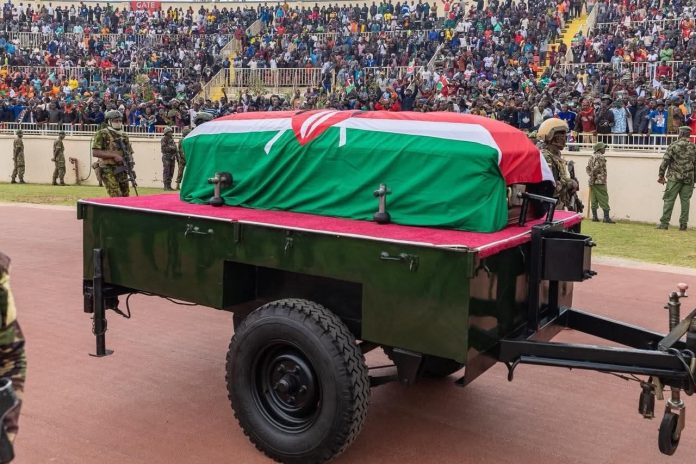
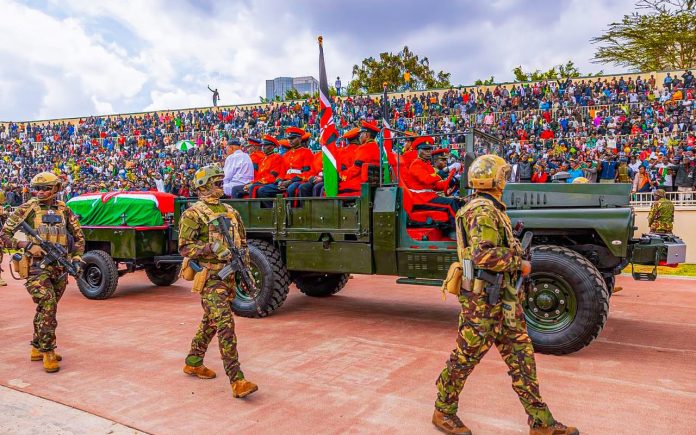
As a hero and a king, Raila is the first civilian to have been driven in a military vehicle that previously carried the late President Mwai Kibaki and the late General Francis Omondi Ogolla, who was the Chief of Defence Forces.

Raila became the third person, and the only civilian, to have enjoyed the status of a military procession, and the pallbearers were Colonels — a rank below the Major who carries the bodies of Presidents.

In the procession were military vehicles — an honour for a statesman and Baba.

President Ruto gave Raila a state burial, declared seven days of mourning, ordered the flying of the national flag at half-mast, and declared Friday a public holiday.

As the military flew off from Jomo Kenyatta International Stadium, Kenyans witnessed the fruits of the two political unions that have shielded the nation and held it together.

The stadium will remain historic as the last point where Uhuru and Ruto converged in honour of Raila’s immense contribution to the nation.

And Kisumu did not disappoint. It was peaceful — no ugly scenes or any reported deaths. Raila rode peacefully to his final resting place.

Who and Why Was MP Gogo’s Rural Home Torched?

0

By Reporter

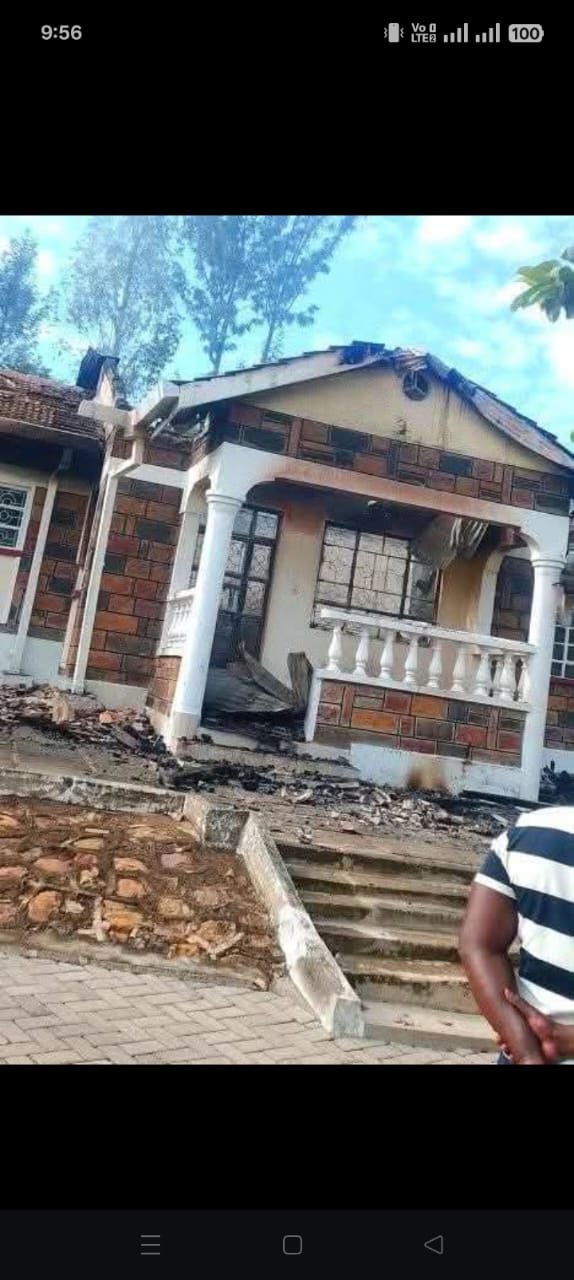
Tough questions are being asked — why and who torched Rangwe MP Lilian Gogo’s rural home last night in Rangwe?

Ironically, last night and today most parts of Rangwe Sub-County are still experiencing a power blackout, including Gogo’s home area.

This points to arsonists for reasons yet to be determined.

The incident occurred on Friday night shortly after midnight, destroying property valued at millions of shillings, but the police were only able to contain and salvage the bedroom from the fire.

Rangwe OCPD Magdalene Chebet, who visited the scene, told journalists that police have launched an investigation into the incident.

She said that at the time of the incident there were employees at the home, and they had to break the gate and the doors to salvage property.

“We were told the husband came home and discharged all the employees from the home, and later locked his gate and the house before leaving for his workstation,” she said.

She added that Gogo was in Kisumu at the time of the incident and was engaged in the preparation and arrangements for the burial of former Prime Minister Raila Odinga.

A Funeral of Witness: Words That Carved Raila’s Legacy

0

By James Okoth

Photo || Courtesy

As thousands filled Nyayo Stadium, the ritual was more than ceremonial. It was a convocation of memory, of grief, and of moral summons. The speakers did more than eulogise; they endeavoured to show what Raila Odinga was — and, by implication, what Kenya still must become.

The Anglican Bishop of Bondo, Rt Rev Prof David Kodia, delivered what many described as a fiery, almost prophetic sermon — part eulogy, part admonition. In one of the more charged passages, he warned:

“If there’s anyone here, at whatever level — be it governor, MCA — who has looted this country, you know you stand the chance to be condemned.”

He contrasted Raila’s style of leadership with the pervasive culture of “handouts” and patronage:

“Baba never used the power of money to intimidate people or lure followers. He used the power of persuasion, the power of the word.”

And he closed with a testing challenge, turning grief into accountability:

“How many can fit in the shoes of Raila Odinga today? How many?”

Kodia also gave a deeply personal frame to the celebration:

“Hardly a month ago, I had breakfast with Baba … I saw a man who was ready to meet God at any time — a humble servant …”

In that moment, the pulpit was not a podium of flattery, but a judge’s bench: a demand that Kenya match its grief with integrity — that leadership not become default for the corrupt.

President Ruto stood as living proof that polity and rivalry do not preclude respect. In his address, he offered a nuanced tribute. Among his lines:

“In his passing, we have lost a patriot of uncommon courage, a pan-Africanist, a unifier who sought peace and unity above power and self-gain.”

He underscored Odinga’s role in shaping Kenya’s legislative and constitutional journey:

“He used his time as legislator to play pivotal roles in shaping some of the most consequential laws in our Republic’s history.”

The power of his speech lay in that tension — a sitting president, once a political adversary, invoking Odinga’s legacy in national, not partisan, language.

It is among the mourners that the abstract becomes real, where the man and his myth collided.

A young supporter, Ephuntus Gikonyo (24), spoke to Western Insight:

“Raila Odinga, the father of democracy in Kenya, was a selfless leader who would risk everything — even his life — to make Kenya work.”

Another mourner, Beatrice Adala, at the stadium when the body arrived, captured the raw emotional substrate:

“We are in mourning as a country. We loved Baba so much — he was the defender of the people.”

These voices matter; they testify not to flawless perfection but to a lived dependence. The grief was not just for a political icon, but for a guardian in the crowd’s imagination.

Editorial Reflection: Where Words Met Legacy

In the silence after each speaker, one could sense that Raila’s life was not being commemorated in relief, but in confrontation. The pulpit, the podium, the pen — all were pressed into the service of a challenge.

Kodia’s sermon cut through nostalgia; it declared that the struggle was unfinished — that looters and sycophants still roamed. His was not a soft farewell but a call to moral arms.

Ruto’s tribute sought to place Odinga above politics — to say that his life belonged to Kenya, not to camps. In that way, Ruto did what great statesmen sometimes must: praise the adversary to elevate himself by association.

The mourners bridged the macro and the intimate. Their words grounded the spectacle. They showed that Odinga’s power was never just institutional, but emotional and relational.

In weaving these voices into the tapestry of that day, what emerges is not simply a man of contradictions (and he had many), but a man of coherence in aspiration — one who demanded that Kenya be better than its worst impulses.

Luo’s Greatest Son, Barack Obama Speaks

0

By Anderson Ojwang

From the heart and centre of world power, and from the revered and respected Luo son, former USA President Barack Obama has spoken.

The long wait is over. The pain is over, and now it is celebration and recognition of the king — Raila Amolo Odinga, Baba, the Enigma.

From every corner, the atmosphere was pregnant with expectation. Just when would our greatest speak?

And the greatest did not disappoint — he spoke loud and clear. Passionately and with conviction, Obama described Raila as a champion of democracy.

“Raila Odinga was a true champion of democracy. A child of independence, he endured decades of struggle and sacrifice for the broader cause of freedom and self-governance in Kenya.”

As the body of Raila touched Kisumu, the capital of Nyanza, and a sea of humanity gathered from all corners of the walk, Obama spoke again:

“Time and again, I personally saw him put the interests of his country ahead of his own ambitions. Like few other leaders anywhere, he was willing to choose the path of peaceful reconciliation without compromising his core values.”

From Kisumu International Airport, tears flowed freely as the convoy snaked its way to the CBD and to Mamboleo Showground — the venue for the viewing — and once again, Obama spoke:

“Through his life, Raila Odinga set an example not just for Kenyans but across the world. I know he will be missed. Michelle and I send our deepest condolences to his family and to the people of Kenya.”

And with that, the Enigma makes a triumphant entry to Bondo — his ancestral home — to join his father, Jaramogi Oginga Odinga; his mother, Mary; and his brothers, Osewe and Odima.

Raila returns to Bondo as Enigma, Statesman and Baba

0

By Anderson Ojwang

Raila Amolo Odinga will today make a triumphant return to Bondo as hero, statesman, enigma and Baba.

Against previous expectations by his political opponents, who for eons wanted to return and retire him to Bondo as a villain and a bitter loser, Raila on his deathbed has had the last laugh.

From every corner of the world, Raila has received glowing tributes and back at home tears have been flowing freely and the love has been outpouring. The enigma, the king, is dead but long live the crown.

On 26 September 2023, Raila said, “Some people have been saying that they will take me back to Bondo. I want to tell them, I know the way to Bondo better than them. That is my home and I know it better than anybody else.”

After the election of the AU Chairman, Raila said, “I wanted to go to AU, but now I am back home. Do you want me to move back to Bondo and live there? I want what is good for all Kenyans.”

Today, Raila returns to Bondo, his birthplace, as a history writer, liberator, hero, statesman, peacemaker and above all, an enigma and Baba.

The mystic Raila’s return leaves his opponents embarrassed and unsettled by the kind of respect and love he continues to draw locally and globally, even in death.

As a hero and a king, Raila is the first civilian to have been driven in a military vehicle that previously carried the late President Mwai Kibaki and the late General Francis Omondi Ogolla, who was the Chief of Defence Forces.

Raila became the third person, and the only civilian, to have enjoyed the status of a military procession, and the pallbearers were Colonels — a rank below the Major who carries the body of Presidents.

In the procession were military vehicles — an honour for a statesman and Baba.

President William Ruto gave Raila a state burial, declared seven days of mourning, ordered the flying of the national flag at half-mast and declared Friday a public holiday.

From every corner of the country and at Nyayo Stadium, President Ruto led Kenyans in singing Raila’s favourite song by Harry Belafonte, “Jamaica Farewell.” In unison, they stood up and sang together with the President in honour of one of Kenya’s greatest sons, Raila Amolo Odinga.

Down the way
Where the nights are gay
And the sun shines daily
On the mountaintop
I took a trip
On a sailing ship
And when I reached Jamaica I made a stop

Chorus
But I’m sad to say
I’m on my way
Won’t be back
For many a day
My heart is down
My head is turning around
I had to leave
A little girl in Kingston town

Winnie Odinga, his youngest daughter, capped it by terming her father a superhero, whom people gave several names and sang his favourite song.

“When I learnt that you were to be buried in 72 hours, I laughed. Good old Dad. Testing and planning for all of us, even beyond the grave. I can see you now laughing in your usual manner. I can see you laughing at all of us, knowing that your wish will be done,” she said.

Winnie said, “Raila died strong, with dignity and pride, and we must all be proud of that. We must walk with our heads high and walk strong and proud that he left as a gentleman.”

Similarly, President Ruto, after singing the song, said Raila was exceptional and that there was and can only be one Raila Amolo Odinga.

“Every once in our generation there comes a leader whose impact transcends their moment, whose courage inspires change, and whose vision shapes destinies.
My brother Raila Amolo Odinga was one such leader across space and time. There are few exceptional persons who, when summoned by the call of history, rise to meet the challenges and opportunities of their time with indomitable vigour.
With absolute conviction and unwavering valour, the Right Honourable Raila Amolo Odinga, Wuod Mary, Wuod Nyar Alego Agwanbo, Tinga, Jakom, Enigma, Wuod Piny, Baba — the man in whose honour we gather here today — belonged to that rare breed of human beings.
Raila, as we bid you farewell with deepest gratitude as a nation and as a people, we grieve your loss and celebrate 80 years of your presence. We salute you for the great statesman and patriot you were,”
he said.

Ruto said Raila’s demise was an immense loss to the country and that Kenyans stood with the Odinga family.

“We thank you for sharing Raila so generously with Kenyans as a family and as a nation.
Amolo may no longer walk with us, but his spirit lives within every Kenyan and African. Such was the depth of his influence and impact that even in his absence, he endures and lives.
We gather here today not just to mourn but to celebrate his purpose, ideals and visions.
He walked among us as a man but also as a movement — a movement for change, justice, inclusivity, and a greater and better Kenya,”
he said.

Former President Uhuru Kenyatta said Raila was his brother and that he was known by several names that defined him.

“We, as Kenyans from all corners of the country, knew and respected him as Baba. We called him Baba because he loved his country, Kenya, more than anything else.
Raila was Baba to all and was never a tribalist; he loved all Kenyans. This was testified by the kind of friends who visited him at his home.
Today, Kenya has lost a leader. When the history of Kenya’s democracy is written, Raila’s name comes first. He leads on all fronts in Kenya’s history. Raila has gone in body, but his spirit lives in us,”
he said.