Home Blog Page 116

Who will blink first? Governor Wanga or former speaker Gaya over 2027 elections

0

By Habil Onyango

The fallout between Homa Bay Governor Gladys Wanga and her key ally, former Speaker and political adviser Julius Gaya, has sparked a political storm in the county.

While Gaya has gained support from greater Rachuonyo and parts of the county over his criticism of the Governor for failing to deliver on her campaign pledge, a section of Members of County Assembly have accused Gaya of bitterness and witch-hunt.

Gaya, at the weekend, apologised to the electorate for having lied to them during the campaigns and said the county government has failed to deliver on the development agenda.

“I am sorry that we lied to you to vote us. You elected Governor Wanga and as an insider I can confirm we have no development projects to show for it.

It is sad that the immediate Governor Cyprian Awiti performed better than the current one.

It is time we say the truth and rescue the county from the collapse. We have no development to show for the over Sh13 billion disbursed to the county,” he said.

But Assembly Majority Leader Richard Ogindo dismissed Gaya’s claims, saying he should be the last person to criticise Wanga’s government because the Governor prevailed on the MCAs to elect him even when he didn’t qualify.

During a recent funeral service in the Karachuonyo Constituency, Gaya expressed his disappointment with Governor Wanga’s administration and apologised to residents for convincing them to support her in the last general elections.

He stated, “Through my influence, you accepted and voted for Wanga as the next governor. However, I want to apologise for misleading you; she has completely failed to honour the promises she made during the campaigns.”

Gaya further asked for forgiveness, noting, “We made a mistake by electing Wanga as governor. We should not have elected a ‘young lady’ to lead us. There will come a time when we will decide what to do in the 2027 general elections.”

The Rachuonyo region comprises the constituencies of Karachuonyo, Kasipul, and Kabondo Kasipul.

But Ogindo described Gaya’s comments as “reckless” and “baseless.”

Ogindo pointed out that Gaya has benefited politically under Wanga’s leadership, having served as the Assembly Speaker before resigning.

He criticised Gaya for belittling the governor by referring to her as a “young lady,” stating, “The young lady gave you an opportunity to serve as the Assembly Speaker and later as her political adviser.”

After stepping down from the Speaker position, Gaya was appointed as the governor’s political adviser, a position he ultimately left.
“Let us respect women in leadership. Some people are trying to belittle her, failing to recognise the development she has brought to the people of Homa Bay,” Ogindo said.

He also noted that Gaya has no standing to dictate directions for the people of Karachuonyo in the upcoming elections. Ogindo reminded Gaya that the very governor he is criticising is the same person who allowed him to serve as Speaker after Gaya failed to produce his academic credentials for nomination to the County Executive Committee for the Trade position.

George Maigo, the ODM Karachuonyo branch chairman, condemned Gaya’s remarks about Wanga’s performance as unfortunate.
He emphasised that the accomplishments of Wanga’s administration over the past three years cannot be equated with the ten years of the previous regime led by Governor Cyprian Awiti, during which Gaya served as an MCA.

“I urge Gaya to refrain from making comments that portray the people of Karachuonyo as opposing Wanga’s leadership. Wanga was elected by the people, and her administration is for the people, by the people, and centred on their needs,” Maigo stated.
He dismissed Gaya as a spokesperson for Karachuonyo, calling him just a voter like any other resident of the region.

MCA Colela Obuya from Wang’chieng cautioned Gaya to stop disparaging the governor by referring to her as a “young lady,” reminding him that there are other leaders in significant positions who are younger than Wanga, such as Embakasi MP Babu Owino, who is eyeing the Nairobi gubernatorial position, and ODM Secretary-General Edwin Sifuna.

“We will not allow anyone to intimidate the governor simply because she is a woman. We, the people of Karachuonyo, will continue to support her and are grateful for the projects she has initiated in our wards,” Obuya declared.

Both Maigo and Obuya spoke during the Karachuonyo ODM leaders’ monthly meeting in Kibiri Ward, warning that no one from the region has the authority to direct voters ahead of the 2027 general elections except the party.

In response, Gaya warned those criticising him, stating on his Facebook account, “I have not yet started the war with the governor, yet you all are making noise.”

Governor Wanga has previously defended her record of development and appointments to the people of Karachuonyo, who she claims voted for her in a landslide victory.
She noted that nearly half of the county appointments have gone to individuals from Karachuonyo, including her deputy, Oyugi Magwanga, who also serves as the Agriculture Chief Executive Committee Member (CECM).
Other appointees from the region include CECMs Joash Aloo (Trade), Dannish Onyango (Roads), Solomon Obiero (Finance), Elijah Munga (Sports), and the Speaker of the County Assembly, Polycap Okombo, among others.

There’s Nothing Wrong with Listing Parastatals

0
Junior Secondary Schools

By Billy Mijungu

Let us be fair, while we could raise money locally by listing Kenya Railways and using it to develop more commuter rails within the city and to other satellite towns, we are not. My imagination is the National Boda Boda Sacco raising funds to buy into the rail business, and so should the Matatu Saccos that move millions of Kenyans daily. When transaction advisors structure such listings, they must create categories that allow participation from local sectors so that ordinary Kenyans and their enterprises are not locked out of owning a piece of national infrastructure. This is how wealth is spread and patriotism in development is strengthened.

Kenya Pipeline is another example. We could list it, raise money, and fast track the expansion of the oil pipeline to service the LAPSSET corridor. The project would link us better to Ethiopia and South Sudan while enhancing our position as a regional hub. Yet we hold back, keeping assets that can develop themselves idle and dependent on government allocations. Why are we afraid? Why can we not be transparent in these transactions? Every time we have opened up parastatals through the capital markets, the stories have been nothing short of successful. KenGen, Kenya Re, Safaricom; these listings remain some of the brightest jewels in the Nairobi Securities Exchange. They elevated our bourse into one of the most attractive in Africa and drew in foreign direct investment that went beyond paper wealth to create jobs, innovation, and infrastructure.

If we were bold enough, we could sell even 10% more of Safaricom and raise substantial capital to finance the next phase of development. That money could fast track Konza Technopolis into becoming a global smart city rather than a project that lingers for decades. The truth is that our parastatals hold untapped capital sitting idle in government books. If unlocked through the market, this capital can build the country faster, while still maintaining state oversight and national interest.

But one rule must be followed religiously: the proceeds of these sales should go directly into the development of the same sector. If Kenya Railways sells shares, the money must build more railways and modernize stations. If Kenya Pipeline lists, the proceeds must extend our oil distribution network. If Safaricom is partly offloaded, the capital must build our ICT backbone, digital hubs, and research centres. What must never happen is for this money to vanish into debt repayment or to be swallowed by recurrent expenditure. That would defeat the whole purpose and leave us in a worse position with nothing left to sell. Strategic reinvestment is the safeguard of our national assets and the guarantee of future growth.

This is how countries grow their capital markets. This is how citizens begin to feel ownership of their national corporations. When Kenyans own a stake in Kenya Railways, when Boda Boda and Matatu Saccos own a stake in transport infrastructure, they protect it, they use it, and they hold it accountable. When farmers buy into Kenya Pipeline, they demand efficiency because they too benefit from its success. It ceases to be the government’s company and becomes the people’s company, a collective pride that inspires discipline in management.

We should not fear privatization through the stock market. It is not selling off the family silver; it is sharpening it to ensure it serves us longer and better. The government’s responsibility is simple: to make sure it is Kenyans buying these shares. That way wealth remains at home, opportunities circulate among us, and future generations inherit institutions that are vibrant, competitive, and globally relevant.

Listing parastatals is not just about raising money. It is about creating a culture of shared prosperity, transparency, and economic participation. The faster we embrace this, the quicker we shall move into the future with confidence, knowing our assets are not only safe but thriving under the collective stewardship of the people

Litmus Test: Why numbers factor in choosing Presidential Candidate may undermine the Opposition Alliance

0

By Anderson Ojwang

The numbers factor or shareholding may come to haunt the newly formed united opposition alliance in the choice of a presidential candidate to face off with President William Ruto in the 2027 presidential contest.

The alliance that brings together the impeached deputy president Rigathi Gachagua, Kalonzo Musyoka, Eugene Wamalwa, Fred Matiangi and Martha Karua may find itself in a similar situation found himself with his former deputy.

During Tuesday night interview with Citizens TV Gachugua could have opened the lid to a stormy and thorny issue of numbers each of the presidential aspirants’ control and why he should be considered as the flag bearer.

After his impeachment, Gachagua retreated to Mt Kenya to consolidate the vote bock and now control the region’s politics through his DCP party while Karua plays second fiddle in the control of the region’s political dispensation.

In the last presidential election, in Kirinyaga Karua whose was running mate to Azimio La Umoja Presidential candidate Raila Odinga only delivered 14 percent of the votes despite the county being her backyard. Gachagua delivered 84.08 percent to Ruto accounting for 220.752 against Raila’s 37,978 votes.

In 2007, when Kalonzo contested for presidency on ODM-K ticke and came third after he secured over 800,000 votes countrywide. His votes in Ukambani accounted for 80 per cent of his total tally, trouncing his competitors, ODM leader Raila and the then president, Mwai Kibaki.

Wamalwa is currently engaged in war over the control of his DAP-K party with the Trans Nzoia governor George Natembeya and this has clouded his political agenda. Equally, Wamalwa controls no specific vote bloc in Western Kenya and nationally, this making him a fringe presidential aspirant in the alliance.

Gachagua during the interview explained why he was the best suited candidate and why the opposition should unite and present a single candidate.

“I am interested in running for presidency. I am a candidate to be the president of Kenya. I am qualified and I have support. I am looking for more support and I will be in the ballot.

The constitution guarantees me the right to vie for any office even if I have been convicted. I have not exhausted the avenues available in law. Rigathi Gachagua  has a matter before the High Court. It has not even been heard. I will go up to Supreme Court to get justice until then nothing stops me from contesting. I remain free to run for any office as provided in the law.

Kalonzo has capacity to lead the country, so it is for Karua, Matiangi and Wamalwa but I hope they will support me.

We have agreed that along the way all the contenders will agree on the one of us who will be our flag bearer.

I pray and hope thar I will be one. Because I have the drive and the strategies and numbers. Knowing William Ruto, I know him well and I am the best suited person to take him home.

Unity is a must, and we have no choice but to choose one candidate to face William Ruto. All of us have committed and I will be persuading my colleagues that we publicly sign a pact with people of Kenya committing that all of us will support whoever is picked and none will rebel. We will have one candidate, and I believe that the candidate will be me,” he said.

But Gachagua will have to contend with the ghost of shareholding and the number factor to convince his colleagues that he is a nationalist and not a tribalist.

Interestingly, Gachagua fall out with Ruto could have been as a result of the number of votes he delivered to Ruto and the unwritten agreement of 40 percent stake in the Kenya Kwanza government.

This left Ruto with only 60 percent to share out to other allies and regions that did not support his presidential bid in the 2022 presidential election.

The move by Gachagua on the numbers factor could scuttle the united opposition agenda after he declared that he has the numbers and should be considered as the presidential candidate.

“What was agreed on must be fulfilled. We made an agreement that we are investing in this government. This is our expectations. It was a negotiated agreement, and it should be honored to the letter.

Other people were not insisting on the honoring of their agreement. I was under pressure from the people I negotiated on their behalf.

William Ruto turned against me and that he did not want to honor on what we had agreed. Luckily for me and it is mistake that I did and I have to live with, I didn’t insist on a written agreement.

I negotiated for positions, developments, roads, coffee and tea reforms, guaranteed minimum returns for the counties in Kenya.

He came to me because he wanted votes from my region, it was a give and take situation. He asked me, Rigathi I want 75 percent of votes from this region, can you deliver, I said yes and delivered 87 percent. I told him that I expect the following, ministries namely Interior, Finance, trade, Agriculture, Water, Lands and Attorney General.

For me and Ruto, where we started having problem, is when he started taking away what we had negotiated. He took away Finance and gave it to John Mbadi,” he said.

Already Raila has declared that the coalition between him and Ruto will go beyond 2027 and that the electorates will make decision at the ballot.

JUKWAA LA USALAMA: CS KIPCHUMBA MURKOMEN’S GAME CHANGER IN KENYA’S PEACEBUILDING AND SECURITY STRATEGY

0

By Remmy Butia

Interior Cabinet Secretary Kipchumba Murkomen has introduced a pioneering platform known as Jukwaa la Usalama (Security Forum), a bold initiative that is transforming Kenya’s approach to peacebuilding and national security. This innovative platform is creating unprecedented links between security agencies and grassroots communities, fostering a long-term, inclusive strategy for sustainable peace.

Since assuming office, CS Murkomen has emphasized the importance of integrating community voices into security planning. The Jukwaa la Usalama is designed to serve as a dialogue and collaboration platform where local leaders, youth groups, women organizations, and security personnel converge to discuss security challenges, share intelligence, and co-create solutions tailored to the specific needs of Kenya’s diverse regions.

Bridging the Gap Between Security Agencies and Communities

Historically, gaps have existed between formal security institutions and ordinary Kenyans, especially in marginalized areas prone to conflicts and insecurity. This disconnect often led to mistrust and inefficient responses to emerging threats.

Through Jukwaa la Usalama, CS Murkomen has strategically bridged this gap by promoting direct engagement and accountability. The platform allows citizens to report concerns in real time, provides a space for community policing initiatives to thrive, and ensures that security responses incorporate on-the-ground realities as narrated by locals themselves.

A Long-Term Vision for Peace and Security

The forum’s strength lies not only in immediate conflict resolution but in nurturing sustainable peace. Murkomen’s vision is to cultivate a bottom-up approach where security policies are informed by community insights, thereby addressing root causes of insecurity such as land disputes, youth unemployment, and ethnic tensions.

Experts and local leaders commend this approach, noting that it creates ownership of peacebuilding efforts among communities. By involving grassroots members in shaping security strategies, Kenya moves toward a holistic and inclusive security model that promises greater resilience against threats such as terrorism, intercommunal violence, and criminal networks.

Early Successes and National Impact

Since its rollout, Jukwaa la Usalama has already yielded positive outcomes in several counties. Notably, in northern and eastern regions, community-led security dialogues facilitated by the forum have led to ceasefire agreements between clans and boosted cooperation with security forces.

Additionally, heightened community vigilance and shared responsibility have seen a marked decline in petty crimes and early detection of extremist activities. The Ministry of Interior credits the forum for enhancing trust between citizens and police, which is critical for effective law enforcement.

Looking Ahead

CS Kipchumba Murkomen is set to scale up Jukwaa la Usalama by expanding its reach nationwide, leveraging mobile platforms, and providing training to grassroots facilitators. The ultimate goal is to institutionalize the forum as a permanent fixture in Kenya’s security architecture.

As Kenya confronts evolving security challenges, Jukwaa la Usalama stands out as a model of participatory governance and peacebuilding – one where the voices of ordinary Kenyans take center stage in safeguarding the nation’s future.

My plan is to create avenues that foster employment for the youth – Aspirant Ogada

0

By Habil Onyango

As the race for the Kasipul by-election heats up, philanthropist Newton Ogada has pledged to create opportunities that enhance employment for young people.

Ogada stated that he will collaborate with security agencies and the community to ensure a safe environment, as well as to promote economic initiatives that will bring relief and prosperity to the people of Kasipul.

In a post following an online meeting with Gen-Z participants on Monday, Ogada described the conversation as an eye-opening dialogue that highlighted some of the pressing issues affecting local youth.

“I had the privilege of engaging with the Gen-Z community of Kasipul. This was not just an ordinary conversation; it was an enlightening dialogue that brought to light the key challenges facing our young people today,” he noted.

“During their discussion, several significant concerns emerged, including the rising challenge of unemployment, which has left many young individuals without meaningful opportunities,” said Ogada.

According to the aspirant, insecurity continues to threaten the peace and stability of their communities, while the ongoing economic crisis places immense pressure on households, making life difficult for many families.

“I believe that through partnership, innovation, and dedication, we can transform these challenges into opportunities for growth and transformation,” Ogada emphasized.

He continued, “The ideas, energy, and resilience of the young generation inspire me greatly, and I remain committed to building a Kasipul where every youth has the chance to thrive, contribute, and succeed.

I empathize deeply with these challenges and recognize the urgency with which they must be addressed.”

The Kasipul constituency seat became vacant following the tragic death of former MP Ong’ondo Were, who was brutally murdered by assailants.

Ogada will compete for the ODM ticket in planned party primaries against businessman Philip Aroko, Boyd Were (the son of the former legislator), Money Bior, Daniel Okendo Majiwa, Samwel Owida, Robert Ouko, and others.

The Independent Electoral and Boundaries Commission has scheduled the by-election for November 27 this year.
The Commission has already appointed Returning and Deputy Returning Officers to oversee the process.

“Our youth represent the backbone and future of Kasipul, and it is our collective responsibility to ensure they are not left behind,” Ogada stated.

“I am committed to working closely with the Gen-Z community and other stakeholders to find sustainable solutions.” He said.

Cleric asks President Ruto to handover evidence to investigating authorities

0

By Correspondent

The head of Stewards Revival Ministry Bishop Samuel Ngacha Njiriri has asked President William Ruto to hand over the evidence and information in his possession implicating Members of Parliament in corruption to investigating agencies.

Bishop Njiriri says that President Ruto should ensure that all MPs implicated in corruption and extortion from civil servants are prosecuted as a deterrence measure to others.

Bishop Njiriri who is also the chairman of the Federation of Evangelical and Indigenous Christian Churches of Kenya (FEICCK) says President Ruto’s claims over corruption in Parliament cannot be taken lightly or ignored as he receives a lot of information from the National Intelligence Service(NIS).

“Officers from NIS are spread all over the country and are privy to almost everything going on in the country. It therefore goes without doubt that whatever they tell the president is credible enough,” Bishop Njiriri said.

In his sermon at the Stewards Revival Ministry headquarters in Kariobangi South during a baptismal ceremony on Sunday, Bishop Njiriri asked the head of state to hand over the information in his possession to the Ethics and Anti-Corruption Authority (EACC) for action.

Two weeks ago, President Ruto accused MPs of perpetuating corruption by demanding bribes from Cabinet Secretaries and governors, claims that have seemingly created a clash between the Executive and the Legislature.

While addressing the Devolution Conference in Homa Bay County, the President called out MPs who, he said, had turned house committees into money-minting rings instead of exercising oversight responsibilities, labelling the House a den of graft.

“There is something happening in parliament that must be called out. There is money being demanded from executives, from governors, from people in executive especially those who are for accountability.” President Ruto, who veered off from his speech, pointed directly to unnamed committees of parliament that he says have turned to extortion rings, claiming that members of a certain committee had demanded as much as Sh 150 million to clear a certain governor implicated in some corrupt malpractices.

“It cannot continue to be business as usual. It cannot be that committees of parliament demand to be paid for them to write reports or look the other way,” said Ruto.

Now Bishop Njiriri wants President Ruto to publicly expose names of all MPs involved in the extortion ring to enable voters to have clear information about their representatives.

“It is also imperative that their names are publicly exposed so that voters do not re-elect them in 2027. Those involved in the scheme should be treated as both criminals and social misfits,” Bishop Njiriri says.

At the same time, Bishop Njiriri has taken issue with assertions by Nyandarua Senator John Methu President Ruto is concentrating much of development in counties such as Homa Bay at the expense of regions such as Mt Kenya that voted for him in 2022.

Homa Bay is among the bastions religiously loyal to ODM leader Raila Odinga, who was Ruto’s chief opponent in the last vote.

According to Methu, the president should only prioritise areas that voted for him in the last General Election.

“I want to ask you, you all saw last week, President William Ruto was in Homa Bay launching many development projects. Did those people in Homa Bay vote for him? So those people saying that we should remain in government, are they stupid or not? And if we were to remain in government, will we stay in a government that is killing people?” he had posed.

But Bishop Njirri now says that all regions across the country are entitled to equal development opportunities as all Kenyans above 18years pay taxes.

“The Senator’s outbursts are completely misplaced. No region should be marginalized on the basis of having not voted for President Ruto in the last election. All Kenyans are entitled to equal development opportunities,” Bishop Njiriri said.

The cleric said Nyanza and North Eastern regions have been marginalized by successive previous governments and it is just logical for the current government to prioritize them in a bid to bring them to the same level as other regions.

MAN ARRESTED IN BARATON FOR STABBING BROTHER-IN-LAW DURING DOMESTIC DISPUTE

0

By Remmy Butia

Baraton, Nandi County – A domestic dispute turned fatal on Monday evening when a man allegedly stabbed his brother-in-law during a confrontation.

The suspect, identified as 38-year-old Daniel Kipkorir, is accused of killing 34-year-old Geoffrey Kimutai following an argument involving his wife.

According to a police report filed by Chemundu Assistant Chief Solomon Tarus, the incident began after Kipkorir had a quarrel with his 32-year-old wife. The woman fled their home with their three children and sought refuge at her father’s residence in Baraton.

Kipkorir reportedly arrived at the homestead around 6:00 p.m., armed with a knife and intent on taking the children. A confrontation ensued when his two brothers-in-law attempted to intervene.

During the heated exchange, Kipkorir allegedly stabbed Kimutai in the chest and left shoulder.

Kimutai was rushed to Kapsabet Referral Hospital but was pronounced dead on arrival due to excessive bleeding. His body was later transferred to White Crescent Hospital mortuary, where a post-mortem examination is expected.

On hearing of her son’s death, the late Kimutai’s mother collapsed and is currently admitted at Baraton University Jeremic Hospital.

Kipkorir, who sustained injuries from the mob assault, was arrested while receiving treatment at White Crescent Hospital. He is currently in custody at Kapsabet Police Station as investigators from the Directorate of Criminal Investigations (DCI) Chesumei Sub-County continue their inquiries.

Strathmore Leos pulled off a spectacular performance to claim the inaugural Embu Sevens title with a 31–21 victory over KCB Rugby at the ASK Njukiri Showground

0

By PHILLIP ORWA

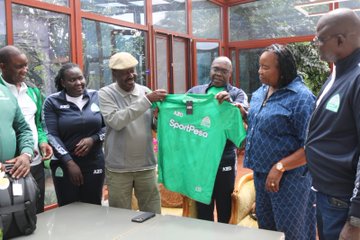
The result not only gave Strathmore their second trophy of the 2025 Sport Pesa National Sevens Circuit but also blew the overall title race wide open with just two legs to go.

With the win, Strathmore inched closer to KCB in the overall standings, with only three points separating the two as KCB remain top with 66 points, but Strathmore’s 63 points keep them firmly in contention.

The two teams at the top have a-piece secured two titles – KCB at Driftwood and Christie, Strathmore at Prinsloo and now Embu – which makes the race for the national crown is delicately poised.

During the first half, Strathmore dominated the opening exchanges, with Nygel Amaitsa’s length-of-the-field try setting the tone, with scores from Victor Mola and Stanlus Shikoli, all converted by Arnold Muita, making the Leos take a commanding 24–7 lead into halftime, gifting the Willis Ojal’s Coached side a deserved win at the breather.

Dennis Mwanja’s Coached KCB, however, refused to go down without a fight making a strategic comeback in the second half, capitalizing on a yellow card to Strathmore’s Gabriel Ayimba. Floyd Wabwire crossed the line twice in quick succession, with Brian Wahinya’s conversions narrowing the gap to 24–21 and setting up a tense finale.

Just when the comeback looked complete, Strathmore showed their resilience, with substitute Samuel Wafula delivering the decisive blow, diving over after the final hooter to seal a famous 31–21 victory for the Leos and silence KCB’s fightback.

With the completion of Embu Sevens, the circuit now heads to its decisive final legs. The Kabeberi Sevens will take place at RFUEA Grounds in Nairobi on September 6–7, before the grand finale at the Dala Sevens on September 13–14 at the Jomo Kenyatta International Stadium in Kisumu.

Tuju: Lack of Economic Planning to address bulging population by successive regimes is blame for Gen Z’s bomb

0

By Anderson Ojwang

The red flags raised by booming population growth and failure by successive presidents to put in place economic plan to address the bulge is what has triggered the current Genz bomb.

Former Cabinet Minister Mr. Raphael Tuju  said lack of economic planning by the successive regimes was to blame for the current unemployment among youths witnessed in the country.

He said warning by the economist and other players on the need to put strictures to avoid the bomb were ignored and is now a challenge the country has to wrestle with and find a solution.

Tuju said in a reference to an interview he conducted in1986 with the then Minister for Economic Development, the late Dr Robert Ouko said the Genz phenomena had been boiling for the last 40 years.

He said Dr Ouko had warned that Kenya would run into problem if  the emerging population bulge against economic growth was not addressed.

He said  in the 1980s and 1990s  Kenya had the highest population increase  in the whole world at 4.2 percent but the subsequent leaderships were not addressing how to tackle the economic growth to tackle increasing population.

Currently secondary schools churn out nearly 1m students every year and in the last five years , the figure is in the region of 5 million while the government can only employ between 50,00-100,000 annually.

The mismatch between job opportunities and the high number of students graduating is what has created unemployment bomb in the country.

“For example, in Kisii , Kiambu and Vihiga the population growth  stood at 6 percent then, which was unprecedented in the world’s history in terms of  demographics. That was attributed to  births and not migration.

Ouko told me that we are going to be in a very hot soup with the youth population bulge in subsequent decades but we never addressed the  problems and that is why we are the situation today.

Those countries that were able to address the problem have been able to get out of them.

 In 1973, when president Kenyatta was launching KICC, the 28 storey KICC building was the tallest in Africa and in the whole of China, there tallest building was 26 storeys tall.

They were marveling at that time just how  young African country had actually surpassed them in some of the important indices. China GDP  per capita was below Kenya until 1978.

We got it wrong at some. Kenya, Singapore and Korea were at the same economic level of development at independence. Kenya got it wrong when anybody who had a mind was shot  dead. They shot dead Tom Mboya, who was the  then Economic Planning, a very visionary leader.

Dr Ouko was killed and the only lucky guy who survived during that generation of thinkers was Mwai Kibaki,” he said.

Tuju credited President Kibaki for trying to address the mismatch and gave credit that for first time in 2007, Kenya reached its  economic growth  rate of over 7 percent, which was essential minimum they needed to address the Genze problem currently witnessed in the country.

“But this was soon scuttled and crushed after Kenya’s resorted to ethnic mobilization and the economic growth took a downward spiral after 2007 general elections.

The biggest  problem in Kenya is the ethnic mobilization in our politics.  We look everything in terms of our tribe and not the country. This explains why I could survive to be re-elected as MP for Rarieda because I supported President Kibaki.

In the 2022 general elections, we had issued and ideology based campaign, but currently we are back to ethnic mobilization which is  still taking place through the political class. What is the source of power of influential political class ?. The tribe. Lack of ideological politics  is what is killing our growth.

We are back to ethnic mobilization. It’s very difficult to get the tribe out of the people,” he said

He said it was possible for the country to change demographic bombs into dividends through economic growth and planning.

“As a country, we must have hope and point out where we have problems. I am convinced Kenya has the potential to become one of the economic households if we get it right,” he said.

Kenya’s economic growth since independence in 1963 can be divided into periods, with a highly successful “Kenyan miracle” of rapid growth (6.6% average annual GDP growth) in the first decade (1963-1973), fueled by agriculture and import-substitution industrialization. Growth then decelerated in the 1970s, declined significantly in the 1980s and 1990s, and saw significant fluctuations with a recession in the early 2000s before a revival in the mid-2000s

  • 1963-1973: Rapid “Kenyan Miracle”
    • Growth Rate: An average annual GDP growth rate of about 6.6%. 
    • ·         Drivers: Favorable weather, rising agricultural incomes, investment in import-substituting industries, and the creation of the East African Community. 
    • ·         Policy: The government promoted public investment and encouraged both private (often foreign) and smallholder agricultural production. 
  • 1974-1979: Slowdown in Growth
    • Factors: This period experienced a deceleration in growth, partly due to oil price shocks and other factors. 
  • 1980s-1990s: Significant Decline
    • Growth Rate: GDP growth declined substantially, averaging 4.2% in the 1980s and further dropping to 2.2% annually in the 1990s. 
  • Early 2000s: Recession and Revival
    • Recession: The economy experienced a significant setback, including a negative GDP growth rate in the 2000/2001 fiscal year. 
    • Revival: The economy began to recover, with growth accelerating to over 6% by the 2006/2007 fiscal year. 

Kenya is currently off and on being rocked by protests by Gen-Zs that represent a significant challenge to President  Ruto’s presidency and the resilience of Kenya’s democratic institutions.

Last year, Kenya  was rocked by protest over a contentious tax bill have turned deadly, which forced the government to shelve the bill.

Young Kenyans are eager to participate in ensuring Kenya’s economic growth.  The  youth have taken the lead in educating, sharing information, and live streaming the protests and their demands.

President Ruto opens Homa Bay lake front as a tourist destination

0

By Habil Onyango

The ongoing CHAN tournament hosted by Kenya ,Uganda and Tanzania has exposed Homa Bay as a destination to enjoy watching the games.

The once neglected and delipidated Homa Bay and market, which were an eyesore and aptly captured the state of economy and development in the county, is today a place to be.

The newly development lake front has turned Homa Bay town as an overnight destination and a place to watch football.

It is a new tourism destination and a place yo while time with friends and enjoy the beauty of the sun rising and setting.

It is a beauty within a beauty a destination comparable to others in the developed worlds and the first of it’s kind in the country.

This is one of the pet projects by a president William Ruto to Homa Bay apart from the construction of state lodge.

The amphitheatre apart from exciting the region and other country , it has also caused discomfort in some quarters.

Some leaders have even accused the President of launching several projects in the county despite it not having voted for him in the last general election.

for President Ruto’s administration focus on the lakefront, where several modern facilities have been established or refurbished.

President Ruto’s administration has constructed the first-ever open amphitheater on Kenya’s lakefront, complete with gardens, cycling and walking tracks, boat rides, and a well-designed sunset viewpoint.

During the CHAN quarter -final, Homa Bay residents had the opportunity to watch the match between Harambee Stars and Madagascar on a mounted TV screen at the venue.

According to Internal Security Permanent Secretary Dr. Raymond Omollo, President Ruto’s declaration of “Kusema na kutenda” (to speak and act) is manifesting at the Homa Bay lakefront, where promises have been transformed into action.

“The transformation unfolding on the shores of Lake Victoria highlights a government that delivers on its commitments, reshaping communities through the Bottom-Up Economic Transformation Agenda (BETA),” Omollo stated on his Facebook page.

At the heart of this regeneration is the state-of-the-art Homa Bay Fish Market, which is now fully operational and hosting more than 2,000 traders. Dr. Omollo remarked that fishmongers are no longer forced to operate from makeshift sheds lacking amenities.

He emphasized that the market is equipped with modern storage, sanitation, and trading facilities, making it a true hub of commerce.

“For the fisherfolk, traders, and buyers, it has brought dignity, order, and efficiency to a sector that supports thousands of livelihoods,” he noted.

“Adjacent to it, the revived Homa Bay Pier is a crucial component in driving the region’s economic development.” Said Dr. Omollo.

Omollo revealed that the once-neglected pier has been renovated, allowing it to accommodate cargo vessels, passenger ferries, and tourist boats.

“This revival connects Homa Bay to wider trade networks, seamlessly linking it with other towns around the lake and beyond,” he added.

The PS pointed out that the fish market drives trade and secures livelihoods, while the pier fosters commerce and connectivity. The amphitheater promotes tourism, generating jobs and revenue in the process.

“As these facilities attract more traders, investors, and tourists, an influx of people into the town is inevitable,” he said.

Omollo emphasized that this is where the government’s foresight comes into play, particularly through the Homa Bay Affordable Housing Project (APH), which is now complete and facilitating occupancy to alleviate accommodation pressure. This ensures that growth in trade and tourism is matched by the development of livable housing.

“The broader picture is compelling. What is happening at the Homa Bay lakefront is much more than local regeneration. It signifies a national transformation, reflecting Kenya’s commitment to the Blue Economy—harnessing water resources for food security, jobs, trade, and tourism,” he said.

“It serves as a model of how government projects, when thoughtfully integrated, can multiply impacts and generate benefits that extend far beyond their immediate areas,” the PS concluded.

“From the lakefront to livelihoods, from trade to tourism, and from housing to human dignity, the government is delivering for the people of Homa Bay!”