Home Blog Page 16

NYATIKE IN MIGORI COUNTY IS BOUND TO GROW EXPONENTIALLY

0

By Billy Mijungu

The future economic revolution of Migori County will happen in Nyatike. In the next fifty years, Nyatike is bound to transform into one of the most vibrant economic zones in Kenya and East Africa. What many people currently view as a rural region will soon become a symbol of opportunity, development, and prosperity. Nyatike carries enormous untapped potential that can redefine the future of Migori County for generations to come.

The region is naturally blessed with valuable mineral resources. Gold mining activities have already placed Nyatike on the map, but the area is believed to possess several other minerals that can fuel industrial and economic growth. Mining will likely become the backbone of Nyatike’s economy, attracting investors, creating employment opportunities, and improving the livelihoods of local communities. If managed properly with transparency and proper infrastructure, the mining sector can elevate Nyatike into a major economic powerhouse.

Nyatike also possesses another hidden treasure, its beautiful sandy beaches along the shores of Lake Victoria. In years to come, the area is likely to become a tourism paradise. Resorts, hotels, holiday homes, and recreational centers will emerge across the lakeshore as both local and international tourists seek relaxation and adventure. The vast land available in Nyatike can also support the establishment of golf courses, conference facilities, and entertainment parks that will boost tourism revenue significantly.

Fishing activities will equally continue to expand due to the strategic location near Lake Victoria. Improved fishing infrastructure, fish processing industries, and modern transport systems will strengthen trade within the region and beyond. The numerous bays surrounding Nyatike will eventually become centers of shipping and passenger transport, connecting Migori County to neighboring counties and countries around the lake region. This development alone has the capacity to open enormous economic opportunities for traders, transporters, and investors.

Sports development will also play a critical role in the transformation of Nyatike. As the economy grows, there will be demand for sports facilities, stadiums, and talent academies to nurture young people. Sports tourism and recreational activities will become part of the region’s identity, helping young people secure opportunities and careers.

Nyatike’s vast land further creates possibilities for major infrastructure projects. In future, Migori County may have a second aerodrome in Nyatike after Lichota Airstrip. Such developments would increase connectivity, promote investment, and support tourism and trade.

Without doubt, Nyatike is destined for greatness. The future of Migori County will heavily depend on how this region is planned, managed, and developed. Nyatike is not merely a constituency; it is the future economic heartbeat of Migori County.

A statement of submission: Oburu ready to quit ODM party leadership for the sake of Luo unity

0

By Anderson Ojwang

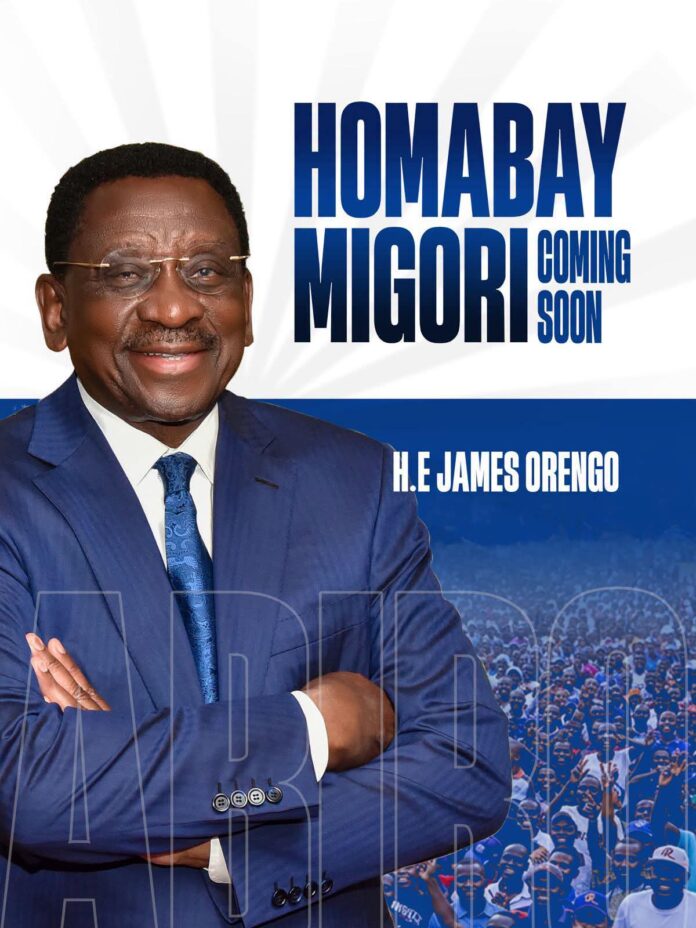
Indeed, the Orange Democratic Movement (ODM) Linda Ground faction promised a statement of intent ahead of the Kisumu rally – a promise of a show of political might over the control of Nyanza against the Linda Mwananchi faction of Siaya Governor James Orengo and Embakasi East MP Babu Owino.

After three weeks of mobilisation, a series of strategic meetings, and a hype of reclamation of the ODM faction, Linda Ground witnessed a bulging Kirembe Grounds in Kisumu.

In trucks and buses, they arrived and turned the ground orange. For the first time, the faction netted a big catch in luring Kisumu Governor and former acting ODM party leader, Prof Anyang’ Nyong’o, to attend a Linda Ground faction rally.

Nyong’o, who had previously given the meetings and rallies by the faction a wide berth, first hosted the team for breakfast at his Kisumu residence and later proceeded to the venue.

In his mien, Nyong’o said: “I had the pleasure of welcoming and hosting the leadership of our Party ODM led by Dr Oburu Oginga as we put our heads together to chart a way forward for ODM based on the original seed. Finally, one fact is clear: the future of ODM will not be decided only in Kisumu, Siaya, Homa Bay, or Migori. It will be shaped in every corner of Kenya where citizens still believe in justice, equality, and democratic change.”

But the celebration didn’t last long. When the party leader, Dr Oburu Oginga, rose to speak, he not only dampened the hearts of his allies, but his submission is likely to stir a major political shift.

Oburu told the crowd that he was ready to quit as the ODM party leader to avoid dividing the Luo community, to the chagrin and dismay of his allies.

“An ok ahero gima ilaro ma pogo oganda (I don’t like things that people fight over that divide the community). An adwaro ni gimora amora ka oponi an ema de apog oganda to ayie weyo (If it’s me who is bringing division to the community, I am ready to quit). Ka pon ni an ema de apog ogandawa to ayie weyo (If it’s me who is the cause of division, then I am ready to quit).”

Sunday’s Kirembe rally came to an abrupt anti-climax with Oburu’s submission when it finally dawned on him that the ship was capsizing under his own reign, presiding over the demise of his younger brother, the late Raila Odinga’s legacy.

“Ka uweyo chama ni ma opodho to kata owadwa ma raila mane ochako chama ni nyalo chuenou (If you leave the ODM party to die, even my brother Raila who founded the party will haunt you),” he said.

He pleaded with the people to continue supporting the party and said that he did not apply to be the party leader.

“Udhi nyime gi chama koso uweyo. Wadhi nyime gi chama koso uweyo (Are you still supporting the party or have you left it)? An bende Oburu Oginga ne ok ayiero ra kenda mondo abed party leader mar ODM, jowa ma uneo kaye ema ne oyiera kendo ne okelo nyinga (I, Oburu Oginga, did not make myself the party leader. I was given the opportunity by the party officials. Those people you saw here are the ones who elected me and brought my name forward),” he said.

Winnie Odinga vindicated

The Kisumu rally finally vindicated Winnie Odinga, who had said that the party leadership required new people to manage it and that the broad-based arrangement was a complex matter that only her father, Raila, understood.

During the ODM celebrations in Mombasa, Winnie called for a National Delegates Conference (NDC) to choose a new team to manage the broad-based arrangement with President William Ruto.

“There is something I wanted to tell you. When it came to the matter of the broad-based government, the people of ODM entrusted one person with the management of that relationship. That person was Baba Raila Amolo Odinga. That relationship is complicated, and therefore we are looking, and we are wondering: those who are taking it upon themselves to manage it now, are they capable of managing that relationship? I don’t think that is the question for me to answer. That is the question for the people of ODM to answer. That is why, party leader, I am requesting that we need to go back to the people and have an NDC to see who the people want to pick to manage that same relationship,” she said.

Oburu admitted for the first time that he never knew he would one day become the ODM party leader.

“An ne ok angeyo ni da bedi ODM party leader (I never knew I would be the ODM party leader). Jogi ema ne oneno ni Oburu Oginga oromo bedo party leader (It is those people who saw that Oburu Oginga was suited to be the party leader).”

The question arises: why didn’t they settle on Nyong’o, who had been acting when the late Raila was campaigning for the seat of AU Chairperson?

This echoes MP Caroli Omondi’s allegations that a stranger’s hand was driving ODM affairs and influencing the happenings in the party.

Party Secretary Edwin Sifuna went ahead to justify that the money currently being used by the party to run its programmes was not from the party coffers but from somewhere else.

Oburu’s submission that he is ready to quit will add fuel to the fire in the ongoing power battle between him and Orengo.

Currently, Orengo is enjoying a huge following in the region, and Linda Mwananchi is rating higher than Oburu’s Linda Ground in recent opinion polls.

Kisumu ODM rally failed to address the community’s economic agenda but turned into political rhetoric of false hope to the hopeless

0

By Anderson Ojwang

In lorries and sugarcane trucks they arrived, crumpled like goods ready for delivery at the factories. They painted the town and the venue orange, whistling and shouting themselves hoarse.

In the sweltering and sweating sun, they patiently waited on empty stomachs and dry throats, yearning for water while their stomachs rumbled and complained irritably and constantly.

Meanwhile, the hosts converged at high-end hotels and the governor’s residence to sample the best menu for brunch.

The clinking of forks and spoons, spiced with soft laughter and pleasantries, formed the mid-morning convergence.

For as many decades, they were promised hope against hopelessness. Yesterday, once again, they were told Canaan was near and that community unity was the only path to the illusive Canaan.

For the journey to Canaan, they were given orange t-shirts, caps, vuvuzelas, whistles, a packet of milk with bread, and a small token of Sh1,000 for their service.

To spice it up, just like the Negro found healing in music to soothe their pain and suffering, the hosts applied the same trick and brought in local artists to temporarily warm hearts.

That is why every speaker invoked the spirit of the Enigma, the late Raila Amolo Odinga, the founder of the now fading Orange Democratic Movement (ODM), to continue holding the community with false hope.

No wonder Kisumu Governor Prof Anyang’ Nyong’o, who for the first time attended the function, said: “Having been there when we started the Party, I believe we honour Rt. Hon. Raila Odinga best, not by invoking his name in every argument, but by remaining faithful to the values he spent a lifetime defending. As well, a strong people are not those who speak with one voice on every issue. A strong people are those who remain united even when they disagree. We shall support what advances the interests of wananchi and oppose what undermines them.”

But the party leader, Dr Oburu Oginga, when he spoke, invoked the spirit of Raila, saying: “If the party dies, my brother Raila could come back to haunt the community and the people.”

And that is why when the crowd became rowdy and noisy and drowned his voice, Dr Oburu promised that he would give them a small token, and that is when the noise subsided.

Once again, fear and hope were sold to the vulnerable and gullible residents about why the community’s unity and being in the broad-based government were top priorities of the meeting.

Politics of rhetoric while development buried

The Kisumu Kirembe meeting was an opportune moment for the leaders and the people to discuss the economy and development of the region.

Instead, it was turned into the usual and casual political rhetoric of fault-finding against an imaginary enemy of the people – the usual whipping up of emotions and self-preservation.

The experts – John Mbadi at the Treasury, the nerve of the country’s economy, and his counterpart, the embattled Opiyo Wandayi of Energy – veered off track and instead accused former President Uhuru Kenyatta of failing to deliver the presidency to the community.

Mbadi went ahead to claim that it was not time for the lake region to have any alliance or association with Mt Kenya after decades of negating the community’s presidential pursuit.

“I started a conversation with the Luo community. But some enemies of the community were asking why Mbadi was inciting the Luos against Mt Kenya,” he said.

Wandayi said going forward he would be more politically engaged, not only in Siaya but also in Nyanza.

“We are going to move forward as one united people. We will walk together as members of the ODM party and as people belonging to this government, the broad-based government. This unity means a lot to our people,” Wandayi said.

But during the recent visit of President William Ruto to Homa Bay, he told Mbadi and Wandayi to ‘tigi wiyi’ (use your head) to fast-track development for the region.

In Mbadi and Wandayi’s speeches in Kisumu, it was purely politics, with not a single mention of development.

All the speakers served the audience the usual political rhetoric of Canaan and unity without purpose.

In the words of ODM National Chairperson Gladys Wanga, she capped it all: “The message from Kisumu is clear: we are done with fragmentation. We seek unity of purpose. We are building a formidable, united front designed to gain power, not for its own sake, but to drive the socioeconomic transformation our people deserve. Historically, our pursuit of power has been defined by resistance and rebellion. Today, we turn a historic page. We are embracing a strategy of cooperation and partnership. This is not a sign of weakness; it is the evolution of our strength. We move forward, stronger together, as one party and one people.”

In the resolution, not a mention of the community’s economic and development agenda was highlighted; only the leadership of Oburu and his team, commitment to staying in the broad-based government, and unity of the region were captured.

Indeed, in Oburu’s own words, the government released Sh200 million for the party to run its operations, and that is why the Kisumu rally was a success.

Finally, when they left crestfallen, the reality of another political ride and false hope was evident. They grappled and asked questions, with some going on to social media to question whether Sh400–1,000 was enough for the time and the scorching sun.

They wondered aloud: when shall the leadership talk about development and not politics, now that the community will not present a presidential candidate in the 2027 general elections?

Ariel Koranga Honoured with BAL Ubuntu Trophy

0

By PHILLIP ORWA

Nairobi City Thunder forward Ariel Koranga was honoured with the 2026 BAL Ubuntu Award in recognition of his work in Kenya using basketball to empower young women.

Through a programme that combines basketball training with mentorship, education, life skills and mental health support, he has reached more than 300 athletes across the country, including those from underserved communities.

The BAL Ubuntu (“I Am Because You Are”) Trophy presented by Qatar Foundation, the Official Community Partner of the BAL, recognises a player for their exceptional contributions to their community. Each season, one player is honoured for their community engagement.

The winner is determined through an online campaign where fans have the opportunity to vote. Each team is invited to nominate one player, and all players are eligible for this award.

The award winner is recognised during a virtual or in-person presentation, and a $10,000 donation is made to a charity of the player’s choosing.

PS Muthoni reassures Kenya over Ebola

0

By PHILLIP ORWA

Principal Secretary for the State Department for Public Health and Professional Standards, Mary Muthoni, has assured Kenyans that there are no confirmed cases of Ebola in Kenya.

The Principal Secretary, while speaking in Kirinyaga County, indicated that the country was well prepared and equipped to handle any cases, but informed the nation that it was still safe from the deadly virus.

Muthoni noted that of the 16 suspected and tested individuals, none had tested positive for the virus.

“I want to reassure all Kenyans that as of May 29th, we do not have any confirmed cases of Ebola virus disease within our borders. Our surveillance systems are working as intended—we have swiftly tested 16 suspected cases from across the country, and I can confirm that all have returned negative.”

Laikipia has been chosen as a quarantine hub by the United States of America (USA).

The USA also has several CDC centres in the country where several labs are in place to test and implement medical tests, treatment, and services.

Agenda Beyond Borders Launches the Digital Hustle Hub

0

By Simon Okola

Agenda Beyond Borders has officially launched the Digital Hustle Hub, a youth-focused skills development platform designed to equip young people with practical digital, employability, freelancing, and income-generating skills for today’s changing world of work.

The Digital Hustle Hub has been established under the powerful tagline: “Learn Skills. Build Income.” This message reflects the urgent need to move beyond traditional job-seeking approaches and empower young people to create, access, and sustain income opportunities through digital skills, innovation, and entrepreneurship.

Across Kenya and many parts of Africa, youth unemployment remains one of the most pressing social and economic challenges. Many young people are educated, ambitious, and talented, yet they continue to face limited access to formal employment, weak career guidance, inadequate exposure to digital work opportunities, and insufficient practical skills for the modern labour market.

Agenda Beyond Borders believes that this gap can be addressed through intentional training, mentorship, digital empowerment, and access to practical tools that help young people position themselves for local and global opportunities.

The Digital Hustle Hub has been created to respond directly to this need.

Speaking after the launch, the Founder of Agenda Beyond Borders, Simon Okola, a renowned educator, youth advocate, and climate finance expert, noted that the greatest challenge facing many young people is not a lack of potential, but a lack of structured mentorship, practical guidance, and access to the right opportunities.

According to him, many youths already have talent, ambition, smartphones, and internet access, but they need someone to show them how to turn these resources into income, employability, and long-term career growth.

“What many young people lack is not ability. What they lack is mentorship, guidance, exposure, and practical support to help them convert their skills into real opportunities,” said Okola.

The lead of the initiative, Emma Anyango, reassured stakeholders that the Digital Hustle Hub will remain practical, inclusive, and results-oriented, with a strong focus on helping young people gain skills that can translate into real income opportunities.

She noted that the initiative is not only about training youths, but also about walking with them through mentorship, career guidance, job readiness support, freelancing exposure, and continuous learning.

“Our commitment is to ensure that every young person who joins the Digital Hustle Hub receives practical support, relevant skills, and the confidence to pursue opportunities in the digital economy,” said Anyango.

Through the platform, young people will be trained in key areas such as AI tools, remote jobs, freelancing, proposal writing, CV optimisation, interview preparation, employability skills, digital marketing, online income opportunities, and climate finance-related opportunities within the green economy. The Hub will also provide access to job alerts, learning resources, mentorship sessions, webinars, practical toolkits, and community-based peer learning.

Unlike many traditional training programmes, the Digital Hustle Hub is designed to be highly practical, youth-friendly, and action-oriented. The goal is not only to teach young people about opportunities but also to help them take real steps toward earning income, building confidence, improving their professional profiles, and accessing sustainable livelihoods.

The platform also recognises that artificial intelligence is reshaping the workplace. Rather than viewing AI as a threat, Agenda Beyond Borders is positioning it as a tool that young people can use to improve productivity, search for jobs, write better CVs, prepare proposals, build businesses, create content, and access global work opportunities.

Digital Hustle Hub will also help young people understand how to participate in emerging sectors such as green jobs, climate finance, sustainability, and digital entrepreneurship. As the world shifts toward climate-smart development, young people must be prepared to benefit from opportunities linked to clean energy, environmental innovation, climate adaptation, sustainable agriculture, and green enterprise development.

Agenda Beyond Borders believes that empowering young people requires more than motivation. It requires practical systems, relevant content, accessible platforms, and consistent mentorship. Through the Digital Hustle Hub, the organisation seeks to build a movement of skilled, confident, and opportunity-ready youth who can participate meaningfully in the digital economy.

The Hub will operate through online communities, webinars, bootcamps, training sessions, downloadable toolkits, and strategic partnerships with institutions, trainers, employers, community organisations, and development actors. This approach will ensure that young people are not only trained but also connected to real opportunities.

At the heart of the initiative is a strong belief that every young person deserves access to skills that can help them build income and improve their future. Whether one is a student, graduate, unemployed youth, young entrepreneur, freelancer, or community worker, the Digital Hustle Hub offers a practical pathway to growth.

Agenda Beyond Borders is calling upon young people, parents, schools, youth groups, community-based organisations, development partners, county governments, private sector actors, and training institutions to support and participate in this initiative.

The launch of the Digital Hustle Hub marks an important step in advancing youth employability, digital inclusion, and economic empowerment. It is not just a training platform; it is a movement to help young people turn skills into income, ideas into opportunities, and ambition into action.

As youths continue to face an uncertain job market, initiatives like the Digital Hustle Hub offer hope, direction, and practical solutions. Through this platform, Agenda Beyond Borders is reaffirming its commitment to building a generation that is skilled, confident, innovative, and ready for the future of work.

Digital Hustle Hub
Learn Skills. Build Income.
Powered by Agenda Beyond Borders

For more information, contact:
Email: agendabeyondborders@gmail.com
Website: www.agendabeyondborders.org

Gor Mahia’s magical number 22: A story of revenue and trophies prowess

0

By Anderson Ojwang

Today, Sunday, Gor Mahia will not be celebrating the crown but the magical number 22.

For many, today’s last and final game of the season will pass as the crowning of Gor Mahia as the league winner, but that is not where the story lies.

Today is a significant day for Gor Mahia and FIFA, the world football body, recognized the feat and indeed sent out a congratulatory message to Kogalo.

What is in the number 22 financially

This year, Gor Mahia set a precedent in revenue collection and opened Kenya’s Premier League to a possible future income goldmine for the teams and stakeholders.

Unlike in the past, Gor Mahia was able to raise Sh22,782,000 from its gate collections from home games.

The least earnings for Gor Mahia from home games were against Home Boys (Sh320,000), Murang’a Seal (Sh385,300), and AP Bomet (Sh360,400), while the highest revenue per game was against AFC Leopards (Sh7,011,500), Mara Sugar (Sh1,001,300), Shabana FC (Sh2,441,000), Kariobangi Sharks (Sh1,054,500), and Ulinzi FC (Sh1,323,800) to wrap up the revenue prowess.

Revenue above the half a million mark came from games against KCB (Sh876,150), Bandari (Sh988,600), Tusker (Sh827,700), Mathare (Sh941,200), Posta Rangers (Sh902,900), Bidco (Sh985,700), and Sofapaka (Sh973,600).

The cumulative revenue by other teams totalled Sh21,809,050, implying that Gor Mahia collected in excess of Sh972,950. The total gate collection during the season was Sh44,591,050.

For Gor Mahia, the gate collection could triple next season with continental participation and a possible increase in the fan base.

Sadly, bitter rivals AFC Leopards only managed Sh7,011,500, while Shabana FC managed Sh2,388,800 and Police FC Sh2,388,800.

Immediate former AFC Leopards chairman Dr Dan Shikanda said: “The real engine lies in the ecosystem surrounding our football: strong broadcasting revenue, vibrant fan culture, sponsorship confidence, sound governance, proper infrastructure, and commercial creativity. Countries that understand this have chosen to treat football not merely as a weekend sport, but as a serious economic sector capable of generating employment, business opportunities, national pride, and sustainable growth. For the Kenya Premier League to grow into a platform capable of generating far greater indirect revenues for clubs, we must honestly confront the challenges holding our game back. These include weak broadcasting revenue, poor commercialisation structures, unstable sponsorships, low merchandise development, inadequate stadium infrastructure, and persistent governance challenges. As the football fraternity, stakeholders, and supporters of the local game, perhaps the biggest question we must ask ourselves is this: ‘If football is the most followed sport in Kenya, why is our league still operating below its true commercial value?'”

Trophy laden and FIFA congratulatory message

While AFC Leopards are still waiting 28 years to lift the Premier League trophy, Gor Mahia have now registered their 22nd league trophy and remain the dominant club in Kenya.

FIFA President Gianni Infantino, in a message to FKF President Mr Hussein Mohammed dated May 28th, 2026, read: “Congratulations to Gor Mahia FC. By means of this letter, I am pleased to congratulate the recently crowned champions of Kenya, Gor Mahia FC. Their constant efforts and results throughout the season have paid off, resulting in this important title. Congratulations to each and every member of the team and the club for this great achievement. While thanking you and your Federation for your continuous support, work, and dedication for the development of football in your country, I look forward, dear president, to seeing you again soon.”

Gor Mahia patron Eliud Owalo wrote: “CONGRATULATIONS GOR MAHIA, KUDOS AFC LEOPARDS. Congratulations to Gor Mahia F.C. on winning a historic 22nd Kenyan Premier League title after a tough and competitive season. Credit to the leadership, technical bench, players, and the Green Army for staying united throughout the journey. Kudos as well to A.F.C. Leopards for a strong fight to the very end that helped raise the standards of Kenyan football.”

Cash award

In the 65-year history of the league, for the first time, Gor Mahia will receive a whopping Sh15 million winner’s prize. In Tanzania, the league winner usually pockets Sh31.94 million for winning the 2024/25 league.

Dr Shikanda wrote: “What is the importance of prize money for league winners in football? Gor Mahia will receive Ksh 15 million for winning the 2025/2026 Kenya Premier League, while champions in South Africa receive approximately Ksh 158 million and champions in Tanzania receive about Ksh 32 million. This raises an important and emotional question about the direction and value of our football. While prize money may sometimes appear too small compared to the actual cost of running a football club, its importance goes far beyond simply rewarding the winner. Prize money influences motivation, professionalism, investment, competitiveness, fan interest, and even the long-term growth of football structures within a country. However, prize money alone is not the true engine that drives football development.”

For AFC, the wait may not be far; it is almost there, and Ingwe fans will soon smile again. For Kogalo, continuing to reap.

Why Gachagua has become a ‘black sheep’ in Nyanza, a tag Mt Kenya gave Raila

0

By Anderson Ojwang’

Former Deputy President Rigathi Gachagua has become a political pariah in Nyanza and has emerged as a political tool to de-campaign his allies ahead of the 2027 general elections.

While other presidential hopefuls including President William Ruto, Wiper leader Kalonzo Musyoka, ODM Secretary General Edwin Sifuna, and Martha Karua of the Peoples Liberation Party, among others, are welcomed, Gachagua remains a persona non grata in the community.

Unlike the late Raila Amolo Odinga and his father, the late Jaramogi Oginga Odinga, who suffered the political consequences of the Mt Kenya oathing against their quest for Kenya’s leadership, Gachagua dug his own grave.

Just as Raila was the black sheep of Mt Kenya’s politics and a potent campaign arsenal which caused many of his associates their political careers, Gachagua has today assumed a similar role in the current political dispensation in the lake region.

Homa Bay MP Peter Kaluma wrote on X handle: “Our Mt Kenya brothers took oath back in 1969 that presidency would never go beyond Mt Kenya. For this reason, whenever the presidency goes to a person outside Mt Kenya, they frustrate, create anarchy and fuel civil unrest.”

The politics of shareholdings and traps

Gachagua now has a date with destiny in his quest for Nyanza votes over the reality of the past when he was the country’s second most senior person in the administrative pecking order.

During his tenure in the office of Deputy President, he rubbed both leaders and the public the wrong way.

Gachagua, while in office, took to criticising Raila and even said that he had laid traps in State House for Raila to negate his entry to meet with President William Ruto.

For instance, during the burial of Mau Mau veteran General Mathenge in Nyandarua, Gachagua took issue with Raila for asking him to allow ongoing consultations between Azimio and the Kenya Kwanza Government.

Raila then said at the funeral: “If we can hold consultations, that is in order. Riggy, there is no harm in people talking. Let people have talks, even if you don’t want to hear my word, just listen to what I say. We don’t want half a loaf. What and which kind of bread? I do not want to become Deputy President. I don’t want to be Prime Minister. I am not interested. Stop panicking. I have not spoken or even met Ruto.”
But Gachagua responded: “Former Prime Minister, we have not rejected consultations and talks, but we fear you. The reason is that you came and had a handshake with our son, former President Uhuru Kenyatta. He was a good person. He loved and worked for us. But when you got into a handshake with him, he changed. We from Mt Kenya fear you. Be like your father, who helped us in the fight for the land that belonged to the Mau Mau and was taken away. Those who have possessed those lands are your friends. Help us get back the land.”

Rejected overtures, a signal of a black sheep

After his impeachment, Gachagua said that he had been mandated by the Mt Kenya people to look for a political formation that will bring power to the people.

“I was looking at it with a few strategists from the region. Raila’s numbers are more exciting. Because Raila already has 6.8 million votes. We only beat him by only 200,000 votes. If we agree to support him, we could – I told you – with his 6.8 million and our 6 million votes, if you look at his voting pattern, he normally votes between 10.00 am and 11.00 am. If we agree to support him, before he votes, he will be the president. That you can take to the bank,” he said in a recent interview.

“I want our people to remain quiet so that we can get what we want going forward. Those who are making noise in the opposition told us that they were in the government of shareholders. They said they have shares. They told us that they have shareholding in the government. Some have more shares while others have the least. Now that they have left the government after their fights, they have come to us so that we may join them in order to make us president. But they are forgetting that when they were in the government, they used to abuse us. They did not know that we are a people who matter. Now at this time, they are in a fix. They want us to join them. They now say that they want to give you the presidency. Bloody bastard,” he said.

Absence at Raila’s funeral

Gachagua remains the senior most politician in the country who never attended Raila’s burial and has never paid homage at his graveside.

While top leaders and Kenyans of all shades of life have paid homage, Gachagua’s absence has cemented the belief that he is anti-Raila, both in life and death.

But Kiambu Senator Karungo wa Thang’wa then said Gachagua’s silence and absence during Raila’s farewell were not a sign of defiance or indifference, but an act of respect and statesmanship.

Karungo said Gachagua’s decision reflected an understanding of the solemnity of the moment. “Kenya does not stop when Deputy President Rigathi Gachagua chooses silence,” he wrote. “It listens even more closely.”

He said Gachagua’s absence allowed the country to focus on celebrating Raila’s contribution to Kenya’s democracy.

“By choosing to step back, Gachagua ensured that the spotlight remained where it truly belonged – on Baba’s journey, sacrifice, and contribution,” he said.

Demonstrations

The recent demonstrations which have rocked most parts of Mt Kenya region have not been replicated in Nyanza.

Nyanza has remained calm as the restive Mt Kenya went to the streets, with ODM leaders led by party leader Dr Oburu Oginga and National Chairperson Gladys Wanga thanking the residents for avoiding demos.

“I am happy that this time our people were not on the streets. We have witnessed several deaths, and now let other people also take the lead,” Wanga said.

The Arrival of the Equalizer: Why Wajir Hosting Madaraka Day is a Historical Correction

0

By Hon. Fatuma Ibrahim Ali

Growing up in Wajir, I often felt like a guest in my own country – a distant observer of a national identity I couldn’t quite touch. On every Madaraka Day, we would huddle around radios, listening to the echoes of celebrations in very far corners of Kenya, never daring to imagine that one day, the national stage would be set here in Wajir, North Eastern Kenya. We were told that independence meant the end of “us versus them,” a new dawn of equality for all Kenyans. But for the people of North Eastern, that promise remained elusive. Instead, we endured decades of systemic neglect, the trauma of state-led violence, and a culture of suspicion that forced us to constantly prove our “Kenyaness.” We were frequently labelled “insurgents” and treated as outsiders, even as we remained deeply rooted in our Kenyaness. Today, that narrative is being dismantled.

Since the inception of the 2010 Constitution of Kenya, only nine counties have hosted Madaraka Day celebrations. Wajir County in North Eastern Kenya will make history as the 10th county to host this historic celebration. Wajir is no longer a peripheral observer of our nation’s celebrations; we have become a stakeholder in Kenya’s history. This moment represents the arrival of the great equalizer, a long-overdue declaration and demystification that the freedom won by all our forefathers belongs as much to the North as it does to the rest of the country.

Today, a 10,000-seater stadium stands complete, built by the same military that once guarded the borders against us, and a new State Lodge now rises – a place where a president can finally sleep among the citizens of North Eastern Kenya. This is a profound, if complex, sign of reconciliation and recognition of citizens’ rights. For decades, the security uniform was a symbol of public scare, a harsh reminder of the ‘insurgent’ labels and the trauma of the many massacres of North Eastern Kenya, particularly the 1984 Wagalla Massacre. To see the Kenya Defence Forces (KDF) lead the construction of these facilities is a shocking but necessary shift. It creates a new dialogue: we are moving from an era where the state’s presence was measured by checkpoints to one where it is measured by infrastructure and civic access. By building here, the military and the state are signalling a transition from keepers of the perimeter to partners in our development. We are finally being invited into the Kenyan house, and we are being given the keys to our own part of it.

Across Wajir town, the signs of this transformation are impossible to miss. Beyond the Ksh 900 million investment in the new stadium, featuring a full-sized football pitch, an eight-lane athletics track, and modern spectator amenities, we have seen a rapid upgrading of critical road networks, the installation of a series of solar street lights, and the expansion of Wajir International Airport. For decades, our potential remained locked behind poor connectivity. Today, these projects are the arteries of a new, 24-hour economy. We are no longer defined by what we lack, but by the potential we are finally being empowered to unlock.

As the inaugural Woman Representative for Wajir, I spent my tenure advocating for the foundational promise of devolution – the idea that resources and dignity should be brought closer to the people. Devolution was our first real attempt to equalize the playing field, decentralizing power and resources to finally give Wajir County a voice in its own development. Hosting this national celebration is a significant scale-up of that vision. This milestone is a testament to an evolving political maturity led by His Excellency President William Samoei Ruto, clearly reflecting a bipartisan consensus between the two broad-based political parties that finally recognize the importance of inclusivity and devolving national celebrations from Nairobi to counties. North Eastern Kenya is now not just a region to be visited during campaign seasons or crises, but a vital engine of our national economy. It is the transition from being mere participants in our own governance to becoming central architects of the national agenda. By sitting at the table in our own capital, we are moving beyond the struggle for basic allocation and toward a new era of national influence, where North Eastern is no longer a place that requires special pleading, but a region that contributes to national development.

Yet, we remain under no illusions. This stadium and these roads should not be the end of our journey; they are the starting blocks. As we look beyond the pageantry of June 1st, we call upon the national government to ensure this momentum is sustained. Partner with us – and with Wajir’s neighbours in Garissa, Mandera, Isiolo, Marsabit and Turkana – so that we may tackle the perennial menace of drought, access to reliable electricity, education, and water security with the same urgency used to build this stadium. This must be the beginning of a deliberate, region-wide investment in sustainable infrastructure and economic initiatives that finally empower our pastoralist communities.

To our fellow Kenyans across the republic, Wajir and North Eastern are no longer the distant frontiers you read about in headlines. We are now a vibrant heartland – a land of untapped potential, unique culture, and resilient people. We invite you to come and see for yourselves the new face of the North. We are proud to host the nation, and we are even more eager to prove that when the North is given its rightful place at the table, all of Kenya rises. Today, we are not just guests; we are finally, unequivocally, home.

The writer is a member of the COIN-10 Committee; former Wajir Woman Representative (2013–2017) and former East Africa Legislative Assembly (EALA) MP

AMERICAN-SPONSORED CDC IS WELCOME, EBOLA IS DEADLY

0

By Billy Mijungu

Worry and anxiety have struck many Kenyans like a thunderbolt following reports of the establishment of an American-sponsored Centre for Disease Control (CDC) unit in Kenya. However, if I were the President, I would welcome it without hesitation because the country stands to benefit greatly from such a partnership.

Kenya already has one of the best medical systems in Africa, second only to South Africa in many respects. The introduction of a CDC facility would therefore not weaken us, but instead elevate our healthcare system to another level. At times, we must rise above politics and suspicion and think patriotically about the future of our nation and region.

Public health threats are becoming more dangerous and unpredictable across the world. Diseases spread quickly due to global travel and trade, and no country can fight such threats alone. A modern CDC presence in Kenya would strengthen disease surveillance, improve laboratory capacity, train local experts, and sharpen our epidemiology response. This is an opportunity for Kenya to become a regional leader in public health research and emergency response.

We can learn from our neighbours. Uganda handled the COVID-19 pandemic and Ebola outbreaks with notable discipline because they had developed clear protocols and response systems over the years. Kenya must equally invest in preparedness rather than wait for emergencies to expose weaknesses in our systems.

Some critics argue that foreign involvement in our health sector may compromise sovereignty. Those concerns are understandable, especially at a time when many Kenyans have lost trust in political leadership. However, not every international partnership is harmful. The United States has no obligation to support Kenya’s health infrastructure, yet it has chosen to invest resources and expertise here. Kenya should take advantage of that opportunity while ensuring transparency and national interests remain protected.

Furthermore, such projects come with funding, technology transfer, research opportunities, and employment for Kenyan professionals. Our universities, hospitals, scientists, and medical workers will gain from collaboration and exposure to global best practices. Instead of fearing progress, we should negotiate wisely and maximise benefits for our people.

Kenya has always positioned itself as a gateway to East and Central Africa. Hosting a CDC facility would strengthen that position and enable us to assist neighbouring countries during future health crises. In the end, diseases know no borders, and cooperation remains the strongest weapon against them.

Follow on Facebook, X, Instagram, TikTok, and LinkedIn @BillyMijungu

Forward #TusongeMbele #Change