By Anderson Ojwang
After successfully acquiring territorial control of Mt Kenya, former Deputy President Rigathi Gachagua and his party, Democracy for Citizens Party (DCP), have escalated the war to the city of Nairobi, where they recently raided former President Uhuru Kenyatta’s Jubilee Party.
Currently, DCP is the main political party in Mt Kenya, having edged out Jubilee and President William Ruto’s United Democratic Alliance (UDA).
After the Ol Kalou parliamentary by-election, where it garnered 86 per cent of the votes against UDA’s 13 per cent, while Jubilee, which held the seat, received a marginal vote, DCP has been on the drive of receiving defectors.
DCP has shifted its political focus from Mt Kenya and wants to lay claim to Nairobi, with Gachagua declaring that his party must control the city’s politics in the 2027 election.
In the 2022 General Election, Jubilee Party managed three parliamentary seats through Yusuf Hassan (Kamukunji Constituency), Mark Mwenje (Embakasi Central Constituency) and Amos Mwago (Starehe Constituency).
Defection
This week, Yusuf Hassan of Kamukunji defected to DCP from Jubilee, a big blow to Uhuru’s party in Nairobi politics.
Gachagua said his party, DCP, was growing by leaps and bounds and welcomed the defectors into the fold.
“We are uniting everyone and scattering no one in our efforts to consolidate our support base and bring more members into our fold.
“I am pleased to welcome Kamukunji Member of Parliament, Yusuf Hassan, to the DCP Party after his defection from the Jubilee Party,” he wrote.
Yusuf was elected Kamukunji MP for a fourth consecutive term in the 2022 General Election on a Jubilee Party ticket.
He garnered 34,264 votes, representing 56.23 per cent of the total votes cast, defeating UDA candidate Robow Hassan, who polled 22,644 votes.
Hassan had previously won the Kamukunji seat on a PNU ticket in 2011, before switching to The National Alliance (TNA) in 2013 and Jubilee in 2017.
“We are now in DCP, and we have decided to support Rigathi Gachagua in his 2027 presidential ambitions,” Yusuf said.
Jubilee fall
The party has undergone immense suffering in Nairobi at the hands of DCP, which has been on a rocking mission in Nairobi.
The recent defection by Yusuf now joins the growing list of Jubilee political bigwigs who have officially joined DCP, including Embakasi East MP Mark Mwenje and Starehe MP Amos Mwago, thus leaving Nairobi County with no Jubilee MP.
“I want to personally welcome MP Hassan into the DCP vehicle as he forges a new path. You joining the party will not only fortify the party but also create a wider inclusion of the Somali community into the wider leadership space,” Gachagua said.
Bloodless coup
DCP did not stop at only the MPs but mastered a bloodless coup by having all the sub-county chairmen and MCAs defect to the party.
At the same event, Gachagua received more Nairobi Jubilee Members of County Assembly (MCAs) into the party, including chairpersons from all Nairobi constituencies.
Cry over spilled milk
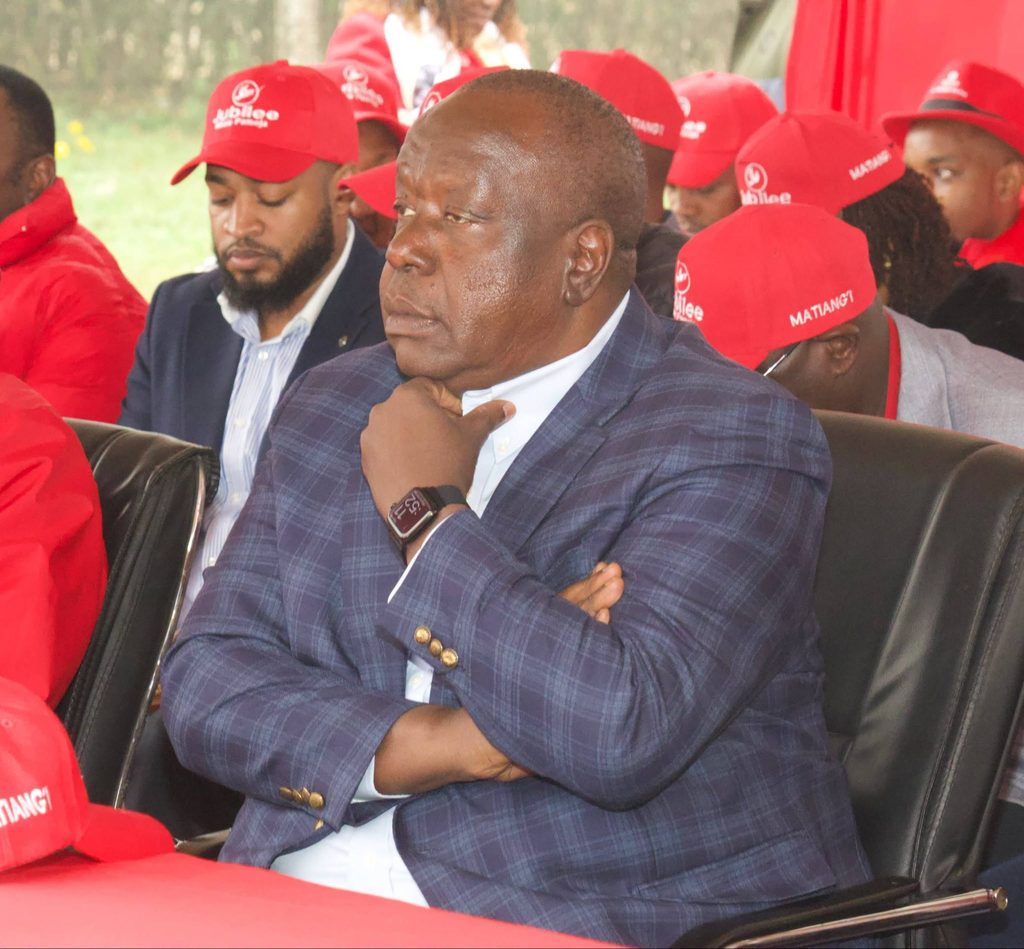
Jubilee Deputy Party Leader Dr Fred Matiang’i moved to downplay the defections, saying the party’s priority now was not to spend its time trading accusations or responding to every political announcement.
“Our responsibility is much bigger, to rebuild, reorganise and strengthen the party from the grassroots upwards. That work is already underway,” he said.
He said the party was undertaking a deliberate process of renewing its structures, strengthening its presence at the ward, constituency and county levels, engaging members and identifying leaders who are prepared to work for the party consistently and faithfully.

“The objective is to build a political organisation that is disciplined, competitive, accountable and firmly rooted in the communities it seeks to serve. Nairobi must be at the centre of that renewal,” he said.
He said the city was politically diverse, sophisticated and constantly evolving.
“Nairobi voters are increasingly demanding leadership that speaks to the realities of everyday life, the cost of living, jobs and opportunities for young people, affordable housing, security, transport, access to services, accountable county government and dignity for every resident.
“That is where Jubilee’s energy will be directed,” he said.
He said Jubilee Party would not allow individual political movements to distract it from the larger task before it.
“The 2027 General Election will not be won through social media arguments, political theatrics or endless commentary on who has moved from one party to another.
“It will be won by organisations that are present in every ward, every constituency and every community, with credible leaders who understand the concerns of the people.
“Jubilee is choosing to build,” he said.
Matiang’i said the party welcomes new members, aspirants, professionals, community leaders, young people, women, entrepreneurs and all Kenyans who believe that the country deserves responsible, inclusive and competent leadership.
“We will continue to engage with Nairobians, listen to their concerns and earn their support through service, organisation and clear political programmes,” he said.
Matiang’i said the party was not interested in politics driven by personalities alone.
“We are building a movement anchored in values, policy, discipline and service to the people. Jubilee Party remains committed to Nairobi and to Kenya.
“Our focus is on the future, rebuilding our grassroots structures, strengthening our leadership, preparing credible candidates and presenting Nairobi residents with a serious political alternative ahead of 2027,” he said.
The battle is just beginning
The scramble for Nairobi is just beginning, and it may be a two-horse race between DCP and the Linda Mwananchi group. ODM, which has been dominant, may struggle just like UDA.