Home Blog Page 21

Judge in Tuju’s commercial debt case gets conservatory order against EACC summons, investigation and arrest

0

By Reporter

The Nairobi Milimani High Court has granted Justice Josephine Wayua Wambua Mongare a conservatory order against the Ethics and Anti-Corruption Commission (EACC).

Justice Bahati Mwamuye issued the conservatory orders pending the inter partes hearing and determination of the Petitioner/Applicant’s Notice of Motion application dated March 18, 2026.

The court ordered that the EACC, whether directly or through its officers, agents, or affiliated bodies, be restrained from investigating, summoning, questioning, arresting, detaining, or requiring statement recording from Justice Mongare.

The orders further bar the commission from searching, seizing, or accessing any property, documents, records, devices, or information related to the judge in connection with matters arising from the discharge of her judicial duties.

The ruling was issued on March 19, 2026, during a session held in chambers before Justice Mwamuye, following a preliminary consideration of the application.

The court also restrained the EACC from taking any adverse action against the petitioner or issuing or disclosing any potentially adverse information concerning her pending the hearing and determination of the case.

Justice Mwamuye directed that Justice Mongare serve the EACC with the application, petition, and court order both in hard copy and soft copy immediately, and file an affidavit of service by close of business on March 23, 2026.

The EACC has been directed to enter appearance and file its responses to both the application and the petition by April 10, 2026.

The petitioner was granted leave to file a rejoinder, if necessary, by April 24, 2026.

“Mention on May 6, 2026, in open court to confirm compliance and take further directions. The public and persons unrelated to the matter shall be excluded from attending the mention and any subsequent appearances unless the court directs otherwise,” ruled Justice Mwamuye.

Related bribery investigations

The development comes amid ongoing investigations involving former High Court Judge Joseph Mutava and three other suspects.

The four were arrested and later released on a cash bail of Sh200,000 each pending investigations into alleged bribery claims.

They spent a night in custody at the EACC Integrity Centre Police Station in Nairobi before their release.

EACC officials confirmed that Mutava, alongside advocate Kimani Wachira and two others, is under investigation over allegations of soliciting a bribe of USD 80,000 (approximately Sh10.4 million).

The money was allegedly intended to influence the outcome of a commercial dispute currently before the High Court involving a former Cabinet minister.

The commission stated that investigations are ongoing and that the suspects may be arraigned once the process is complete.

EACC reiterated its commitment to combating corruption and safeguarding the integrity of the judiciary, warning that those found culpable will face the full force of the law.

Mutava was removed from office in 2016 after findings of gross misconduct and corruption, which were later upheld by the Supreme Court.

ICPAK Partners with Migori County Assembly, Donates Generator to Nyatike School

0

By Erick Otieno

Migori County witnessed a major boost in both education and institutional capacity following a series of impactful engagements by the Institute of Certified Public Accountants of Kenya (ICPAK), led by its National Chairperson, Prof. Elizabeth Kalunda.

In Nyatike Sub-County, ICPAK Nyanza Branch donated a fully installed standby generator to Akala Secondary School, an initiative funded, purchased, and installed by members of the institute. The generator was officially handed over during a ceremony witnessed by the National Chairperson, Prof. Elizabeth Kalunda, alongside Council Member Wicklife Bichanga and Collins Bala, among other regional and national officials.

Speaking during the event, Prof. Kalunda reaffirmed ICPAK’s commitment to empowering communities through education and professional support. “Beyond this donation, we also encourage bright but needy students to pursue accounting-related courses. Through our university, KCA University, we offer scholarship opportunities to support such learners in achieving their academic and professional dreams,” she said.

The ICPAK team also donated over 2,000 tree seedlings to Akala Secondary School and neighboring institutions to promote environmental conservation, as well as learning materials including revision books and geometrical sets. They commended the school for its impressive performance in the recent KCSE examinations.

Mr. Bala, who also serves as a board member at Akala Secondary School, welcomed the initiative, noting its impact on both learning and school operations. “This generator is a game-changer for the school. It will ensure uninterrupted learning, especially during exam periods, while also addressing the persistent power challenges in this area,” he said.

In a separate engagement, ICPAK entered into a strategic partnership with the Migori County Assembly, marked by the signing of a Memorandum of Understanding (MoU) aimed at strengthening governance and institutional capacity.

Migori County Assembly Speaker, Christopher Rusana, hailed the partnership as transformative. “This partnership is a bold step forward in strengthening our legislative mandate, enhancing oversight, and building the capacity of both Honourable Members and staff,” he said.

“It reflects our unwavering commitment to professionalism, accountability, and improved service delivery to the people of Migori County,” he added.

Rusana further noted that the collaboration would enhance transparency and effectiveness within the Assembly. “Together, we are laying a firm foundation for a more effective, transparent, and people-centered County Assembly,” he said.

The partnership is expected to strengthen financial oversight, governance standards, and professional development within the Assembly, in line with ICPAK’s mandate of promoting accountability and excellence in public finance management.

A battle of parallels: Linda Mwanainchi to hold People’s National Delegates Convention to rival ODM Special National Delegates Conference

0

By Anderson Ojwang

On March 27 this year, the Orange Democratic Movement (ODM) is set for what is shaping up to be a battle of parallel conventions within the party.

Two rival factions have planned separate meetings, with the Linda Ground wing set to hold the Special National Delegates Conference (SNDC), while the Linda Mwanainchi faction has announced a parallel People’s National Delegates Convention.

The Linda Mwanainchi faction, led by Siaya Governor James Orengo, ODM Deputy Party Leader Geoffrey Osotsi, and Embakasi East MP Babu Owino, said their convention will run concurrently with the SNDC organized by the Oburu Oginga-led faction.

“On March 27, we will hold the People’s National Delegates Convention, which will run parallel to the SNDC called by the Linda Ground faction,” Osotsi said.

Osotsi also revealed that legal challenges have already been filed to contest the legitimacy of the SNDC.

“Some ODM members have gone to court questioning the legitimacy and legality of the NDC,” he said.

He described the SNDC as illegal, unconstitutional, and undemocratic, urging delegates to attend the alternative convention.

“As Linda Mwanainchi, we have made a decision that we are not going to participate in the NDC convened and organized by the Linda Ground group. This is because the NDC is illegal, unconstitutional, and undemocratic,” he said.

Osotsi further accused the rival faction of compiling a list of illegitimate delegates.

“They are compiling a list of fake delegates to attend their SNDC. ODM members should be aware that the SNDC convened by Linda Ground is illegal and should be avoided like a plague. Let them attend the People’s NDC. We control 35 out of the 47 counties and expect genuine delegates to attend our meeting, as opposed to theirs, which will have fake delegates,” he claimed.

Oburu faction prepares for SNDC

On Wednesday, ODM Party Leader Dr. Oburu Oginga chaired a Central Committee meeting to review preparations for the SNDC.

“Today, I presided over the ODM leadership meeting at our party offices to evaluate our readiness for the upcoming Special National Delegates Conference (SNDC). Our deliberations focused on a rigorous assessment of logistical and strategic frameworks.

I was joined by National Chair H.E. Gladys Wanga, National Treasurer Hon. Timothy Bosire, Director of Elections Hon. Junet Mohamed, Senate Minority Leader Hon. Stewart Madzayo, and others. We continue to prioritize the party’s stability and unity,”he said.

Legal battle looms

The rivalry between the two factions appears headed for a legal showdown, with the Orengo-Sifuna camp already laying the groundwork for court battles.

Recently, the Linda Ground faction, through Deputy Secretary General Catherine Omanyo, issued a notice for the SNDC, a move likely to trigger legal challenges.

The notice includes the ratification of National Governing Council resolutions on party leadership, a move similar to the parliamentary group decision that endorsed the removal of Secretary General Edwin Sifuna.

However, critics argue that the notice fails to recognize that the party is required to elect new leaders every five years in line with its constitution.

According to the ODM constitution, the National Delegates Conference is mandated to elect national officials who serve a five-year term.

Dispute over party leadership

The party constitution states that a party leader remains in office until the next election of national officials. However, in the event of death, resignation, or incapacity, a Special NDC must be convened to elect a new leader.

Saboti MP Caleb Hamisi questioned the legality of Dr. Oburu’s leadership.

“For Oburu to be validly elected party leader, a Special NDC should have been called after the death of Raila Odinga to give him the mandate. That was never done. So why is he in office? You cannot occupy an office first and then go for an election,” he said.

Secretary General dispute

The ODM constitution also outlines the role of the Secretary General, who is the party’s official spokesperson and custodian of records.

It further states that notice for an NDC must be issued by the Secretary General or an authorized official appointed by the National Executive Committee.

Orengo insisted that only the Secretary General can legally issue such a notice.

“The notice must be given by the Secretary General. That is mandatory. The NDC notice we have seen was issued by the Deputy Secretary General,” he said.

However, Omanyo defended her actions, saying the party could not stall due to one individual.

“We cannot stop to wait for one person. The party is made up of millions of members, and we cannot hold progress because one person is unavailable,” she said.

Senate to issue summon to Governor Wanga after she fails appear before the Senate CPAC

0

By Habil Onyango

For the second time in a row,Homa Bay Govermor Gladys Wanga has faiied to appear before the Senate Public accounts committee (PAC) forcing the Senate to issue summons .

Pac chairman Moses Otieno Kajwang said they had expected wanga to appear before them to response to various audit querries in her government .

The Auditor General’s report on the financial statements for the fiscal year 2024/2025 had raised pertinent issues that the committee wanted Wanga to respond to

The Committee was also set to interrogate the County Executive of Homa Bay about the revenue collected and the County Revenue Funds statement for the same period.

Kajwang expressed regret over Wanga’s absence, urging her to take a cue from her predecessor, Cyprian Awiti, who consistently attended Senate hearings, even while unwell.
He stated, “I recall that the first Governor of Homa Bay, Cyprian Awiti, never failed to appear before the Senate,” he noted.

“In fact, I remember instances where he attended Senate sessions shortly after being discharged from the hospital,” he said
According to Kajwang Awiti did this not because it was a favor to the people of Homa Bay but because it was part of his core responsibilities.
“I hope that Governor Wanga will also learn from her predecessor.” He said

The Chairman further advised the governors to uphold the principles of the Constitution and devolution, emphasizing that these are crucial for transforming the lives of Kenyans.
According to Homa Bay Senator Kajwang, accountability is a fundamental pillar of their campaign promises.
He noted, “In Homa Bay, accountability has always been part of our political and governance culture.”

Kajwang highlighted that there are critical issues that require clarity, as mentioned in the Auditor General’s report.
He pointed out that pending bills in Homa Bay are on the rise, with the financial statements indicating that the County is facing Ksh. 1.5 billion in pending bills.
“That is a significant amount of money that is locked up within the County. If released, it could stimulate the local economy. Unfortunately, more than Ksh. 1 billion of that debt is older than 365 days,” Kajwang said.

He also expressed the need to discuss the escalating wage bill, which currently stands at 54 per cent.
Kajwang indicated that this percentage of the County’s revenue goes to salaries and wages, and noted that a recent audit by PricewaterhouseCoopers revealed that the Homa Bay payroll is riddled with ghost workers, necessitating a cleanup.
“This was a substantial discussion we had with the Governor in our last meeting, and we expected her to inform us about the measures taken to address the issues of ghost workers and the spiraling wage bill,” he stated.

Furthermore, the Governor was expected to clarify the County’s priorities, as some of them were deemed misplaced.
Kajwang noted that the Homa Bay County Referral Hospital is currently under construction at a cost of roughly Ksh. 270 million, while the County’s new headquarters cost Ksh. 800 million.
He questioned whether the people of Homa Bay needed an extravagant headquarters or a quality hospital for children and women in dire need of health services.

Wanga was also anticipated to respond to concerns regarding the slow implementation of certain programs, such as the Kenya Informal Settlement Improvement Project (KISIP), which has been allocated Ksh. 1.4 billion as a conditional grant.
The project aims to improve informal settlements in areas such as Makongeni, Sofia, and Shauri Yako estates within Homa Bay Town, as well as in various locations in Suba North Constituency.
Kajwang remarked, “The Auditor General indicates that the project is not proceeding according to the original plan, and we wanted to know what plans the County Government has in place to ensure its success.”

Regarding the County’s Own Source of Revenue, Kajwang mentioned that the County collects a substantial amount of money, primarily from hospitals.
This should contribute to the Facility Improvement Fund (FIF), yet the fund is not fully disbursed, which contradicts national legislation.

A conflict has arisen between the Senate and the Council of Governors after the governors announced their decision not to appear before the CPAC, citing issues of harassment, intimidation, and extortion by committee members.
However, they indicated their willingness to appear before other Senate committees.
On Tuesday, Wanga did appear before the Senate Committee on Land, Environment, and Natural Resources to respond to inquiries regarding the FLLoCA and CCRI grants.
Nairobi Senator Edwin Sifuna had urged the Senate to take drastic action against County Chiefs who defy oversight, urging the lawmakers to cut funding to non-compliant Governors.
He said that CPAC work is critical in safeguarding devolution and ensuring transparency across all 47 Counties.

The Kenya Enterprise Environment Shaken to the Core

0

By Billy Mijungu

The recent happenings in the country have shaken Kenya’s enterprise environment in unimaginable ways. Events unfolding across major institutions are sending troubling signals to investors, entrepreneurs, and professionals who rely on stability, fairness, and the rule of law to conduct business. Confidence in the predictability of Kenya’s business environment is being tested, and the implications reach far beyond the individuals directly involved.

The controversy surrounding governance struggles at has left many Kenyans stunned. Reports of influence peddling, leadership disputes, and the dramatic jailing of an 80 year old doctor connected to the matter have raised serious questions about the management of institutions that are supposed to serve the public with integrity. Even more shocking to observers has been the alleged attempt to replace directors without the clear say of members, an action that undermines the basic principles of corporate governance and member driven institutions.

Elsewhere, the tribulations of have amplified concerns about the security of private enterprise in the country. Tuju’s experience has sparked debate about whether commercial disputes in modern Kenya can still be resolved through straightforward settlements when powerful interests enter the arena. Many entrepreneurs are beginning to ask a troubling question: if influence can override negotiation and due process, how safe are businesses and private property?

The anxiety has been compounded by developments surrounding , one of the country’s most influential media institutions. Reports that the media giant may be changing hands under unclear but widely discussed circumstances have unsettled the public. For decades, the organization has symbolized editorial independence and a watchdog role over power. Any perceived erosion of that independence sends ripples across both the media sector and the wider business environment.

These developments collectively paint a worrying picture. Institutions that should anchor trust in Kenya’s economic system are increasingly seen through the lens of political power struggles. When business decisions appear entangled with political influence, the lines between enterprise, governance, and power become dangerously blurred.

For Kenya to preserve its reputation as one of Africa’s most vibrant business hubs, politics must remain very far from business. Corporate governance must respect members and shareholders, commercial disputes must be resolved fairly, and institutions must operate free from undue interference. Investors, both local and international, ultimately thrive in environments where rules are clear and consistently applied.

Kenya’s entrepreneurial spirit remains strong, but that spirit cannot flourish in uncertainty. The country must recommit to transparency, institutional independence, and respect for private enterprise. Only then can confidence in the Kenyan business environment be restored and protected for future generations.

Kenya at its lowest, as leaders go raw, bare knuckle in diatribe

0

By Anderson Ojwang

Kenyans have in the last few days witnessed raw and unpalatable diatribe by leaders as the pressure of the 2027 presidential elections gains momentum.

It has been the lowest moment for the country as top leaders turned to body shaming, mudslinging, name-calling, raw insults and personal attacks that have baffled and embarrassed Kenyans and the world.

From issue- and ideology-based campaigns, the leaders have deteriorated to non-issues that have no direct impact on the country and the citizens and fail to address the high cost of living and emerging issues.

It can be said the exchanges have been one of the darkest days in the country’s political history ahead of the 2027 general elections and could be the tip of the iceberg of how the 2027 campaigns are likely to be.

Former Deputy President Rigathi Gachagua lit the flame at the weekend in Kiambu when he attacked President William Ruto, wondering why he had reduced in weight and body-shamed him over his ears.

“We will make sure, William Ruto, you are not going to sleep for the next 15 months. You will sleep when you finally reach Sugoi. We will expose you. You have seen how he has reduced in weight. It’s just the beginning,” he said.

President Ruto, on Tuesday while on a tour of Mt. Elgon, did not take it lying down and hit back, saying his attacker was driven by the demons of tribalism and hatred and cannot lead the country.

“Someone who has gone to the bedside of his sick and dying brother to manipulate the will. You cold-blooded thief, stealing from your own brother. Stealing from orphans, widows. You want to give us lectures.

Someone who impregnated a young girl and then later allegedly killed her. What will you tell us about deaths? You cold-blooded murderer. You want to mislead our nation. We will not allow you to mislead anyone in Kenya and you are not going to be anything in this nation. You belong to the rot in jail,” he said.

President Ruto did not stop at that but cast his net wider and body-shamed another opposition leader.

“You have eaten until your stomach is bulging. You have overeaten. I want to ask them to kindly have a look at themselves in a mirror.

Look at your shape in the mirror. Bulging stomach almost tearing the shirt. Go to the gym and exercise. Kindly reduce overeating so that you may stop sleeping at functions,” he said.

But Jubilee Deputy Party Leader and presidential aspirant Dr. Fred Matiang’i hit back at Ruto, wondering why he was concerned about his eating style.

“I do not understand why you are concerned about my eating style. Because I don’t eat your wife’s food. Have you seen me come to look for food from your wife?

I eat bananas from Kisii and food cooked by my wife. If my eating style is a problem to you, ask yourself why I have not come to ask you why you have grown thin?” he said.

President Ruto’s next target was a leader in Kitale whom he dismissed as a failure and incapable of leading.

“There is another one from Kitale; I do not know what to say about him.

He was left a wife by his brother, he was left acres of land by his brother. He was left children by his brother.

In that farm, he has not built a house; he hires a wife and rents a house. He has left his brother’s children to die from poverty.

He is now traversing the country in hope to lead the country. Who will you lead? Go build a house first at your home, look for a wife and buy diapers so that you can know the cost of living,” he said.

But DAP-K Leader Eugene Wamalwa said President Ruto has stooped low and that the insults against him were unnecessary.

“You have abused me. Today, I want to tell William Ruto that Michelle Obama once said when they go low, you go high, and that is why we go high.

Today, William Ruto, you have stooped to the lowest in your public life. What you said today, the insults against Eugene Wamalwa, were quite unpresidential. Very unpresidential and I want to request you. I have never insulted you.

You were mad and even wanted to slap me. It is the truth. It is not an insult; it is true you wanted to beat Matiang’i. It is the truth.

We have witnesses because it is about your character and what happened. Hunger management is an issue that you have.

If we say what you have done, Eugene Wamalwa is not insulting you. Why would you come home to insult me?”he said.

With the campaign gaining momentum, Kenyans are likely to be treated to raw insults.

Rasanga withdraws from Linda Ground, ready to lead a walk by Siaya residents to Nairobi over Tuju’s tribulations

0

By Team

The first Siaya Governor, Rasanga Amoth, has withdrawn his support for the Linda Ground, which supports the pre-election coalition pact between President William Ruto’s UDA and ODM, over the tribulations faced by former Cabinet Minister Raphael Tuju.

Rasanga, the former Governor of Siaya, also said he will mobilize and lead a walk by Siaya residents to Nairobi to camp at the disputed property in solidarity with their son.

“My humble request to the President is to ensure that this property is restored back to Tuju.

Failure to do so, I was supporting Linda Ground faction in the ODM, which supports a broad-based government, we cannot support a regime that does not support our cause. I have withdrawn my support to Linda Ground.

I am asking Siaya residents to withdraw their support if they ever thought of supporting this regime.

I will soon ask Siaya people to register in large numbers so that we can walk between Siaya and Nairobi to converge at the disputed property. We are not ready to lose one of our properties,” he said.

Rasanga said the loss of property by Tuju was a loss to the people of Siaya and they cannot allow this to happen under their watch.

“We have been very pained as Siaya people over the loss of property, which belongs to one of us, and that is Raphael Tuju.

Raphael comes from Siaya and really sweated to own it, which somebody is hell-bent on snatching away from him.

We are kindly asking that person to surrender that property back to Tuju, because by extension what Tuju owns is owned by Siaya.

Therefore, this is Siaya property and I want to state that we are not going to support this government in any way if things like this will be happening to us.

I believe that the docket being held by Opiyo Wandayi cannot help him to generate a property to that extent even for the next many years,” he said.

Similarly, the Ker of Luo Council of Elders, Mzee Odungi Randa, also expressed concern over Tuju’s tribulations and appealed to the President to intervene.

“As leaders of the Luo community, we wish to castigate the barbaric act and use of force at night by police to threaten, vilify and humiliate Tuju. We are behind Tuju and hope he will be given the opportunity to pay the debt and regain his property,” Randa said.

Over the weekend, Kisumu Governor Prof. Anyang Nyong’o said Tuju does not deserve to be treated as a fugitive or a criminal and to be exposed to public humiliation and embarrassment.

Nyong’o said Raphael Tuju is a former senior public servant who has served this country at the highest levels of leadership and deserves respect.

“Whatever the merits of the commercial dispute at hand, nothing justifies actions that subject him to humiliation or unnecessary public embarrassment,” he said in a press statement.

Nyong’o condemned the use of the police to evict Tuju from his premises without a court order.

“The use of uniformed police officers whose primary duty is to maintain law and order to facilitate actions that seemingly bypass established legal processes is troubling.

Debt recovery and commercial disputes are clearly addressed within the framework of civil law, and such matters ought to be handled transparently and through lawful procedures.

The resort to nocturnal operations and coercive displays of state power in matters of a civil nature invites legitimate public concern. One must ask: under what legal provision are such actions justified?” he said.

Nyong’o also raised concern over the recent events surrounding the handling of Tuju’s loan dispute, saying the commercial affairs raise serious questions about the conduct of institutions entrusted with upholding the rule of law in the country.

“Kenya has travelled a long and painful road to build a democratic society grounded in the protection of civil liberties and the rights of its citizens.

That journey demanded immense sacrifice, including the loss of lives.

It is therefore deeply concerning when institutions mandated to safeguard those rights appear to act in ways that undermine the very principles they were created to defend,” he said.

Nyong’o said those entrusted with public authority must exercise it with restraint, legality, and respect for due process.

“The credibility of our institutions—and indeed our national reputation—rests on their ability to act within the law and with decorum. Investor confidence, public trust, and the broader ambition of positioning Kenya among the world’s leading economies cannot flourish where arbitrariness and excess appear to prevail,” he said.

He said for Kenya to achieve the transformation envisioned by its leadership, then the institutions responsible for protecting justice and economic stability must inspire confidence rather than erode it.

“Ultimately, every Kenyan—regardless of status, creed, or political inclination—deserves fair and just treatment under the law. Otherwise, the solemn pledge contained in our national anthem, ‘Haki iwe ngao na mlinzi,’ risks becoming not a guiding national principle, but merely words we recite,” he said.

Siaya Governor James Orengo also told Tuju not to give up but to continue fighting for constitutional rights and those of his family.

“Raphael Tuju is a wonderful leader and strategist. A good man doing good. He is a victim of ferocious capitalism and a bloody cabal in a kleptocratic state. When the judiciary cannot protect the weak against the mighty, justice becomes a distant and remote mirage. Tuju, let me say this: the struggle continues,” he wrote on his social media handles.

Kenyans from all walks of life and political leaders have been in solidarity with Tuju after the police locked him out of his disputed business premises.

ODM National Chairperson Gladys Wanga, Vice National Chairman Dr Otiende Amolo, Embakasi East MP Babu Owino and businessman Jimmy Wanjigi were among the leaders who visited the premises to stand with Tuju in solidarity.

Wanga was captured making frantic telephone calls in a bid to break the stalemate while Otiende called for the removal of the police officers from the facility.

“It is legally wrong to block Tuju from accessing his premises when you do not have court papers that guarantee you such liberty. Get the court documents first and before that Tuju should be allowed to access his facility,” he said.

Tuju on Saturday, in a meeting with his family and relatives, showed them his burial place should he be killed over the bid to take over his multi-billion premises in Nairobi’s upmarket Karen.

Tuju told the family the specific place he would wish to be buried should he be killed over his move to protect his property.

“Today, I told and showed my family and relatives the specific place I would wish to be buried. I am not ready to be killed over my property.

I will not sit and watch my property taken away.

Let them kill me first. I will be happy that I was killed protecting the family property and my grandchildren will know where and how their grandfather died,”he said.

On Saturday at dawn, over 100 police officers stormed Tuju’s premises in what Tuju termed as continuous intimidation.

He said the police officers, some with unmarked police vehicles, stormed the facility and denied everyone entry to the facility.

“I do not know why the police have decided to occupy my facility. They do not even have court orders. I will not be cowed,” he said.

Tuju has declared that only over his dead body will he lose his property after an auctioneer went to claim the facility.

Wanga appears before Senate  Committee on Lands, Environment and Natural resources

0

By Habil Onyango

The County Government of Homa Bay has implemented a range of development projects funded through budgetary allocations under the FLLoCA-CCIS and CCRI grants.

Governor Gladys Wanga disclosed this when she appeared before the Senate Committee on Land, Environment and Natural Resources.

Among the initiatives highlighted were the drilling and equipping of boreholes with solar powered pumps to provide reliable, clean and safe water to communities and households across Sub counties and Wards. 

The County has also rehabilitated the Awach Tende Rural Water Scheme and the Sindo Water Project alongside developing the Homa Bay Town Arboretum.

In addition, the County distributed drought resistant seeds and issued grants to 82 youth and women community groups to support tree nurseries.

Governor Wanga stated that a total of Ksh. 358,145,148 had been spent on the projects.

Despite these achievements, she pointed out several challenges that have negatively affected implementation. These include unpredictable and delayed disbursement of funds, capacity gaps within community groups and inadequate resources to support climate resilience efforts.

She further told the Committee that vandalism of completed projects remains a major threat to the sustainability of climate resilience investments in the County.

“These challenges have restricted the scale and reach of interventions, making it difficult to deliver comprehensive solutions for all proposed interventions across all vulnerable population,” submitted Governor Wanga.

Members of the Committee commended the Governor for the progress made but urged the County Government to take decisive action to curb vandalism.

“We are impressed with the projects implemented and being implemented in Homa Bay Governor. Your tree nursery is rated among the best projects,” stated Committee Chairperson Sen. Mohamed Faki (Mombasa).

Other Senators present were Allan Chesang (Trans Nzoia), Joe Nyutu (Murang’a), James Murango (Kirinyaga), Beatrice Ogolla and Johnes Mwaruma (Taita Taveta).

The Sh 27.9 billion National government investments in ongoing and new road projects in Homa Bay county

0

By Habil Onyango

Road infrastructure is a critical driver of economic development and social connectivity, serving as a foundation for economic growth, trade, and poverty reduction within society.  

Good roads enhance access to essential services such as healthcare and education. They reduce transportation costs for goods and services, improve connectivity, and boost regional economic growth and mobility. 

Additionally, improved infrastructure increases agricultural productivity and allows for greater workforce mobility, ultimately fostering investment, supporting tourism, and linking rural areas to markets, which enhances the overall standard of living.  

However, many regions in Nyanza, particularly in Homa Bay, have been marginalized regarding road infrastructure development for an extended period. 

Some areas have never had tarmacked roads since independence, while others have left abandoned projects that were never completed.  

To address this gap, the National Government, through the Kenya National Roads Authority (KeNHA), is implementing a Ksh. 27.9 billion, 515 km road infrastructure project in Homa Bay. 

This was detailed in a report released by KeNHA, which includes both ongoing projects and new initiatives launched by President William Ruto’s government since he took office.  

According to the report, the government has allocated Ksh. 10.9 billion for the completion of 259 km of ongoing road projects and another Ksh. 17 billion for 256 km of new road infrastructure across all seven constituencies. 

Additionally, the government has earmarked Ksh. 5.9 billion for road projects in the county for the 2025/2026 fiscal year and settled pending bills worth Ksh. 1.5 billion.  

Dr. Raymond Omollo, the Permanent Secretary for Interior Security, stated that the State Department for Internal Security and National Administration has played a key role in facilitating grassroots coordination, community mobilization, and local administration support, which have helped to maintain a stable operating environment and ensure the project runs smoothly while addressing local needs.  

For the first time, Suba South, which has gone a decade without a tarmacked road, is set to benefit from the ongoing construction of the 74 km, Ksh. 2.9 billion Mbita-Sindo-Kiabuya-Karungu road, which is being upgraded to bitumen standards. 

KeNHA reports that the contractor is already on-site working on Agolo Muok and has dispatched a second set of equipment to commence work on the Sindo-Nyabera road.  

The current overall progress is at 36 percent, with 18 km of the project completed. 

The PS emphasized that, upon completion, the upgraded road will provide a vital transport corridor linking fishing towns, farmlands, and trading centers along Lake Victoria. 

“The project is already transforming the region’s economic landscape. Improved connectivity is boosting trade and market access, allowing farmers and traders to move their produce and fish with ease,” he noted on his Facebook page. 

“The road is also enhancing access to schools, health facilities, and government services, which is essential for inclusive socio-economic growth,” he added.  

Another significant initiative is the Ksh. 650 million, 10 km dualling project in Homa Bay Town, which has improved the town’s infrastructure. 

During his visit to Homa Bay Town last year, President Ruto promised to make Homa Bay the next city. 

This project involves widening the carriageway, enhancing the murram layer, and installing pedestrian walkways to improve accessibility, making it the second dual carriageway in Homa Bay after the one in Oyugis Town.  

Among the other ongoing projects the government is set to complete are the Kadel-Kilusi-Ramba road (67 km, Ksh. 3.92 billion), the Nyaburu-Oboke-Rangwe road (18 km, Ksh. 984 million), and the Number Karabok-Adiedo road (18 km, Ksh. 925 million).  

The 256 km of new projects initiated by the current government include the 50 km Marindi-Magina-Pala Koguta road (Ksh. 3.4 billion), the 38 km Kalamindi Osani-Nyakweri road (Ksh. 2.47 billion), and the 23 km Agolo Muok-Otati-Kogore road (Ksh. 1.98 billion), with 2 percent of the works already commenced. 

Other projects include the 11 km Ruga-Lala road (Ksh. 1.16 billion), the 17 km Tonga-Kisaku-Osiri road (Ksh. 1.11 billion), and the Ksh. 550 million, 5 km Mfangano Island ring road, which will be the first bitumen-standard road in the island’s history.  

Homa Bay Governor Gladys Wanga has said through her government lobbying and closer working relationship with the national government, the county has witnessed remarkable development from the national government.

Wanga is one of the key supporters of President William Ruto in Nyanza and in the Orange Democratic movement (ODM) and she has the ears of the president.

David Okiki Kwanya, a resident of Karachuonyo Constituency, expressed his happiness regarding the road infrastructure development in the county attributed to President Ruto. 

However, he appealed to the government to address the condition of the main road from Pala to Got Oyaro, which is currently in a dilapidated state. 

Okiki, a businessman, noted that the tarmacking of feeder roads has significantly improved business at the shopping centers, allowing for easier delivery of goods compared to the past.  

Wanga nominates Danish Otieno Onyango as the Deputy Governor, promotes journalist Ongiri to CEC

0
Gladys Wanga

By Habil Onyango

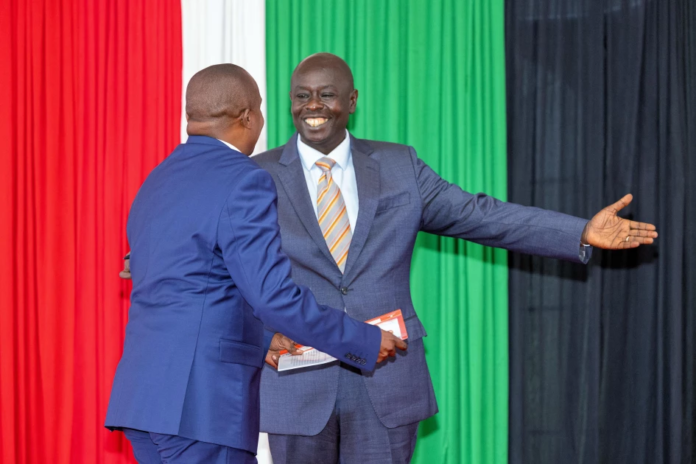
Homa Bay Governor Gladys Wanga has nominated Mr Danish Otieno Onyango as the deputy governor.

Onyango, who is the CEC for Roads, takes over from the immediate former deputy governor Joseph Oyugi Magwanga who resigned after irreconcilable differences with Wanga.

Onyango’s nomination is subject to approval by the County Assembly.

The Governor also made changes in the constitution of the County Executive Committee following the nomination.
Onyango hails from Kasipul Kabondo Constituency which forms the larger Rachuonyo region.
According to the press release, Onyango joined the public service in 2003 and has a stellar record of excellent performance and integrity in high echelons of public service up to Under Secretary in the State Department of Infrastructure.
“I am confident that he will ably serve the County in this new DG role based on his exemplary performance since 2022,” noted Wanga.
“Pursuant to a vacancy in the Office of the Deputy Governor in Homa Bay County, following the resignation by the previous holder and in compliance with the County Government Act section 32, 32C, and 32D, I hereby nominate Mr Danish Otieno Onyango to serve as the DG of Homa Bay…”

The Governor said that through the DG nominee, who will continue serving as the CECM in charge of Roads and Public Works, result-based performance and leadership have expanded the County roads network and connectivity in all the 40 wards.
She said that in the 2024/25 fiscal year they managed to open 736 kilometres of new roads while 538 km of existing roads received routine maintenance.
She described the nominee as a resourceful team player and team leader who has partnered with the National Government in the Homa Bay Town upgrading of roads and expansion of Kabunde Airstrip.

Further, Wanga has nominated Elijah Obiny Dede from Ndhiwa Constituency to serve as the County Executive Committee Member in charge of trade, industry, tourism, marketing and co-operative development, previously held by Joash Aloo.
He holds a Bachelor of Arts Sociology Degree from the University of Nairobi and an Executive Master of Business Administration.
Dede served as the Chief Officer in the same department before moving to Roads and Public Works and previously served as the CEO of Kenya Bankers SACCO.
Wanga said courtesy of his leadership of the department, 127 new cooperatives were registered and 10 dominant ones were revived while membership grew from 29,000 to 40,000 with asset expansion growing from Ksh 200 million to Ksh 500,000.

Isaac Ongiri from Kasipul Constituency, who is the former Chief Officer Department of Governance, Administration and Devolution, is the new CECM for Governance, Administration, Communication and Devolution.

The Governor however reassigned Dr Joash Aloo to serve as the CECM in charge of Agriculture, Irrigation and Livestock Development, which was previously held by Onyango.
Aloo has been moved from Trade, Industry, Tourism, Marketing and Co-operative Development and before that Water and Sanitation.
“Dr Aloo had a tangible and positive impact in the previous dockets and I have no doubt he will move our agriculture to the next level, paying meticulous attention to our value chains, the key ones being cotton, sugar, millet, maize, rice, sweet potatoes, pineapples, edible oil, as well as livestock,” reads the letter.
“I direct the County Secretary to oversee a smooth handing over process,” said the Governor.

The Governor is set to forward the nominees’ names and vetting documents for approval by the County Assembly as required by law, save for the reassignment.