Home Blog Page 20

Indiza, Nsanzuwera Earn Sunshine Tour Cards, Join Njoroge Kibugu on Global Stage

0

By Phillip Orwa

Kenya’s Dismas Indiza and Rwanda’s Celestin Nsanzuwera have earned full playing rights on the Sunshine Tour, joining fellow East African Njoroge Kibugu following “an impressive inaugural season” of the Sunshine Development Tour – East Africa Swing.

The two secured their cards after finishing second and third respectively on the Tour’s Order of Merit, “capping off a highly competitive season” that has now firmly positioned East African golfers on a clear pathway to the global professional game.

The trio will now transition to the Sunshine Tour, where they have received “special dispensation” to feature in the early part of the 2026 season, known as the “Winter Swing.” The swing runs from April to June and consists of a series of tournaments across Southern Africa before the mid-year break in July and August.

Their schedule begins with the Mediclinic Invitational from April 15 to 18. They will then feature at the FBC Zim Open from May 7 to 10, before competing in the Kit Kat Cash & Carry Pro-Am from May 14 to 17. The trio is also expected to tee off at the SunBet Challenge at Humewood Golf Club from May 20 to 22.

Further events in the swing include the Waterfall City Tournament of Champions from June 4 to 7, the Mopani Zambia Open from June 11 to 14, and the KCM Challenge from June 18 to 21, providing “a consistent run of high-level competition” as they settle into the Tour.

Nsanzuwera earned his Sunshine Tour card after “a standout season” that saw him win the Diani and Kigali legs, alongside multiple top-three finishes, to secure second place on the Order of Merit with 1,317 points. Indiza, who finished third with 753 points, claimed victory at the Ruiru leg and maintained “strong consistency” throughout the season to seal his elevation to the continental stage.

They join Kibugu, who was crowned the inaugural Order of Merit champion after winning four of the 10 events and registering several top finishes. His progression has already been evident at the Magical Kenya Open 2026, where he was the only Kenyan to make the cut and went on to finish at an impressive 6-under par—the “best score by a Kenyan” in the tournament’s history.

Speaking on the trio’s transition to the Sunshine Tour, Sunshine Development Tour Chairman Peter Gacheru highlighted both the opportunity and the challenge ahead:

This is where the real test begins. The Winter Swing is competitive, week-in, week-out golf against seasoned Sunshine Tour players, on courses that demand consistency and mental strength. For Njoroge, Celestin and Dismas to step straight into this stretch is “a huge opportunity.” They are not going there to make up the numbers; they have earned their place, and this is their chance to prove that East African golfers can compete and win at that level.”

Indiza, reflecting on his season, emphasized the importance of consistency:

It was a long and competitive season, and every event counted. Winning in Ruiru and staying consistent across the other tournaments made the difference for me. This Tour has “raised the level of competition” in the region, and earning a Sunshine Tour card is a strong motivation as I take the next step.”

The three now step up to compete on the Sunshine Tour, marking “a significant milestone” not just in their individual careers, but also for the growth of professional golf in the region.

The performance of Nsanzuwera and Indiza highlights the competitive depth of the Sunshine Development Tour – East Africa Swing, which in its first season saw 88 players earn Official World Golf Ranking (OWGR) points.

The two recorded “significant upward movement” in the global rankings, with Nsanzuwera gaining 2,981 places, followed by Dismas Indiza (+2,483), underlining the Tour’s role in providing meaningful competitive opportunities.

FIFA Mandates Female Coaching Presence in Women’s Tournaments: A Landmark Step for Equity and Development

0

By Phillip Orwa

The Executive Director of the Smart Ladies Initiative, Eunice Dollar, has welcomed the regulation by FIFA directing every team in a FIFA women’s competition to have “at least one female head coach or assistant.”

In a statement, the regulation indicated: “Each team will be required to have at least one female head or assistant coach; this is part of sweeping new regulations from soccer’s governing body aimed at boosting the number of women coaching at the highest levels.”

The regulations were approved by the FIFA Council on Thursday and come “into effect with this year’s U-17 and U-20 Women’s World Cups and the Women’s Champions Cup,” and will also include the Women’s World Cup next year in Brazil.

The new regulations stipulate each team “must have two female staff on the bench” and will cover all FIFA women’s tournaments, from youth to senior level. Only 12 of the 32 head coaches at the 2023 FIFA Women’s World Cup 2023 in Australia were women.

FIFA said this is a proportion that “does not reflect the rapid growth of the women’s game globally.” The body added that the new rules are part of a “long-term strategy to ensure that representation of women in technical and leadership roles keeps pace with the rapid growth of the women’s game.”

In response to FIFA’s newly enacted directive, Eunice said: “We acknowledge this regulatory shift as a pivotal, albeit complex, intervention in the landscape of women’s football in developing countries.”

“This regulation, aimed at addressing the significant gender disparity in high-level technical leadership, represents a formal recognition that the development of women’s football cannot be solely measured by player participation rates, but must also encompass leadership pathways and safeguarding for female athletes,” she added.

She noted that “a female figure in the leadership position” within each team will build a sense of safety for players, with such roles carrying added responsibilities.

The Executive Director also said the directive will help in “correcting a systemic imbalance.”

Historically, women’s football has suffered from a “leaky pipeline,” where female athletes transition to coaching at far lower rates than their male counterparts. Despite the exponential growth of the women’s game at the player level, the percentage of female head coaches in top-tier leagues and international tournaments has stagnated, and in some cases declined, over the past decade.

She said the directive will act as a “structural correction,” ensuring women are not merely participants on the pitch but also decision-makers on the sidelines.

On development, she described the move as “catalyzing development and mentorship.”

She noted that female coaches serve as a critical catalyst for growth, helping young athletes see football as a viable long-term career beyond playing. This will create “a clear pathway to tomorrow’s coaching roles,” strengthening sustainability in the sport.

However, she cautioned on implementation, noting that while the intent is commendable, it must go beyond “mere compliance.”

Mandates without resources risk creating ‘tokenism,’ including hiring female coaches in name-only roles without real authority,” she said.

She urged FIFA and confederations to ensure the rule fosters “authentic growth” by:

  1. Expanding funding for UEFA Pro and CAF License courses targeted at female coaches.
  2. Establishing safeguarding measures to prevent tokenism and ensure equitable compensation.
  3. Supporting succession planning to build a pipeline for future female head coaches.

She concluded that the directive marks “a step toward holistic professionalization” of women’s football.

“True professionalization requires not just elite playing environments, but diverse, representative leadership structures. By mandating female representation, FIFA is acknowledging that the sustainability of the women’s game depends on empowering women across all facets of the sport,” she said.

We look forward to monitoring the implementation of this regulation and ensuring it becomes a springboard for long-term systemic change, rather than a short-term administrative checkbox.

A new dawn: Naivasha-Kisumu-Malaba SGR project to catalyze regional economic growth, position Kenya as a leading transport and logistics hub in Eastern and Central Africa

0

By Anderson Ojwang

Today in Kisumu, a new dawn rises—a ray of hope and a beginning—marking a bold step forward in connecting regions and unlocking opportunity.

History is repeating itself. On December 20, 1901, the first train reached Port Florence, marking the completion of the Uganda Railway line from Mombasa to Lake Victoria. This was a critical development for transport and the subsequent founding of Kisumu City, with the movement of goods and passengers beginning shortly after in 1903.

Today, a new chapter opens in Kisumu as President William Ruto will launch the Naivasha-Kisumu-Malaba Standard Gauge Railway (SGR) project, which will bring Kenya closer to a fully connected regional railway network.

The project is expected to unlock trade, just like the Uganda Railway, create jobs, and transform livelihoods across Western Kenya.

President Ruto said that in 2014 they embarked on a bold task of replacing the 130-year-old colonial railway line from Mombasa to Kisumu, and that today marks a milestone.

“In 2014, we embarked on the bold task of replacing the 130-year-old colonial railway line from Mombasa to Kisumu, infamously called the ‘Lunatic Express’, with a modern Standard Gauge Railway (SGR).

The first phase of the SGR, running from Mombasa to Naivasha, was initially dismissed by skeptics as a ‘railway to nowhere’, but today, it stands vindicated as a transformative backbone of our national transport system, driving efficiency in the movement of goods and passengers.”

He said the Naivasha-Kisumu-Malaba SGR project will advance the next phase.

We are now advancing the next phase by extending the SGR from Naivasha to Kisumu and eventually to Malaba.

The Naivasha-Kisumu main line will span 264km, complemented by an 8.69km line branching to the proposed new Kisumu Port, while the Kisumu-Malaba section will cover 107km, seamlessly linking Kenya to Uganda and the wider region.

Traversing nine counties, this strategic corridor will significantly ease the movement of people, goods, and services.”

President Ruto said the corridor holds immense economic potential.

“Western Kenya produces tea, maize, sugar, and rice, supports a vibrant fisheries sector in the Lake Victoria region, and supplies critical inputs for agro-processing and industry.”

He said there was sound economic logic underpinning the project.

“Every reduction in logistics costs translates into lower food prices, more affordable construction, and greater industrial competitiveness.

Second, it will increase freight volumes and economic activity by linking production zones directly to the rail network, transforming the SGR into a two-way economic system.”

President Ruto said this is how the railway secures its full economic value.

“The SGR will decongest our roads. Each freight train removes hundreds of trucks from our highways, reducing accidents, lowering maintenance costs, and saving lives.

It will also position Kisumu as a major logistics hub, integrating rail, road, and lake transport.”

President Ruto said he is fully conscious that this is a major investment.

“This railway will be built for performance: it will be freight-driven, phased and demand-driven, leverage innovative financing mechanisms, and be integrated with logistics hubs and multi-modal transport systems.”

President Ruto said the project is about the future of trade in the Great Lakes region.

“Today, Kenya serves as their primary gateway, but that position is neither permanent nor guaranteed and must be secured and strengthened.

By extending this railway, we are consolidating Kenya’s role as the logistical backbone of East and Central Africa.”

Ruto said when complete, the project will establish a continuous railway artery of nearly 1,000km from Mombasa to Malaba.

Kisumu Governor said the region looks forward to the project opening up the economy and spurring growth and development.

This milestone marks a major step forward in infrastructure development, opening up new opportunities for growth, connectivity, and regional integration.”

Senator Osotsi among the 39 aboard ALS Limited flight in a death scare at Wilson Airport on Friday evening

0

By Sandra Blessing

Vihiga Senator Godfrey Osotsi was among the 34 passengers and five crew members on board the ALS Limited flight which was involved in a runway excursion at Wilson Airport on Friday evening.

Osotsi wrote on his social media handles, “I thank God for His protection after I came out safely from an aircraft accident at Wilson Airport this evening. I was among the 39 passengers on board the Safarilink flight, including three crew members and the pilot, when the plane crash-landed.

I commend the pilot for his remarkable skill and presence of mind in controlling the aircraft and steering it off the runway, causing it to stall—an action that averted what could have been a catastrophic fire had the plane continued on the runway.”

In a press statement by ALS Limited, they confirmed the incident, saying one of their aircraft was involved in a runway excursion at Wilson Airport.

We confirm that all passengers and crew on board were unharmed. The safety and well-being of our passengers and staff remain our highest priority,” the statement read in part.

The statement also said the incident was under investigation and that they were cooperating with relevant authorities.

The incident is currently under investigation and we are cooperating fully with the relevant authorities. We will provide a further update as more information becomes available. We appreciate the patience and understanding of all concerned parties at this time,” read the statement.

Senator Osotsi said he was concerned about the absence of a rescue team at the airport at the time of the incident.

“It is deeply troubling that despite the pilot’s efforts to save lives, there were no immediate rescue operations from the airport management.

There was no ambulance on site and no emergency response team came to our aid. This level of unpreparedness is unacceptable for an airport of such significance,” he wrote.

Osotsi said he recently sought a statement in the Senate regarding safety concerns and deteriorating infrastructure at Wilson Airport.

“This incident comes just days after I sought a statement in the Senate regarding the safety concerns and deteriorating infrastructure at Wilson Airport.

Today’s events have only reinforced those concerns. The runway was flooded and the lighting system is not functioning properly.

It is common knowledge that due to these poor conditions, flights are often diverted to Jomo Kenyatta International Airport in the evening, raising serious questions as to why this particular flight was not redirected,” he wrote.

He said there is a need to upgrade Wilson Airport to international standards.

Wilson Airport must be closed and comprehensively upgraded to meet international safety standards before it is allowed to resume full operations. The safety of Kenyans and all air passengers must never be compromised,” he wrote.

Tuju writes to IG Kanja over continued occupation of his premises, decries huge losses by tenants in the facility

0

By Reporter

Former Cabinet Minister Raphael Tuju has written to the Inspector General of Police, Douglas Kanja, seeking his intervention over the continued occupation of his business premises by the police.

Tuju said it is wrong for the police to continue occupying his premises without any court order or documents, and that businesses in the facility continue to suffer huge losses.

“With utmost humility, may I seek your kind and gracious intervention as the Inspector General. In the middle of the night of 13th March 2026, a contingent of over 100 policemen raided Dari Business Park with an inordinate number of police vehicles.

They had no court order. Until this morning, the police are still occupying the Business Park. They are waiting for instructions from above. There is no documentation or explanation from any police officer,” he wrote.

Tuju said the police should allow the tenants to access the facility even if they deny him entry into the premises.

“I request that while you have all the brute power of force to stop me personally from gaining access, the tenants running legitimate businesses should be allowed to get items like laptops from the offices,” he wrote.

Tuju said he was yet to get any verbal or written confirmation from the police over the continued stay in his premises.

“Not even a verbal explanation. We are witnessing an amazing Hollywood-style ‘playing deaf’ response. Besides all the above, may I, with all the respect I can fathom, request that you address the following issues that should not be associated with our police force, ‘Utumishi kwa Wote,’” he wrote.

Tuju said businesses in the premises continue to incur huge losses as they cannot access the facility.

“Your officers have been occupying the Dari Business Park for the last six days.

The 24 tenants, including the Tamarind restaurant, continue to incur huge losses.

Professionals like lawyers have not been able to remove vital files and laptops from their offices. Even the politest requests from professionals seeking to get documents from the private offices under police supervision or escort have been met with rudeness at worst or silence at best,” he wrote.

Tuju asked the Inspector General of Police to explain why the police raided his premises at night while they did not have any court documents.

“Some of the police vehicles that came for the 2:40 a.m. raid removed their vehicle number plates and identification of the police station they originated from. As a civilized country, we need a professional police force. Many of the policemen wore balaclava masks,” he wrote.

He said he was looking forward to a response from Kanja on the issues he has raised.

“I look forward to your response that is defined by your compassion and humanity, affecting professionals and hundreds of employees who are caught in the middle of your fantastic display of power,” he wrote.

YALA TOWN EYED AS CENTRAL NYANZA’S NEXT LOGISTICS AND AGRO-PROCESSING HUB

0

By Staff Reporter

Siaya County, Kenya — As the Standard Gauge Railway (SGR) extension from Naivasha pushes westward toward Kisumu and onward to Malaba through Yala Town, leaders and stakeholders in Siaya County are being urged to seize a transformative economic opportunity by positioning Yala as a key inland logistics and agro-processing hub.

The proposed plan calls for the conversion of Yala Town into an Internal Container Terminal (ICT) and a regional packaging and food processing center serving Central Nyanza. Advocates say such a move would unlock significant economic potential by connecting local agricultural producers directly to national and international markets via the SGR corridor.

Strategic Location, Untapped Potential

Yala Town sits along the anticipated SGR route linking the port of Mombasa to Uganda and the wider East African region. This strategic positioning places it in an ideal spot to serve as a cargo consolidation, storage, and distribution center.

Economic analysts note that similar inland container depots in other regions have catalyzed industrial growth, reduced transport costs, and created thousands of jobs.

“Yala has the potential to become what Naivasha is fast becoming — a logistics and industrial hub. But this will require deliberate planning and legislation,” said a regional development expert familiar with infrastructure-led growth models.

Call for Legislative Action

Stakeholders are now calling on the Siaya County Assembly to urgently develop and pass enabling legislation to support land use planning, investment incentives, and public-private partnerships.

Key policy proposals include:
• Designation of Yala as a Special Economic and Logistics Zone
• Tax incentives for agro-processing investors
• Infrastructure planning for warehousing, cold storage, and packaging facilities
• Environmental and zoning regulations to support sustainable urban growth

Without such frameworks, experts warn, the county risks missing out on the economic spillovers associated with the railway expansion.

Boost for Agriculture and Food Security

Central Nyanza is a major producer of crops such as maize, beans, rice, groundnuts, and horticultural produce. However, much of the region’s output is sold raw, with minimal value addition.

The proposed packaging and processing facilities in Yala would allow farmers to:
• Access better pricing through value addition
• Reduce post-harvest losses
• Reach wider export markets through standardized packaging

“This is how we create wealth — by moving from raw production to value chains,” said a local agribusiness stakeholder.

Job Creation and Urban Growth

The development of an inland container terminal and processing hub is expected to generate employment across multiple sectors, including:
• Transport and logistics
• Manufacturing and packaging
• Storage and warehousing
• Support services such as banking, retail, and housing

Urban planners also anticipate that Yala Town would experience rapid growth, necessitating investments in housing, roads, water, and social amenities.

A Defining Moment for Siaya

With the SGR extension poised to reshape regional trade dynamics, leaders say the window for proactive planning is now.

“If Siaya positions itself early, Yala could become the economic heartbeat of Central Nyanza,” a county official noted. “But if we delay, the opportunity may shift elsewhere along the corridor.”

As debate intensifies, residents and business leaders alike are watching closely, hopeful that bold policy action will turn infrastructure into inclusive economic growth.

PAC probes possible wastage of Sh 1.3billion in projects in the Sports Department

0

By Habil Onyango

The Public Accounts Committee (PAC) has raised concern  over possible wastage of public funds amounting to over Shs.1.36 billion at the State Department for Sports.

The wastage could have been  due to poor planning and failure to utilize completed projects.

The concerns arose during a session in which the Committee, chaired by Tindi Mwale, examined the State Department’s report of the Office of the Auditor-General for the 2023/2024 financial year.

Principal Secretary Elijah Mwangi, who appeared before the committee to respond to audit queries, faced a hard time responding to concerns raised by members on why large sums of money were spent on the two projects without delivering value to the public.

The Auditor-General, in the report for the financial year ended June 30, 2024, flagged the demolition of part of the Jamhuri Posta Sports Ground, which had cost Sh 1.2 billion, to pave the way for the construction of the Talanta Stadium project. 

The stadium is expected to host the 2027 Africa Cup of Nations.

According to the audit, two football pitches, restrooms, and access roads constructed under the project were destroyed, raising serious concerns that a significant portion of the Shs. 1.2 billion investment may have been wasted.

Another concern in the report was the office partitioning project at Maktaba Kuu, which cost Sh 98.9 million but remained unused after completion, as staff of the State Department were relocated to Talanta Plaza.

As a result of leaving the premises unused, the department has accumulated rent arrears of Kshs. 63,923,644. This means that a combined amount of at least Kshs. 162.8 million, comprising the cost of partitioning and accrued rent, is at risk of being wasted on a facility that has not been utilized.

Hon. Mwale led the committee members in opining that taxpayers got a raw deal in the two projects.

“Do you think there was value for money in the two projects?” posed Hon. Mwale, who challenged the PS to explain the circumstances around both projects, including overlap in planning and changes in office use.

Committee members Hon. Marianne Kitany (Aldai), Hon. Victor Koech (Chepalungu), Hon. Adow Mohammed (Wajir South), Hon. Otiende Amollo (Rarieda), Hon. Edwin Mugo (Mathioya), and Hon. Nabii Nabwera (Lugari) questioned the planning process, pointing out that public funds worth over Ksh 1.36 billion had gone to waste.

In his response, PS Mwangi confirmed that the ultra-modern Talanta Stadium project overlapped with the sports ground and stated that the site had been selected for convenience. 

He explained that some facilities had to be removed to allow for the construction of the new stadium, and that the contractor had agreed to rebuild the demolished amenities at a different location.

Regarding the renovations at the Maktaba Kuu office, PS Mwangi acknowledged that the department had initially intended to occupy the offices but later opted to move to Talanta Plaza to consolidate staff in one location.

He added that discussions were ongoing to offset the rent arrears against the cost of partitioning. His explanation, however, did not go down well with members, who noted that the sequence of events pointed to poor planning by the State Department that led to avoidable losses.

The House team requested the PS to avail full documentation of the two projects, and Committee Chairperson Hon. Mwale said members will conduct site visits to verify whether taxpayers’ money was put to proper use.

MPs back Sh400M plan to repatriate Kenyans in distress from Middle East, Russia

0

By Habil Onyango

Members of Parliament have backed a proposal to allocate an additional Sh400 million to facilitate the repatriation of Kenyans stranded in conflict-prone regions, including the Middle East and areas affected by the Russia-Ukraine war.

The funding request was made by the State Department for Diaspora Affairs as part of the Supplementary Estimates, which would raise the department’s budget from Sh717.8 million by an additional Sh400 million.

Appearing before the National Assembly Committee on Defence, Intelligence and Foreign Affairs, officials led by Ambassador Hellen Gichuhi said the funds are critical to support a structured evacuation programme targeting the most vulnerable Kenyans abroad.

The lawmakers, however, raised concerns over the rising cost and long-term sustainability of repatriation efforts.

“We are currently evacuating 15 Kenyans from Iran to Turkey, which has already incurred significant costs,” Amb. Gichuhi told the committee. “Among them are five children, who are being prioritised under our repatriation guidelines.”

The department emphasised that repatriation is guided by strict criteria and cannot cover all Kenyans living abroad.

“We prioritise the most vulnerable, including children and distressed persons. It is not feasible to repatriate all Kenyans abroad, especially considering that over 500,000 reside in the Middle East alone,” she added.

Gilgil MP Martha Wangari sought clarity on how beneficiaries are identified and how the Sh400 million figure was arrived at, terming the matter one of national importance.

“Regarding the request for Sh400 million, what criteria is used to identify beneficiaries, and how were these figures arrived at?” she posed.

In response, officials noted that some diplomatic engagements in Russia remain confidential but confirmed progress in securing safeguards for Kenyans.

“We have agreements in place to prevent the conscription of more Kenyans into the Russia-Ukraine conflict,” the committee was told.

Kamukunji MP Yusuf Hassan cautioned against committing to large-scale repatriation without clear limits.

“It is not sustainable to repatriate all citizens in distress abroad. There must be shared responsibility, including working with international organisations such as the International Organization for Migration (IOM),” he said.

The department also revealed it is grappling with pending bills amounting to Sh206 million, including Sh131.9 million for foreign air tickets, of which only 4.3 per cent has been settled.

Despite the financial strain, officials reported a 100 per cent response rate to distress cases and ongoing high-level engagements in several countries, including Russia.

They reiterated that while advisories are issued for Kenyans to leave high-risk areas, government support is reserved for those in critical need.

“We have established clear repatriation guidelines. Those who are able are encouraged to return at their own cost,” the department said.

The Nelson Koech-led committee is expected to deliberate on the funding request amid growing pressure to safeguard Kenyans caught in volatile regions abroad.

Kenya yet to pay Sh 3.9B hosting rights to CAF,deadline nears, as Sports Committee pledges to ensure payment

0

By Reporter

The much awaited football carnival in Kenya, the AFCON games, could be at risk if the government fails to pay Sh 3.9B hosting rights by March 30th, 2026.

Kenya’s hosting rights for the upcoming AFCON games could be in jeopardy if it will not have paid the hosting fee.

While the co-hosts Tanzania and Uganda have so far paid the hosting rights fees, Kenya was yet to make payments to CAF.

This was according to the PS for Sports, Mr. Elijah Mwangi, who appeared before the Sports and Culture Committee chaired by Hon. Peter Wanyama (Webuye West) for the 2025/26 Supplementary Estimates I.

The PS during the meeting requested the Committee to ask the National Treasury to move the allocation amounting to Kshs 5 billion towards the games projected in the 2026/27 Budget Policy Statement be moved forward to this Supplementary.

“We have received communication from CAF giving the timelines on the activities that should be done in readiness to host the CHAN.

We appreciate the NT because in the 2026/27 BPS, there was an allocation of around Kshs 5 billion, 3.5 billion being the hosting fees. But in light of the recent communication from CAF, we have been given up to 30th of March to clear the payment of hosting fees,” the PS said.

According to the PS, Tanzania and Uganda, who are also in the Pamoja hosting bid, have already paid their fees and the gains made so far by Kenya towards hosting the games will go down the drain.

“CAF are very particular that we must show commitment by paying the contribution. So I am seeking this Committee to kindly consider this Supplementary in conjunction with the NT to have the 2026/27 budget brought forward,”

At the same time, he disclosed to the Committee that the infrastructure expected to host the games may also not be ready in six months’ time due to pending bills owed to the contractors engaged during the 2024 CHAN games.

Hon. Wanyama, while reacting to the PS request, assured the State Department that the Committee will push NT to release the hosting funds.

“We’ve heard you and we will push Treasury to release money for the hosting rights so that we do not get into the quagmire of us being denied to host AFCON and then we give a chance to our neighbors to do so. It will be a big shame to Kenya, which has always been a big brother in the region,” the Chairperson said.

PS Jacob Fikirini for Youth Affairs and Creative Economy also appeared before the Committee where he sought an additional budgetary allocation of Shs 615 million, which he says Shs 244 million will go towards establishment of three film hubs in Yatta, Webuye West and Turbo constituencies.

PS Fikirini told the Members that film hubs will eventually be established across all constituencies in a bid to tap into the creative minds of youths and give them opportunities.

Kinyua family writes to DPP to open inquest into the death of her daughter Maureen, after President Ruto stoked the flame over the death

0

By Anderson Ojwang

What started as a political spat could spill over as a legal nightmare after an advocate wrote to the Director of Public Prosecutions to open an inquest into the death of Maureen Gathiga Kinyua on 24th May 2019.

The family of James Kinyua Macharia wants an inquest opened into the death of their daughter to establish the cause of her death.

“Our instructions are thus to request you to direct the Inspector General of Police to put up a team of investigators and open an inquest on the same,” wrote Goeffrey Andanje of Omenke Andanje and Co. Advocates.

Through the law firm, the family wrote to the Director of Public Prosecutions in a letter dated March 19, 2026, requesting an inquest into the death. The letter reads in part:

“This is in reference to the above subject matter in which we have been instructed by James Kinyua Macharia, the father to the deceased. Documents and witnesses whom we have talked to on the facts leading to the death of the late Maureen indicate to the contrary that she died from a road traffic accident. On the fateful day, the deceased was called by a lady friend who may have lured her to her death,” it read in part.

The family claimed a relative of a senior political figure from the Mt Kenya region could have lured their daughter to her death.

“The said lady who is a relative to a senior political figure in Mount Kenya region then called his brother who apparently operates boda boda and asked him to drop the deceased at her home. The said gentleman then immediately fled from the scene and went back only after the area base commander called him. At the scene, the purported motorcycle did not have dents to suggest that there was an accident and the deceased had a hole penetration in the forehead,” it reads.

Kinyua also claimed the wife of the senior political figure visited the scene of the alleged accident, raising questions about the motive.

“It is also worth noting that the wife to the said senior political figure immediately appeared at the scene and left after confirming the death. As a cover-up, the deceased’s mobile phone, which would have revealed the thick plot, went missing as it could have indicated the people she had been in communication with,” it reads.

They based their belief of a possible murder on several factors:

“The father is highly suspicious and doubts that the deceased died out of an accident based on the following facts: Maureen was called to Mataga area and stayed there until after 6:00pm. When the deceased wanted to leave, the said lady called the brother with instructions on where to take her. The said brother disappeared and went back to the sister (probably after delivering Maureen to her killers). The motorcycle purported to have been involved in the accident did not have any dents. The deceased had a hole in the forehead (suspected to be a bullet entry), which the autopsy failed to mention. The wife of the senior political figure came to the scene to confirm something and later left,” it reads.

President William Ruto, at a function in Mt Elgon, claimed that a senior opposition politician had impregnated a girl the age of his daughter and later allegedly murdered her.

“Someone who impregnated a young girl and then later allegedly killed her. What will you tell us about deaths? You cold-blooded murderer. You want to mislead our nation. We will not allow you to mislead anyone in Kenya and you are not going to be anything in this nation. You belong to rot in jail,” he said.

The President and opposition leaders have, in the last week, been engaged in an open spat involving body shaming, personal attacks, and insults.

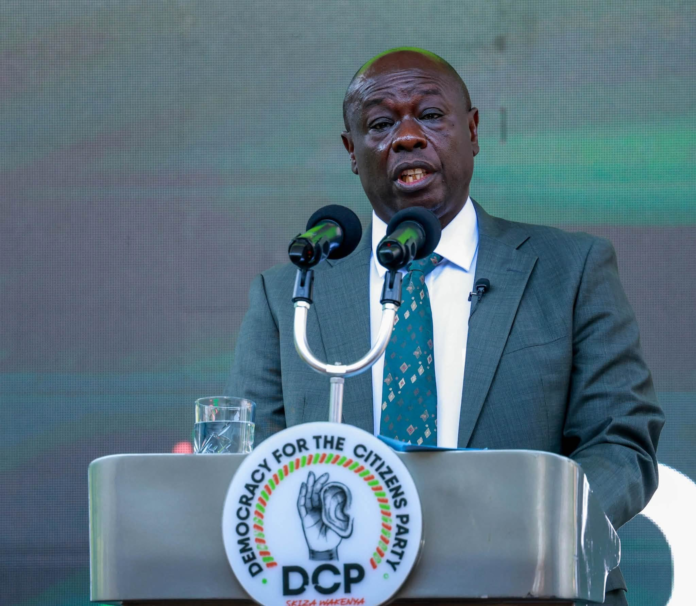
Former Deputy President Rigathi Gachagua ignited the row at the weekend in Kiambu when he attacked President Ruto.

“We will make sure William Ruto, you are not going to sleep for the next 15 months. You will sleep when you finally reach Sugoi. We will expose you. You have seen how he has reduced in weight. It’s just the beginning,” he said.

Recently, Gachagua’s DCP party refuted claims linking him to the death of the blogger.

“Popular blogger and social media personality Maureen Gathigia Kinyua tragically passed away on May 24, 2019, in a road traffic accident near Sagana Catholic Church in Mathira, Nyeri County. Investigations into the incident classified it as a hit-and-run, and there is no official evidence linking her death to murder or foul play,” the statement read.

“The driver involved in the incident was subsequently charged in Karatina Court with causing death by dangerous driving and later released on a Ksh150,000 bond while awaiting further legal proceedings. Thus, there is no possible way Gachagua could be linked with the death of the blogger,” it added.